NASA's Roman Telescope Coronagraph Captures Its First In-Space Starlight
A faint star in the Large Magellanic Cloud became the first target for Roman's planet-imaging instrument, in a test NASA calls "very limited" but necessary before any exoplanet science can begin.
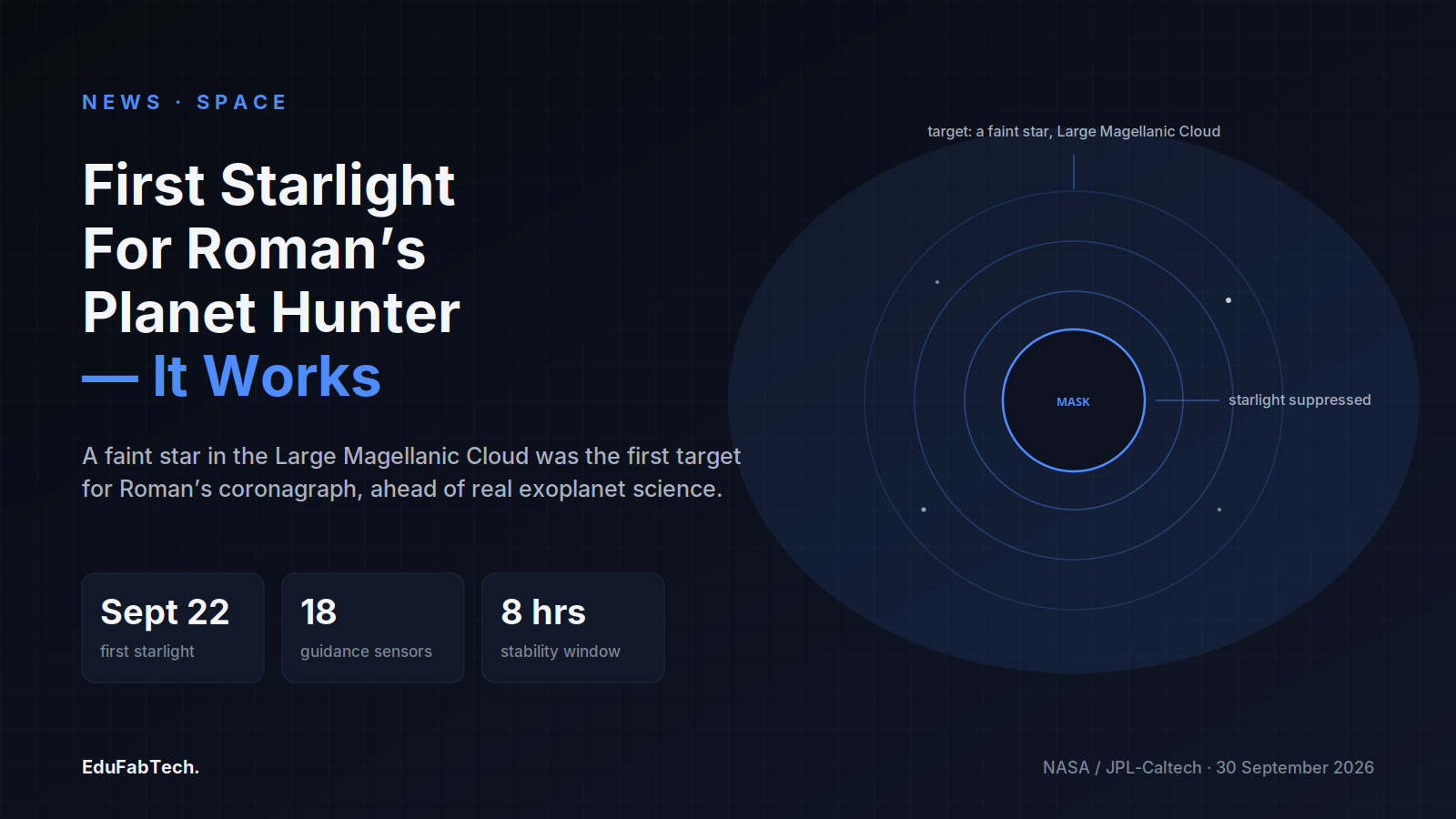
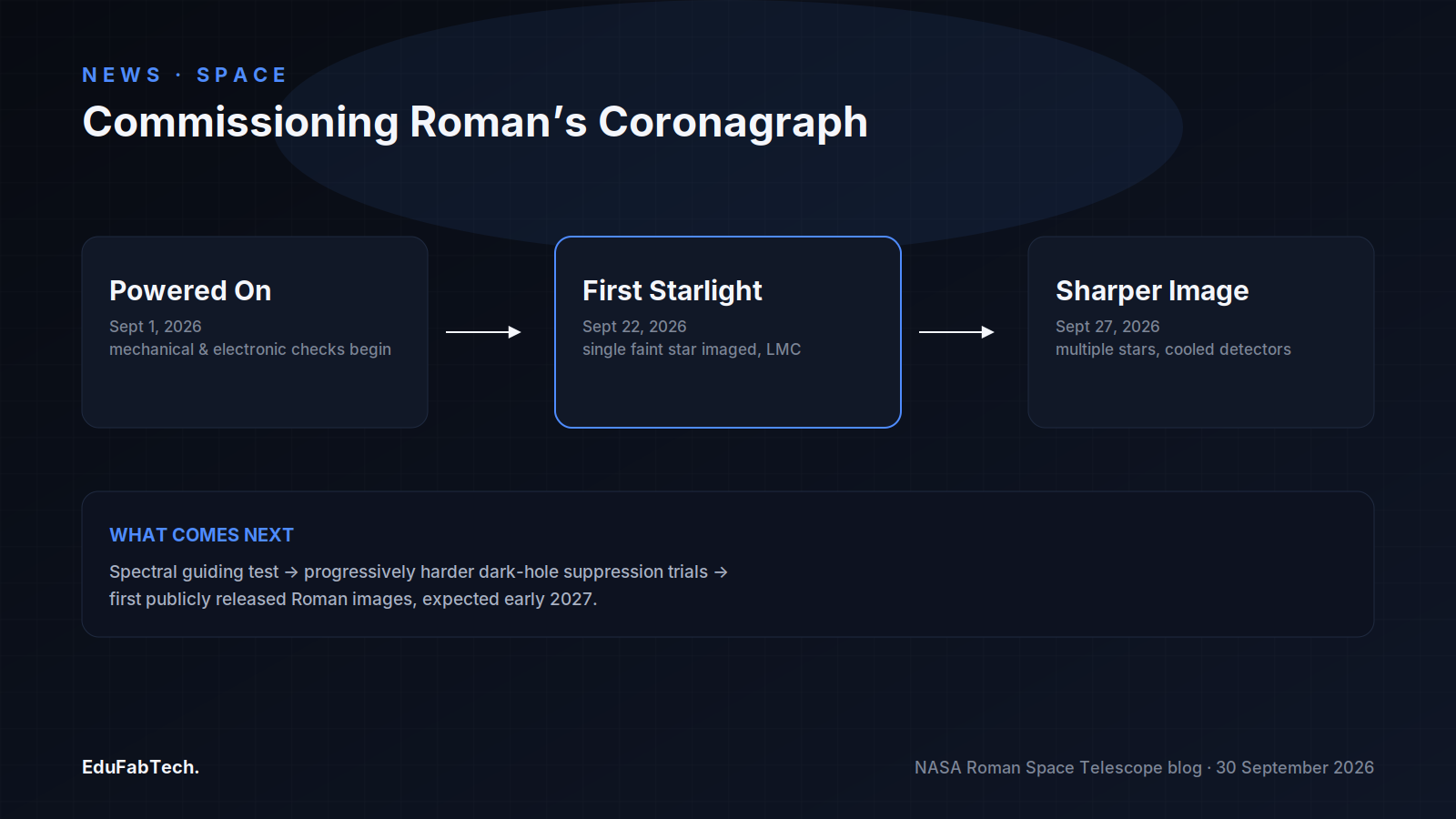
NASA announced on September 30, 2026, that the Coronagraph Instrument aboard the Nancy Grace Roman Space Telescope captured its first observation of cosmic light on September 22, imaging a single faint star in the Large Magellanic Cloud. A second, sharper observation followed on September 27. Roman launched on August 30, 2026, and is now operating near the Sun-Earth L2 point, roughly a million miles from Earth, where it is working through a three-month commissioning period before science operations begin.
What Happened in Orbit
According to the NASA Roman mission blog, the Coronagraph Instrument was powered on September 1, 2026, and spent the following weeks undergoing mechanical and electronic checks. Its detectors were deliberately kept warmer than their final operating temperature during the September 22 test to avoid contamination risk, then cooled ahead of the September 27 follow-up, which captured multiple stars in a different part of the same galaxy. Vanessa Bailey, the Roman Coronagraph Instrument scientist at NASA's Jet Propulsion Laboratory, said the observation "confirms that the instrument can produce a focused image," adding that it is "a very limited test that kicks off a methodical process of increasingly complex tasks that help us prepare for the instrument's future observations," a characterization reported by NASA JPL.
The same commissioning period also validated Roman's fine-guidance system, which steers the observatory using 18 detectors built into the Wide Field Instrument rather than a separate guide-star camera. Begoña Vila, the guiding instrument systems lead at NASA's Goddard Space Flight Center, said the system reports guide-star positions about four times per second, which the NASA blog describes as holding the observatory stable enough, over 30 minutes with the Wide Field Instrument, to be equivalent to focusing a laser on a US dime from 150 miles away. The Coronagraph Instrument's internal stabilization goes further still, the agency reports, maintaining comparable stability for up to eight hours at a time — a requirement for the long exposures needed to separate a planet's faint light from its much brighter host star.
Why a Coronagraph Is Different From a Camera
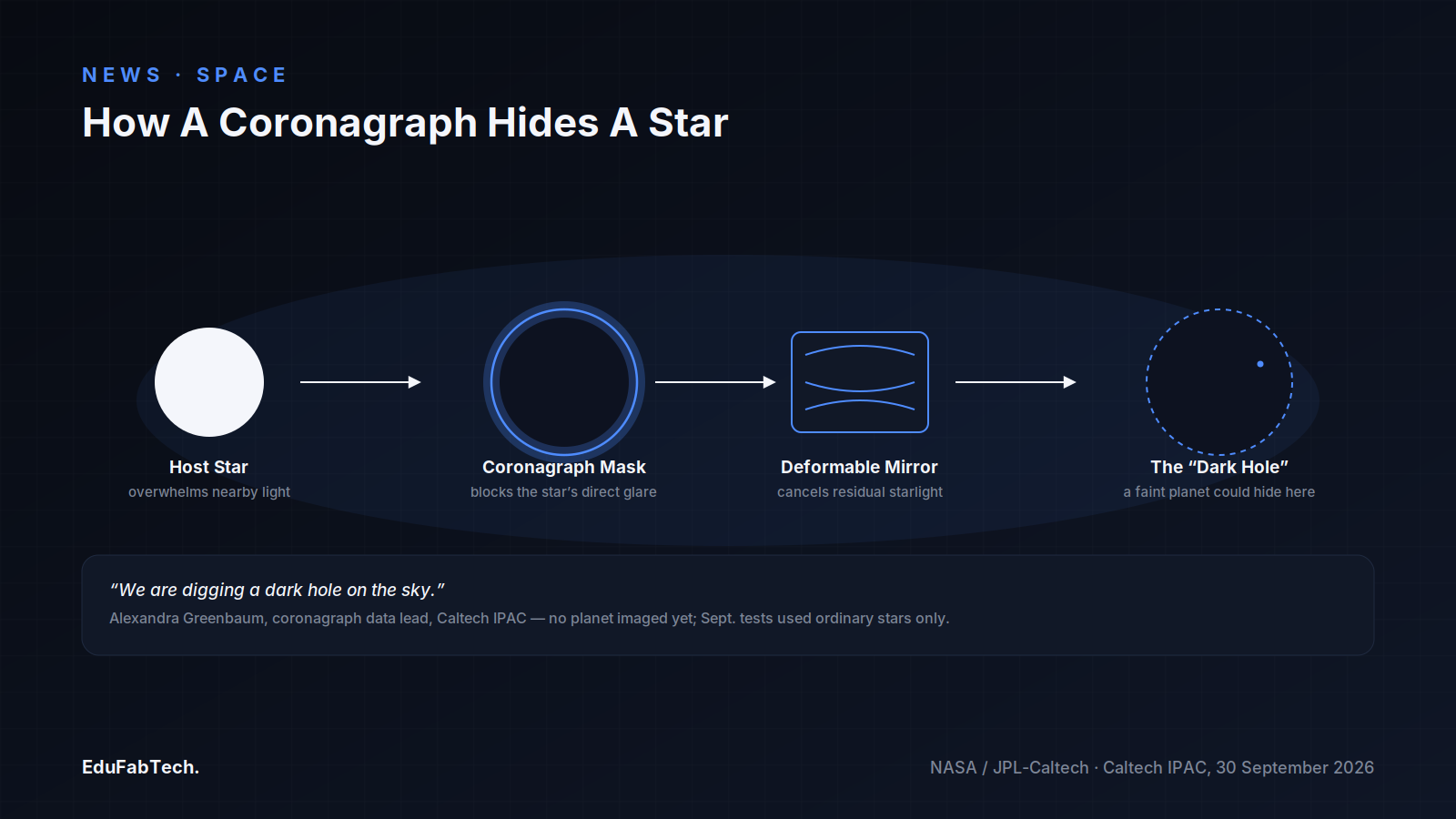
A coronagraph does not simply take a picture of a star system; it blocks the overwhelming light of the host star so that the much fainter light reflected or emitted by an orbiting planet or dust disk can be detected. Alexandra Greenbaum, the coronagraph data management system lead at Caltech's IPAC, described the process to Caltech News as building toward "digging a dark hole on the sky" — using the instrument's deformable mirrors to actively cancel out starlight across a region where a planet might otherwise be hidden in the glare. Caltech's IPAC center operates a dedicated Coronagraph Commanding Center for the instrument, which was designed and built at NASA's Jet Propulsion Laboratory.
This is the first time this specific combination of deformable-mirror wavefront control and active starlight suppression has been tested with real starlight from space, rather than only in ground-based vacuum chambers. NASA and Caltech describe the Coronagraph Instrument as a technology demonstration rather than a guaranteed science instrument: its stated purpose is to prove that this starlight-suppression approach can work in orbit, ahead of future missions that would need far greater precision to image Earth-sized, potentially habitable planets around other stars.
Greenbaum told Caltech News that the team is "extremely pleased with how well things are working" so far, though both NASA statements are explicit that September's results are preliminary checkouts, not finished science observations. No planet or disk has yet been imaged by the instrument; the September tests targeted ordinary stars specifically chosen to validate that the optics and guidance system function together as designed.
What Comes Next
NASA's commissioning schedule, as described in the September 30 update, calls for validating a novel spectral guiding mode in the coming weeks, followed by progressively more demanding tests of the coronagraph's dark-hole suppression. The agency has said it expects to release Roman's first publicly shared images in early 2027, once the three-month commissioning phase on both the Wide Field Instrument and the Coronagraph Instrument is complete.
For researchers working on direct-imaging exoplanet science, the relevant fact is narrower than "Roman found a planet" — it has not. What changed on September 22 and 27 is that a flight coronagraph behind an 18-detector, spectrally guided pointing system produced a focused stellar image in actual space conditions, rather than only in ground simulators. That distinction matters for anyone modeling how the instrument's wavefront control will behave once engineers attempt the harder task of suppressing starlight well enough to detect a faint planet at all — a milestone still ahead of this commissioning phase, with any eventual detection of Earth-like planets left to later missions built on lessons from this one.
A quick question for readers
Which study habit do you think is most overrated?
Some popular habits have little evidence behind them. Which one do you think gets too much credit?
Pick an answer, create a free account in a minute, and your vote counts. Already a member? Sign in
Source: NASA
Sources (3)
- NASA. NASA Checks Roman Guidance System, Takes First Coronagraph Observation. NASA Science (Roman Space Telescope blog), 2026. science.nasa.gov ↗ · checked 3 Oct 2026
- NASA Jet Propulsion Laboratory. NASA's Roman Team Snaps Test Coronagraph Image. NASA JPL News, 2026. jpl.nasa.gov ↗ · checked 3 Oct 2026
- Caltech / IPAC. NASA's Roman Space Telescope Takes First Coronagraph Instrument Observation. Caltech News, 2026. caltech.edu ↗ · checked 3 Oct 2026