NASA Finds 12 Stratospheric Dust Grains Pointing to a Heavy-Water Reservoir Beyond Neptune
A Science Advances study of 12 interplanetary dust particles collected by a NASA aircraft offers direct evidence for a long-theorized ice reservoir in the Kuiper Belt.
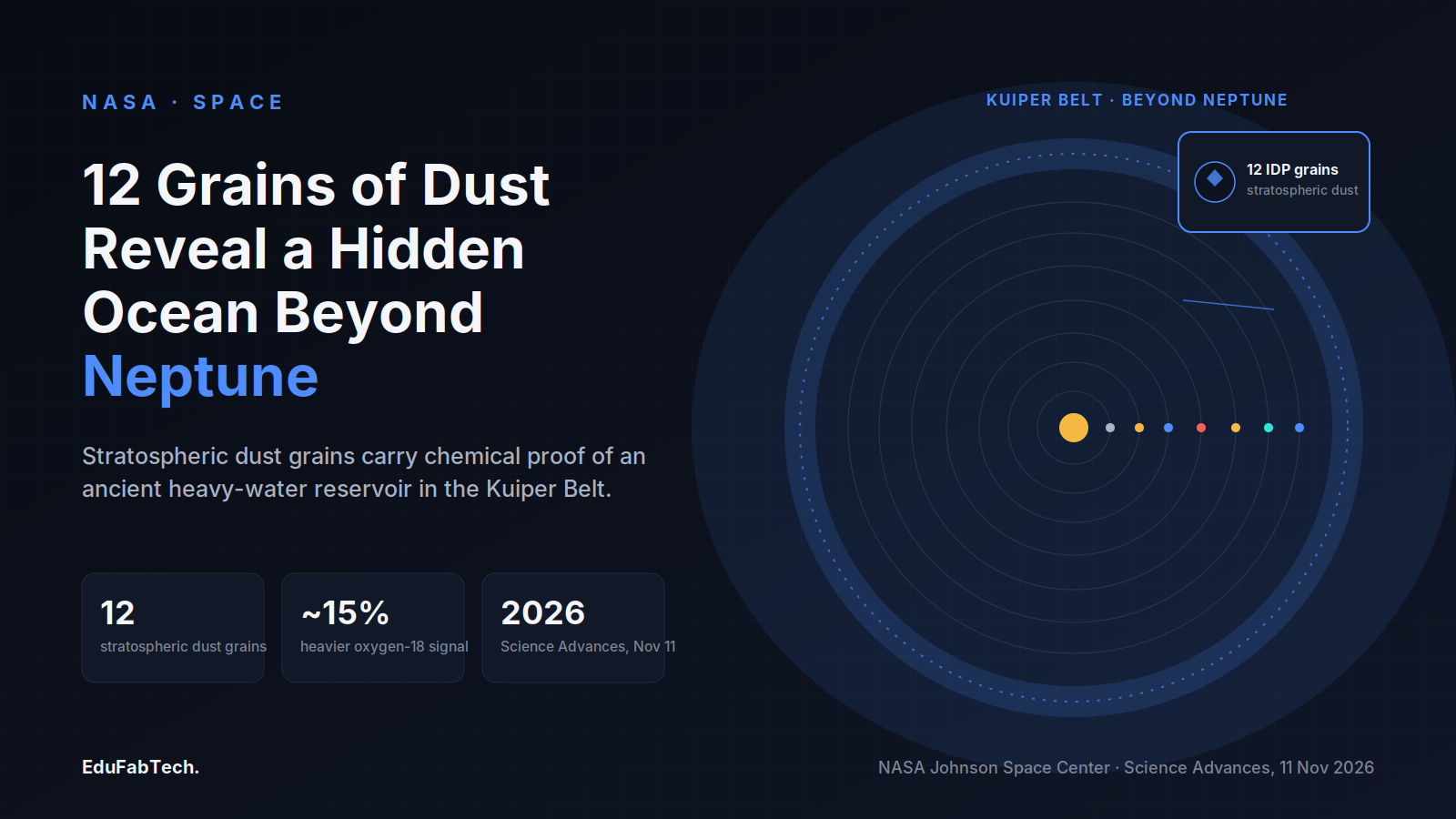
NASA's Johnson Space Center said on 18 November 2026 that researchers studying 12 microscopic dust particles collected from Earth's stratosphere have found direct evidence for an ancient reservoir of "heavy" water in the Kuiper Belt, the band of icy bodies beyond Neptune. The findings, published in Science Advances on 11 November 2026 and credited to lead researcher Lindsay P. Keller of NASA Johnson Space Center working with colleagues at the University of California, Los Angeles (UCLA), address a reservoir that had been theorized for decades but had lacked direct physical evidence, according to NASA's account of the study.
Twelve grains, one high-altitude aircraft
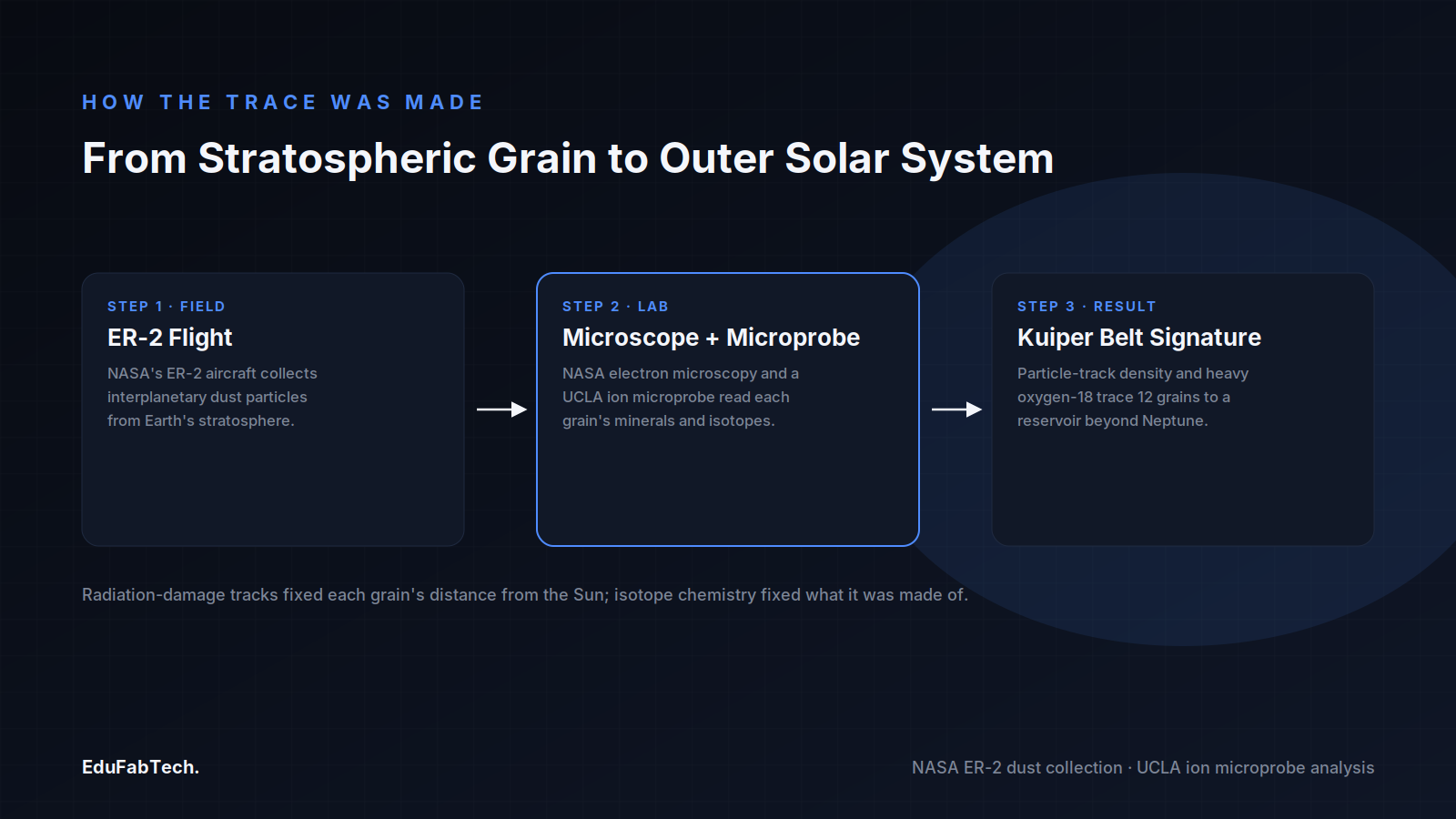
The particles at the center of the study are interplanetary dust particles (IDPs), grains far too small to see without a microscope, collected from Earth's stratosphere by NASA's ER-2 high-altitude research aircraft, NASA reports. Researchers identified solar energetic particle tracks inside the grains — radiation damage caused by exposure to the Sun's particle outbursts over long stretches of time in space — and used the density of those tracks to trace the particles' origin to the Kuiper Belt region beyond Neptune, per the NASA account.
The team then turned to two analytical techniques to probe the grains' chemistry: electron microscopy at NASA and an ion microprobe at UCLA, according to a report from Phys.org on the same paper. Those methods let the researchers identify hydrated minerals inside the dust — minerals that only form when water has reacted with rock-forming material — and measure the oxygen isotope ratios locked into them.
What the oxygen isotopes show
The isotopic signature is the core of the finding. According to Phys.org's report, the researchers' chemical calculations put the ratio of oxygen-18 to oxygen-16 in the reconstructed ancient water at approximately 15% higher than Earth's ocean-water standard, described as a model-based upper-limit estimate. NASA's account describes this as a signature of "heavy" oxygen that had been predicted on theoretical grounds but had not previously been tied to physical samples.
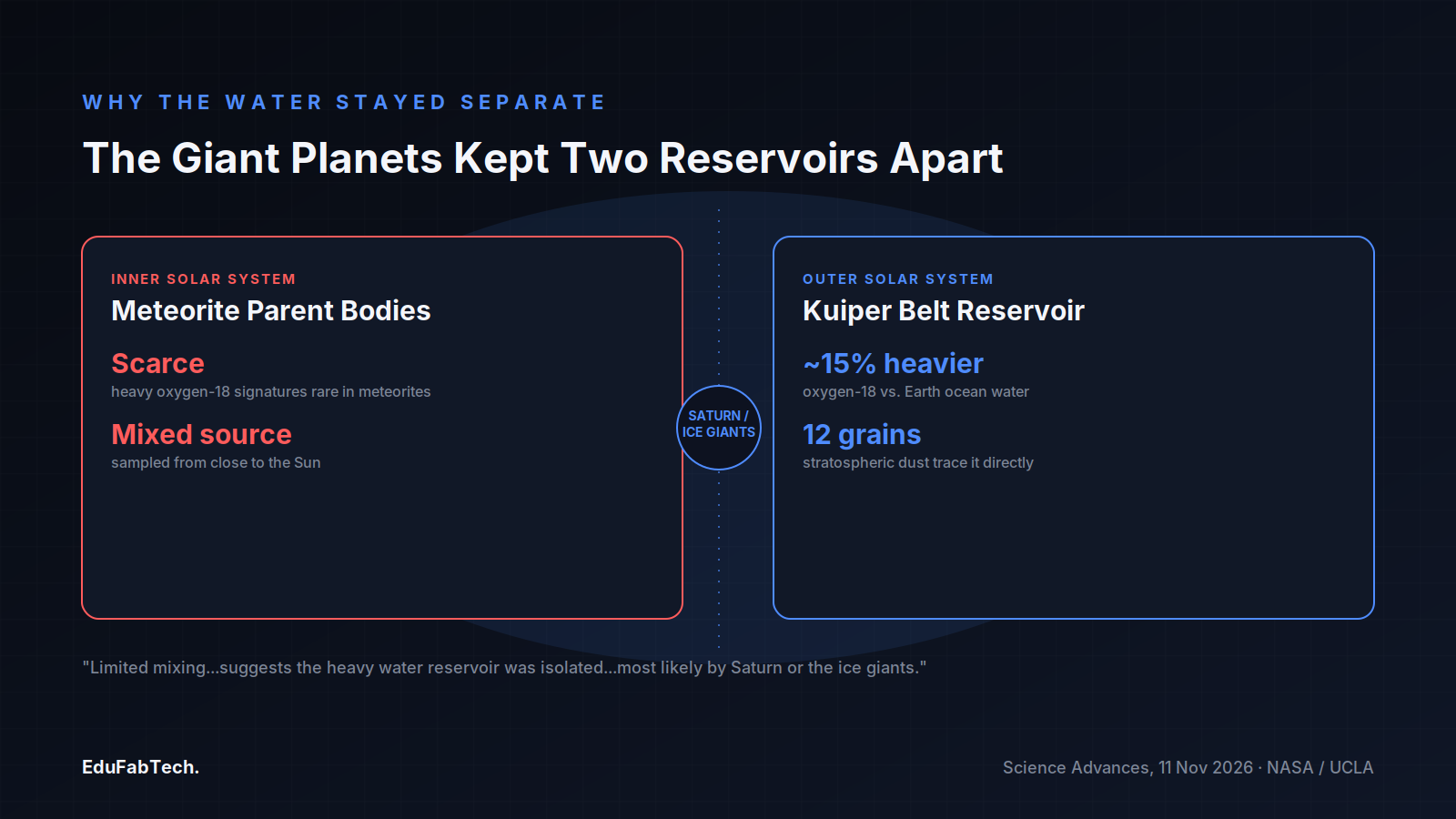
A statement attributed to the paper's authors in the EurekAlert release from the American Association for the Advancement of Science (AAAS), the publisher of Science Advances, calls the result "compelling evidence for the presence of a major heavy water reservoir beyond the orbits of the gas giant planets." Phys.org also reports a direct quote on the mechanism that may have kept that reservoir separate from the inner solar system: "The limited mixing between these outer solar system reservoirs suggests that the heavy water reservoir in the outer solar system was isolated from the inner regions, most likely by Saturn or in combination with the ice giants."
Why isolation matters
NASA's account notes that similar heavy-oxygen isotopic signatures are relatively scarce in meteorites, which mostly sample material from closer to the Sun. The research team argues this scarcity is consistent with the idea that the giant planets acted as a barrier, limiting the exchange of icy material between the outer solar system — where the Kuiper Belt reservoir formed and stayed isolated — and the inner solar system, where meteorite parent bodies formed. The team also compared its isotope measurements against reference data from NASA's Genesis mission, which sampled solar wind, to help distinguish the ancient water's signature from solar material, according to NASA's report.
What this adds to planet-formation models
Models of the early solar system have long proposed that water ice formed with different oxygen-isotope ratios depending on how far it condensed from the young Sun, with material farther out — in the region that became the Kuiper Belt — expected to be enriched in the heavier isotope. Until this study, NASA's account says, that prediction had been difficult to test directly because no spacecraft has returned a sample from the Kuiper Belt itself. Stratospheric dust capture offers a workaround: some fraction of the particles the ER-2 aircraft collects over years of flights originated far beyond the orbits of the planets and fell to Earth after being perturbed out of their original orbits.
What it means for researchers and students
For planetary scientists, the result offers a physical anchor for isotope-based models of solar system formation that have, until now, relied mostly on theoretical predictions and indirect meteorite evidence. For students working in astrochemistry, cosmochemistry or planetary geology, the paper is a worked example of how microscopic sample analysis — electron microscopy paired with ion-microprobe isotope measurement — can be used to trace material back to a specific solar system region using nothing but a particle's internal radiation damage and mineral chemistry. The approach does not require a dedicated sample-return mission to the outer solar system; it relies on material that already falls to Earth and is captured during routine high-altitude research flights.
The paper does not report having analyzed material from a Kuiper Belt object directly, and NASA's account frames the finding as evidence supporting a long-standing theoretical model rather than a direct sample-return result. Researchers interested in the full isotopic dataset and statistical treatment of the 12 particles can consult the paper directly in Science Advances.
A quick question for readers
Which study habit do you think is most overrated?
Some popular habits have little evidence behind them. Which one do you think gets too much credit?
Pick an answer, create a free account in a minute, and your vote counts. Already a member? Sign in
Comments 3
Comment-
The part I keep coming back to is "model-based upper-limit estimate" sitting right next to the 15% number. That's doing a lot of quiet work…
-
What's notable is how indirect the chain of inference is: solar energetic particle track density to guess origin, then oxygen isotopes as th…
-
The part I'd put in front of a student is that they never actually touched a Kuiper Belt object - they traced 12 stratospheric dust grains b…
Join free to read the full comments and reply Comments are between members; an account takes a minute.
Source: NASA Science
Sources (3)
- Victoria Segovia. NASA Scientists Find Clues to Ancient Ice Beyond Neptune. NASA Science, 2026. science.nasa.gov ↗ · checked 20 Nov 2026
- Lindsay P. Keller et al.. Solar energetic particle tracks reveal a heavy-oxygen water reservoir in the outer solar system. Science Advances, 2026. science.org ↗ · checked 20 Nov 2026
- Dust from the Kuiper Belt suggests the outer solar system contains water with heavy oxygen. EurekAlert / AAAS, 2026. eurekalert.org ↗ · checked 20 Nov 2026