Nature Index 2026 Finds China's Research Output Up 22% in a Year as Japan and South Korea Also Outpace the West
A widened Nature Index, now covering applied and social-science journals, shows China's weighted research output rising far faster than any other country in the global top ten for 2025.
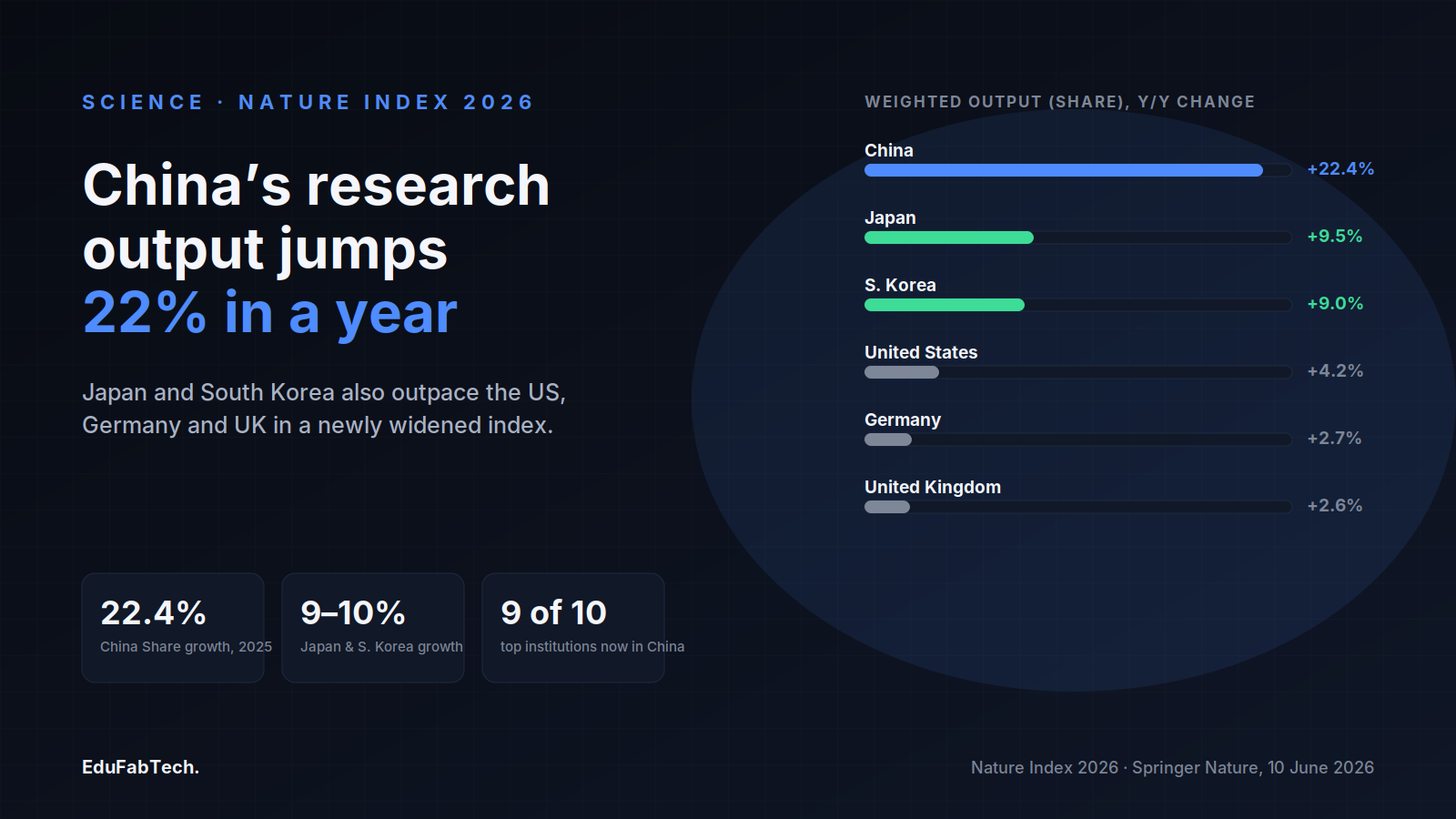
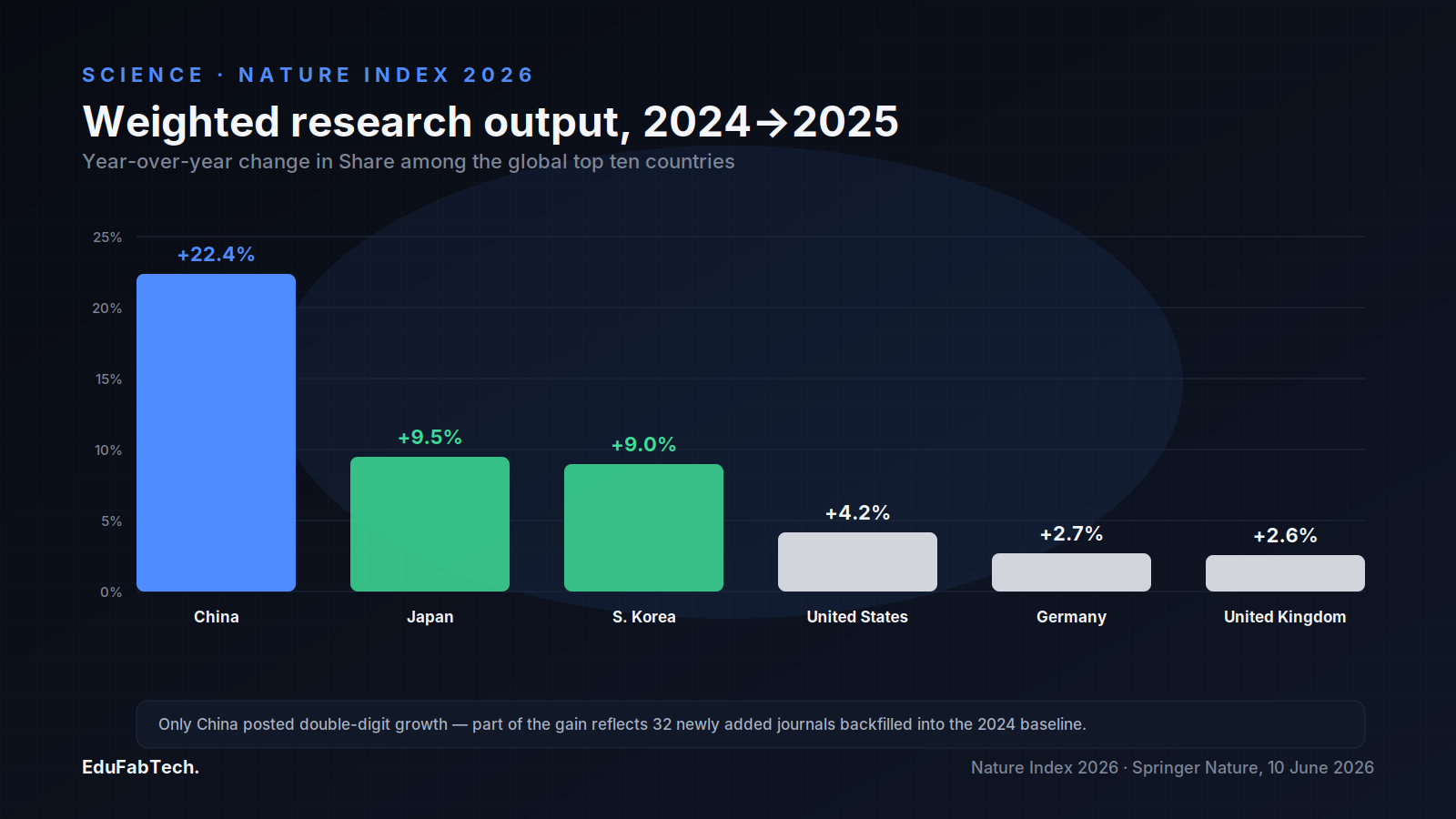
On 10 June 2026, Springer Nature published the 2026 edition of its Nature Index Research Leaders tables, the annual accounting of which countries and institutions produced the most output in a curated set of high-visibility journals. The headline number: China's weighted research output, measured by the Index's Share metric, rose 22.4% from 2024 to 2025, according to the Springer Nature press release accompanying the tables. It was the only country in the global top ten to post double-digit growth.
China's lead over the rest of the field is not new. What the 2026 tables add is a wider lens: Japan and South Korea, both in the global top ten, each recorded growth close to 9-10% year over year, well ahead of the United States (+4.2%), Germany (+2.7%) and the United Kingdom (+2.6%), per the same Springer Nature release. India also held a place in the global top ten of the Nature Index's 2026 country tables, though the public tables do not break out its year-on-year change with the same granularity as the top five.
At the institutional level, the shift is more pronounced. Nine of the world's top ten research institutions by Share are now based in China, up from eight in the prior year, with the Chinese Academy of Sciences retaining first place overall, according to STM Publishing News. Harvard University climbed to third place globally and led the social sciences category, where nine of the top ten institutions are American, the same source reports.
A wider net, not just a new leaderboard
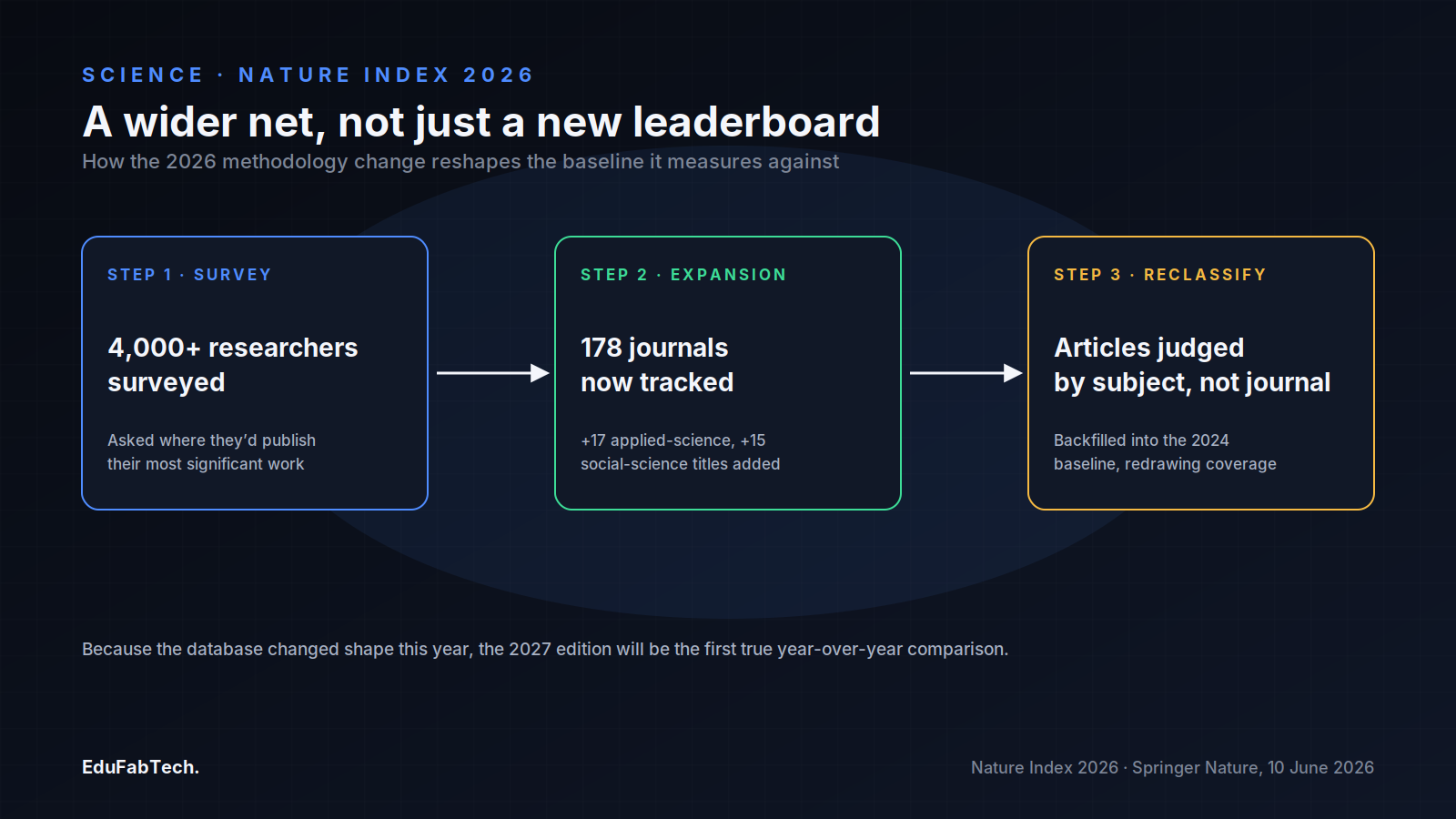
The 2026 edition is not a like-for-like continuation of prior years. Nature Index added 17 applied-science journals and one conference, plus 15 social-science journals, bringing the tracked database to 178 titles across seven subject areas, 84% of them published outside Springer Nature, according to the Springer Nature press release. The selection followed a survey of more than 4,000 researchers asked where they would publish their most significant work.
The Index also switched from classifying articles by the journal they appeared in to classifying each article individually by subject, a change Springer Nature says gives "a more comprehensive and precise view of high-quality research output," in the words of Nature Index chief editor Simon Baker, quoted in the same release. Because the new journals and the new classification were backfilled into the 2024 baseline, part of the year-over-year change reflects a redrawn boundary around what counts as covered research, not only a change in what researchers actually published.
That distinction matters for reading the country-level numbers. The United States and Germany, per Research Information, remained among the top five countries across all seven subject areas, including the newly added applied and social sciences — a pattern of breadth across fields rather than concentration in a smaller number of them, in contrast with the scale of China's overall gain in Share.
What the Index does and does not measure
Nature Index's Share metric is a fractional count: an article with ten authors from ten institutions contributes 0.1 of a Share to each, and an author affiliated with more than one institution has that fraction split again, per the Index's own methodology description. It rewards participation in articles that appear in a specific set of selective journals, not total publication volume, citation impact, patents, or research spending, and a 178-title database is a small slice of the tens of thousands of academic journals published worldwide.
Those limits do not make the trend meaningless. East Asian research systems posting sustained growth across several editions, while the United Kingdom sits at the bottom of the growth ranking among the confirmed top five, is a pattern policymakers and funders will read alongside other indicators. One is public investment itself: the OECD reported in 2026 that government research budgets across its member countries fell 4.1% in real terms in 2024, with preliminary 2025 data from early-reporting countries showing a steeper drop of more than 5%, even as defence-related R&D spending rose — by 11.5% in the EU27 and 17.9% in Japan. For a fuller comparison across research systems, the Index is best read as one input among several, not a single scoreboard for national science policy.
Because the underlying database changed shape this year, the most useful comparison will be the 2027 edition, when the redrawn journal list and article-level classification are held constant against a second year rather than a newly backfilled baseline.
- Springer Nature Group. Nature Index expands to applied and social sciences with release of 2026 Research Leaders tables. Springer Nature press release, 2026. link
- Layal Liverpool. China extends lead in Nature Index global research rankings. Research Information, 2026. link
- STM Publishing News. Nature Index expands to applied and social sciences with release of 2026 Research Leaders tables. STM Publishing News, 2026. link
- Nature Index. 2026 Research Leaders: Leading countries/territories. Nature Index (Springer Nature), 2026. link
- OECD. OECD overall R&D growth stable; government R&D budgets decline and reorient towards defence. OECD, 2026. link