nginx Patches Five Critical Flaws Dubbed 'nginx2root'; No Exploitation Confirmed
On 18 November 2026, F5 shipped nginx 1.30.7 and 1.31.9, fixing five flaws rated 9.2 on CVSS v4.0 and collectively named nginx2root.
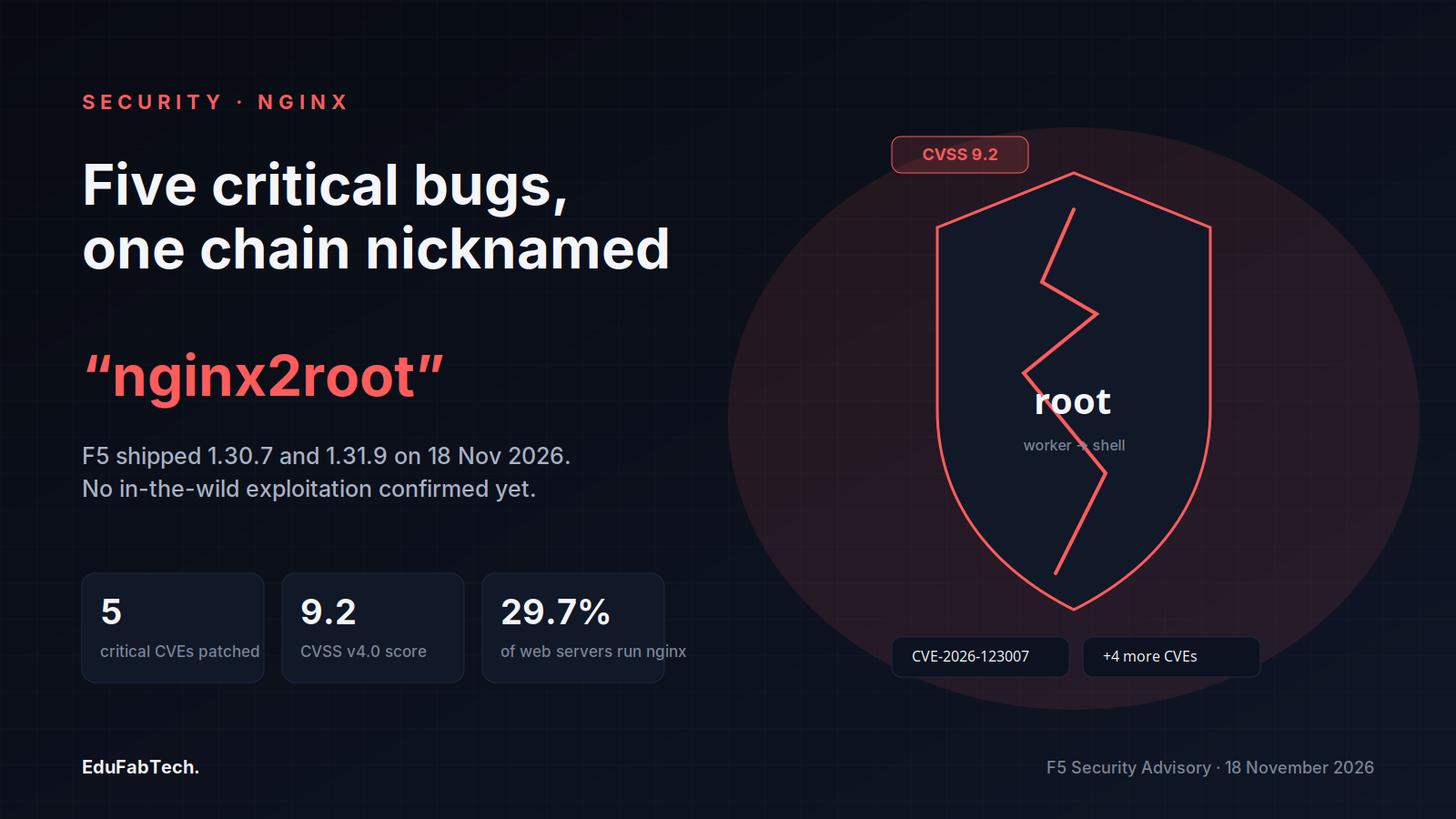
F5, which has owned and maintained nginx since 2019, released nginx 1.30.7 (stable) and 1.31.9 (mainline) on 18 November 2026, fixing ten vulnerabilities in the web server. Five of them were rated 9.2 out of 10 on the CVSS v4.0 scale and 8.1 on CVSS v3.1. Researchers at Xint, working with Theori, named the cluster "nginx2root" because the five nginx bugs can, in principle, be chained with a separate and still-unpatched Linux kernel privilege-escalation flaw — an SCTP use-after-free with no CVE number assigned as of 19 November 2026 — to reach root; on their own, the nginx bugs execute code only inside the nginx worker process, according to Tenable's security research blog (2026).
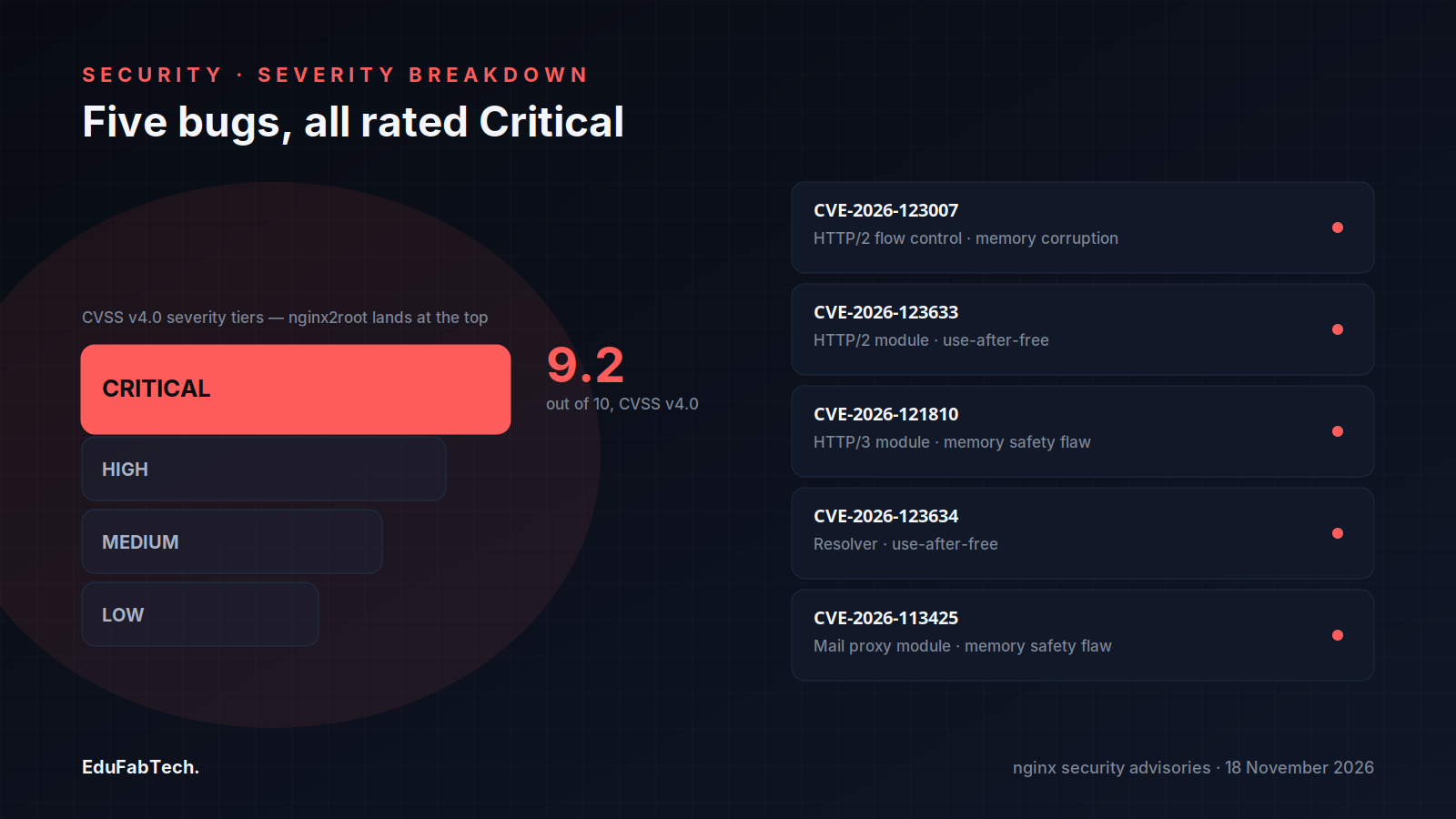
The five critical flaws sit in different parts of the server: CVE-2026-123007 is memory corruption in HTTP/2 flow control, present in every nginx release from 1.9.5 up to 1.31.8 — a range that stretches back to a version first published in 2015 — while CVE-2026-123633 is a use-after-free elsewhere in the HTTP/2 module. CVE-2026-121810 affects the HTTP/3 module, CVE-2026-123634 is a use-after-free in the resolver, and CVE-2026-113425 sits in the mail proxy module. All five, along with their affected and fixed version ranges, are listed on nginx's own security advisories page.
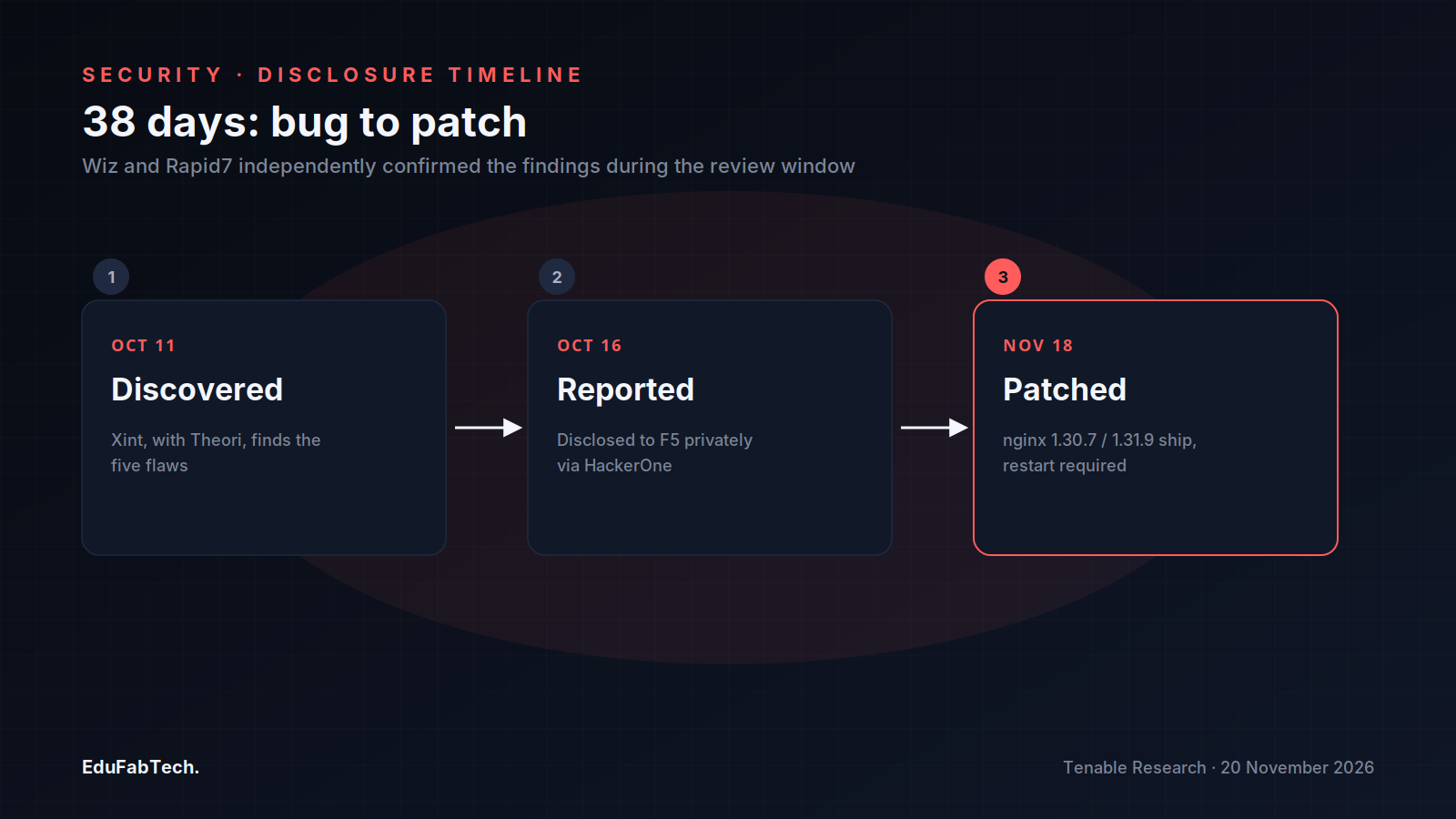
The flaws were found by the research team Xint, affiliated with Theori, which identified the bugs on 11 October 2026 and reported them to F5 through HackerOne on 16 October 2026, ahead of the coordinated 18 November disclosure; Tenable's blog post says the Wiz and Rapid7 security teams independently confirmed the findings during that window.
How practical is the exploit, really
CVSS scores describe severity in the abstract, not how easy an attack is to carry out. According to a technical write-up from security vendor StepSecurity, the proof-of-concept that Rapid7 published for CVE-2026-123007 needs a direct connection to nginx with no HTTP/2-terminating proxy in front of it, roughly 119 GiB of HTTP/2 traffic sent within a single connection's one-hour limit, and a target server that is otherwise idle; triggering full code execution, rather than just a crash, additionally requires an x86-64 CPU with AVX-512, according to the same StepSecurity write-up (2026).
As of 20 November 2026, StepSecurity reported no confirmed exploitation of the flaw in the wild, and it had not been added to the US Cybersecurity and Infrastructure Security Agency's Known Exploited Vulnerabilities catalog. Tenable's blog reached the same conclusion for the other four critical bugs: working exploit code exists for research purposes, but there is no public evidence of in-the-wild attacks as of its publication.
What administrators are told to do
Tenable's blog lays out a staged response. Removing the http2 parameter from listen directives, or adding http2 off;, blocks CVE-2026-123007 and CVE-2026-123633 without an upgrade, but it does nothing for the HTTP/3, resolver or mail proxy flaws. The only complete fix is to install 1.30.7 or 1.31.9 and restart the server process — Tenable's post stresses that a configuration reload is not enough, because reloading does not replace the running nginx executable in memory.
Customers running NGINX Plus rather than the open-source build need 37.0.8.1 on the long-term-support track or 37.3.0.1 on the continuous-release track, per the same advisory. F5 says in a post on its DevCentral community site that BIG-IP is not vulnerable to CVE-2026-123007 and CVE-2026-123633 "within the evaluated software scope," but recommends that BIG-IP operators still check any standalone nginx instances running alongside it, since those follow the same patch requirements as any other deployment.
Why the deployment base matters
Nginx is used by 29.7% of websites whose web server software is identifiable, according to W3Techs' web server usage survey, current as of 22 November 2026. That scale is why a bug with a decade-long affected-version window, as with CVE-2026-123007 tracing to a 2015 release, draws attention even without confirmed exploitation: any engineer who inherited a long-lived HTTP/2-enabled deployment, rather than one built recently, is a candidate for the fix.
For students and researchers studying protocol security, the nginx2root cluster is a concrete case study in how flow-control and connection-lifecycle logic in HTTP/2 and HTTP/3 implementations keeps producing memory-safety bugs years after the protocols themselves were standardized. The coordinated timeline here, from a mid-October private report to a mid-November public patch with versioned fixes for both the open-source and commercial product lines, is also a working example of how such disclosures are expected to be handled at this scale.
A quick question for readers
Which skill will matter most for getting a job in 2030?
Everyone has a prediction. Add yours and see what students are betting on.
Pick an answer, create a free account in a minute, and your vote counts. Already a member? Sign in
Comments 3
Comment-
The number that undercuts the urgency here is right in the write-up: triggering actual code execution on CVE-2026-123007 needs 119 GiB of HT…
-
The part worth sitting with is the exploitability gap, not the 9.2 score. Rapid7's own PoC needs a direct connection with no HTTP/2-terminat…
-
The number that undersells the risk is the 119 GiB of HTTP/2 traffic needed in a single connection's one-hour window for CVE-2026-123007 - t…
Join free to read the full comments and reply Comments are between members; an account takes a minute.
Source: nginx (F5)
Sources (3)
- nginx/F5 Security Team. nginx security advisories. nginx.org, 2026. nginx.org ↗ · checked 22 Nov 2026
- Tenable Research. NGINX2Root FAQ: Five vulnerabilities in NGINX (CVE-2026-123007). Tenable Blog, 2026. tenable.com ↗ · checked 22 Nov 2026
- W3Techs. Usage statistics of Nginx for websites. W3Techs, 2026. w3techs.com ↗ · checked 22 Nov 2026