OECD's 2026 Education at a Glance Finds a 13-Point Gender Gap in Degrees That Runs Both Ways
Young women out-earn young men in tertiary degrees across almost every OECD country, while young men are more likely to leave school without an upper-secondary qualification — except in a handful of countries where both patterns reverse.
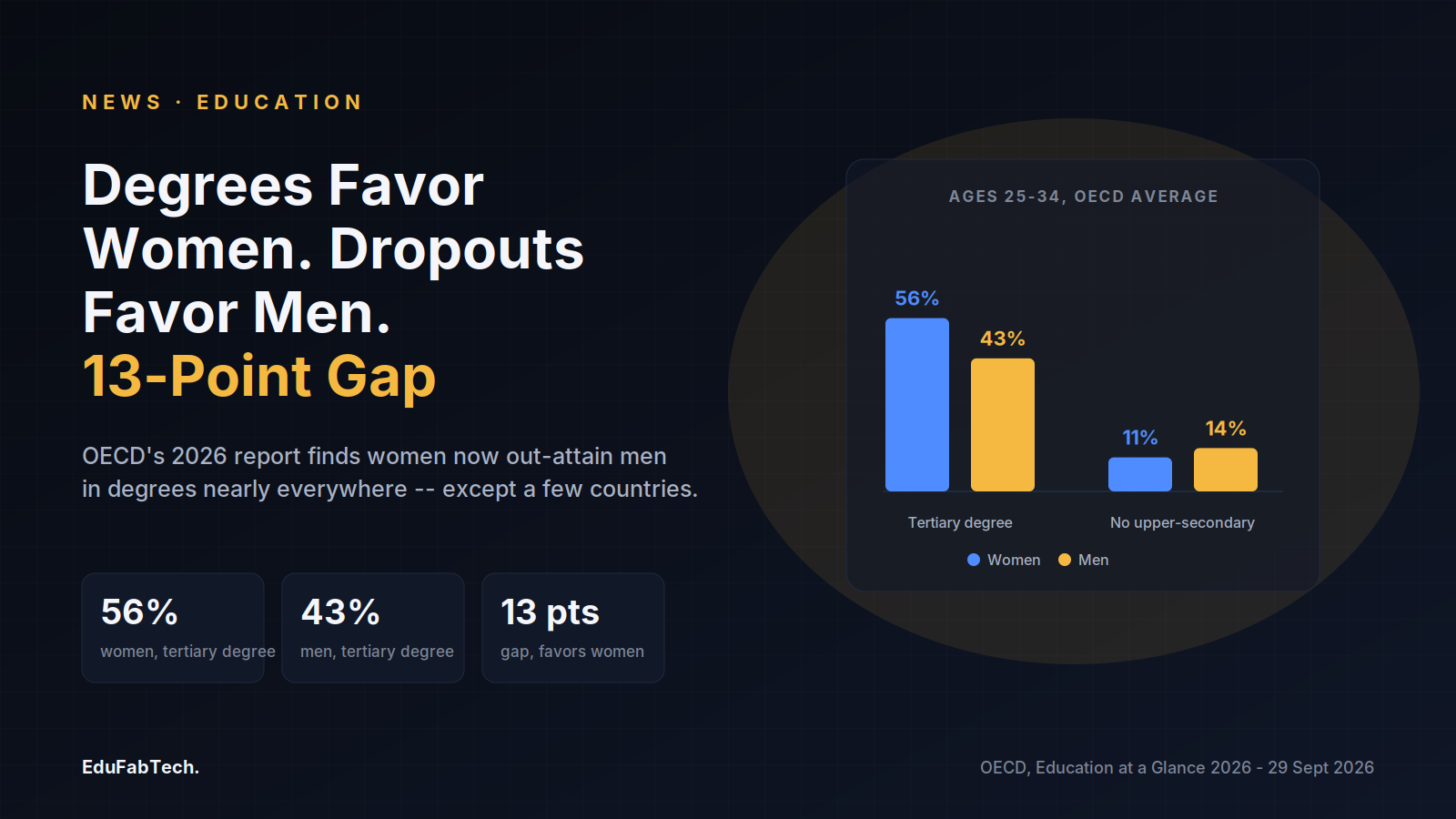
On 29 September 2026, the OECD launched Education at a Glance 2026, its annual comparison of education systems across member and partner countries. Alongside a special chapter on teacher shortages, the report's chapter on adult attainment documents a gender gap in education that has become a fixture of OECD statistics: on nearly every measure, young women now out-attain young men, except at the bottom of the qualification ladder, where the pattern flips.
A gap that runs in two directions
According to the OECD's 2026 chapter on adult educational attainment, 56% of women aged 25-34 held a tertiary qualification in 2025 across OECD countries on average, compared with 43% of men — a 13-percentage-point gap in favour of women, slightly wider than the 12-point gap recorded in 2015.
The same report finds the opposite pattern lower down the qualification ladder. On average, 14% of men aged 25-34 had not completed upper-secondary education, against 11% of women. And among those whose highest qualification was upper-secondary or post-secondary non-tertiary education, men outnumbered women by 10 points — 44% versus 34%. Put together, the figures describe two related trends: men are somewhat more likely to leave school without finishing upper-secondary studies, and among those who do finish, more of them stop there instead of going on to a degree.
Where the gap is widest, and where it is widening fastest
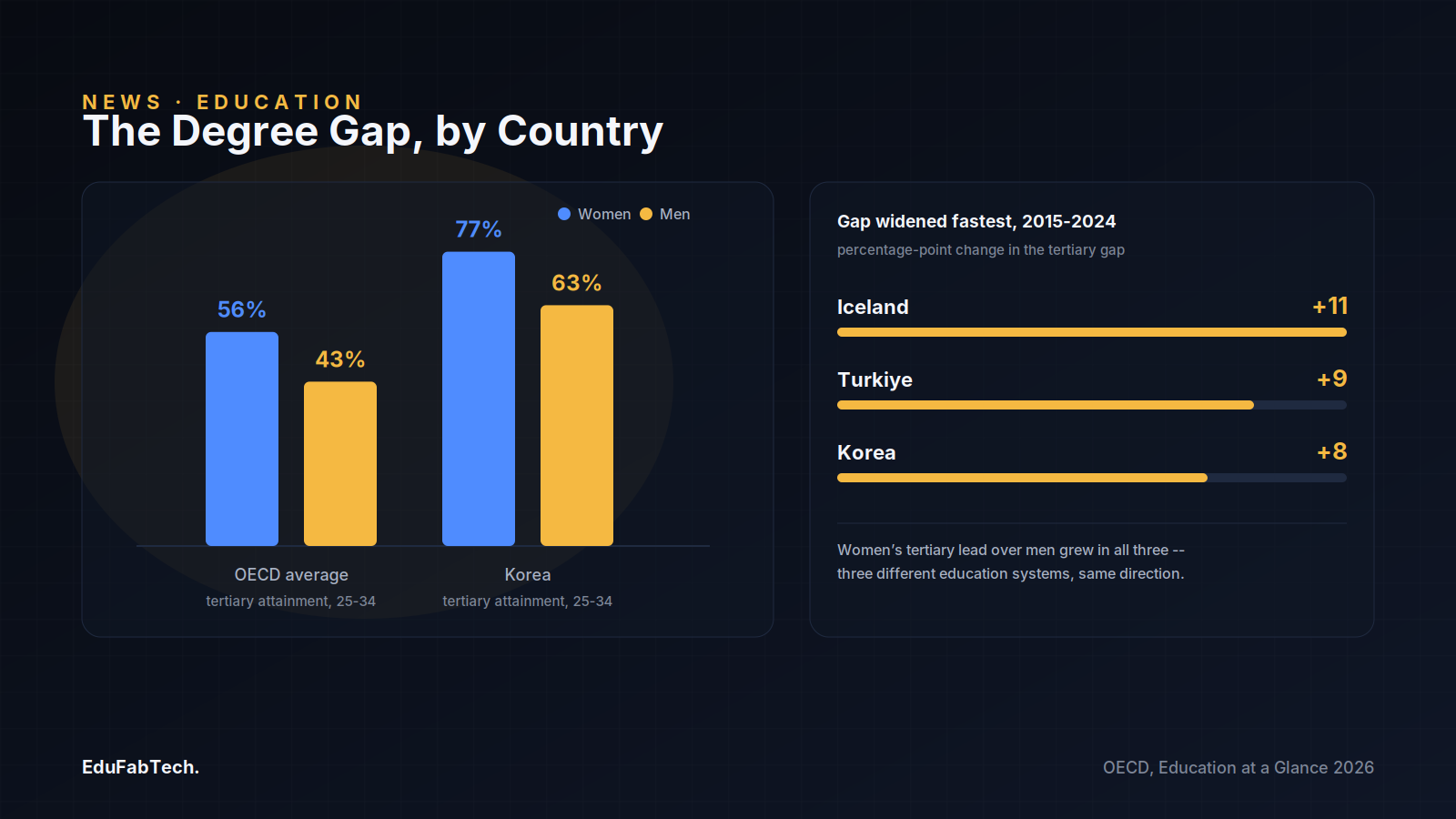
The size of the tertiary gap varies sharply by country. In Korea, the OECD reports 77% of women aged 25-34 hold a tertiary qualification against 63% of men, a 14-point gap. Over the decade to the mid-2020s, the gap widened most in Iceland (up 11 points between 2015 and 2024), Türkiye (up 9 points) and Korea (up 8 points) — three very different education systems moving in the same direction.
| Population | Women, tertiary attainment | Men, tertiary attainment | Gap |
|---|---|---|---|
| OECD average (25-34, 2025) | 56% | 43% | 13 points |
| Korea (25-34) | 77% | 63% | 14 points |
The countries where it runs the other way
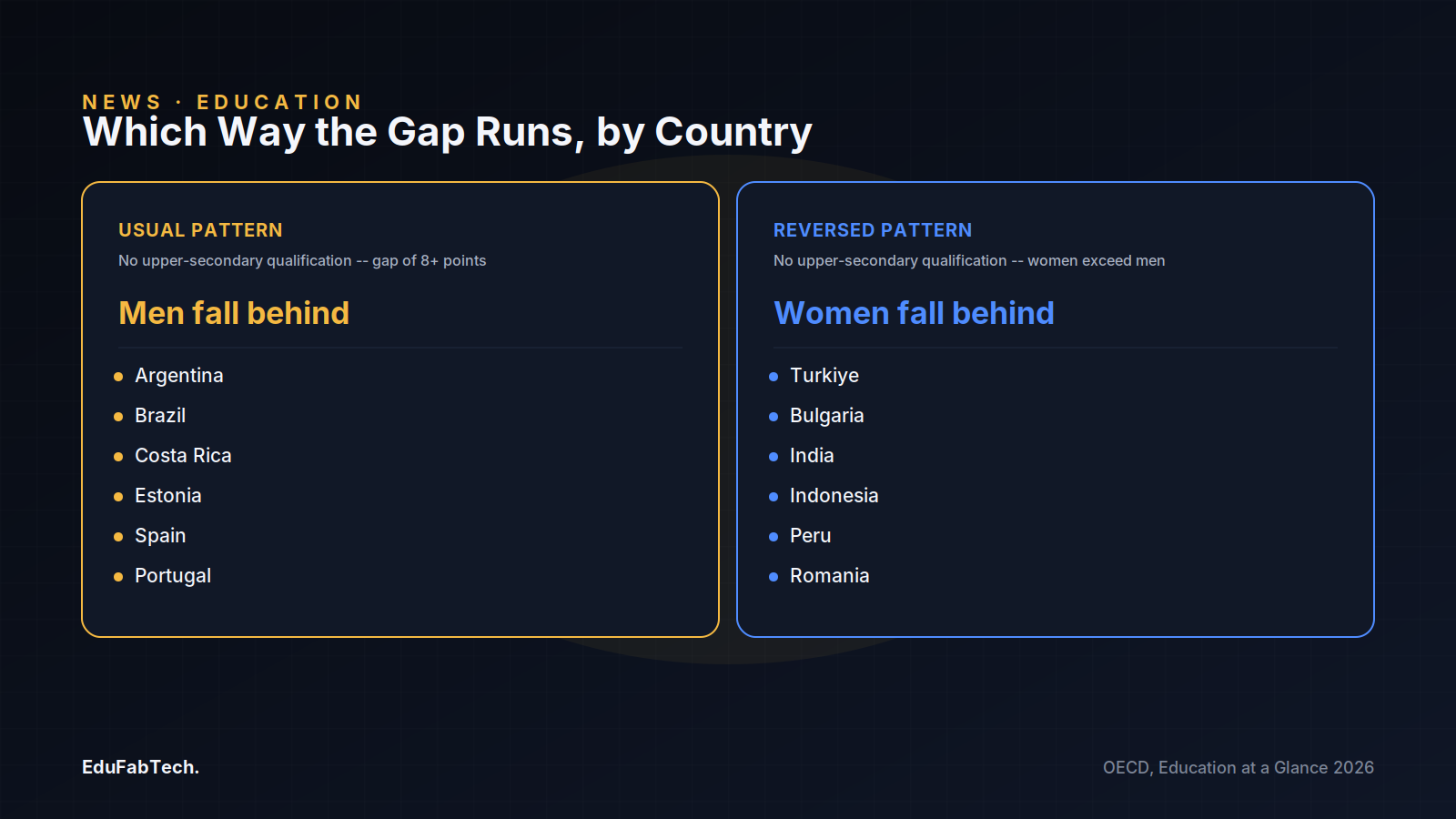
The OECD's data also identify where the more common pattern of male disadvantage in upper-secondary completion is largest, and where it inverts entirely. Gaps of 8 percentage points or more, with young men more likely than young women to lack an upper-secondary qualification, appear in Argentina, Brazil, Costa Rica, Estonia, Spain and Portugal. But among OECD and partner countries with available data, only in Türkiye, Bulgaria, India, Indonesia, Peru and Romania does the share of young women without an upper-secondary qualification exceed that of young men — a reminder that the "boys falling behind" narrative common in wealthier OECD countries does not hold everywhere the organisation collects data.
Completion, not just enrolment
A related chapter in the OECD's 2025 edition of Education at a Glance found the same divide shows up once students are actually enrolled. Across OECD and partner countries, 48% of women who started a bachelor's programme finished on time, compared with 37% of men. Extending the window by three years beyond the expected graduation date narrows the enrolment-to-completion pool but not the gap: 75% of women had completed their bachelor's degree, against 63% of men. Fewer men enter tertiary programmes in the first place, and a smaller share of the men who do enter finish them.
Not a one-report finding
The reversal is not particular to this dataset. A 2025 analysis of United States degree data in the RSF: The Russell Sage Foundation Journal of the Social Sciences, by Claudia Buchmann, Rachel Dwyer and Man Yao, found women's share of bachelor's degrees has held near 57-58% since 2000, and that a similar reversal has now spread to advanced and professional degrees — women's share of those credentials rose from 45.3% in 2000 to 56% in 2021. It is one country's data rather than a cross-country comparison, but it points to the same structural shift the OECD describes at a multi-country scale: a gap that opened at the bachelor's level decades ago and has since climbed the credential ladder.
None of this says which direction is the anomaly. Where men are overrepresented among early school leavers, the policy question is about retention and pathways back into upper-secondary study. Where women remain less likely to finish secondary school — as in the six countries the OECD flags — the barriers are typically different, and older. The OECD's own data make clear that a single global narrative about gender and education does not fit: the shape of the gap, and which sex it favours, changes depending on which rung of the ladder and which country you look at.
A quick question for readers
Are group projects good for learning?
Loved by some, dreaded by many. What is your real experience?
Pick an answer, create a free account in a minute, and your vote counts. Already a member? Sign in
- OECD. To what level have adults studied?: Education at a Glance 2026. OECD, 2026. doi:10.1787/b5466dac-en
- OECD. OECD to launch Education at a Glance 2026 on 29 September. OECD, 2026. link
- OECD. Who is expected to complete tertiary education?: Education at a Glance 2025. OECD, 2025. doi:10.1787/a1099e2e-en
- Ileana Najarro. How the U.S. Teaching Profession Compares to Global Peers. Education Week, 2026. link
- Claudia Buchmann, Rachel E. Dwyer, Man Yao. The Deepening Gender Divide in Credentials, 2000-2020: Continuity, Change, and Implications. RSF: The Russell Sage Foundation Journal of the Social Sciences, 2025. doi:10.7758/RSF.2025.11.1.06