New OECD-EU Database Compares Researcher Mobility and Pay Across 53 Countries, Finds Wide Divergence
The first full edition of the Research and Innovation Careers Observatory tracks doctoral mobility, gender gaps and pay across dozens of countries, and finds that similar training systems still produce very different careers.
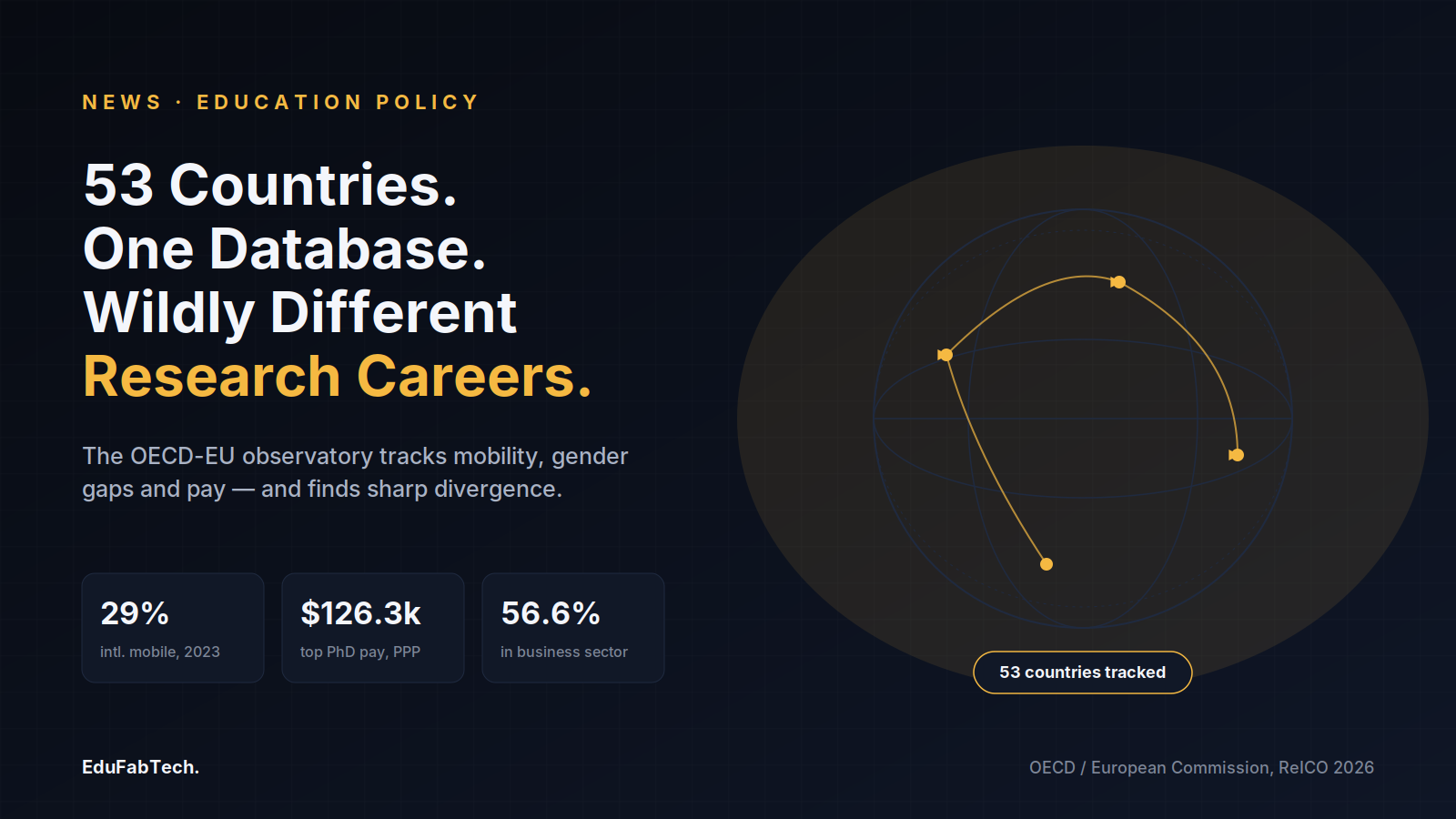
For decades, comparing research careers across countries meant stitching together national surveys that measured different things in different years. A new database launched jointly by the OECD and the European Commission tries to close that gap. The Research and Innovation Careers Observatory (ReICO) published its first full statistical edition in September 2026, and it is the most detailed cross-country picture yet of who does research, where they trained, where they moved, and what they are paid.
The observatory is a six-year project hosted at the OECD and primarily funded by the European Commission. It pulls together national labour-force data, doctoral education records and bibliometric data from scientific publications to cover 53 countries across Europe, the Americas, Asia and Oceania, plus South Africa. The goal, according to the OECD, is to give governments comparable evidence on three things: training and skills, jobs and career conditions, and geographic mobility.
The first findings, drawn from the OECD's Research and Innovation Careers Observatory 2026 report, show a workforce that looks similar on paper across countries but diverges sharply in practice.
Mobility Is Rising, But Unevenly
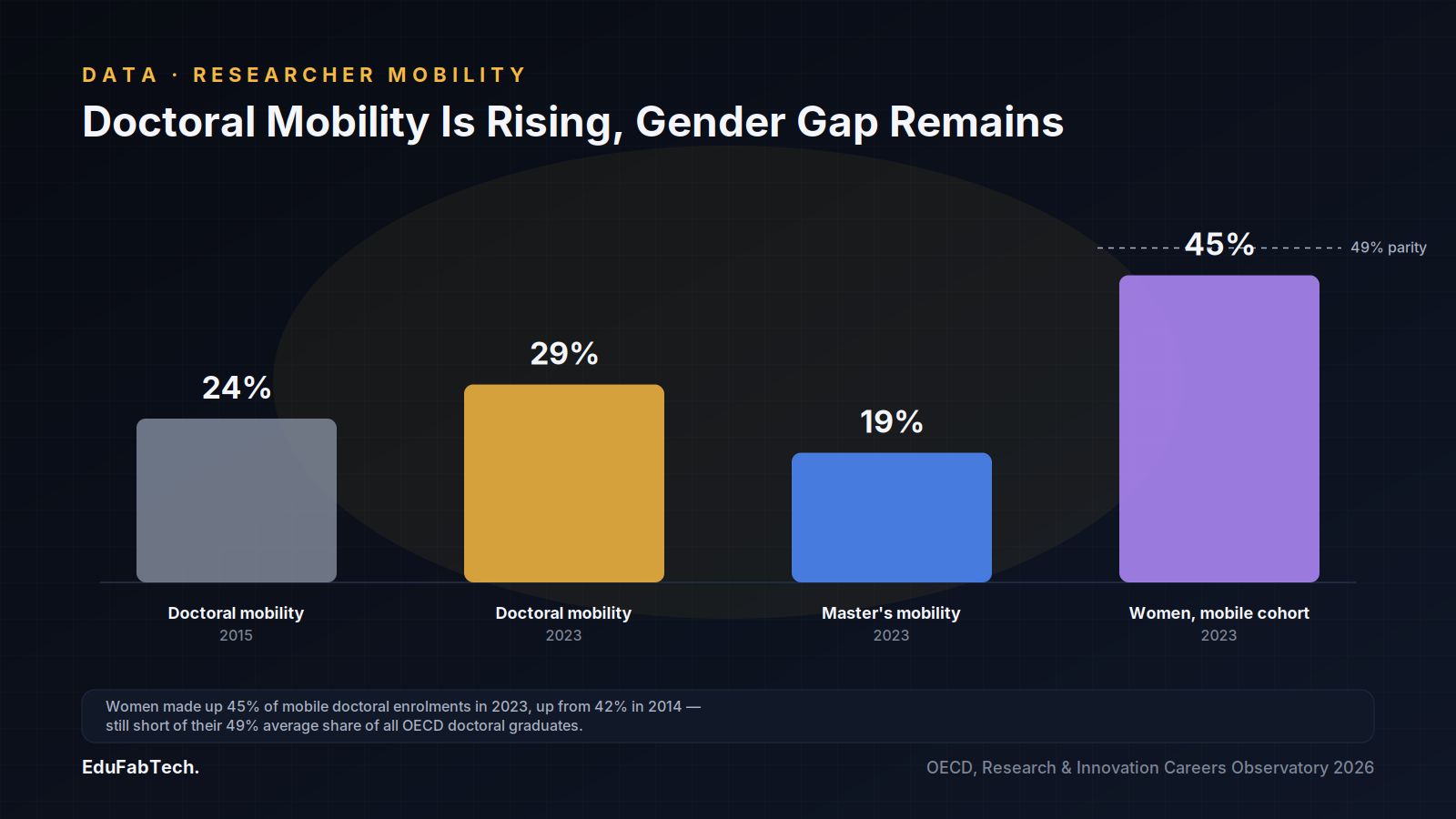
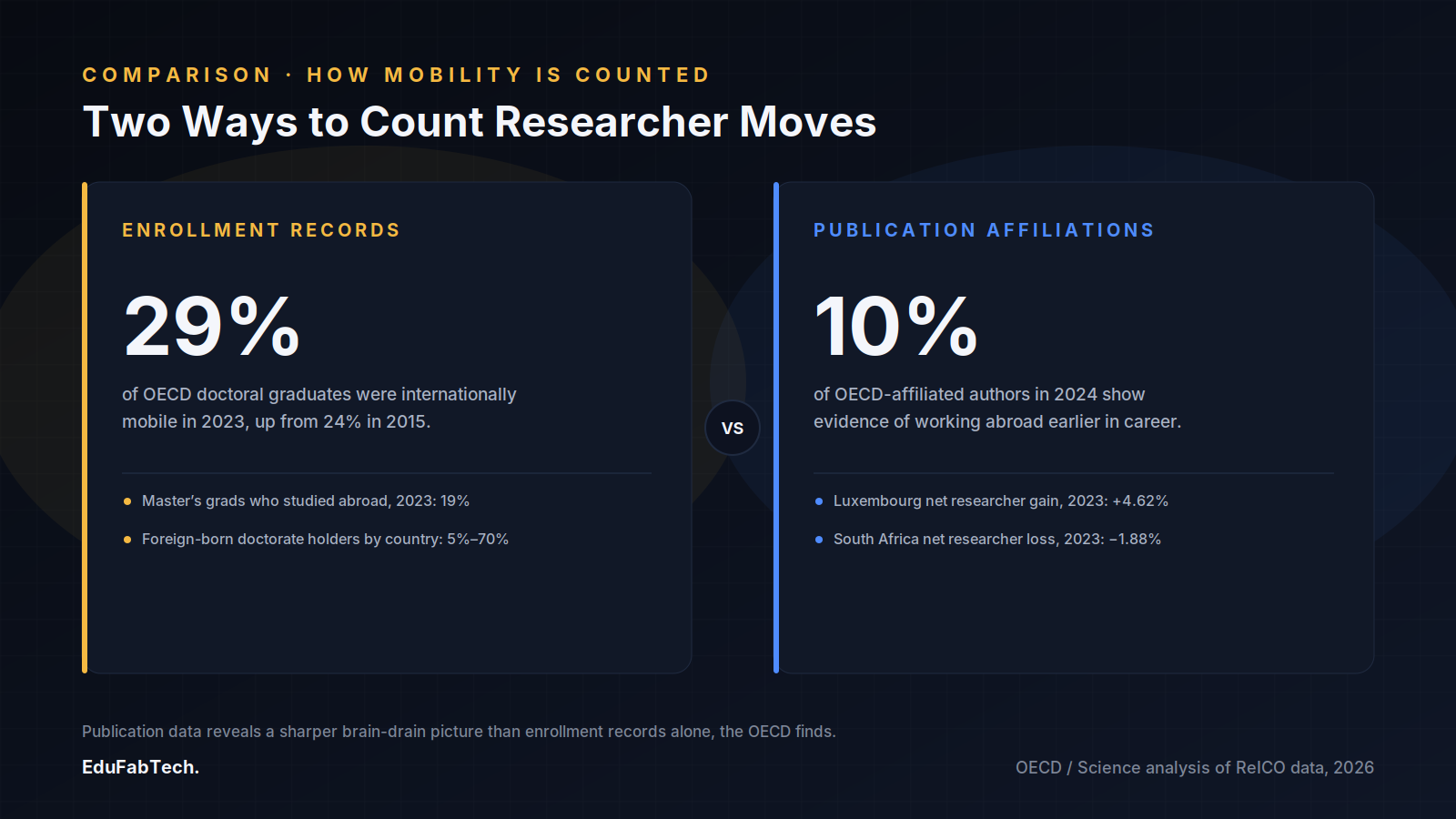
Across the OECD, 29% of doctoral graduates in 2023 were internationally mobile, meaning they had crossed a border to study, up from around 24% in 2015, the OECD reports. Mobility is lower earlier in training: 19% of master's graduates in 2023 had studied abroad. But national starting points differ enormously — the share of foreign-born people holding a doctorate ranges from below 5% to more than 70% of the doctorate-holding population depending on the country, according to the same report.
Gender patterns follow a similar split. Women made up 45% of internationally mobile doctoral enrolments in 2023, up from 42% in 2014, but still below parity, and below their 49% average share of doctoral graduates overall. Their share of mobile doctoral students exceeds 50% only in Chile, Greece, Israel, New Zealand and Slovenia, and falls below 40% in Estonia, Hungary, Latvia, Norway, the Slovak Republic, Türkiye and the United States, the OECD data show. Field of study matters too: STEM subjects account for 46% of OECD doctoral graduates on average, but reach or exceed 60% in France, Italy and Luxembourg.
Counting Mobility Through Publications Tells a Different Story
Alongside enrolment records, ReICO also tracks mobility by checking the institutional affiliations researchers list on their published papers. Roughly 10% of scientific authors affiliated with an OECD country in 2024 showed evidence of having worked abroad at some earlier point, the OECD finds — and mobile researchers cluster heavily in countries that are already well connected to international research networks.
That bibliometric approach produces a sharper brain-drain picture than enrolment data alone. An independent analysis of the ReICO data published by Science found Luxembourg posting the largest net gain of researchers in 2023, a 4.62% increase based on publication affiliations, while South Africa recorded the largest net loss, at 1.88% of its research authors. The OECD frames this as evidence that policy should treat mobility as "talent circulation" that can benefit sending and receiving countries alike, rather than as a one-way loss.
Pay and Equity Gaps Don't Track Training Systems
Among the 19 countries that supplied comparable income data, PhD holders in the United States were the best compensated, at roughly $126,300 a year adjusted for purchasing power, with Switzerland, the Netherlands and Norway close behind, according to the Science analysis of ReICO figures. Gender pay gaps among doctorate holders varied just as widely: employed women with doctorates in Colombia earned close to parity with men, while in Italy they earned only 62% of male doctorate holders' pay.
The observatory also puts the scale of the doctoral workforce in context: more than 1% of the working-age population across OECD countries now holds a doctorate, and new doctoral graduates exceeded 300,000 across the OECD area in 2023 alone. Separately, the European Commission's side of the platform reports that the EU's researcher population has roughly doubled over the past two decades, with the business sector now employing 56.6% of EU researchers as of 2023.
What the Database Does and Doesn't Cover
ReICO's coverage leans toward OECD and EU member countries, with China, the United Kingdom, Australia and the United States tracked as comparison economies; large parts of Africa, South Asia and Latin America still have thin or no comparable data, which is itself one of the report's findings rather than a footnote. The OECD and European Commission plan to update the observatory's indicators regularly through its dashboard rather than treating this as a one-off release, positioning it as a reference point for national science and immigration policy rather than a finished picture.
A quick question for readers
Which study method makes things stick for you until the exam?
Research says some methods work far better than others. Vote first, then see whether students agree with the evidence.
Pick an answer, create a free account in a minute, and your vote counts. Already a member? Sign in
- OECD. Research and Innovation Careers Observatory 2026: Key Indicators on Talent, Mobility and Working Conditions. OECD Publishing, 2026. doi:10.1787/138ed294-en
- European Commission, ERA Talent Platform. Research and Innovation Careers Observatory (ReICO). European Commission, 2026. link
- Science (AAAS). How do research careers compare across countries? New global database has some answers. Science, 2026. link