OECD and European Commission Launch STEM Skills Report for Higher Education
Launched in Dublin on 23 October 2026 during Ireland's EU presidency, the OECD-European Commission report targets STEM pathways from enrolment to career, as other 2026 OECD data show teacher shortages and sub-55% apprenticeship completion in several countries.
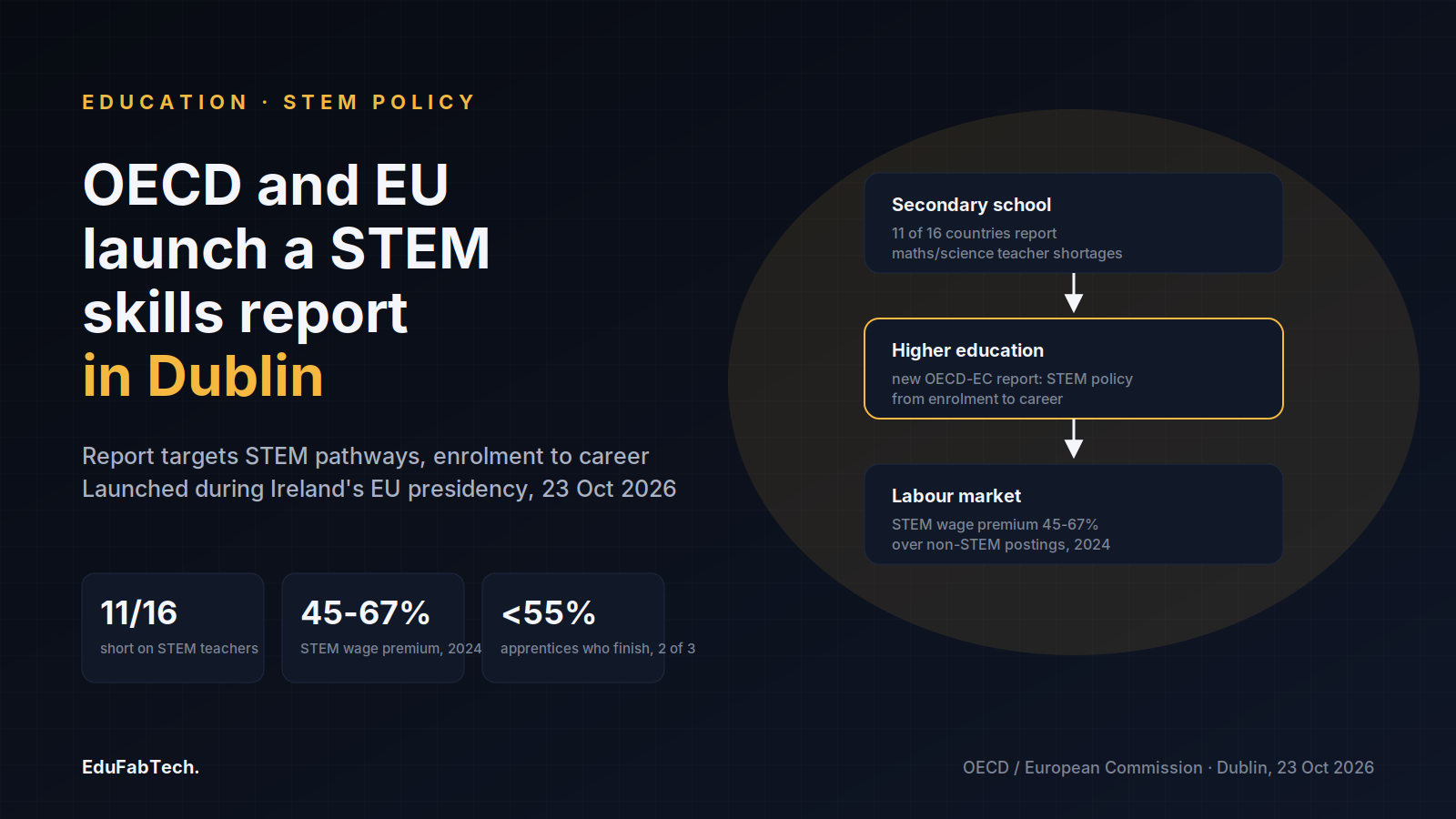
On 23 October 2026, the OECD and the European Commission launched a report titled Policies for Developing Advanced STEM Skills in Higher Education at a meeting of Directors-General for Higher Education (DG HE) in Dublin, held as part of Ireland's presidency of the Council of the European Union, according to Ireland's Department of Further and Higher Education, Research, Innovation and Science.
The report examines problems across the full span of higher education, from entry into STEM study through career progression and continuing skills development, and sets out policy options meant to strengthen STEM talent pipelines as higher education systems respond to demand linked to artificial intelligence and quantum technologies, the department said.
Senior higher education officials from European Union and European Free Trade Association countries met at Royal Hospital Kilmainham in Dublin on 22 and 23 October to discuss the report alongside other priorities, including participation in higher education, the Erasmus+ programme and AI literacy across the sector, Trinity College Dublin's student newspaper University Times reported.
Where the pipeline already leaks
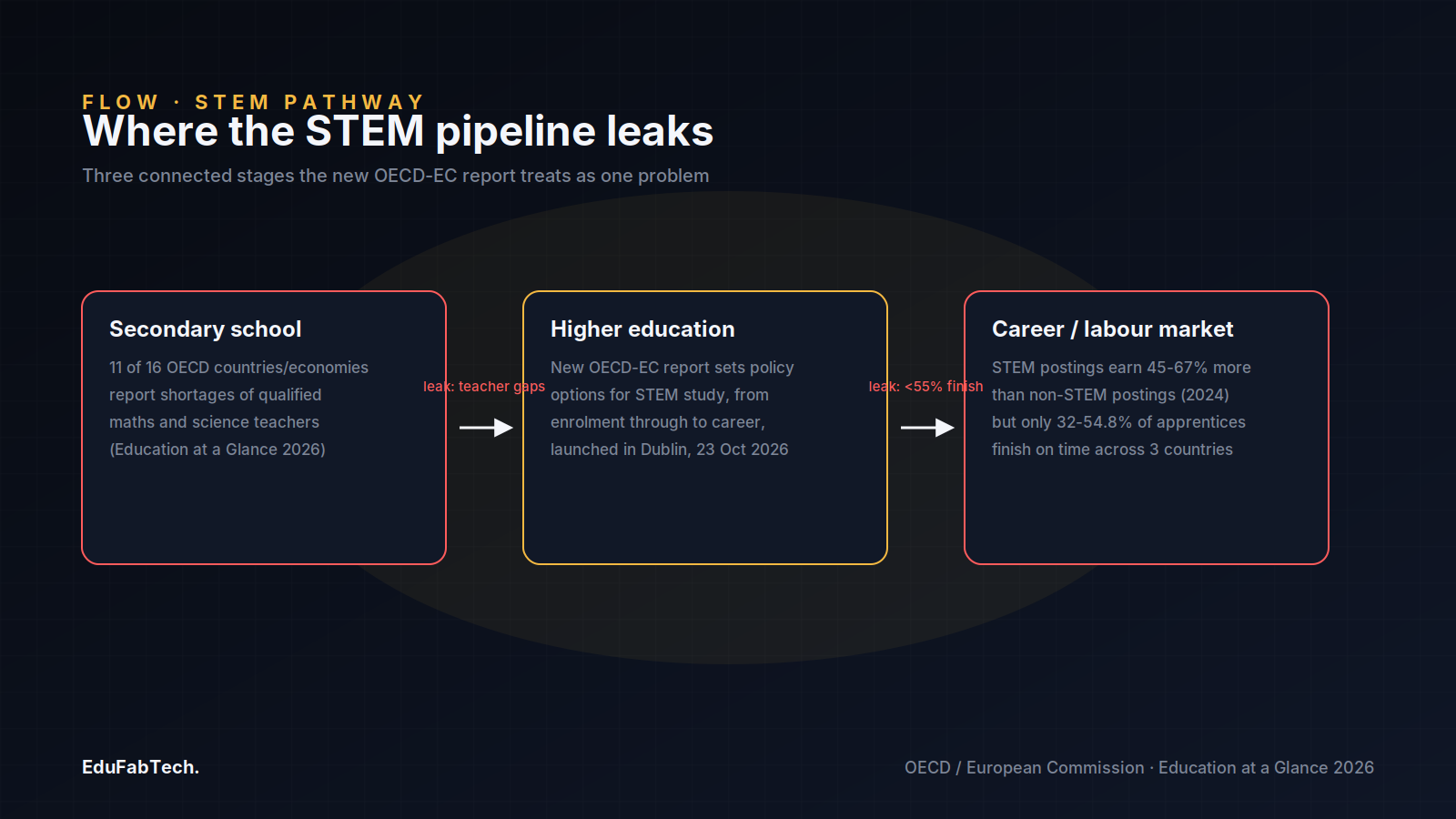
The new report responds to strains that show up well before students reach university. In the OECD's Education at a Glance 2026, 11 of the 16 countries and economies with available data reported shortages of fully qualified mathematics and science teachers at secondary level, the OECD found.
That shortage matters for the pipeline the Dublin report is meant to repair: if secondary schools cannot staff mathematics and science classes, fewer students arrive at university ready, or willing, to choose a STEM degree in the first place.
What employers are already asking for
A separate OECD working paper gives a sense of what advanced STEM skills look like once students reach the labour market. Analysing 2024 online job-vacancy data from the analytics firm Lightcast, the OECD's Małgorzata Kuczera and Marta Bernardi, a research associate at Dresden University of Technology, found that STEM job postings made up 9% of all vacancies in the United Kingdom, 8% in Australia and 6% in Canada that year, while postings for occupations the paper classifies as green ranged from about 22% of all postings in Australia and the United Kingdom to 25% in Canada.
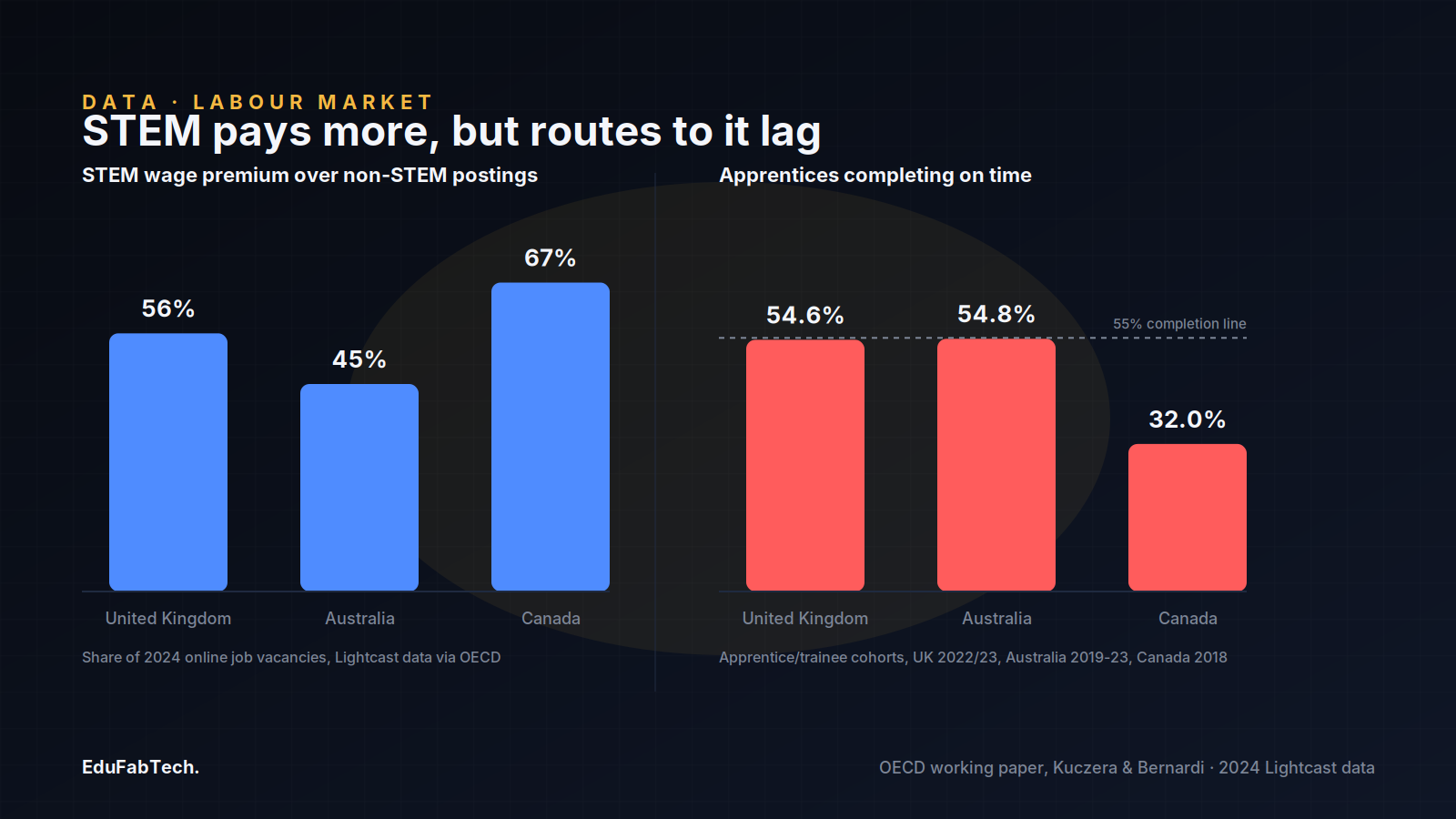
Employers paid clearly for STEM skills: the wage premium on STEM job postings over non-STEM ones in 2024 ranged from 45% in Australia to 56% in the United Kingdom and 67% in Canada, the paper found. Within green occupations, STEM requirements overlapped most with the newest, most technologically complex jobs in the United Kingdom, where 46% of postings for what the paper calls "New Green" roles also required STEM skills, compared with 37% in Canada and 35% in Australia.
Vocational routes into these jobs are not filling reliably. The same paper found that only 32% of Canadian apprentices obtained a certificate within 1.5 times the expected programme duration, based on 2018 data from Statistics Canada, while 54.8% of Australians who began an apprenticeship or traineeship in 2019 had completed it by the end of 2023, and 54.6% of UK apprentices expected to finish in the 2022/23 academic year actually did so, according to figures from Australia's NCVER and the UK Parliament cited in the paper.
What it means for students and researchers
For prospective STEM students, the Dublin report signals that the OECD and the European Commission are treating enrolment, completion and career progression as one connected problem rather than separate issues, the Irish department said. For researchers studying skills systems, the working paper's country comparisons point to where more study could help: apprenticeships and vocational routes already carry a large share of STEM-adjacent hiring in Canada, Australia and the United Kingdom, yet with completion running below 55% in two of the three countries, strengthening that pipeline may matter as much as the new report's focus on university-level STEM study.
A quick question for readers
Are group projects good for learning?
Loved by some, dreaded by many. What is your real experience?
Pick an answer, create a free account in a minute, and your vote counts. Already a member? Sign in
Comments 3
Comment-
Funny that the headline report is aimed at universities when the paper's own numbers point lower down the pipeline. Only 32% of Canadian app…
-
The apprenticeship numbers are the real story buried under the university framing: 32% of Canadian apprentices finished within 1.5x the expe…
-
The apprenticeship numbers are the bit worth sitting with longer than the report probably wants you to: 32% of Canadian apprentices finished…
Join free to read the full comments and reply Comments are between members; an account takes a minute.
Source: Department of Further and Higher Education, Research, Innovation and Science (Ireland)
Sources (3)
- Department of Further and Higher Education, Research, Innovation and Science. Ireland hosts launch of OECD-European Commission report on Advanced STEM Skills at DG HE meeting. Government of Ireland, 2026. gov.ie ↗ · checked 23 Oct 2026
- Kuczera, M. and Bernardi, M.. Vocational education and training (VET), green and STEM jobs: Insights from job vacancy data. OECD Social, Employment and Migration Working Papers No. 331, OECD Publishing, 2026. doi.org ↗ · checked 23 Oct 2026
- OECD. Education at a Glance 2026: OECD Indicators. OECD Publishing, 2026. doi.org ↗ · checked 23 Oct 2026