OECD's First Skills-First Index Finds No Country Has Fully Moved Past Degree-Based Hiring
A new cross-country index measures how far labour markets have shifted from degrees toward skills, while separate hiring data show the shift is uneven and, in the United States, partly stalled.
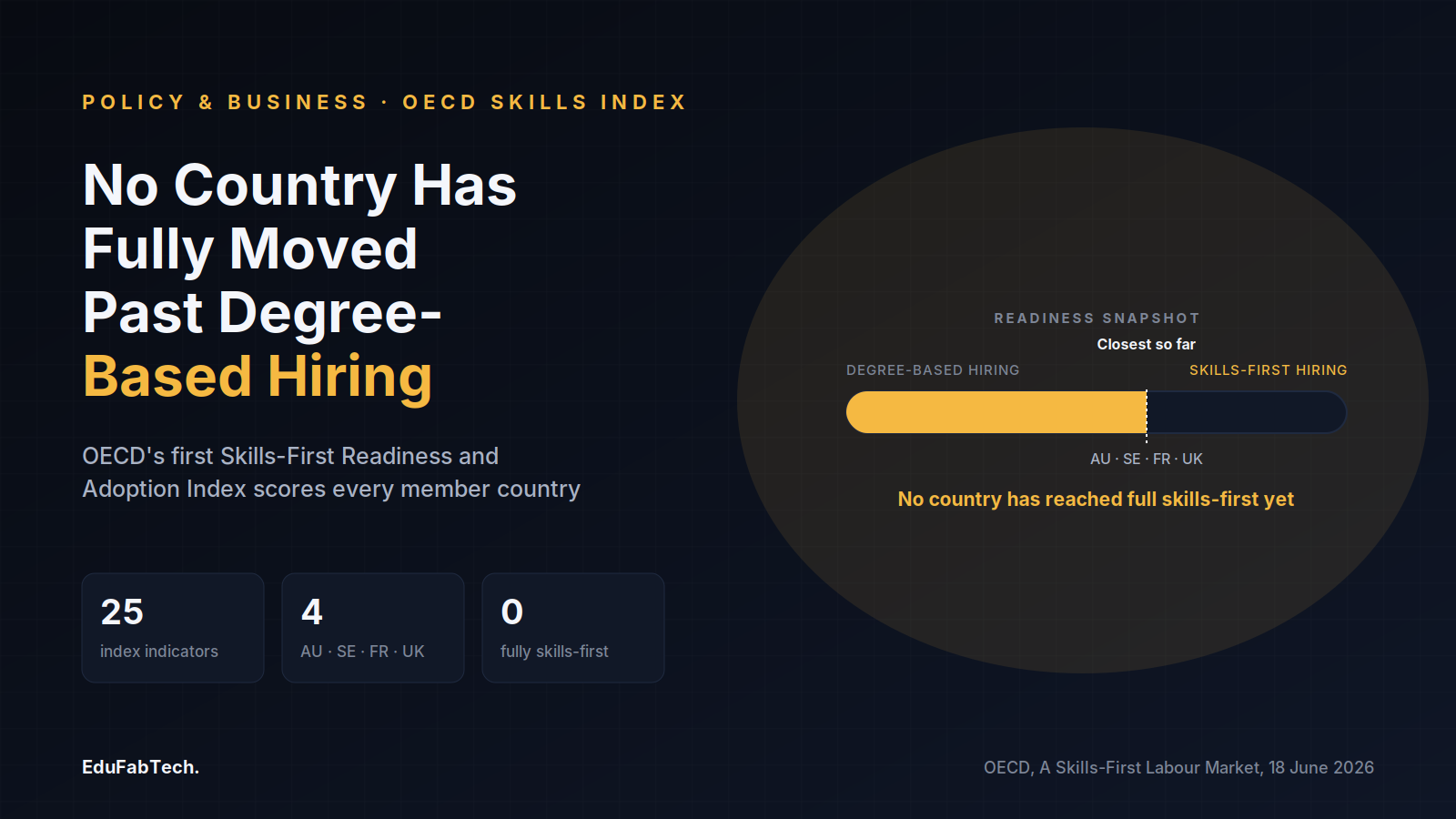
On 18 June 2026, the OECD published "A Skills-First Labour Market", the first report to systematically measure, across its member countries and Singapore, how far labour markets have actually moved from hiring on degrees toward hiring on demonstrated skills. The headline finding is a caution against overstatement: the OECD writes that no country has yet fully implemented a coherent skills-first system, even though most have built at least some of the pieces.
"Skills-first" is the OECD's term for treating formal qualifications as one signal among several, rather than as a gatekeeping requirement, and for building the infrastructure — shared skills vocabularies, recognition procedures, data systems — needed to let people show what they can do independent of where they studied. To measure progress toward that, the report introduces the Skills-First Readiness and Adoption Index, a composite built from 25 indicators grouped into three sub-indices covering skills development, recognition mechanisms, and the enabling conditions — governance, data, employer practice — that connect the two.
Across the countries with available data, Australia, Sweden, France and the United Kingdom emerge as the closest to frontrunners on the composite score, combining relatively strong skills-focused learning systems with more developed recognition mechanisms. But the OECD is explicit that no single country leads on every dimension — a country with strong credential-recognition infrastructure may still lag on employer adoption, and vice versa.
Where employers and jobseekers don't line up
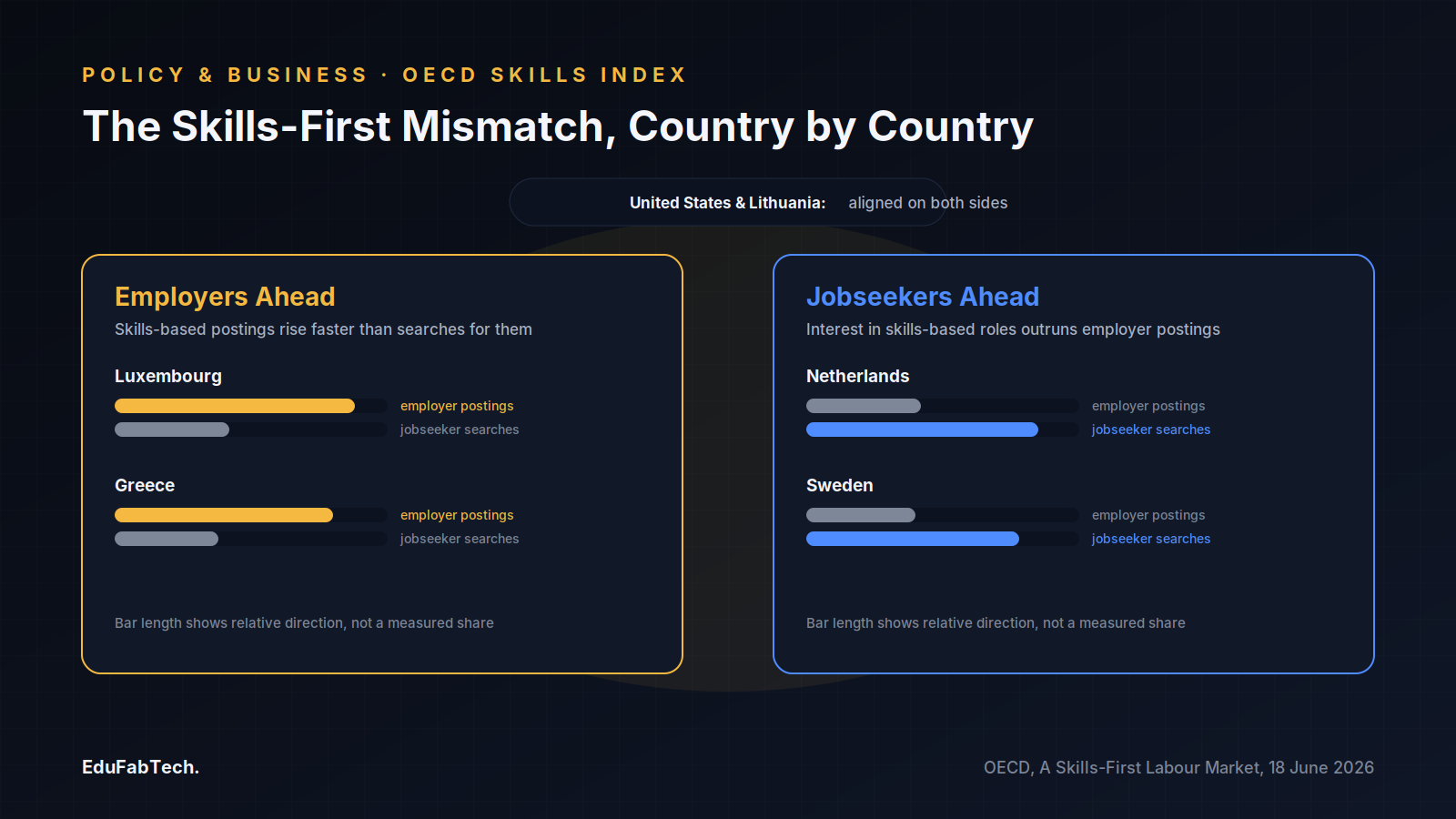
One of the report's more granular findings is a mismatch, country by country, between how much employers are posting skills-based vacancies and how much jobseekers are actually searching that way. In the United States and Lithuania, the OECD finds employer demand for skills-based hiring aligned with jobseeker interest. In Luxembourg and Greece, employers are ahead of jobseekers — skills-based postings are rising faster than searches for them. In the Netherlands and Sweden, the pattern reverses: jobseeker interest in skills-based roles runs ahead of what employers are posting.
How the recognition side is being built
The report catalogues how individual countries are building the machinery to validate skills gained outside formal education. In Czechia, the national system for recognising non-formal and informal learning runs through the National Register of Qualifications, which lists around 1,500 full and partial vocational qualifications. In India, a recognition-of-prior-learning framework operating under the country's national skill certification scheme draws on the National Skills Qualification Framework and National Occupational Standards. In France, the occupational classification system ROME — maintained by the public employment service France Travail — was substantially revised into ROME 4.0 in 2023 to describe jobs in terms of skills rather than job titles alone.
On the employer side, the OECD cites IBM's roughly decade-long shift in its US hiring: more than half of the company's current US job postings no longer require a college degree, and about one-fifth of its American hires now lack a college qualification. The OECD is careful to frame this as one company's experience rather than a general trend, noting separately that removing a degree requirement from a job posting does not, by itself, reliably expand hiring to people without degrees.
What independent hiring data show
That caveat is backed by research the OECD report draws on. A 2025 study by Harvard Business School and the Burning Glass Institute tracked companies that had publicly dropped degree requirements and found the change was mostly nominal: only 37% of those companies went on to meaningfully increase their share of non-degree hires, by an average of 18 percentage points, while most of the rest showed little change in who actually got hired. Across all the firms the researchers examined, fewer than 1 in 700 new hires could be attributed to the reforms.
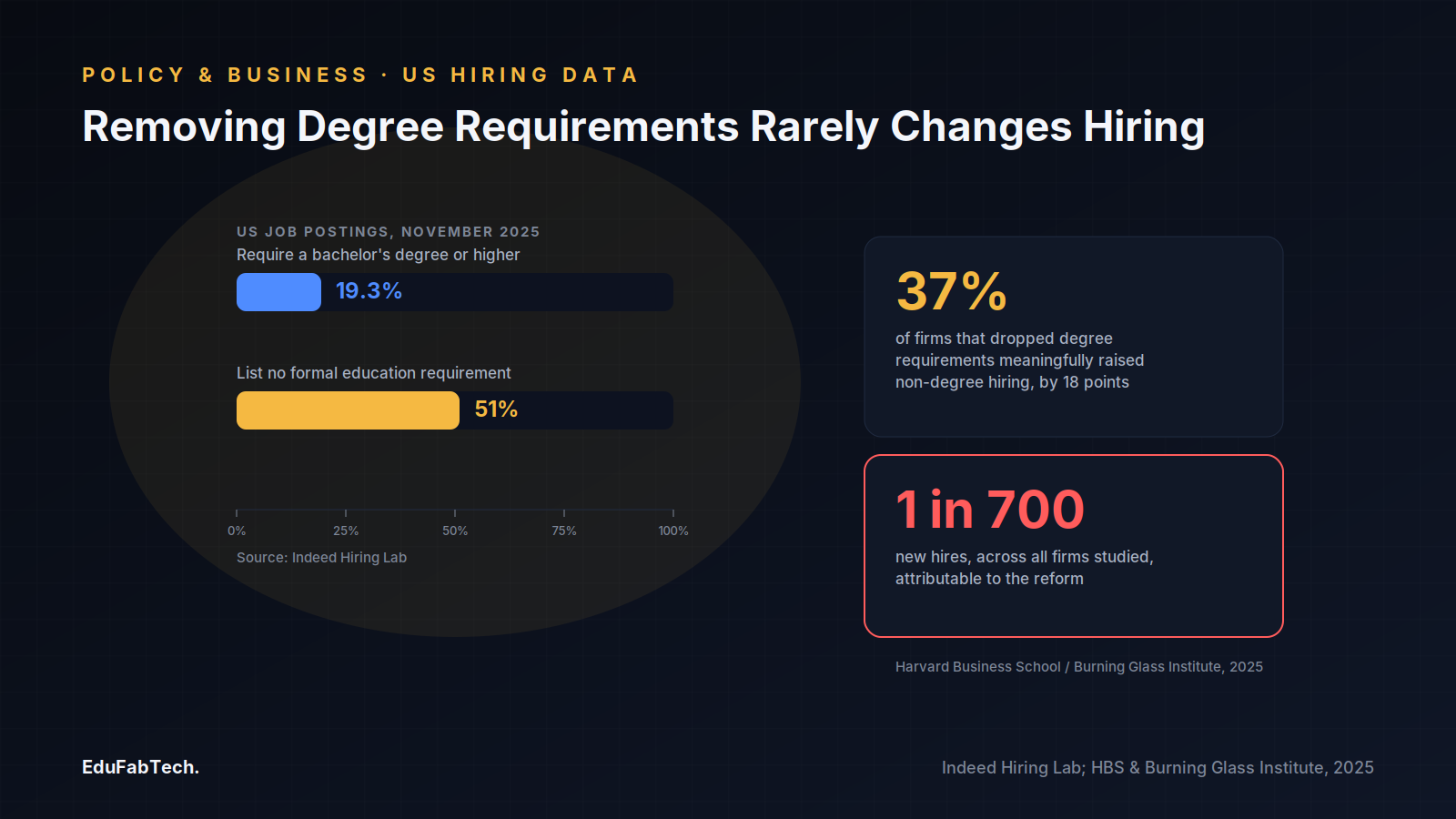
US data from early 2026 point the same way. According to Indeed Hiring Lab, 19.3% of US job postings on the platform required a bachelor's degree or higher as of November 2025, even as 51% of postings listed no formal education requirement at all — a reminder that "no degree required" and "skills-first" are not the same thing, and that aggregate postings data can move in directions the policy conversation doesn't anticipate.
What the index is for
Taken together, the OECD's report supplies something that discussions of skills-based hiring have mostly lacked: a repeatable, cross-country way to track whether recognition systems, employer practice and jobseeker behaviour are actually moving together, rather than three separate conversations. The early scores suggest they mostly are not yet — which is consistent with the OECD's own conclusion that skills-first labour markets remain, everywhere it looked, a work in progress rather than an achieved state.
- OECD. A Skills-First Labour Market. OECD Publishing, 2026. doi:10.1787/2e1b85f0-en
- Digital Skills and Jobs Platform. A Skills-First Labour Market. European Commission, 2026. link
- Joseph Fuller et al.. Skills-Based Hiring: The Long Road from Pronouncements to Practice. Harvard Business School / Burning Glass Institute, 2025. link
- Sneha Puri. Where Do College Degrees Still Matter in a "Skills-First" Job Market?. Indeed Hiring Lab, 2026. link