OECD Finds Vocational Training Data Too Patchy to Track Who Is Being Trained for Green Jobs
A September 2026 OECD policy brief maps technical and vocational education data across the world and finds most countries still cannot say whether their training systems are keeping pace with green and STEM job growth.
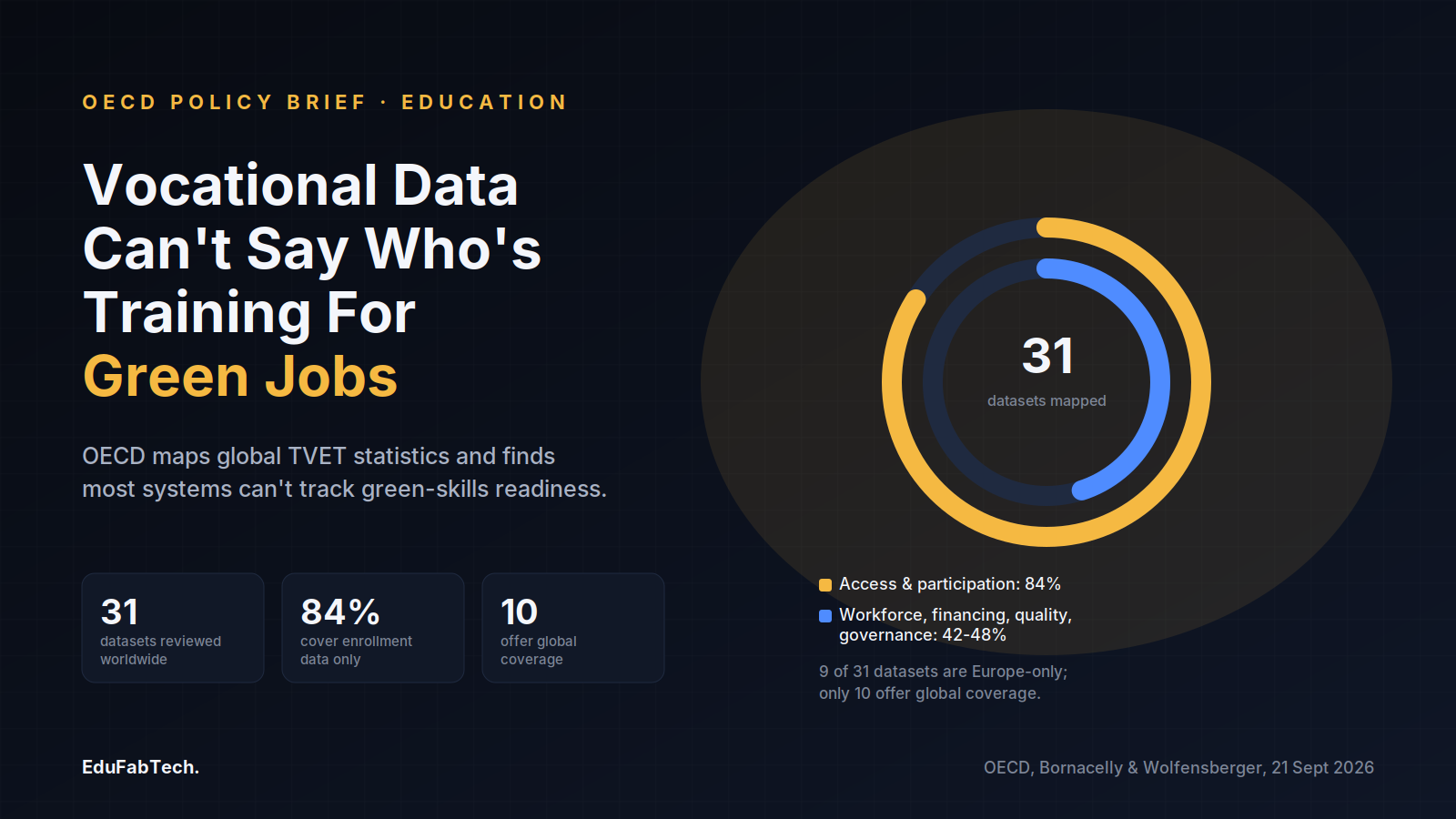
On 21 September 2026, the OECD published a policy brief with an unglamorous title and an uncomfortable conclusion: after years of effort to measure technical and vocational education and training (TVET) around the world, policymakers still cannot reliably answer basic questions about who is enrolled, what they learn, or whether it leads to work. The brief, written by Iván Bornacelly and Mere Wolfensberger, arrives as vocational systems everywhere are being asked to retrain workers for a labour market reshaped by the shift to low-carbon energy and automation.
The OECD's own mapping, cited in the brief, reviewed 31 international datasets that touch on vocational education. It found uneven coverage: 84% of the datasets capture basic access and participation figures, such as enrolment, but only 42-48% cover workforce, financing, quality or governance indicators — the kinds of measures a ministry would actually need to decide where to put money. Nine of the 31 datasets focus exclusively on Europe, and only 10 offer anything close to global coverage, leaving large gaps across Asia-Pacific and Sub-Saharan Africa.
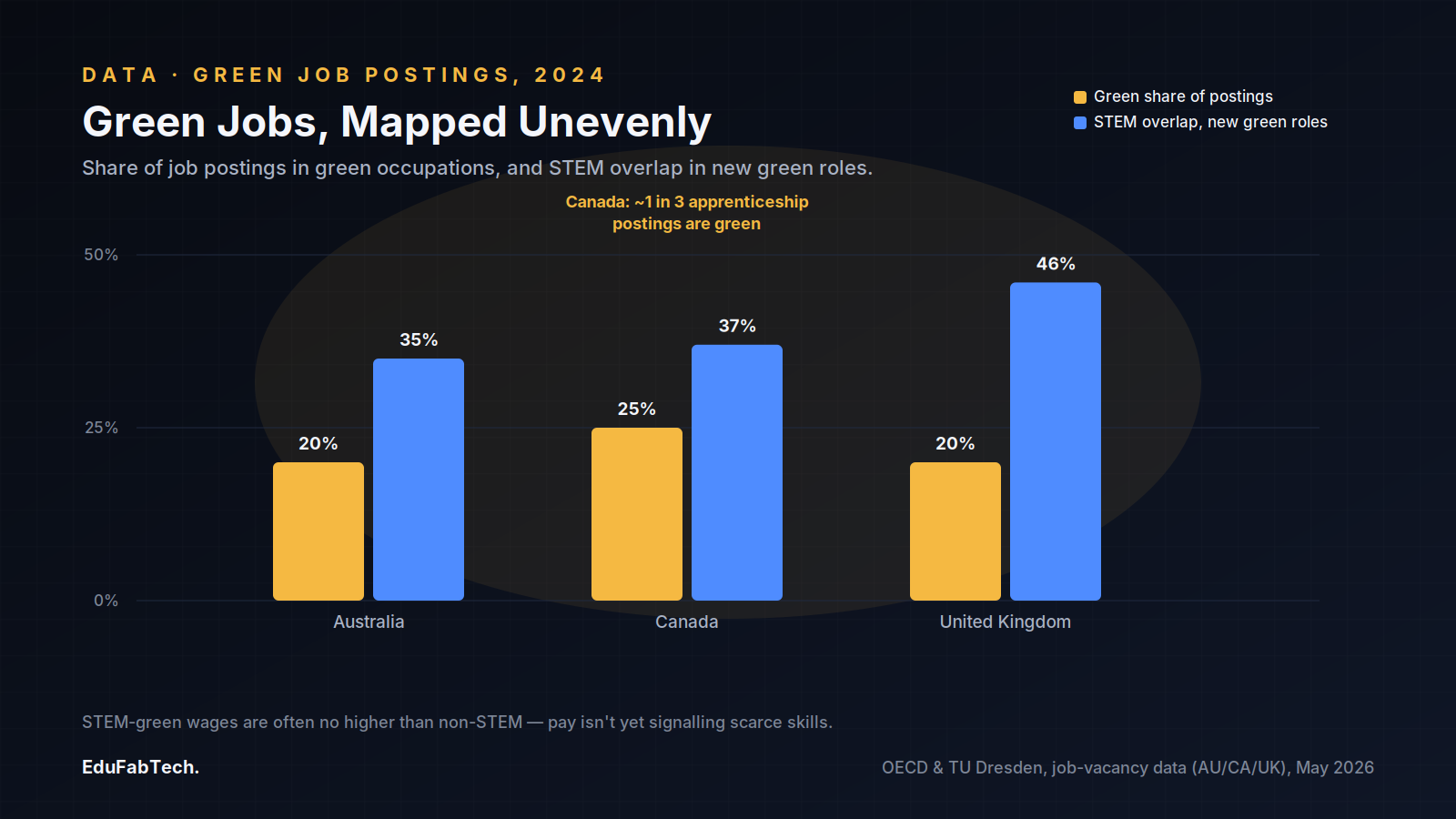
That matters because vocational training is increasingly where climate and labour policy meet. A separate OECD working paper published in May 2026 used online job-vacancy data from Australia, Canada and the United Kingdom and found that green occupations accounted for roughly a quarter of all job postings in Canada and about one-fifth in Australia and the UK during 2024. In Canada, the paper found, nearly one in three apprenticeship postings was for a green occupation.
What the numbers already show
Where data does exist, it suggests vocational graduates are already deeply embedded in the green economy, just unevenly so. A 2025 OECD working paper using European Union Labour Force Survey data from 2014 to 2022 found that 24% of upper-secondary vocational graduates under 35 worked in "green-driven" occupations, compared with 19% of their peers overall. The same paper found that only 2.2% of upper-secondary vocational graduates worked in newly created green roles, such as hydrogen-vehicle conversion, ranging from 1.2% in Greece to 3.2% in Estonia, and that green-driven employment among vocational graduates ranged from 15% in Greece to 30% in Lithuania and Estonia.
The May 2026 job-postings paper, co-authored with Dresden University of Technology, also found that new green roles overlap heavily with STEM skills — 35% in Australia, 37% in Canada and 46% in the United Kingdom — but that wages for these STEM-green jobs were often no higher than for non-STEM equivalents, which the authors read as a sign that pay is not yet signalling where the hardest-to-fill skills are.
These findings exist because three research teams built bespoke datasets for a single study each. The September 2026 brief argues that is the wrong way to run a global monitoring effort: one-off research projects cannot substitute for routine national statistics that can be compared year to year and country to country.
Why the gaps persist, country by country
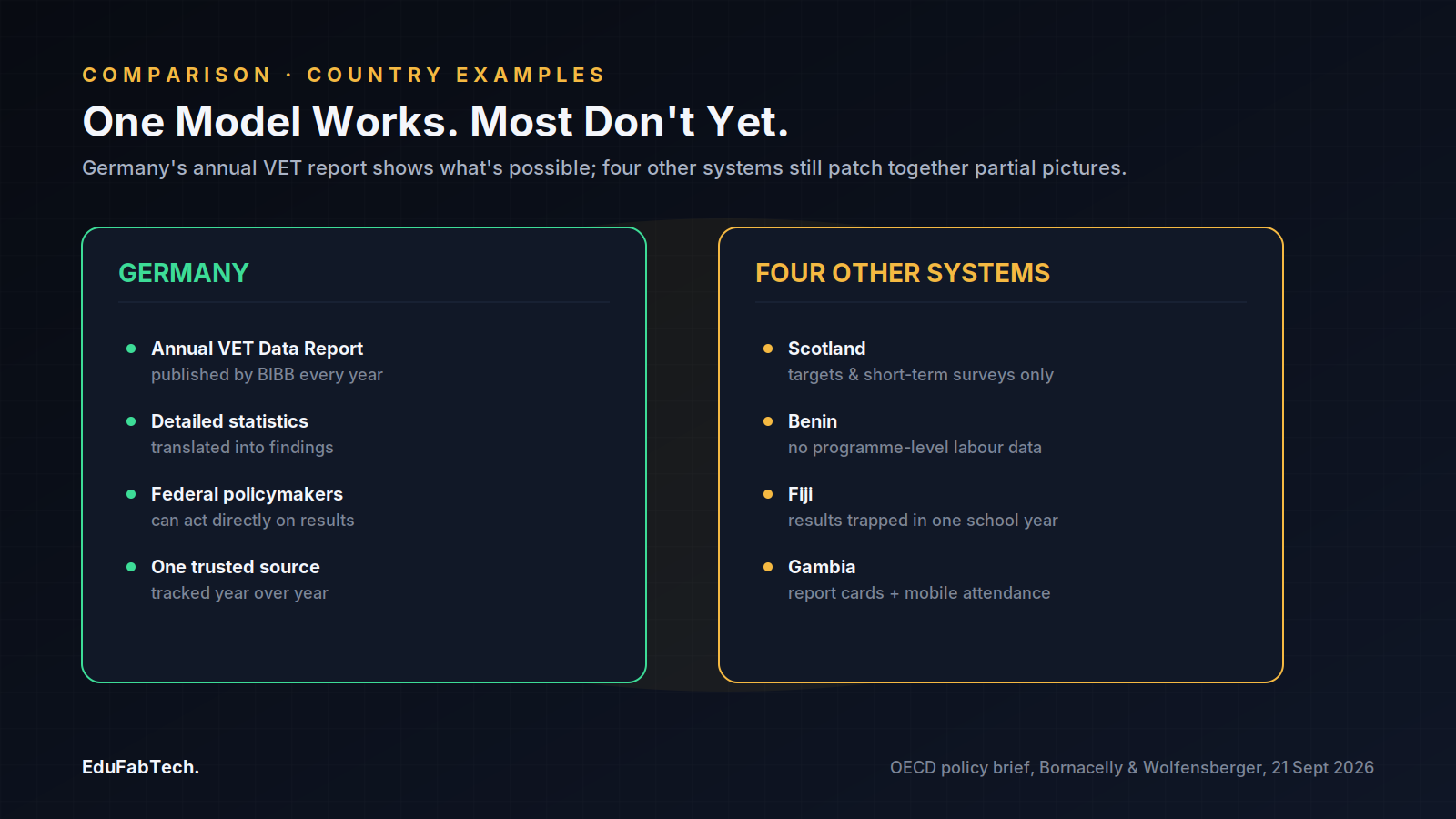
The brief sets out five recurring barriers — data that doesn't match policy questions, inconsistent access across platforms, fragmented responsibility between agencies, thin analytical capacity, and labels that look identical but measure different things — and illustrates them with examples drawn from countries at very different income levels:
- Scotland monitors apprenticeships mainly through participation targets and short-term, self-reported outcomes rather than data linked to tax or benefits records.
- Benin lacks programme-level labour-market data, making it impossible to estimate the economic return on technical secondary education.
- Fiji tracks learners through an education management information system that reports results only within the same academic year.
- The Gambia combines school report cards, stakeholder reviews and mobile attendance reporting adapted to limited connectivity.
- Germany is held up as a comparative success: the Federal Institute for Vocational Education and Training (BIBB) publishes an annual VET Data Report that translates detailed statistics into findings federal policymakers can act on.
What the OECD is proposing
The brief's recommendations echo the structure that already exists for school and university statistics: agree on a minimum set of indicators covering participation, completion, work-based learning, employment outcomes, financing and the teaching workforce, modelled on the joint UNESCO-OECD-Eurostat data collection used for mainstream education. It also calls for shared classifications and learner identifiers that would let researchers link training records to employment outcomes, pointing to England's Longitudinal Education Outcomes dataset as a working example, and sustained statistical capacity-building rather than one-off training exercises.
The brief is explicitly framed as groundwork for a larger effort, the Global Technical and Vocational Education and Training Data Report, an OECD project developed with the UNESCO International Centre for Technical and Vocational Education and Training (UNESCO-UNEVOC). Its findings will determine whether the next round of research on green and digital skills can draw on comparable national statistics, or whether it will again have to be built, country by country, from scratch.
A quick question for readers
Have you thought about studying abroad?
The answers show what really stops students — cost, language or something else.
Pick an answer, create a free account in a minute, and your vote counts. Already a member? Sign in
- Iván Bornacelly and Mere Wolfensberger. Making Comparable TVET Data Work for Evidence-Informed Policymaking. OECD, 2026. doi:10.1787/e0e154a3-en
- Małgorzata Kuczera. Vocational Education and Training (VET) and the Green Transition: Insights from Labour Market Data. OECD Social, Employment and Migration Working Papers No. 327, 2025. doi:10.1787/02b7fcb1-en
- Małgorzata Kuczera and Marta Bernardi. Vocational Education and Training (VET), Green and STEM Jobs: Insights from Job Vacancy Data. OECD Social, Employment and Migration Working Papers No. 331, 2026. doi:10.1787/03944cd5-en
- OECD. Global Technical and Vocational Education and Training Data Report (project page). OECD, 2026. link
- Devdiscourse. Green and STEM Jobs Surge as OECD Calls for Urgent Skills and Training Reform. Devdiscourse, 2026. link