Three 2026 Reports Find Research-Funder Open-Access Mandates Spreading, but Adoption Still Splits Sharply by Region
A 26-million-paper bibliometric study, a funder policy survey and a European Commission review, all published in 2026, agree that open-access mandates are multiplying while compliance and infrastructure still lag outside Europe.
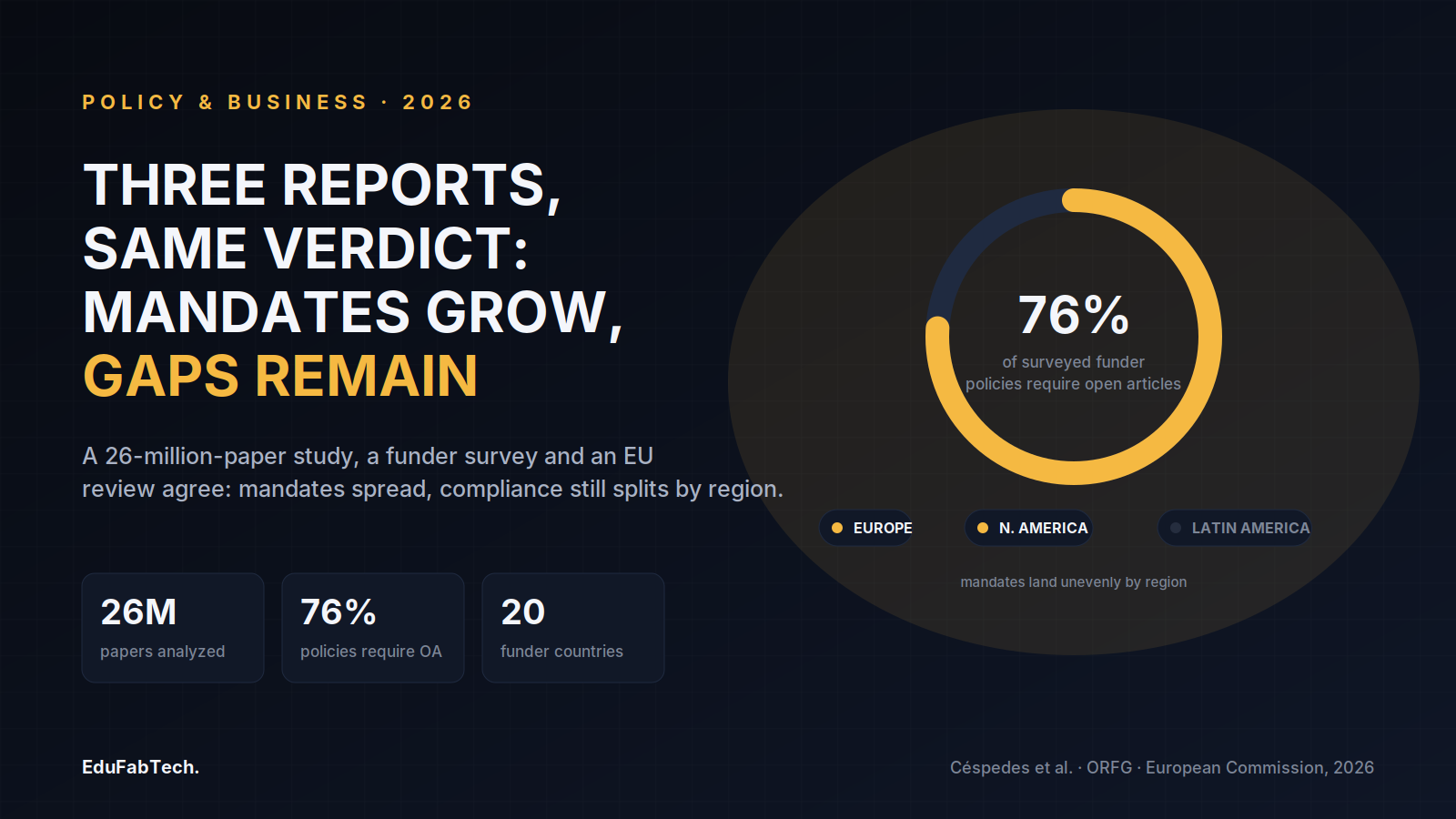
Three reports published within months of each other in 2026 converge on the same conclusion from three different angles: research funders around the world are writing open-access requirements into their grant terms faster than ever, but where a paper gets published, and whether anyone can actually find it, still depends heavily on which country funded the research.
The most detailed picture comes from a bibliometric study by Céspedes, Hare, van Bellen, Mongeon and Larivière, posted to arXiv in 2026. The authors traced 5 million papers supported by 36 funders across 20 countries, alongside 11 million papers funded by other organisations and 10 million papers with no funding reported at all — 26 million papers in total. Funded papers, they found, are consistently more likely to be openly available than unfunded ones, and open access overall keeps growing, driven mainly by gold and hybrid models rather than the older green route of self-archiving in repositories.
The study credits two mechanisms for most of that growth: Plan S, the funder coalition that requires immediate open access to publicly funded research, and read-and-publish agreements negotiated between library consortia and publishers. Both, the authors note, have had their strongest effect among European funders specifically — which is also where most of the 36 funders in the sample are based.
Where the mandates don't reach
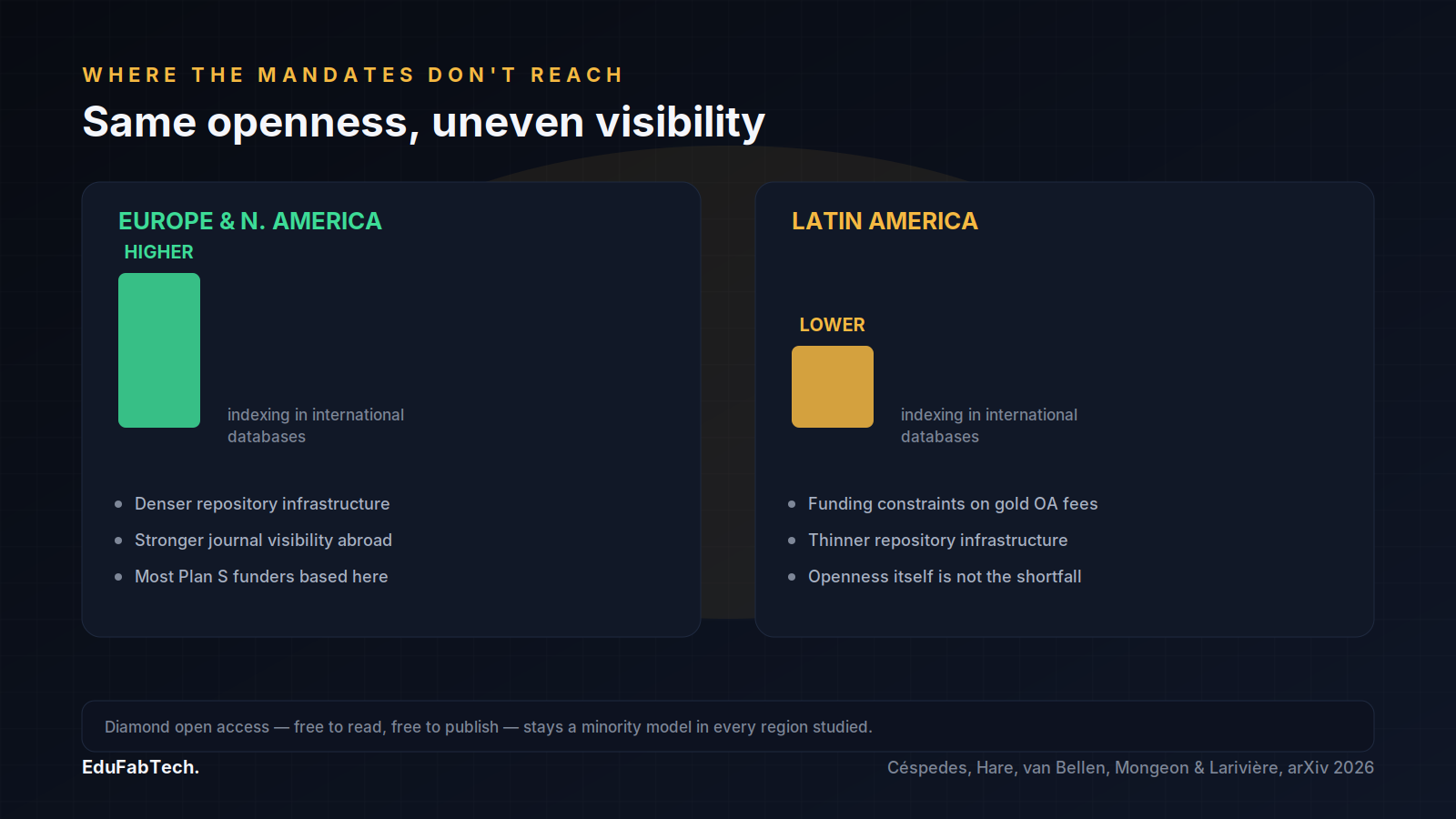
The same study flags two persistent gaps. Diamond open access — journals that charge neither readers nor authors — remains a minority model everywhere, despite being the version of open access least dependent on a funder's budget. And open-access papers from Latin American countries are indexed in international databases at consistently lower rates than comparable output from Europe or North America, a gap the authors attribute to funding constraints, weaker journal visibility, and thinner repository infrastructure rather than to lower actual openness.
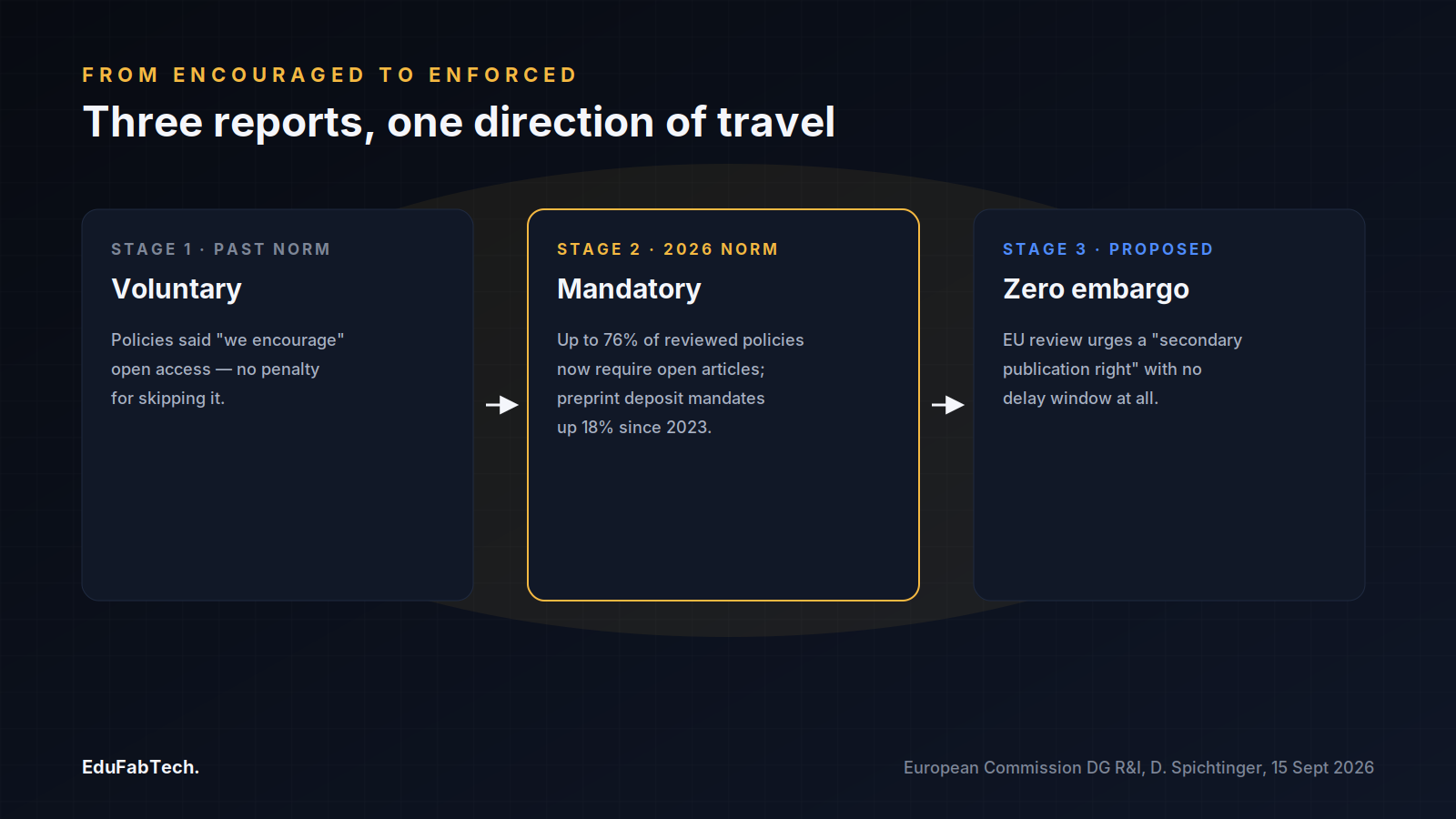
A separate analysis from the Open Research Funders Group, examining the policies of 39 funders and published as a full report on Zenodo in 2026, found the same shift toward stricter terms. Requirements for open articles now appear in up to 76% of the policies it reviewed, and mandatory preprint deposit has risen by 18% since the group's previous analysis in 2023. Voluntary "we encourage" language, in other words, is being replaced by contractual obligation.
What funders are being told to fix next
The Open Research Funders Group's report does not stop at describing the trend — it recommends five changes for funders still finalising 2026-era policy:
- Eliminate embargo periods on deposited manuscripts entirely, rather than allowing publishers a delay window
- Fund and partner with open infrastructure providers instead of relying solely on commercial repositories
- Expand data management plan requirements alongside article-level mandates
- Accelerate preprint adoption deliberately, rather than treating it as a secondary channel
- Build incentives and workflows that make compliance easy, not just contractually required
That last point echoes what the bibliometric study found on the ground: a mandate on paper does not guarantee compliance, which the authors show varies by discipline, by how closely a funder monitors it, and by whether researchers in a given country have a repository to deposit into.
Europe's own audit reaches the same verdict
A third report, commissioned by the European Commission's Directorate-General for Research and Innovation and published on 15 September 2026, reviewed open-access policy across all 27 EU member states plus eight non-EU countries, including the United Kingdom, the United States, China and Japan. Its author, Daniel Spichtinger, described progress across the European Research Area as "uneven and fragmented" despite a decade of EU-level measures, and recommended that policies combine national strategy, funder mandates and legislation rather than relying on any single instrument. The full report instead argues for a union-wide "secondary publication right" that would let researchers make their work openly available regardless of where it first appeared — and states that, to be effective, such a right should ultimately allow no embargo period at all between the original and the open publication.
Taken together, the three reports describe a policy landscape that has moved past the question of whether funders should mandate open access — most now do, in some form — and into a harder second problem: making that mandate mean the same thing regardless of which country's funding agency wrote the grant.
- Lucía Céspedes, Madelaine Hare, Simon van Bellen, Philippe Mongeon, Vincent Larivière. Funders' Open Access Mandates: Uneven Uptake and Challenging Models. arXiv preprint, 2026. link
- Open Research Funders Group. Funder Policy Landscape Report and Recommendations: 2026. Open Research Funders Group / Zenodo, 2026. doi:10.5281/zenodo.20451484
- Daniel Spichtinger. Open Access Policies in EU Member States and Beyond. Publications Office of the European Union, Directorate-General for Research and Innovation, European Commission, 2026. doi:10.2777/8921907
- European Commission, Directorate-General for Research and Innovation. Open Access in the European Research Area: Progress Remains Uneven as New Report Calls for More Concerted Action. European Commission, 2026. link