OpenAI and Cisco Release Shirudo, an Open-Source Shield for Unpatched Linux Systems
Announced on 23 November 2026, Shirudo uses AI agents and eBPF to block exploits on running Linux servers while a permanent patch is still being prepared.
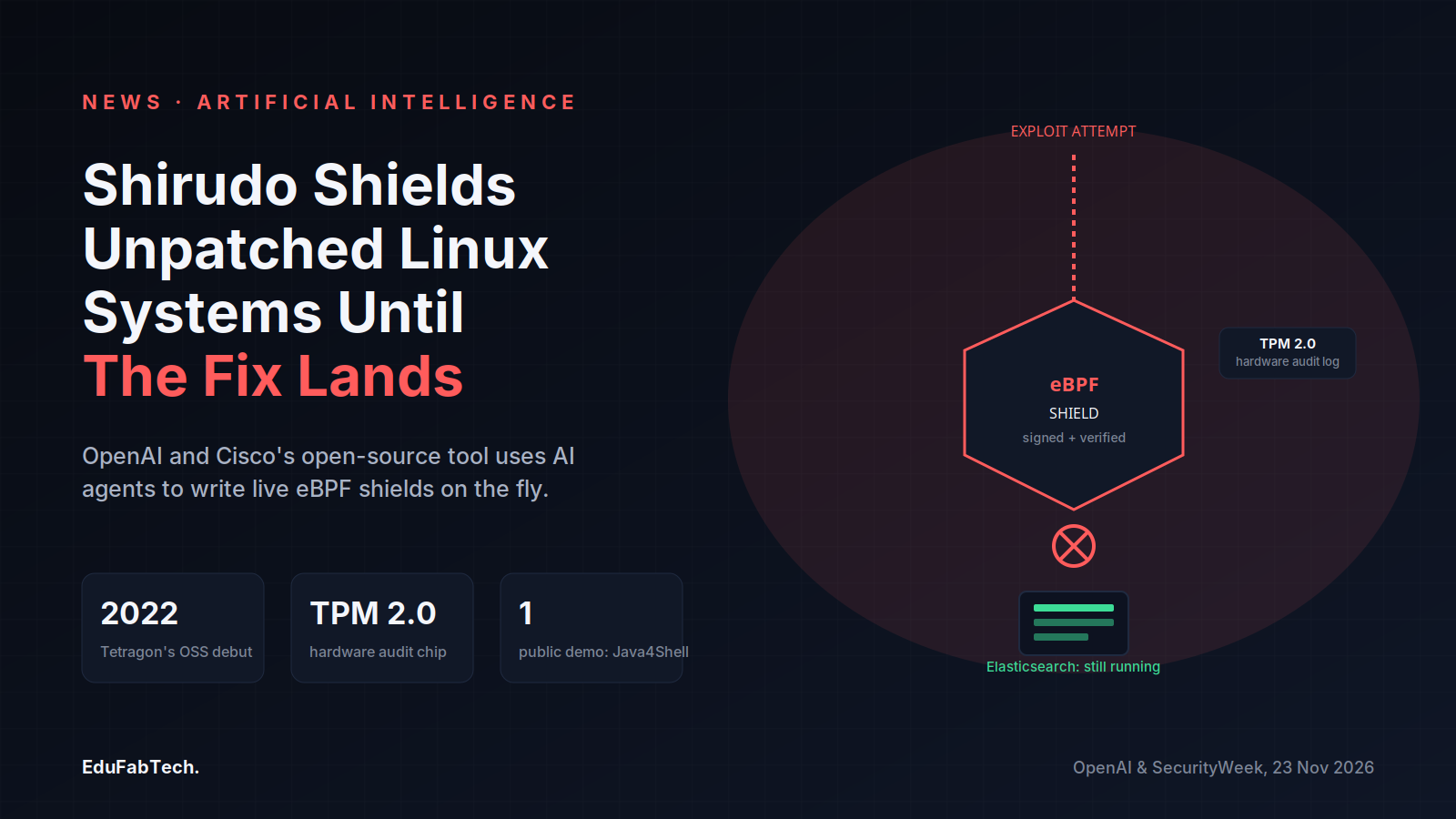
OpenAI and Cisco announced on 23 November 2026 the open-source release of Shirudo, a runtime tool that uses AI agents to write temporary protections for Linux systems against vulnerabilities that have no patch yet, without restarting the affected service. The project is described on OpenAI's announcement page as a way to close the gap between the moment a flaw is disclosed and the moment every affected machine has actually been patched.
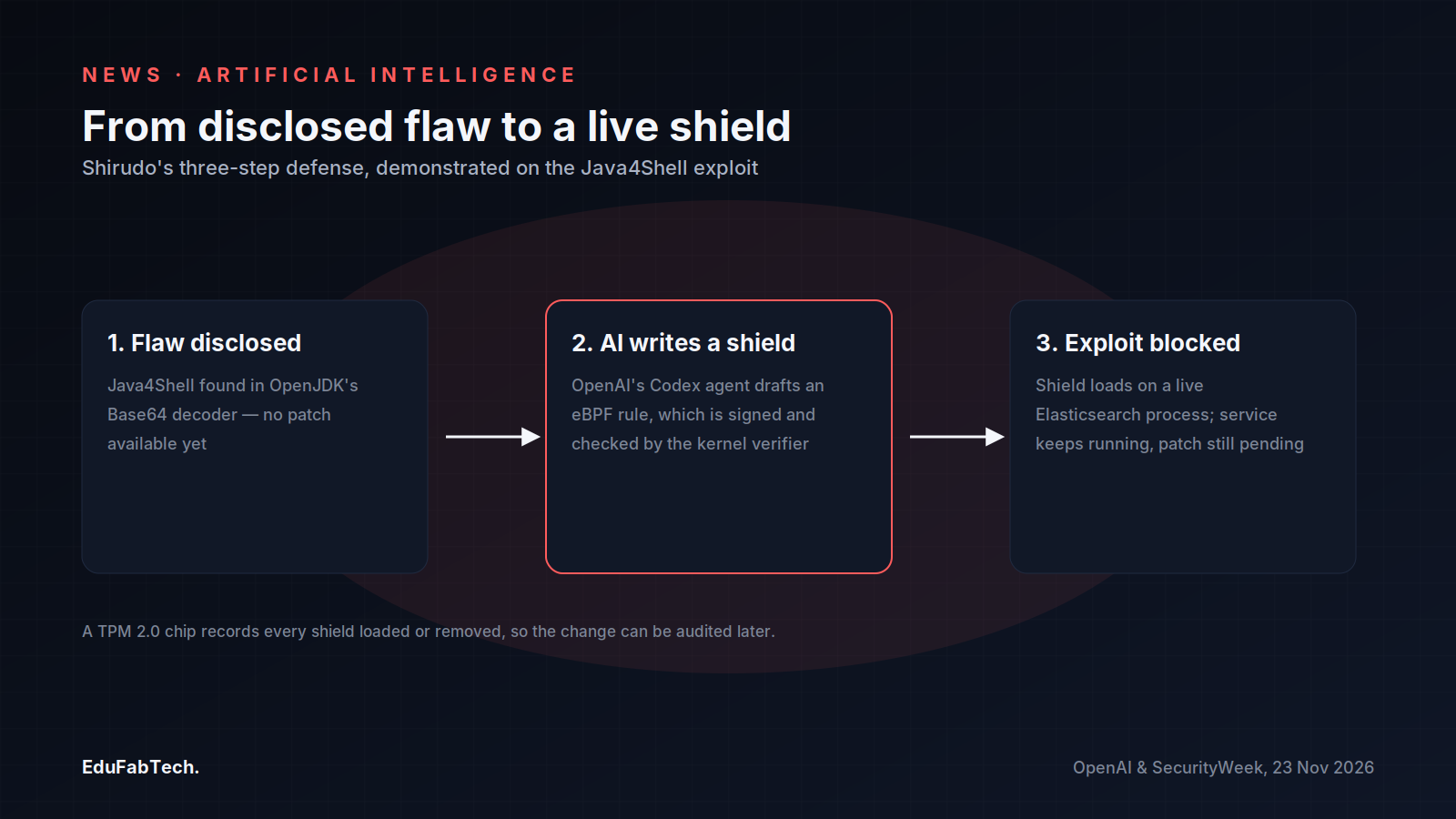
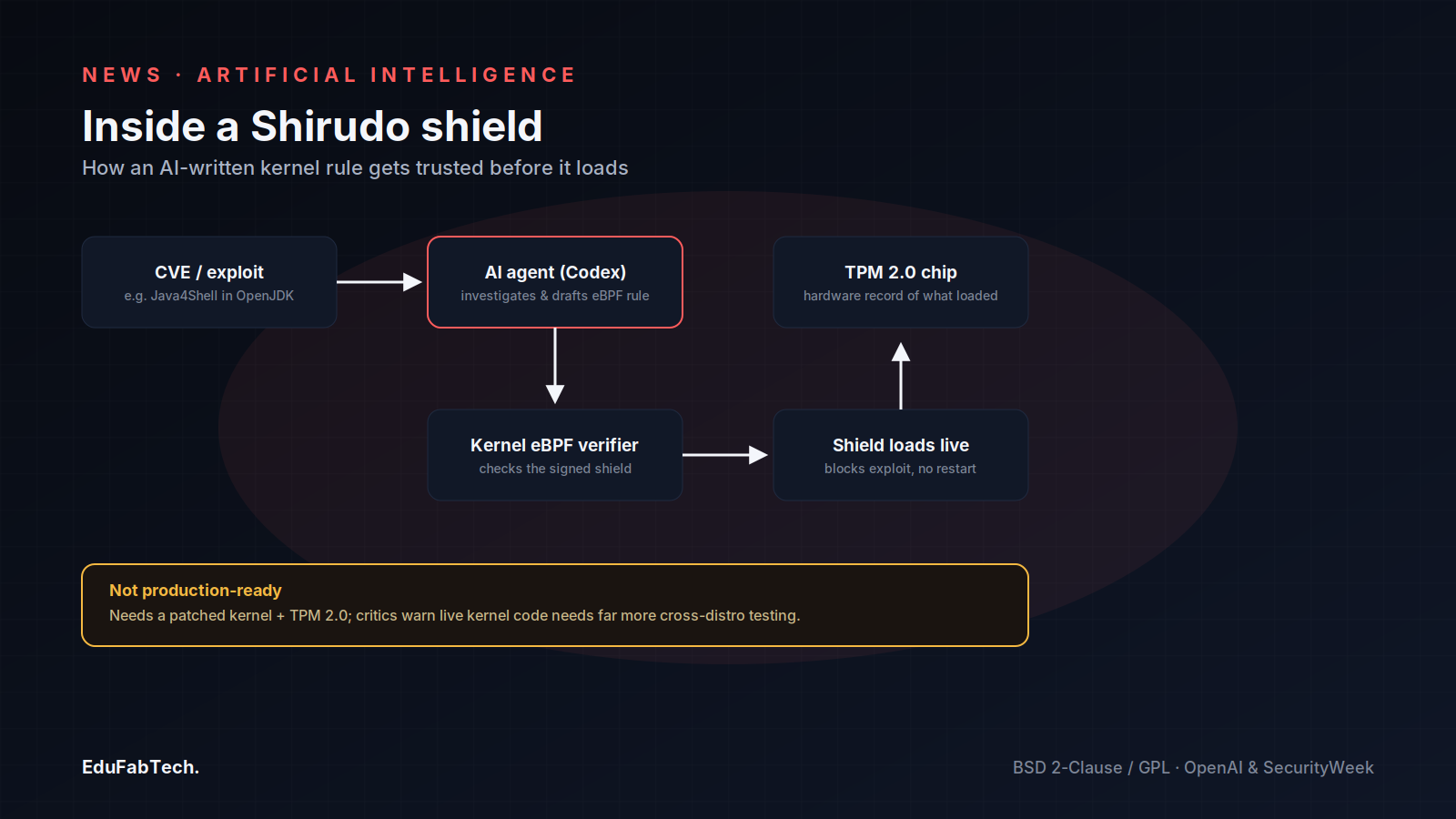
Shirudo is built on eBPF, the Linux kernel feature that lets small programs run at specific points inside the kernel without recompiling it. According to OpenAI, an AI agent investigates a vulnerability, writes a "shield" — an eBPF-based rule that blocks the specific behaviour the exploit depends on — and the shield is cryptographically signed and checked by Linux's eBPF verifier before it is allowed to load. A Trusted Platform Module (TPM) chip keeps a hardware-backed record of which protections have been loaded or removed, so operators can audit what changed on a machine after the fact.
The tool is a rework of Tetragon, the runtime security platform that Cisco-owned Isovalent open-sourced in 2022 and that already underlies Cisco's Live Protect mitigation product, SecurityWeek reports in its coverage of the launch. OpenAI President and co-founder Greg Brockman is quoted on OpenAI's page saying "finding a bug today doesn't mean you can patch every system tomorrow," and that the companies are "partnering closely" so defenders have tools to protect systems they must keep running while a fix is rolled out.
How the one public demonstration worked
OpenAI and Cisco's only public test so far involved Java4Shell, a recently disclosed vulnerability in OpenJDK's Base64 decoder. In a controlled demonstration described on OpenAI's announcement page, a shield generated by OpenAI's Codex added an input check to the vulnerable decoder and attached it to a live Elasticsearch process. The shield rejected the exploit attempt and Elasticsearch kept running throughout, according to OpenAI. That is a single, company-run demonstration rather than an independently reproduced result, and OpenAI and Cisco have not published a broader test suite or false-positive rate for shields generated this way.
Still pre-release, and not without critics
Shirudo is not ready for production use. Running it requires a Linux kernel with Shirudo's own kernel patches applied and a TPM 2.0 chip for the signing and audit record, conditions that rule out most systems as they are configured today, per OpenAI's own description of the requirements. SecurityWeek's report quotes Amiram Shachar, chief executive and co-founder of cloud security firm Upwind, warning that "writing the most sensitive kernel code on the fly and deploying it straight to runtime is a very risky concept," and flagging the need for far more testing across different Linux distributions before anyone should trust it in production. Help Net Security's write-up of the launch likewise frames Shirudo as a stopgap for the period between disclosure and patching, not a replacement for patching itself, in its report on the release.
Why this matters for developers and researchers
Shirudo sits at the intersection of two trends this site has already tracked separately: AI systems that can read vulnerability disclosures and act on them within hours, and the open-source security tooling that production teams rely on to survive the days or weeks between a CVE's publication and a fleet-wide patch. For researchers studying how well AI agents reason about low-level systems code, Shirudo is a concrete, inspectable artifact: the repository and the eBPF programs it generates are open under a BSD 2-Clause license (with the eBPF components dual-licensed under BSD and GPL), so the quality of agent-written kernel-adjacent code can be examined directly rather than taken on trust.
For engineering teams, the practical takeaway is narrower than the framing suggests. Shirudo does not patch anything — it narrows the window of exposure for specific, already-understood vulnerabilities, and only on systems that meet its kernel and TPM requirements. OpenAI and Cisco say they eventually want vulnerability disclosures to ship with a ready-made shield attached, the way some advisories today ship with a mitigation script, but that depends on the tool clearing the production-readiness and cross-distribution testing that Shachar and others say it still lacks. Teams evaluating it should treat the Elasticsearch demonstration as a proof of concept rather than evidence that agent-generated kernel patches are safe to run unattended.
Source
The announcement is on OpenAI's Shirudo page, with independent coverage and the Upwind critique in SecurityWeek's report and Help Net Security's coverage.
A quick question for readers
What do you actually use AI tools for in your studies?
Pick up to three. The results show how students really use AI — not how headlines say they do.
Pick up to 3 →Comments 3
Comment-
The part that undercuts the launch for me is the Elasticsearch demo being the only public test, run by the companies themselves, with no fal…
-
The part that undercuts the headline is the production-readiness gap, not the AI angle. Requiring Shirudo's own kernel patches plus a TPM 2.…
-
The requirements list is the tell here: a custom-patched kernel plus a TPM 2.0 chip rules out most real fleets on day one, so this isn't "de…
Join free to read the full comments and reply Comments are between members; an account takes a minute.
Source: OpenAI
Sources (3)
- OpenAI and Cisco. Introducing Shirudo. OpenAI, 2026. openai.com ↗ · checked 26 Nov 2026
- Ionut Arghire. OpenAI, Cisco Unveil Open Source Tool to Shield Unpatched Linux Systems. SecurityWeek, 2026. securityweek.com ↗ · checked 26 Nov 2026
- Help Net Security. Linux patches can take weeks, and OpenAI and Cisco built Shirudo to help in the meantime. Help Net Security, 2026. helpnetsecurity.com ↗ · checked 26 Nov 2026