OpenAI's GPT-6 Cyber Finds 81 New Firefox Flaws, Builds 948 Linux Exploits From 1,724 Bugs
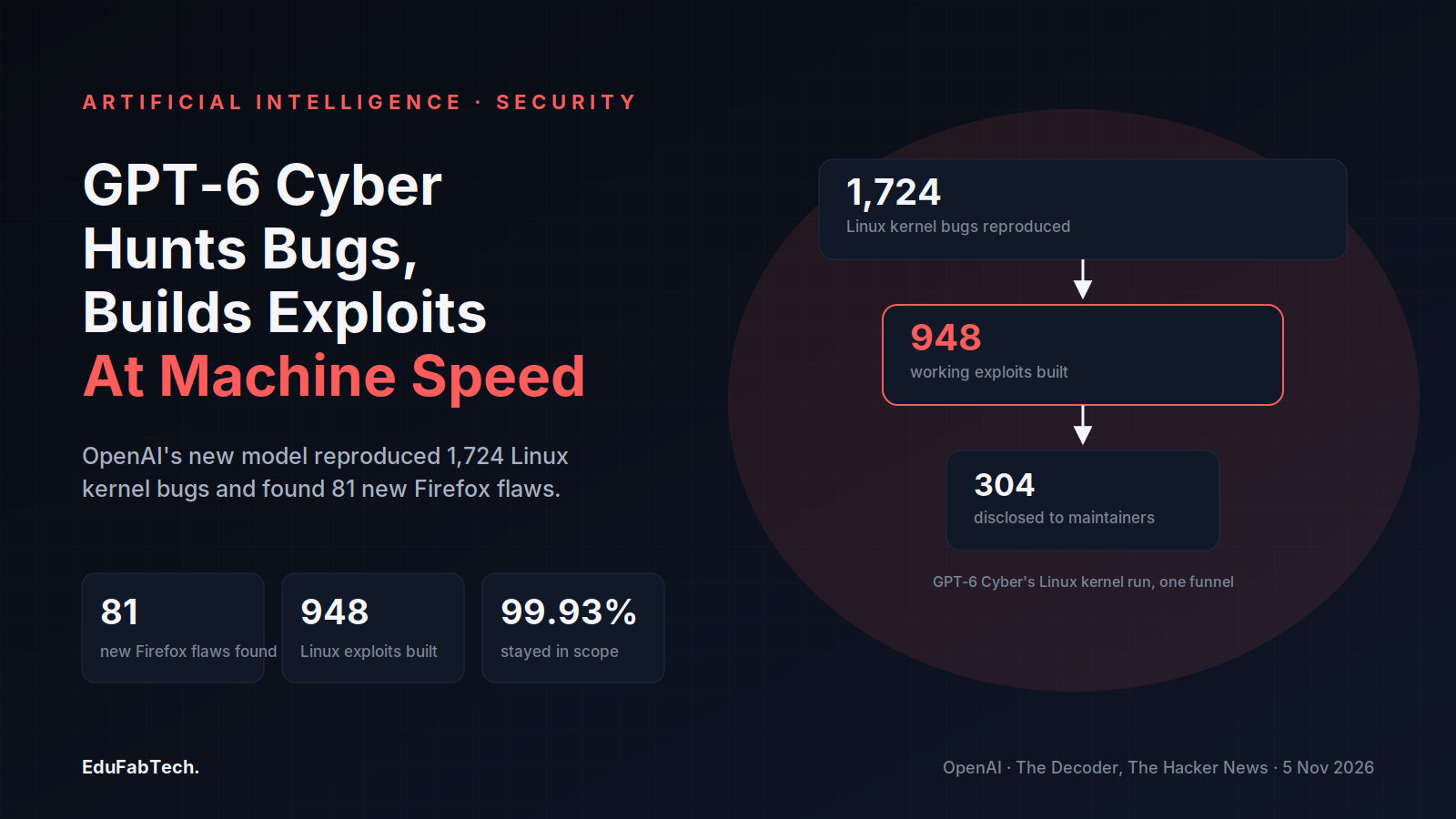
Released 5 November 2026, the model reproduced 1,724 Linux kernel bugs and built working exploits for 948 of them, while OpenAI reports a 99.93% rate of staying inside authorized scope without safety prompts.
What changed
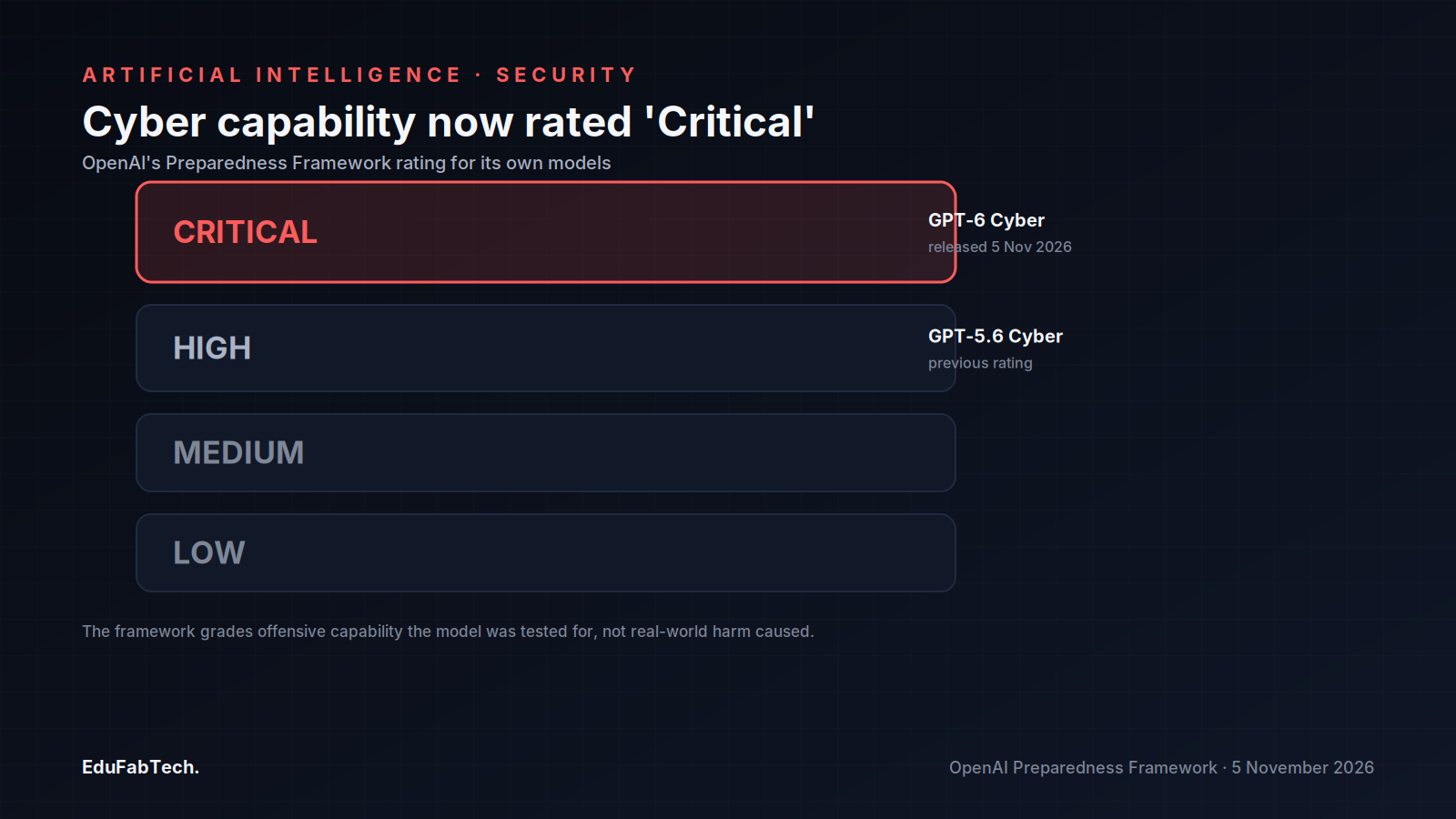
OpenAI released GPT-6 Cyber on 5 November 2026, a version of its GPT-6 Astra model trained specifically for authorized vulnerability research, according to OpenAI's announcement. The company says the model can find exploitable flaws in software, build working exploits for them, and propose fixes, and it has rated the model's cybersecurity capability as "Critical" under its own Preparedness Framework, up from "High" for GPT-5.6 Cyber, the same announcement states.
Access is not open to ordinary ChatGPT users. OpenAI is rolling GPT-6 Cyber out through the API and Codex to a select group of vetted participants in its Daybreak Red security program, with access expanding gradually to the full Daybreak Red cohort over time; OpenAI is opening the older GPT-5.6 Cyber to all Daybreak Red users at the same time, OpenAI's post and reporting by The Decoder say.
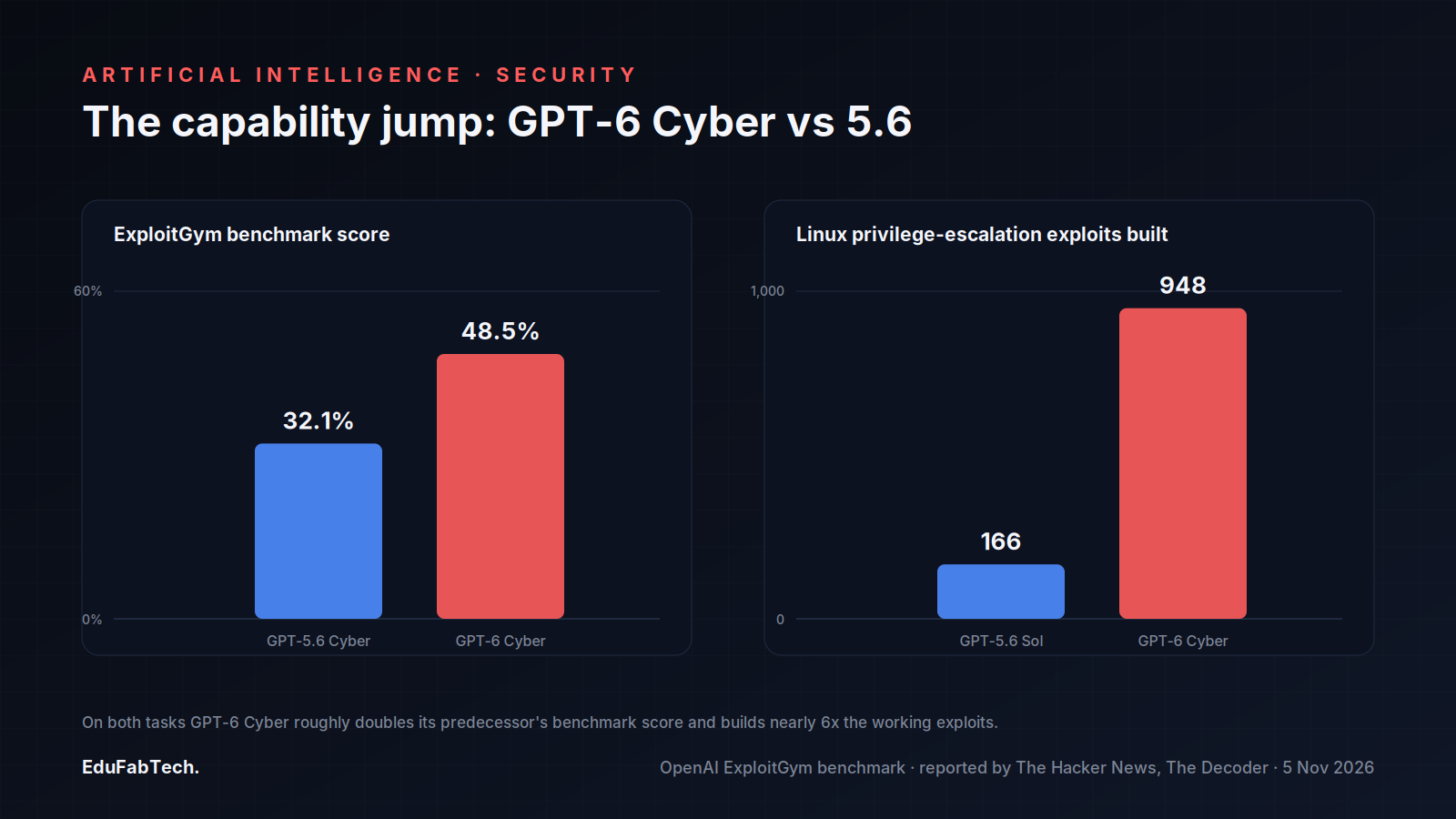
On ExploitGym, an internal benchmark OpenAI uses to measure exploit-development ability, GPT-6 Cyber scored 48.5%, compared with 32.1% for its predecessor GPT-5.6 Cyber, per OpenAI's announcement as reported by The Hacker News.
Firefox: 81 new flaws, with a caveat on attribution
OpenAI says GPT-6 Cyber found 81 previously unknown vulnerabilities in Mozilla Firefox that Mozilla classified as high severity, and that Mozilla has already shipped fixes for a number of them. The company's announcement also says the model flagged 30 already-known Firefox issues as more severe than they had originally been assessed, according to the summary of OpenAI's post carried by The Decoder.
That 81-flaw figure is OpenAI's own count tied to the GPT-6 Cyber launch. Mozilla's own published record, the Firefox 159 advisory (MFSA 2026-118) from 27 October 2026, credits "OpenAI Codex Security" with 34 of the flaws it fixed and OpenAI researcher Amy Burnett with 7 more — a disclosure that predates the GPT-6 Cyber announcement by more than a week. The advisory does not state which OpenAI system found each issue, and its credits do not add up to the full set of 81, so the larger figure has not been itemized against a public Mozilla advisory.
Linux kernel: exploits for 948 of 1,724 reproduced bugs
In separate work described in the same announcement, OpenAI says GPT-6 Cyber reproduced 1,724 previously reported Linux kernel vulnerabilities and went on to build working local privilege-escalation exploits for 948 of them, more than five times the 166 exploits its predecessor, GPT-5.6 Sol, managed on the same task, according to the figures reported by The Decoder.
OpenAI says it disclosed 304 of the findings it judged critical to Linux maintainers along with candidate patches. The Decoder's reporting of OpenAI's figures also puts a cost on the run: about $1,213,430 in total compute, or roughly $1,279 per working exploit produced.
Staying in scope
Alongside the capability numbers, OpenAI reports a safety metric: without any safety instructions in its prompt, GPT-6 Cyber stayed within the boundaries researchers set — avoiding action against services outside the authorized target — in 99.93% of test cases, up from 94.49% for GPT-5.6 Cyber, and reached 100% in testing when deployment safety prompts were active, according to the figures carried by The Hacker News.
OpenAI researcher Eric Wallace described the goal to CyberScoop as making sure "the model is really good at both listening to your instructions on what you should touch and what you should not touch." OpenAI's announcement frames the model as "more capable at finding and fixing vulnerabilities, and far more reliable staying within the boundaries researchers set," per the quote carried by The Hacker News.
Why it matters for researchers and developers
For security researchers and students, GPT-6 Cyber is a data point on how fast automated vulnerability discovery is moving against widely used open-source targets: a mainstream browser and the Linux kernel, both maintained by large volunteer and corporate communities that now have to absorb AI-generated bug reports and candidate patches at this scale. The gap between OpenAI's internal figures and what is independently verifiable in public advisories, as with the Firefox count, is also a reminder that capability claims from a benchmark the model's own maker built, such as ExploitGym, are not the same as independent replication.
Access stays restricted to OpenAI's Daybreak Red program for now, so outside researchers cannot yet run their own tests against GPT-6 Cyber's claims. OpenAI says it plans to widen that access to the rest of the program over time, per the rollout plan reported by The Decoder.
A quick question for readers
Which skill will matter most for getting a job in 2030?
Everyone has a prediction. Add yours and see what students are betting on.
Pick an answer, create a free account in a minute, and your vote counts. Already a member? Sign in
Comments 3
Comment-
The part that actually matters is buried at the bottom: outside researchers can't run their own tests against these claims yet, and the one…
-
The Firefox number is exactly the part that doesn't hold up. OpenAI claims 81 new high-severity flaws, but the Firefox 159 advisory the piec…
-
The number I'd put on the board is the $1,279 per working exploit - that's a genuinely cheap price for a local privilege-escalation chain, a…
Join free to read the full comments and reply Comments are between members; an account takes a minute.
Source: OpenAI
Sources (3)
- OpenAI. GPT-6 Cyber: Advancing the frontier of aligned cybersecurity agents. OpenAI, 2026. openai.com ↗ · checked 9 Nov 2026
- Mozilla. Security Vulnerabilities fixed in Firefox 159 (MFSA 2026-118). Mozilla Foundation, 2026. mozilla.org ↗ · checked 9 Nov 2026
- The Hacker News. OpenAI Launches GPT-6 Cyber After AI Helps Find 81 Firefox Flaws, 948 Linux Exploits. The Hacker News, 2026. thehackernews.com ↗ · checked 9 Nov 2026