OpenJDK's 'Java4Shell' Flaw Lets Pre-Auth RCE Hit Jira, Jenkins and Keycloak on AVX-512 Servers
A memory-corruption bug in OpenJDK's Base64 decoder, disclosed 17 November 2026, lets attackers run code on affected x86-64 servers without logging in.
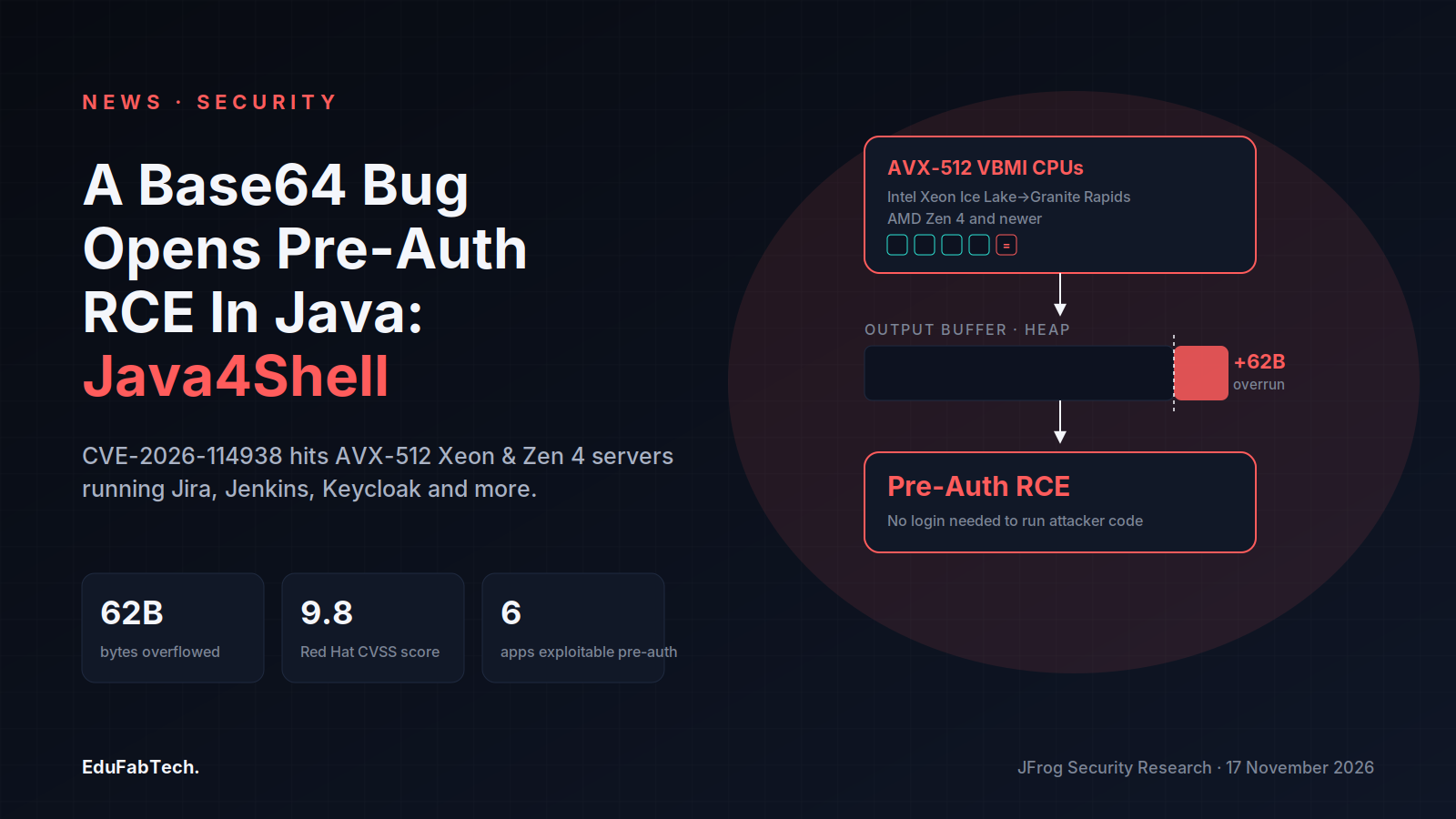
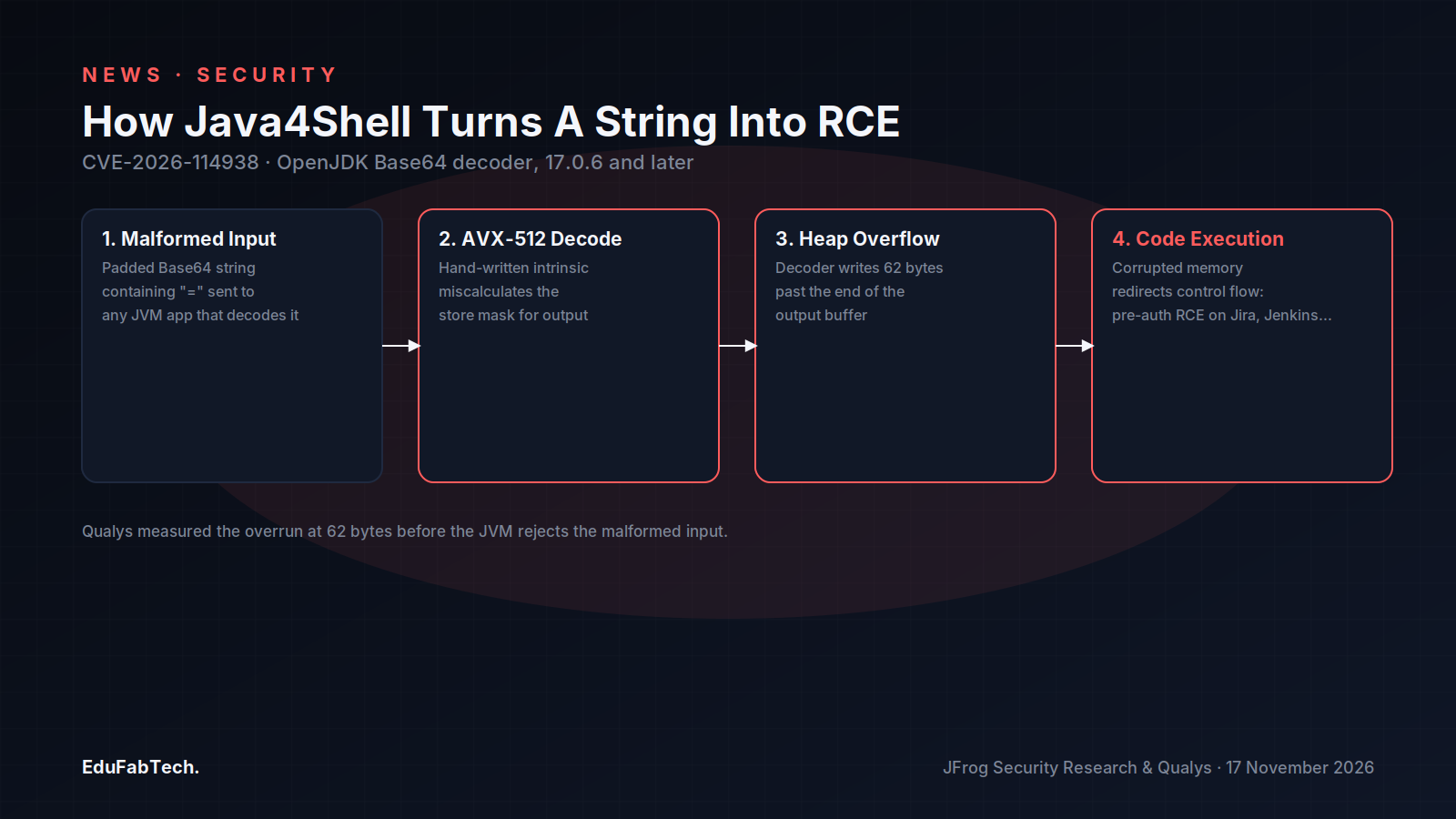
Security researchers at a firm called Calif disclosed a critical memory-corruption vulnerability in OpenJDK on 17 November 2026, naming it "Java4Shell" and tracking it as CVE-2026-114938. The flaw sits in the Base64 decoder built into the Java Virtual Machine and can let an attacker who sends nothing more than a malformed Base64 string trigger remote code execution on affected servers, in several cases without needing to log in first, according to JFrog Security Research's technical write-up.
What the bug actually does
The problem lives in OpenJDK's hand-written, AVX-512-optimized assembly routine for decoding Base64 input. When the routine processes padded input containing the = character, it miscalculates the store mask it uses to write decoded bytes, producing an out-of-bounds heap write past the end of the output buffer, JFrog's analysis explains. One independent write-up by Qualys puts the overrun at 62 bytes written past the buffer's end before the JVM rejects the malformed input, which is enough to corrupt adjacent heap memory and, with the right input, redirect execution.
Because any Java application that decodes externally supplied Base64 data can be exposed, the practical blast radius is large: Base64 decoding sits behind authentication tokens, file uploads, API payloads and countless integration points in everyday server software.
Which systems are exposed
The bug only triggers on x86-64 processors that support AVX-512 VBMI (Vector Byte Manipulation Instructions) — specifically Intel Xeon chips from Ice Lake through Granite Rapids and AMD chips from the Zen 4 generation onward, according to The Hacker News. ARM64 servers are not affected. On the software side, it hits OpenJDK and Oracle Java SE builds from version 17.0.6 onward, spanning the 17.x, 21.x, 25.x and 27.x lines, plus Temurin and Corretto builds derived from them, according to JFrog.
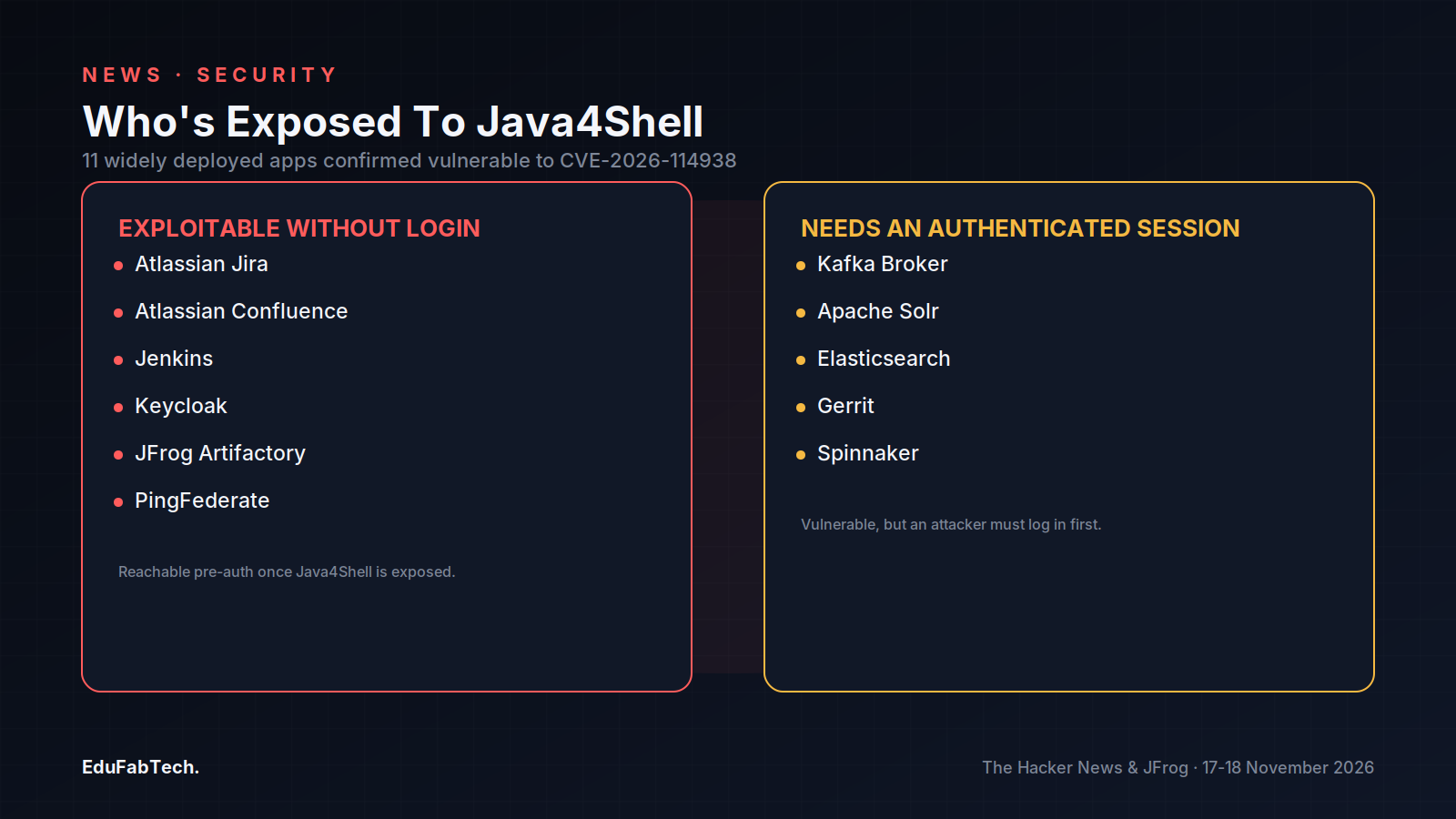
The Hacker News reported that researchers confirmed six widely deployed applications could be exploited without authentication once Java4Shell is reachable: Atlassian Jira, Atlassian Confluence, Jenkins, Keycloak, JFrog Artifactory and PingFederate. A further set of systems, including Apache Kafka Broker, Apache Solr, Elasticsearch, Gerrit and Netflix's Spinnaker, were shown to be vulnerable but required an authenticated session first, per the same report.
| Exploitable without login | Exploitable with an authenticated session |
|---|---|
| Jira, Confluence, Jenkins, Keycloak, Artifactory, PingFederate | Kafka Broker, Solr, Elasticsearch, Gerrit, Spinnaker |
Two different severity scores
The scoring split tells its own story about how fast this moved. Calif, the firm that reported the bug, rated it 9.2 under CVSS 4.0. Oracle's own advisory logged it at 8.1 under CVSS 3.1. Red Hat, in a preliminary assessment cited by The Hacker News, rated its own exposure as high as 9.8.
Exploitation status and what to do
As of the disclosures on 17 and 18 November 2026, no organisation had confirmed active exploitation in the wild. The Hacker News reported that the Canadian Centre for Cyber Security said it was "not aware of any attacks exploiting the flaw." That is not the same as low risk: The Hacker News also reported that the malformed input needed to trigger the overflow had been posted publicly on 9 September 2026 in a pull request submitted to OpenJDK's code repository, and that the pull request was closed without being merged in early November — meaning the technical path to exploitation predates the disclosure by more than two months.
Oracle and the OpenJDK project shipped fixed builds — 17.0.21.1, 21.0.13.1, 25.0.5.1 and 27.0.1.1 — on 17 November 2026, and Amazon patched its Corretto distribution; Red Hat had not yet released fixes for Red Hat Enterprise Linux or its own OpenJDK builds as JFrog and Qualys published their analyses, according to The Hacker News. Where an immediate update is not possible, JFrog and Qualys both point to the same two JVM flags as a stopgap: starting the JVM with -XX:-UseBASE64Intrinsics disables the vulnerable fast path directly, while -XX:UseAVX=2 achieves the same result at a broader performance cost by turning off AVX-512 use altogether.
Why this matters beyond the patch cycle
For students and researchers working with Java-based systems, Java4Shell shows how a performance optimisation deep in a runtime's standard library, invisible to almost every application developer who merely calls a decoding function, can become a remote-code-execution path the moment it runs on the right CPU generation. The affected intrinsic exists specifically because AVX-512 VBMI instructions make Base64 decoding faster — the same hardware feature that improved throughput is what exposed the flaw. Anyone teaching or studying secure software design now has a recent, documented case of how a change meant to speed up a library function went unreviewed in a way that let a single malformed string corrupt memory.
Developers building or maintaining Java services should treat the CPU architecture of their deployment targets as a security-relevant variable, not just a performance one, and should check which of the frameworks and middleware named in JFrog's and The Hacker News's reporting are running in their own environments before assuming an update to the JVM alone closes the gap.
A quick question for readers
Which skill will matter most for getting a job in 2030?
Everyone has a prediction. Add yours and see what students are betting on.
Pick an answer, create a free account in a minute, and your vote counts. Already a member? Sign in
Comments 3
Comment-
The stopgap is the part worth picking apart: two flags offered, but only one is a scalpel. -XX:-UseBASE64Intrinsics turns off the broken rou…
-
Three different severity scores for the same CVE is the detail that actually matters here. Calif says 9.2, Oracle says 8.1, Red Hat says 9.8…
-
The detail that'll stick with me is the timeline: the exact malformed input needed to trigger this was sitting in a public OpenJDK pull requ…
Join free to read the full comments and reply Comments are between members; an account takes a minute.
Source: JFrog Security Research
Sources (3)
- JFrog Security Research. Java4Shell: What We Know About the Critical OpenJDK RCE Vulnerability (CVE-2026-114938). JFrog, 2026. research.jfrog.com ↗ · checked 18 Nov 2026
- The Hacker News. Java4Shell (CVE-2026-114938) Enables Pre-Auth RCE in Jira, Jenkins, Keycloak on Java 17+ AVX-512 VBMI Servers. The Hacker News, 2026. thehackernews.com ↗ · checked 18 Nov 2026
- Qualys Threat Research Unit. How to Find, Mitigate, and Patch the Critical Java4Shell Flaw (CVE-2026-114938) Now. Qualys, 2026. blog.qualys.com ↗ · checked 18 Nov 2026