29 African Countries Adopt Oran Declaration on Cross-Border Skills Cooperation
Meeting in Oran, Algeria, ministers from 29 African countries adopted a declaration on 18 November 2026 for comparing vocational qualifications, though cross-border recognition still runs through national procedures.
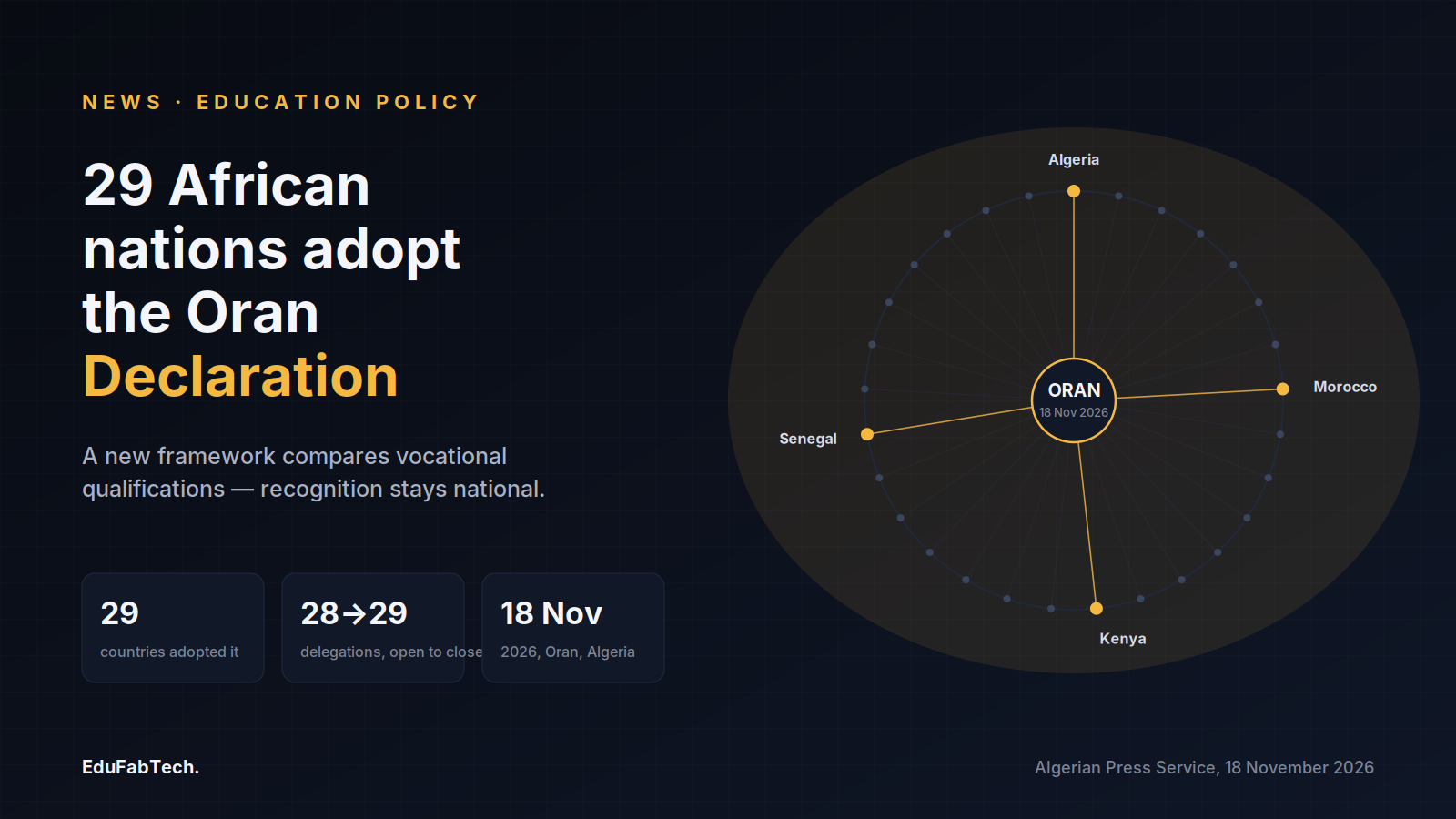
Ministers and officials from 29 African countries adopted the Oran Declaration on the Future of Skills in Africa on 18 November 2026, at the close of the African Skills Policy Forum in Oran, Algeria, the Algerian Press Service reported. The forum had opened the previous day with 28 ministerial delegations in attendance, organised by Algeria's Ministry of Vocational Training and Education in cooperation with the African Union Commission and chaired by Algeria's Minister of Vocational Training and Education, Nacima Arhab, according to a separate APS report on the opening session.
A framework for comparing qualifications, not transferring them automatically
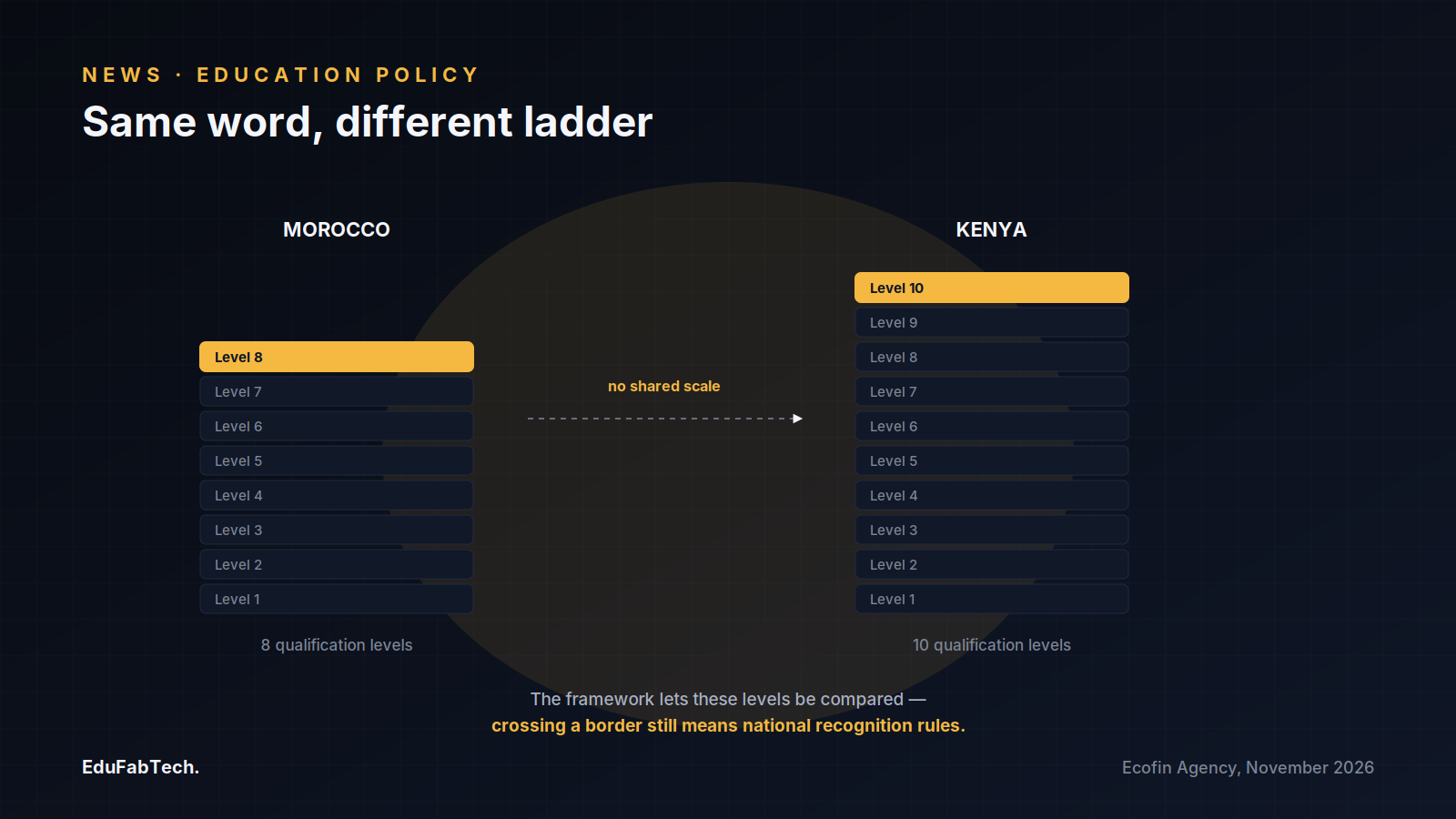
The forum's central topic was the African Continental Qualifications Framework, which sets common reference points between countries' separate certification systems by linking national and continental qualification levels to the knowledge and competencies a qualification is meant to represent, Ecofin Agency reported. The problem it addresses is structural: a qualification's level tells employers where it sits within one country's system, but that position does not automatically translate when a worker crosses a border, because countries number and structure their levels differently.
| Country | Number of qualification levels |
|---|---|
| Morocco | 8 |
| Kenya | 10 |
A continental qualifications platform, launched in Nairobi from 28 to 30 July 2026, already lets users search for and compare qualifications across African countries, but Ecofin Agency noted that comparison does not amount to automatic recognition — a worker or student still has to go through each destination country's own national procedure.
What the declaration commits governments to
According to APS's reporting on the declaration, the signatories committed to modernising technical and vocational education and training, anticipating future qualification needs, promoting entrepreneurship and innovation, and improving youth employability. They also agreed to work toward facilitating worker mobility and the cross-border recognition of professional qualifications, including through exchanges of expertise organised around centres of excellence and institutional partnerships.
- Modernising technical and vocational education and training systems
- Anticipating the qualifications the labour market will need
- Promoting entrepreneurship and innovation among graduates
- Improving youth employability
- Facilitating the cross-border mobility of workers and recognition of their qualifications
An implementation framework called the "Oran Action Framework 2026-2027" was adopted alongside the declaration, setting out coordination and monitoring mechanisms agreed in consultation with the African Union Commission, and aligned with the African Union's Agenda 2063 and its Continental Strategy for Technical and Vocational Education and Training covering 2025 to 2034.
What recognition looks like when it already works
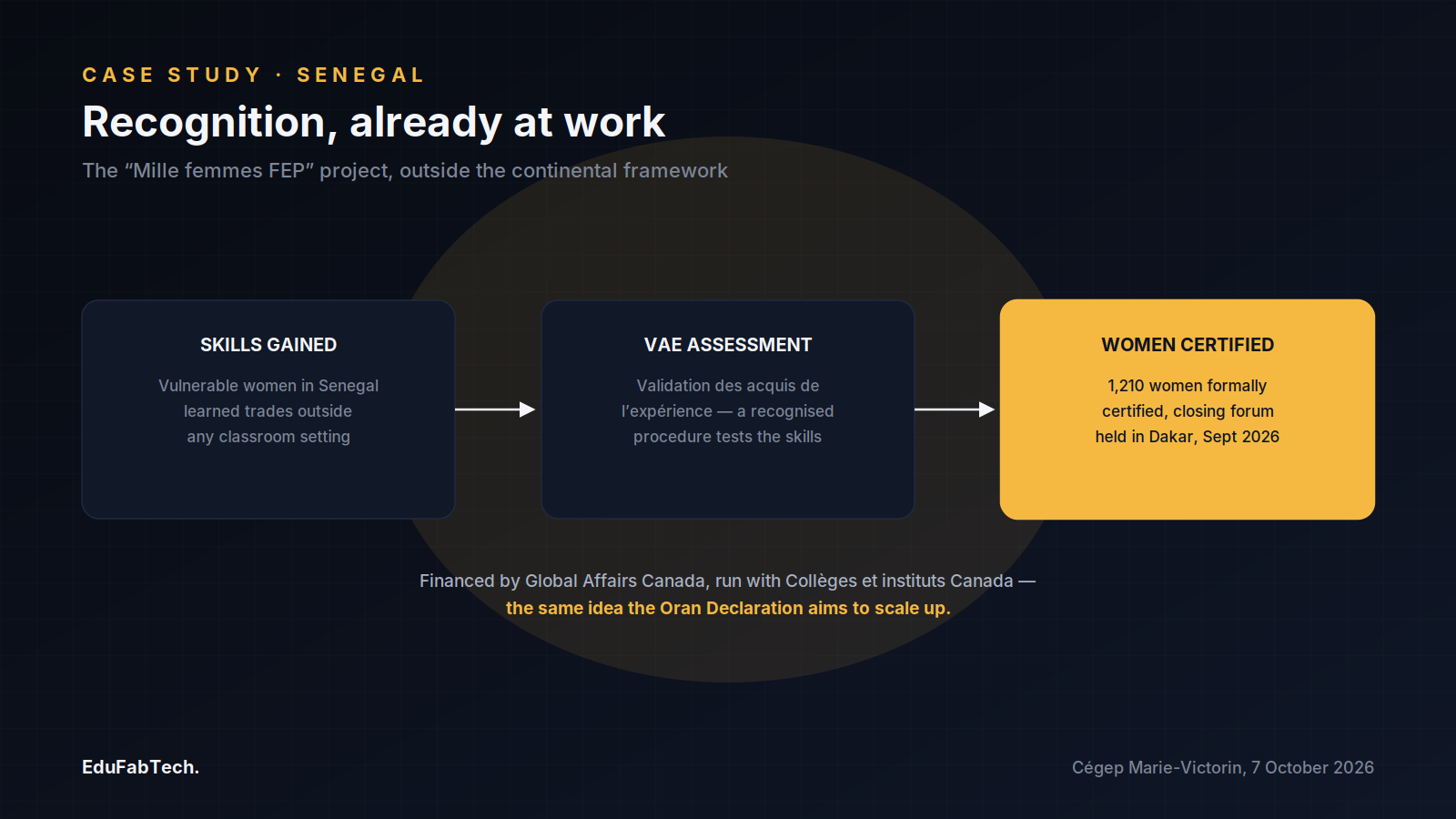
A separate, national-level project in Senegal shows what formal skills recognition can achieve once it is put into practice, even without a continental framework behind it. The "Mille femmes FEP" project used validation des acquis de l'expérience — recognition of prior learning — to formally certify the professional competencies of vulnerable women who had gained skills outside the classroom, Cégep Marie-Victorin reported on 7 October 2026.
Over more than three years, financed by Global Affairs Canada and implemented by Colleges and Institutes Canada with Cégep Marie-Victorin as a partner, the project certified 1,210 women, exceeding its initial target, and closed with a forum held in Dakar on 23 and 24 September 2026. The project is not part of the African Continental Qualifications Framework, but it illustrates the same underlying idea the Oran Declaration is trying to scale up: that skills gained informally or on the job can be formally certified, provided a recognised procedure exists to assess them.
What it means for students, workers and researchers
For students and workers in technical and vocational education, the declaration signals that governments across the continent intend to keep building toward credentials that travel more easily between countries, particularly in fields the forum discussed, such as digitalisation, artificial intelligence and renewable energy. In practice, though, the distinction between comparability and recognition still matters: a qualification's continental reference level, once mapped, tells an employer or institution abroad how it compares to their own system, but it does not substitute for the destination country's own assessment or licensing process.
For researchers studying skills systems and labour mobility, the gap between the 28 ministerial delegations reported at the forum's opening and the 29 countries reported to have adopted the declaration at its close is itself worth tracking, since it points to how fluid participation in continental policy processes can be from one day to the next. The practical test of the Oran Declaration will be whether the "Oran Action Framework 2026-2027" produces mutual recognition agreements between specific pairs or groups of countries, rather than comparability tools that, as Ecofin Agency's reporting makes clear, still leave the final decision to each national authority.
A quick question for readers
Are group projects good for learning?
Loved by some, dreaded by many. What is your real experience?
Pick an answer, create a free account in a minute, and your vote counts. Already a member? Sign in
Comments 3
Comment-
The number worth sitting with is 28 ministerial delegations at the opening versus 29 countries signing at the close. Nobody explains that ju…
-
The number that'll actually tell you if this worked isn't 29, it's zero — zero mutual recognition agreements between specific country pairs,…
-
The number worth flagging is the 28-to-29 gap between the opening and the adoption. The piece reads that as fluid participation, but it's al…
Join free to read the full comments and reply Comments are between members; an account takes a minute.
Source: Algerian Press Service (APS)
Sources (3)
- Algerian Press Service. Oran Declaration on Future of Skills in Africa adopted. Algerian Press Service, 2026. aps.dz ↗ · checked 26 Nov 2026
- Ecofin Agency. African Countries Seek Mutual Recognition of Professional Qualifications at Algeria Forum. Ecofin Agency, 2026. ecofinagency.com ↗ · checked 26 Nov 2026
- Cégep Marie-Victorin. Un bilan marquant pour la fin du projet Mille Femmes FEP au Sénégal. Cégep Marie-Victorin, 2026. cegepmv.ca ↗ · checked 26 Nov 2026