Personalized Ovarian Cancer Vaccine Clears Early Safety Bar in 10-Patient Trial
A Dana-Farber-led phase 1 trial, published in Nature Medicine on October 14, 2026, found a custom neoantigen vaccine feasible and immune-active in some patients with high-grade epithelial ovarian cancer, with no unexpected safety signals and no toxicity-related discontinuations.
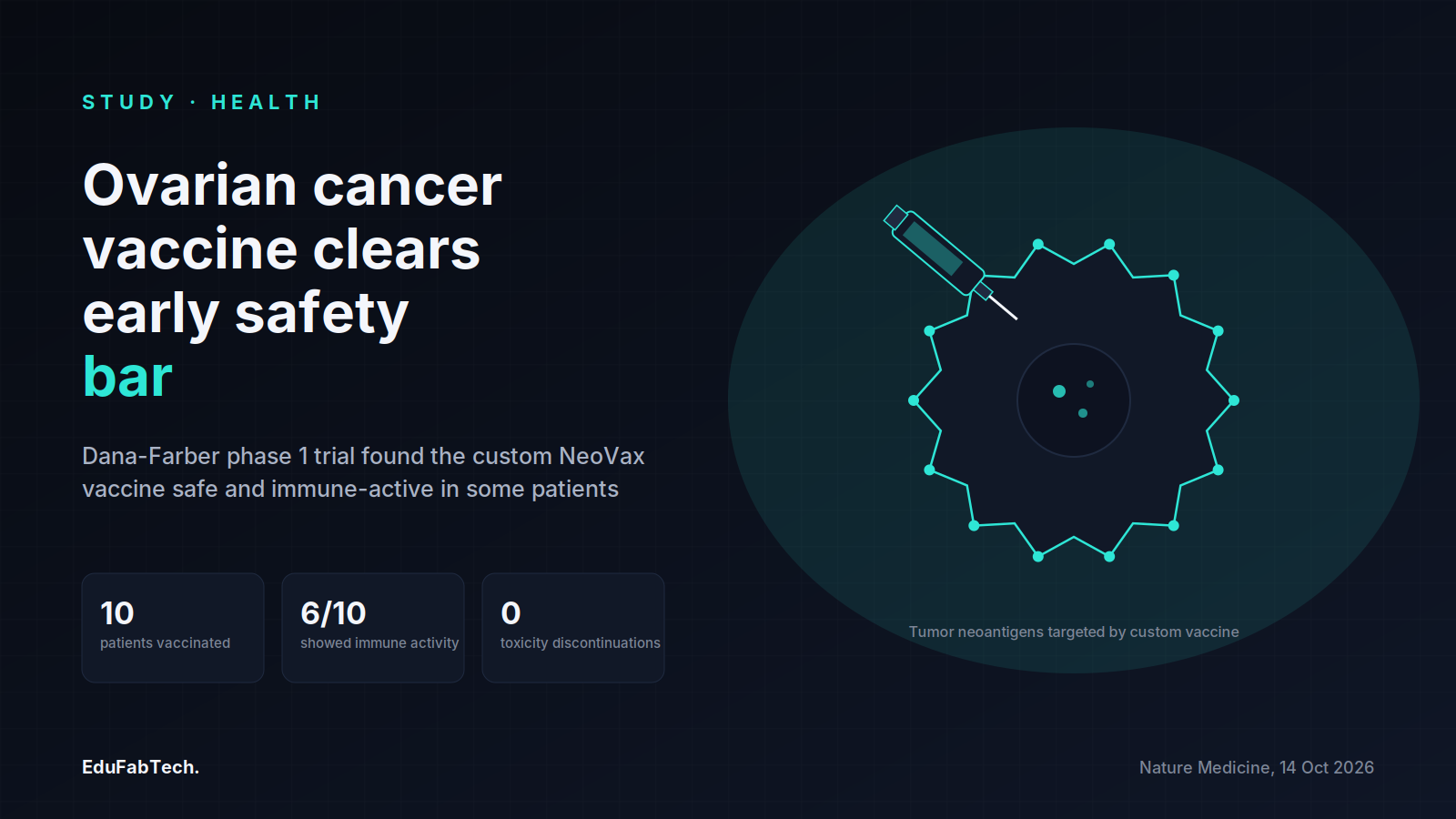
A phase 1 trial testing a personalized cancer vaccine in patients with high-grade epithelial ovarian cancer found the approach feasible and immunologically active in some participants, researchers led by Dana-Farber Cancer Institute and Harvard Medical School reported in Nature Medicine on October 14, 2026. Ten patients ultimately received the vaccine, and the trial is registered with the US National Library of Medicine as NCT04024878.
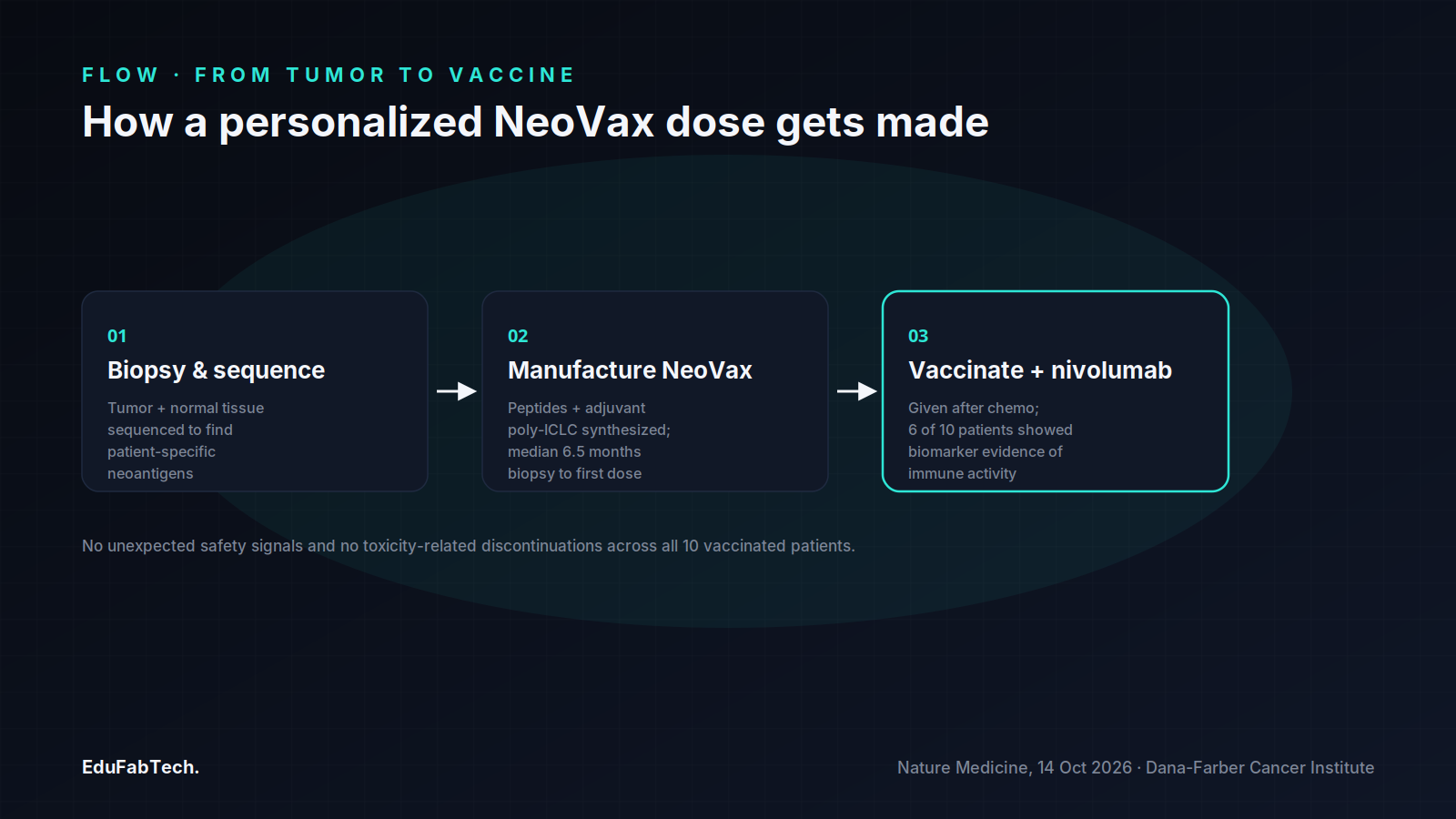
The vaccine, called NeoVax, is built individually for each patient. Tumor and normal tissue are sequenced to identify neoantigens — mutated proteins unique to that patient's cancer — and a subset predicted to be visible to the immune system is synthesized into long peptides, mixed with the immune-stimulating adjuvant poly-ICLC, and injected. In this trial the vaccine was paired with delayed dosing of the anti-PD-1 checkpoint inhibitor nivolumab, given after standard platinum-based chemotherapy, according to the Nature Medicine paper.
High-grade serous ovarian cancer is the most common and most lethal form of epithelial ovarian cancer, and it made up most of the trial's enrollment alongside related high-grade histologies. Most patients respond to initial platinum-based chemotherapy but eventually relapse, and tumors that recur within six months of finishing treatment are classified as platinum-resistant and respond poorly to further chemotherapy. The trial was designed to test whether a personalized vaccine could be manufactured and delivered in time to intervene in that recurrence window.
What the 10-patient cohort showed
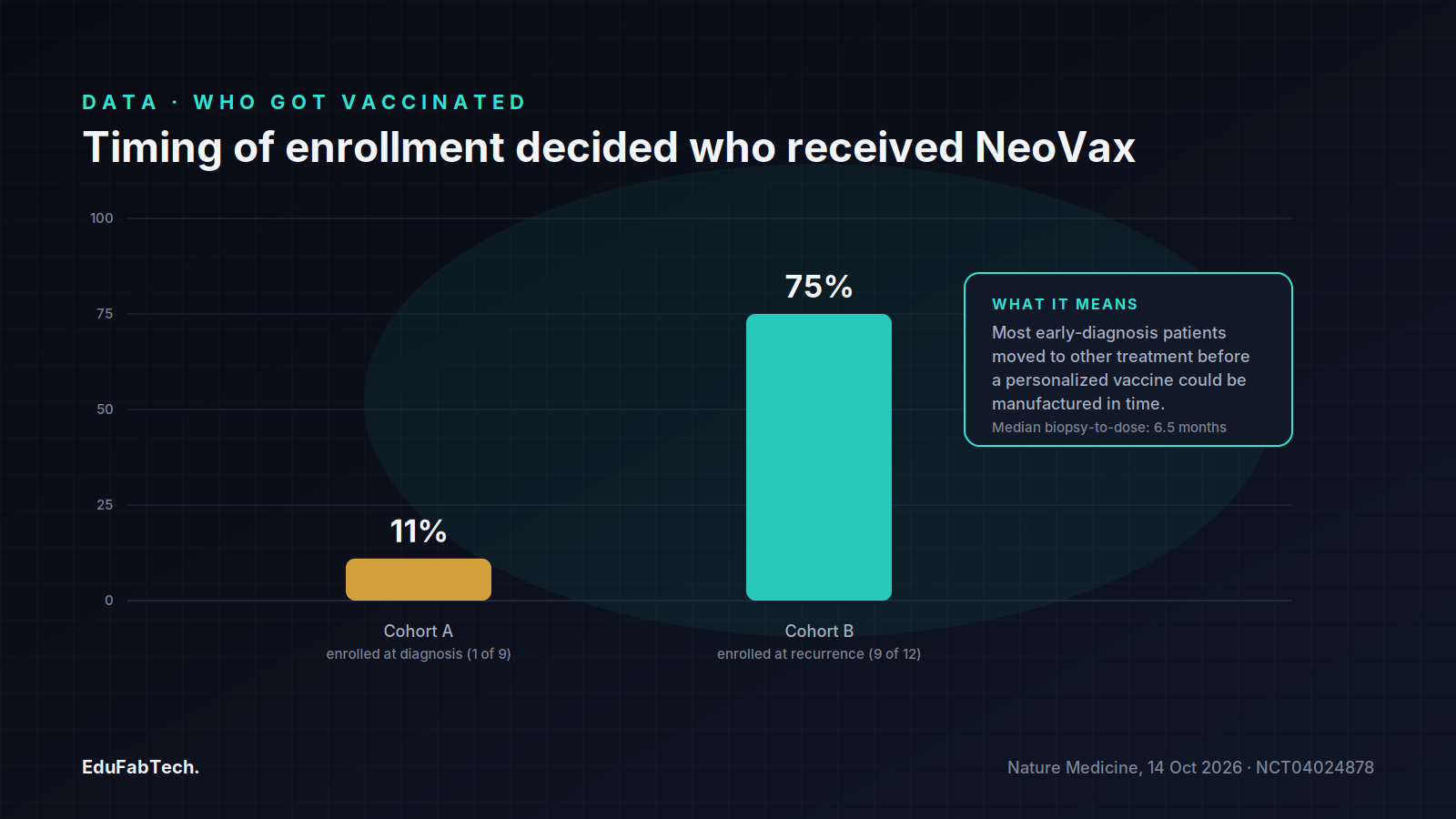
Of patients evaluable for vaccination, only 1 of 9 (11%) who enrolled shortly after initial diagnosis (Cohort A) went on to receive the vaccine, compared with 9 of 12 (75%) who enrolled at the time of first disease recurrence (Cohort B) — most Cohort A patients moved ahead with other treatment before a personalized vaccine could be manufactured in time. Across the 10 patients who were ultimately vaccinated, the paper's deposited manuscript on the Oxford University Research Archive gives a median of 6.5 months from diagnostic biopsy to the first vaccine dose — the time needed to sequence each tumor and manufacture a matched vaccine. The authors report no unexpected safety signals and no patients who discontinued treatment because of toxicity.
Biomarker analysis found evidence of biological activity — meaning detectable, vaccine-associated immune responses in blood or tumor tissue — in 6 of the 10 patients. The researchers tracked more than 70% of each patient's selected neoantigen targets using non-invasive cell-free DNA analysis, a method for monitoring tumor DNA shed into the bloodstream without repeat biopsies, per the trial manuscript.
Where tumors did progress despite vaccination, the researchers found that resistant tumor clones had altered the way they present antigens to the immune system — a sign, they write, that the vaccine was exerting selective pressure on the cancer rather than being ignored by it. The paper frames this as evidence that the balance between the range of antigens a tumor presents and the breadth of immunity the vaccine induces appears to shape how much clinical benefit follows vaccination.
A feasibility result, not an efficacy one
The authors describe this explicitly as a first-in-disease phase 1 trial, the stage of testing focused on safety and feasibility in a small group rather than on proving a treatment works. Ten patients, and in particular the single vaccinated patient in Cohort A, is too small a sample to draw conclusions about survival or recurrence rates, and the paper does not claim otherwise. What it establishes is that a custom vaccine can be designed, manufactured and delivered to ovarian cancer patients on a clinically workable timeline when disease pace allows, and that it can provoke a measurable immune response in a majority of those treated without serious added toxicity when combined with checkpoint blockade.
NeoVax itself is not new — the same personalized-vaccine platform, developed at Dana-Farber and the Broad Institute of MIT and Harvard, has previously been tested in melanoma and kidney cancer. This trial is the first published application of it in ovarian cancer, a disease where immunotherapy has so far shown far more limited success than in melanoma or lung cancer.
Why it matters for the field
For researchers studying cancer immunotherapy, the trial adds ovarian cancer to the list of tumor types where personalized neoantigen vaccines have reached human testing, and it supplies a concrete manufacturing benchmark — a median 6.5-month turnaround from biopsy to injection — that other groups designing similar trials will need to match or beat. The cell-free DNA tracking method used to follow more than 70% of vaccine targets without repeat surgery is also likely to be adopted in follow-on trials, since repeat biopsies of ovarian tumors are invasive and not always feasible.
The authors note that larger, randomized trials will be needed to determine whether the immune responses observed translate into longer remission or survival. Dana-Farber and its collaborators have previously run NeoVax trials in melanoma and renal cell carcinoma, and the ovarian cancer program's next step would plausibly follow a similar path toward a larger controlled study, though the current paper does not announce one.
A quick question for readers
Which study habit do you think is most overrated?
Some popular habits have little evidence behind them. Which one do you think gets too much credit?
Pick an answer, create a free account in a minute, and your vote counts. Already a member? Sign in
Comments 0
CommentNo comments yet. Members start the conversation.
Source: Nature Medicine
Sources (3)
- Sellars MC, Wu CJ, et al.. Personalized neoantigen-targeting cancer vaccines in ovarian cancer: a phase 1 trial. Nature Medicine, 2026. nature.com ↗ · checked 15 Oct 2026
- National Library of Medicine. NeoVax With Nivolumab in Patients With Ovarian Cancer (NCT04024878). ClinicalTrials.gov, 2026. clinicaltrials.gov ↗ · checked 15 Oct 2026
- Sellars MC, Wu CJ, et al.. Personalized neoantigen-targeting cancer vaccines in ovarian cancer: a phase 1 trial (deposited copy). Oxford University Research Archive, 2026. ora.ox.ac.uk ↗ · checked 15 Oct 2026