Pentagon Says All 30 Universities Resolved Foreign Research-Security Audits
On 19 October 2026 the US Department of War said 30 universities ordered in August to audit foreign research ties had completed the review, with more than 80 partnerships terminated and other federally funded institutions now "on notice."
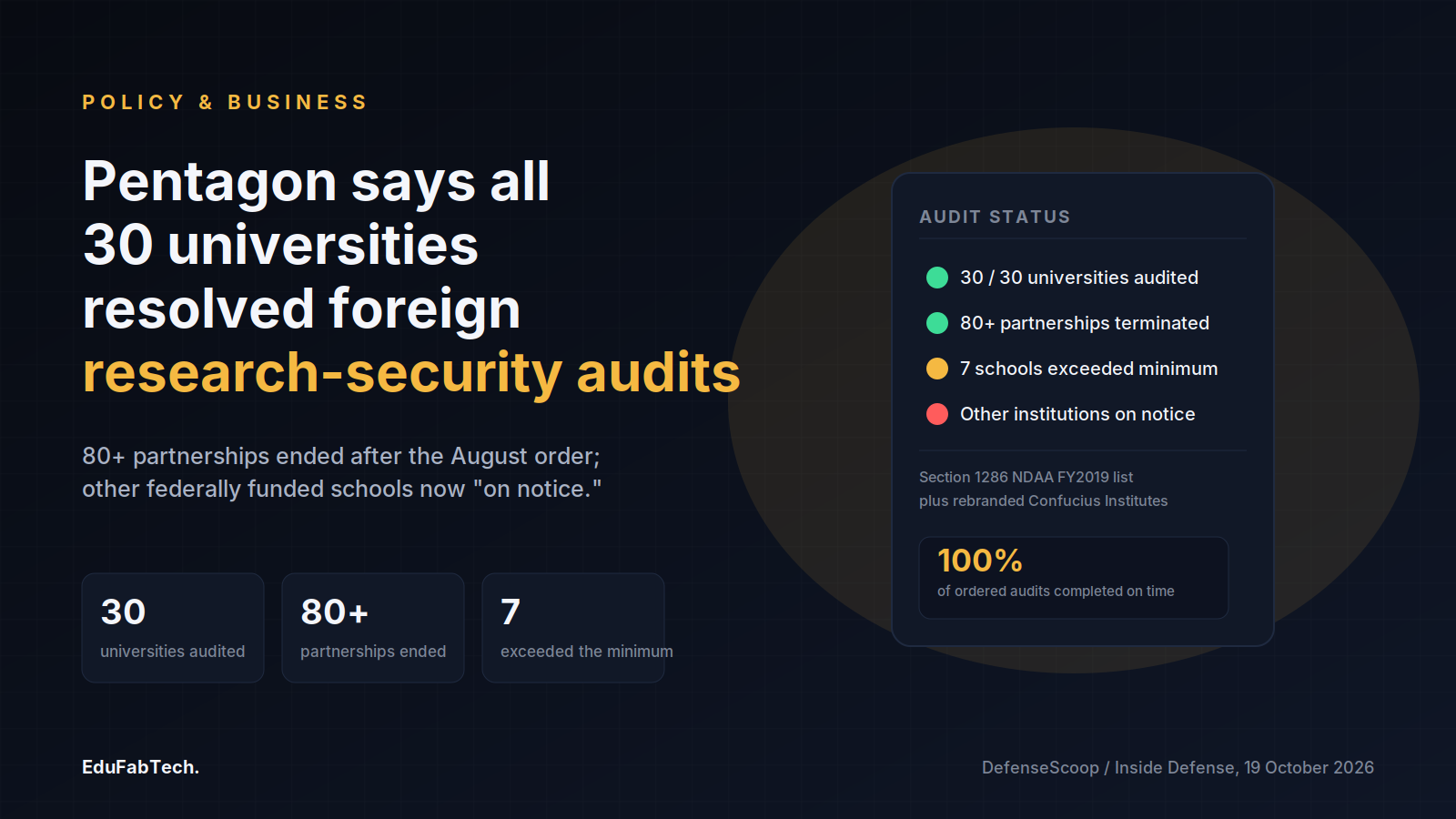
On 19 October 2026, the US Department of War said that all 30 universities it had ordered in August to audit their foreign research partnerships had completed the review, producing more than 80 "termination-related actions" across the group, according to DefenseScoop and Inside Defense. The department — renamed from the Department of Defense — framed the result as a model for research-security compliance it intends to extend to other federally funded institutions.
The August order and its deadline
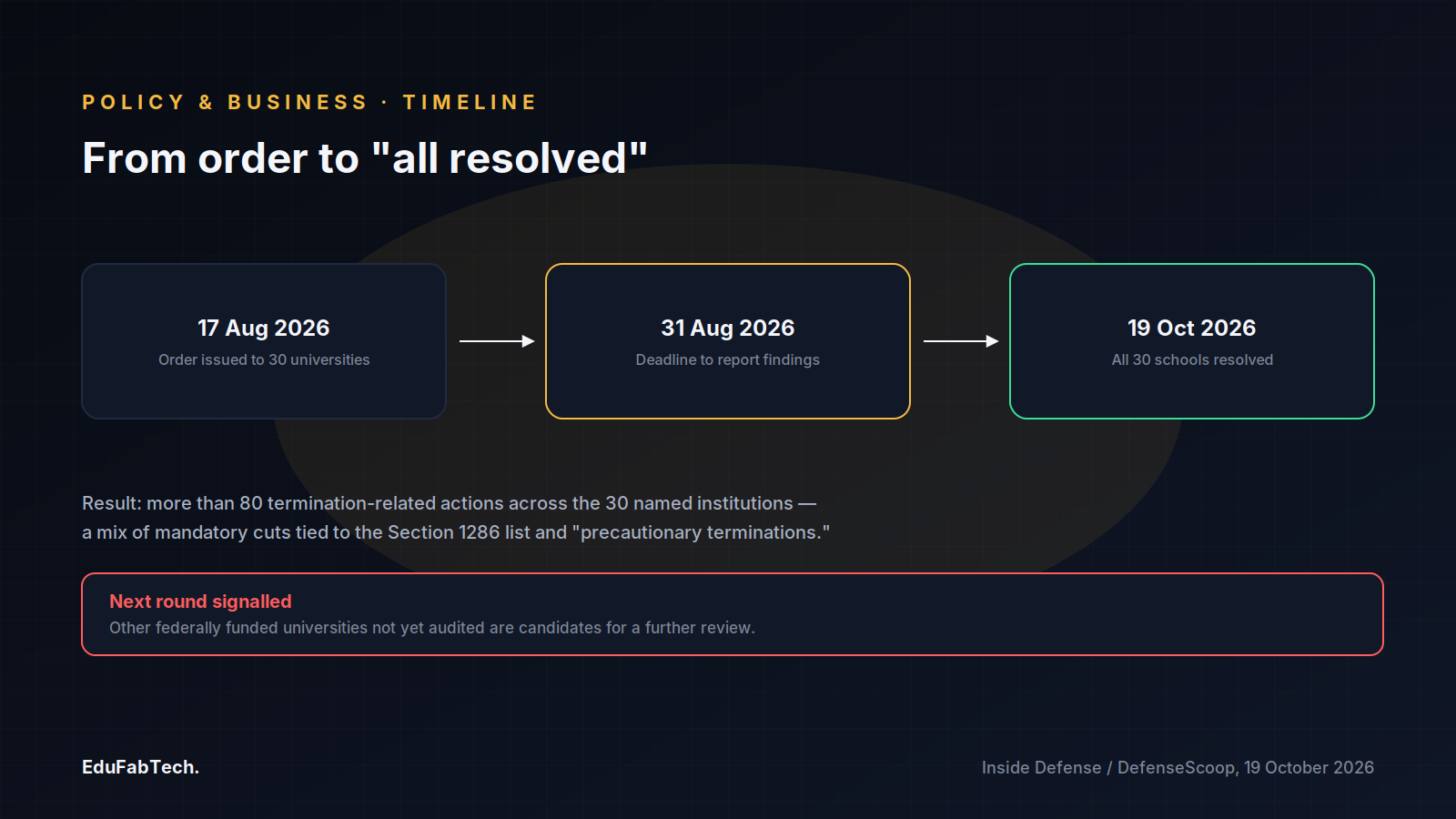
The audits began on 17 August 2026, when the department issued formal notifications requiring 30 academic institutions to review their academic, financial and research collaborations with "foreign entities of concern," according to a legal alert from Arnold & Porter. The entities in question sit on a list maintained under Section 1286 of the National Defense Authorization Act for Fiscal Year 2019, last updated in July 2026, plus organizations tied to rebranded Confucius Institutes programmes, the alert states. Universities had to report their findings and any mitigation steps back to the department no later than 31 August 2026.
Arnold & Porter's alert lists the consequences the department attached to non-compliance: loss of eligibility for future federal research funding, potential liability under the False Claims Act, exposure under export-control law, congressional oversight and, in principle, criminal exposure for individual faculty members. The same alert notes one exemption: the Assistant Secretary for Science and Technology may waive the funding bar "on a case-by-case basis" where continuing a partnership is judged to be in the national security interests of the United States.
What the audits found
The 30 universities named across reporting on the order include Harvard, MIT, Cornell, Duke, Georgetown, New York University, Johns Hopkins, the University of California, Berkeley, the University of California, Los Angeles, Penn State, the University of North Carolina at Chapel Hill, the University of Southern California, the University of Texas at Austin and Virginia Tech, among others, per DefenseScoop. All 30 resolved their flagged ties, the department said, through a mix of outright terminations of partnerships tied to the Section 1286 list and what it called "precautionary terminations" of relationships with entities not on that list.
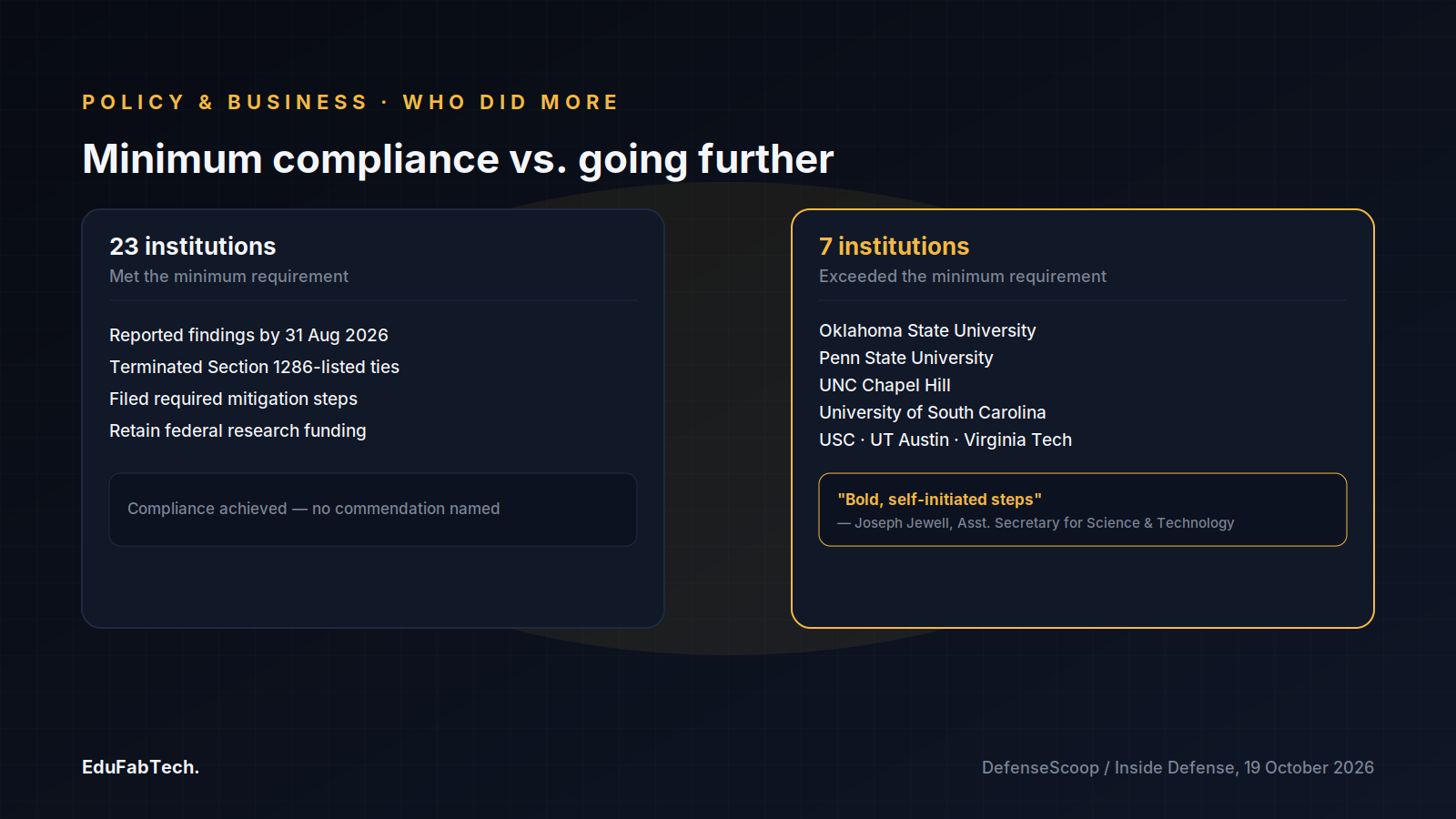
Seven institutions — Oklahoma State University, Pennsylvania State University, the University of North Carolina at Chapel Hill, the University of South Carolina, the University of Southern California, the University of Texas at Austin and Virginia Tech — were singled out for exceeding the minimum requirement. Joseph Jewell, the Assistant Secretary of Defense for Science and Technology, said "rather than settling for minimum compliance, these institutions took bold, self-initiated steps to protect their labs, faculty and intellectual property from foreign exploitation," according to Inside Defense. Emil Michael, the Under Secretary of Defense for Research and Engineering, said in the same announcement that "institutions that fail to meet research security standards are on notice: taxpayer dollars will not support institutions whose partnerships put the American warfighter or the Nation's technological advantage at risk," per DefenseScoop.
A second wave, and the oversight behind it
The department said its effort will continue, naming the House and Senate Armed Services Committees, the House and Senate Appropriations Committees, and the House Select Committee on the Chinese Communist Party as the lawmakers it is coordinating with, and signalled that other federally funded research universities not yet audited are candidates for a further round, particularly where they maintain partnerships with entities on the Section 1286 list, according to Inside Defense.
What it means for students and researchers
None of the department's public statements or the reporting on them describes what happens to the graduate students, postdoctoral researchers or exchange partners attached to the more than 80 terminated collaborations — whether projects were wound down, reassigned to other funding, or simply closed to new foreign co-authors. Researchers working on Department of War-funded grants at the 30 named institutions, and at any university added in a future round, are the ones most directly exposed to further terminations.
The move sits inside a wider pattern of governments tightening scrutiny of cross-border research and study ties rather than funding levels alone. Denmark's university deans, for instance, have separately backed proposals to let institutions screen bachelor's and master's applicants for security risk, a different mechanism — vetting individual students rather than institutional partnerships — aimed at a similar concern, as reported by Times Higher Education. For researchers who collaborate across borders, the practical lesson from the US rollout is that a partnership can be judged compliant one audit cycle and flagged the next if an institution is added to the Section 1286 list, which the department updates periodically rather than fixing once.
For now, the department has not published the full list of the more than 80 terminated agreements, nor named which of the 30 universities' projects were affected beyond the seven singled out for commendation. Students and faculty at institutions not yet audited have, per the department's own framing, no guarantee they will be left out of the next round.
A quick question for readers
How much do you spend on books and course materials per term?
Amounts in US dollars. The results help show how much course materials really cost students.
Pick an answer, create a free account in a minute, and your vote counts. Already a member? Sign in
Comments 3
Comment-
What stands out is the 'precautionary terminations' framing — cutting ties with entities not even on the Section 1286 list, just to be safe.…
-
The part that actually matters here is buried in the last section: the department won't say what happened to the people on those 80+ termina…
-
The bit that actually matters here is buried in the last section: nobody's saying what happens to the people on these projects. More than 80…
Join free to read the full comments and reply Comments are between members; an account takes a minute.
Source: DefenseScoop
Sources (3)
- DefenseScoop Staff. Pentagon threatens universities that have ties to 'foreign entities of concern,' hints at additional audits. DefenseScoop, 2026. defensescoop.com ↗ · checked 22 Oct 2026
- InsideDefense Staff. Pentagon says 30 universities resolve foreign research security concerns. Inside Defense, 2026. insidedefense.com ↗ · checked 22 Oct 2026
- Arnold & Porter. The Pentagon Gives 30 Universities Two Weeks to Audit and Report on Collaborations With Foreign Entities of Concern. Arnold & Porter Enforcement Edge, 2026. arnoldporter.com ↗ · checked 22 Oct 2026