Westlake University's Pinal AI Designs Four Working Proteins From Text Prompts
A Nature paper published 21 October 2026 describes Pinal, a 16-billion-parameter model that turned plain-language descriptions into a fluorescent protein, two enzymes and a CO2-fixation helper protein, each tested in the lab.
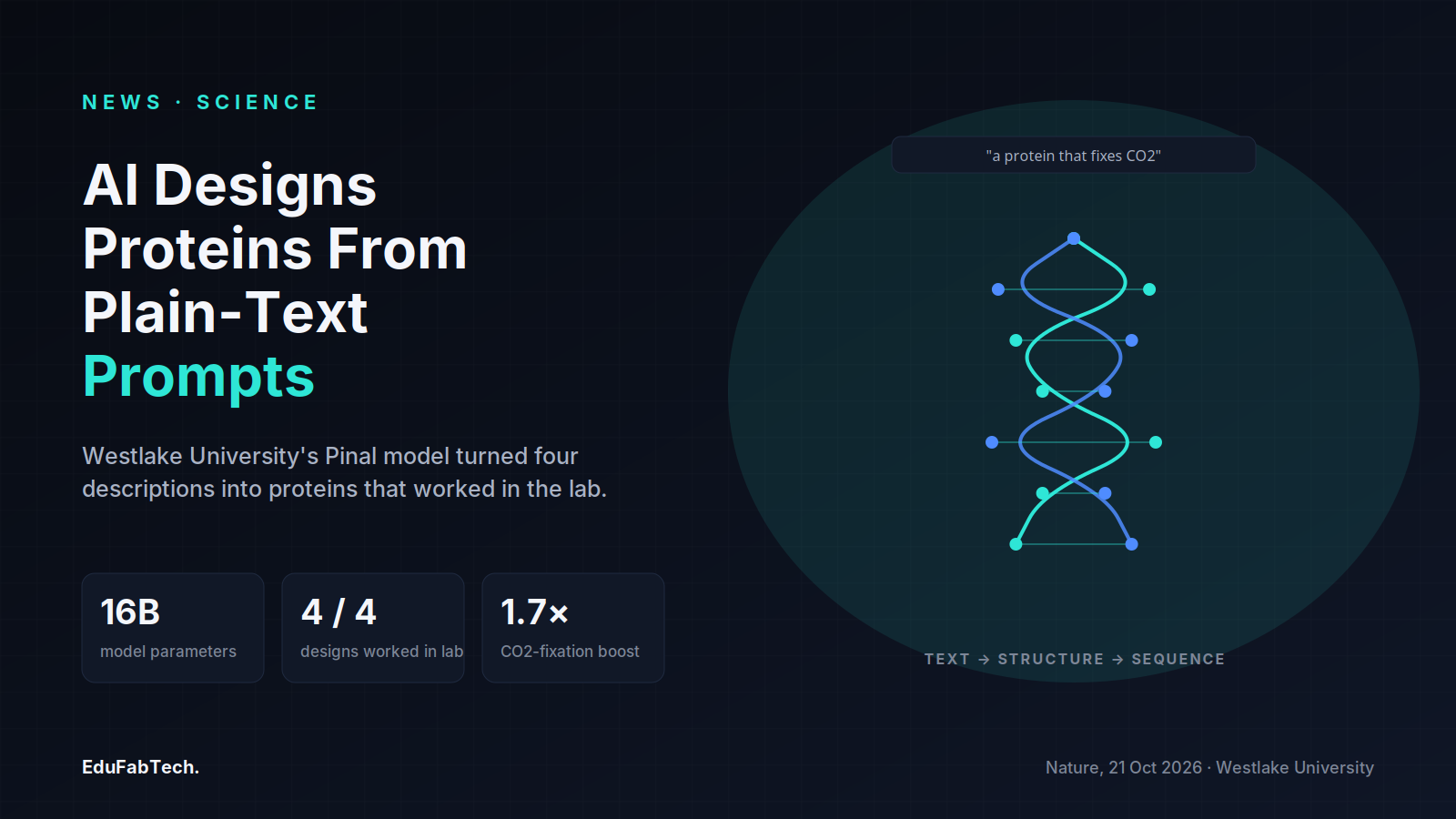
A team led by Fajie Yuan at the School of Engineering of Westlake University in Hangzhou, China, reported in Nature on 21 October 2026 that an AI model it built, called Pinal, can take a plain-language description of a desired protein function and generate a working protein sequence for it. The team tested Pinal on four separate design tasks — a fluorescent protein, two enzymes and a carbon-fixation helper protein — and reported that all four produced the intended activity when made and tested in the lab.
A model built on structure first, sequence second
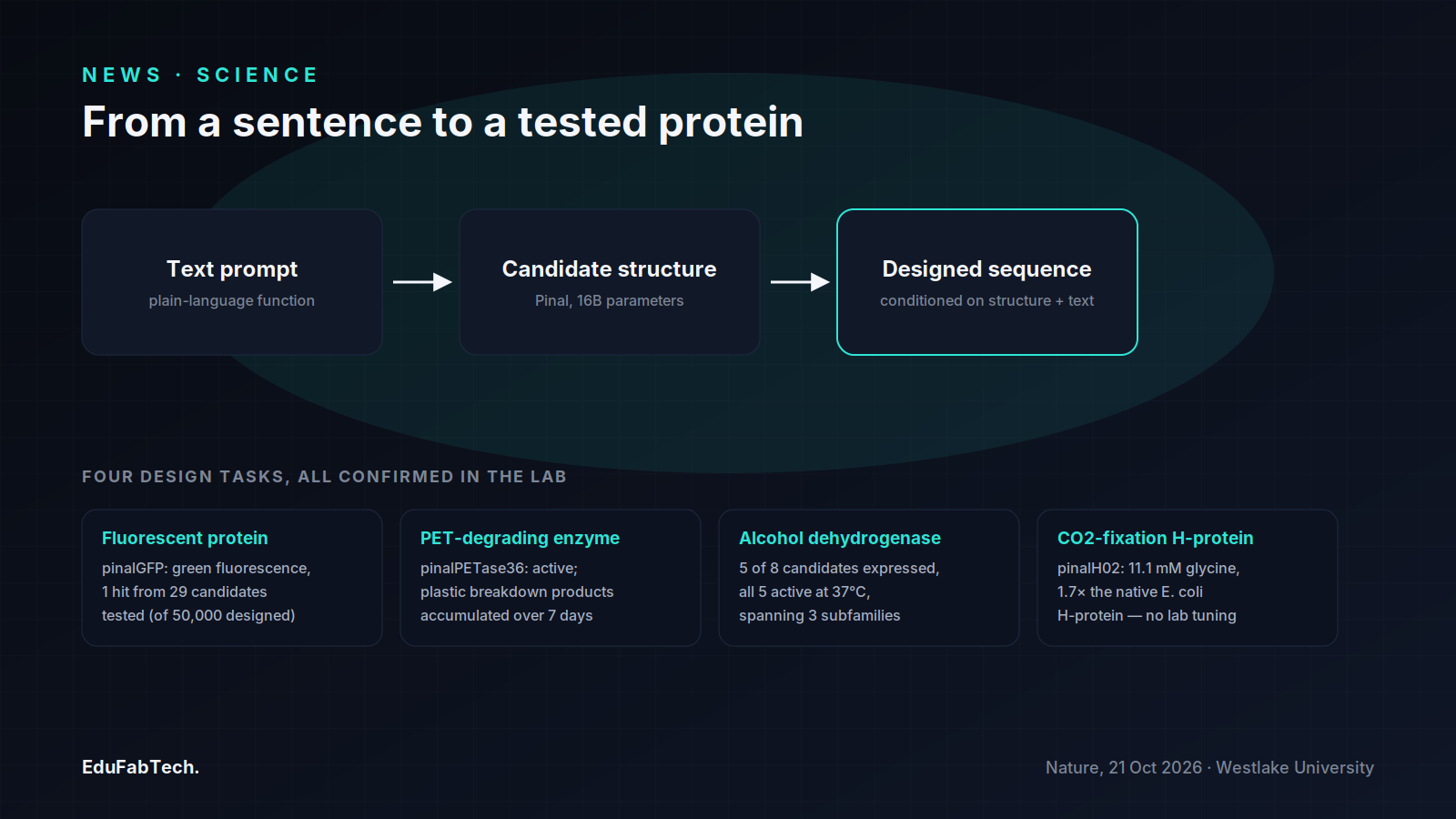
Pinal is a 16-billion-parameter foundation model trained on 1.7 billion synthetically annotated protein-text pairs linking functional descriptions to protein sequence and structure, according to the final preprint version of the paper posted on bioRxiv. Rather than generating a protein sequence directly from text, the model works in two stages: it first generates a candidate protein structure from the language instruction, then designs a sequence conditioned on both that structure and the original text. The authors' rationale is that protein structure is more conserved than sequence, making it a more stable intermediate representation to generate from a text description before committing to a specific chain of amino acids.
Four tasks, four proteins that worked in the lab
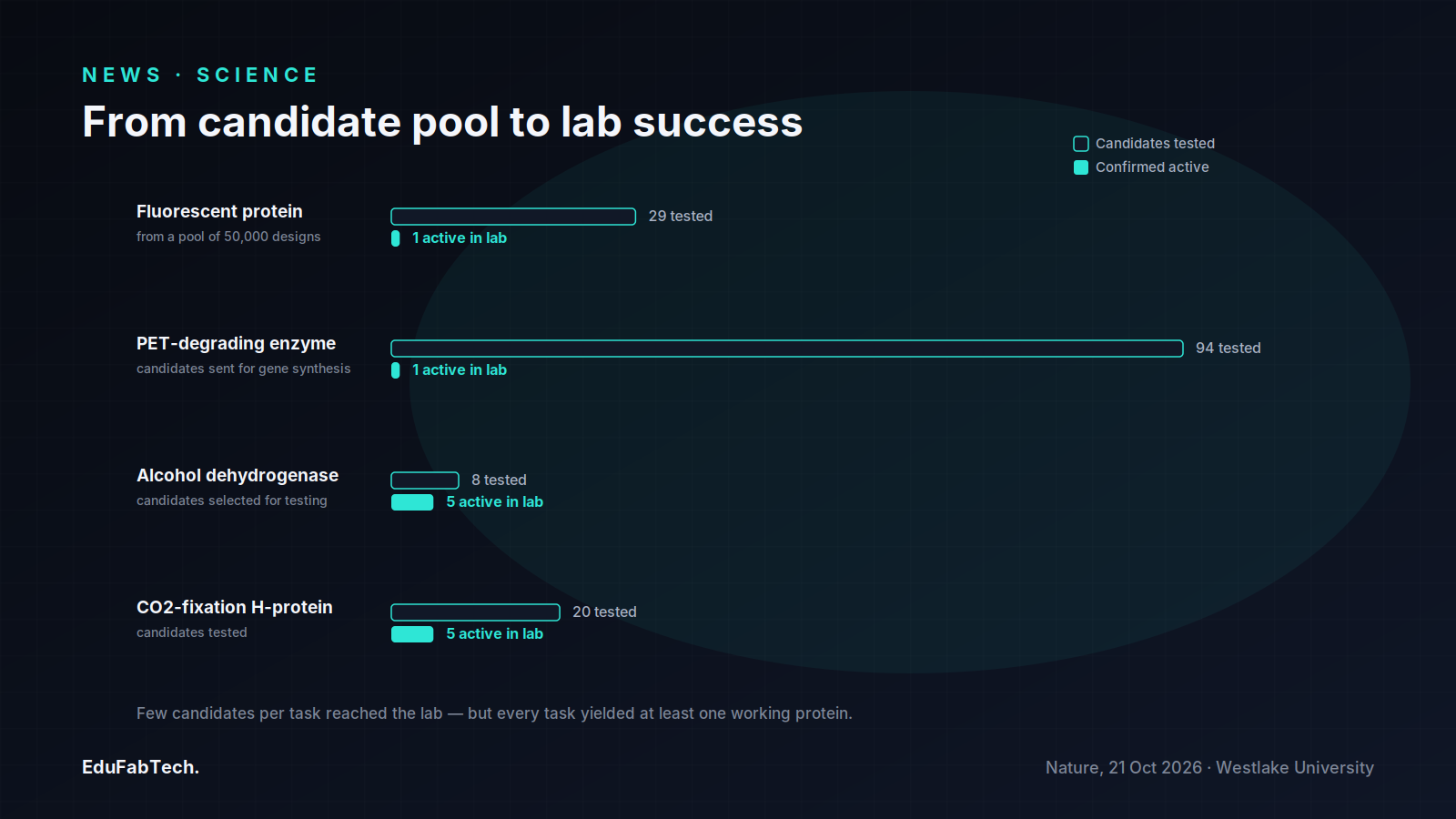
For a green fluorescent protein, the team started from 50,000 candidate designs, narrowed them to 29 for testing, and found one, named pinalGFP, that produced green fluorescence with excitation and emission spectra "analogous to those of natural avGFP," though with a more complex oligomeric state than the primarily dimeric natural protein, the paper reports.
For a PET-degrading enzyme, the researchers selected the top 94 candidates for gene synthesis and identified one, pinalPETase36, with catalytic activity, showing progressive accumulation of plastic-degradation products over seven days. For alcohol dehydrogenase, eight candidates were selected for testing; five were successfully expressed and purified, and those five spanned three distinct subfamilies and all showed detectable activity at 37°C.
The fourth task targeted a metabolic "H-protein" used in a multi-enzyme CO2-fixation pathway. Of twenty candidates tested, five were active, and the top performer, pinalH02, drove glycine synthesis to a final titer of 11.1 mM — a 1.7-fold increase over the native E. coli H-protein — without any iterative experimental optimization, according to the paper.
Why this matters beyond one lab
For students and researchers in computational biology and synthetic biology, the result is notable less for any single protein than for the workflow: a natural-language prompt, run through a single model, produced a structure and sequence that someone then expressed, purified and measured — and it worked without the multiple rounds of lab-based optimization that de novo protein design has typically required. The CO2-fixation result is the clearest illustration, since the designed H-protein outperformed its natural counterpart in a pathway relevant to engineering microbes for carbon capture, on the first attempt reported.
The authors also make the underlying model available for others to test. A demo interface is published at denovo-pinal.com, referenced in the paper, letting users submit their own functional descriptions.
What the authors say is still limited
The paper is explicit that the four successes do not mean the method generalizes freely. The authors state that "Pinal's capabilities are constrained by the granularity and coverage of available biological annotations," and note that the candidates advanced to experimental testing in each task were "prioritized conservatively" using in silico proxies such as AlphaFold confidence and ProTrek scores, which they say "may restrict exploration to a limited region of the design space." In practice, that means the model was asked to pick its most confident designs out of much larger candidate pools — 29 out of 50,000 for the fluorescent protein, for instance — rather than being judged on an unfiltered success rate across everything it generates.
Even with that caveat, the four confirmed results span different protein classes: a fluorescent reporter, two enzymes with distinct catalytic mechanisms, and a metabolic pathway component. For researchers deciding whether to try text-prompted design on their own target protein, the paper's own framing is the useful signal — a demonstrated but conservatively filtered capability, not a general guarantee that any described function will yield a working protein on the first try.
Who worked on it
The Nature paper lists Fengyuan Dai and Fajie Yuan among the authors based at Westlake University's School of Engineering and the Zhejiang Key Laboratory of Low-Carbon Intelligent Synthetic Biology, alongside collaborators including Hongyuan Lu at the Hong Kong University of Science and Technology (Guangzhou). The paper declares no competing interests.
A quick question for readers
Which study habit do you think is most overrated?
Some popular habits have little evidence behind them. Which one do you think gets too much credit?
Pick an answer, create a free account in a minute, and your vote counts. Already a member? Sign in
Comments 2
Comment-
The number that jumps out is the filtering ratio on the fluorescent protein: 50,000 candidates down to 29 tested, with one that worked. That…
-
The H-protein number is the one I'd actually trust: 11.1 mM, a clean 1.7-fold improvement over the native E. coli enzyme, on a pathway with…
Join free to read the full comments and reply Comments are between members; an account takes a minute.
Source: Nature
Sources (2)
- Fengyuan Dai, Fajie Yuan et al.. Programmable design of functional proteins from natural language. Nature, 2026. nature.com ↗ · checked 24 Oct 2026
- Fengyuan Dai, Fajie Yuan et al.. Programmable design of functional proteins from natural language. bioRxiv (Cold Spring Harbor Laboratory), 2026. biorxiv.org ↗ · checked 24 Oct 2026