PISA 2025: Reading and Maths Scores Fall to Record Lows Across the OECD
The OECD's test of 760,000 15-year-olds in 91 countries and economies finds reading and maths at their lowest recorded levels since 2015, with low performers rising sharply.
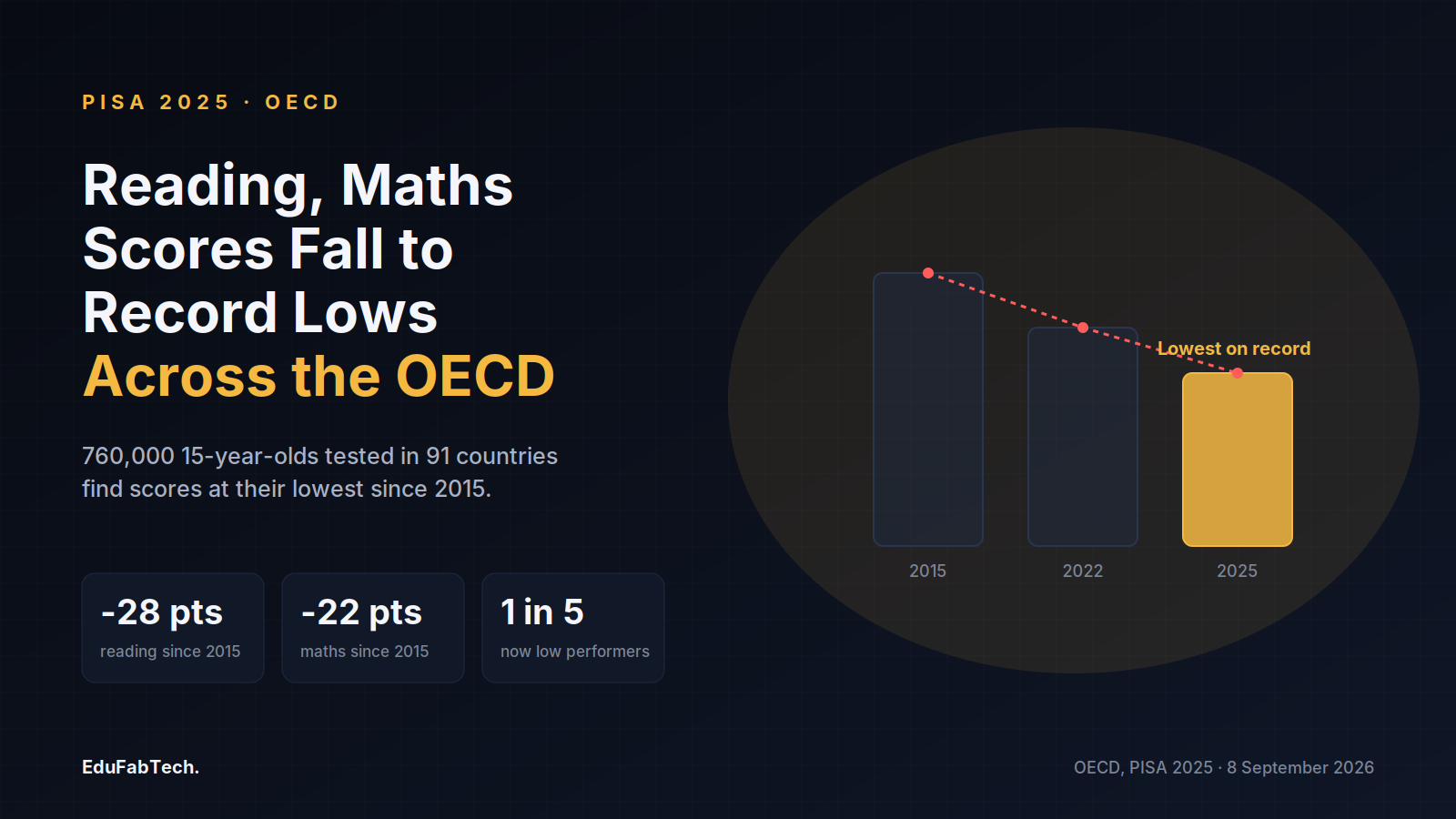
On 8 September 2026, the OECD published the results of PISA 2025, the seventh cycle of its Programme for International Student Assessment since 2000. Reading and mathematics scores across its member countries fell to the lowest levels the OECD has recorded, continuing a decline that started well before the pandemic and has not reversed since.
A test of unusual scale
PISA 2025 tested roughly 760,000 15-year-olds across 91 countries and economies, a sample the OECD says represents about 33 million students of that age worldwide. Every cycle rotates which subject gets the deepest treatment; this one focused on science, alongside the regular reading and mathematics tests, and added a new domain — Learning in the Digital World — assessed for the first time.
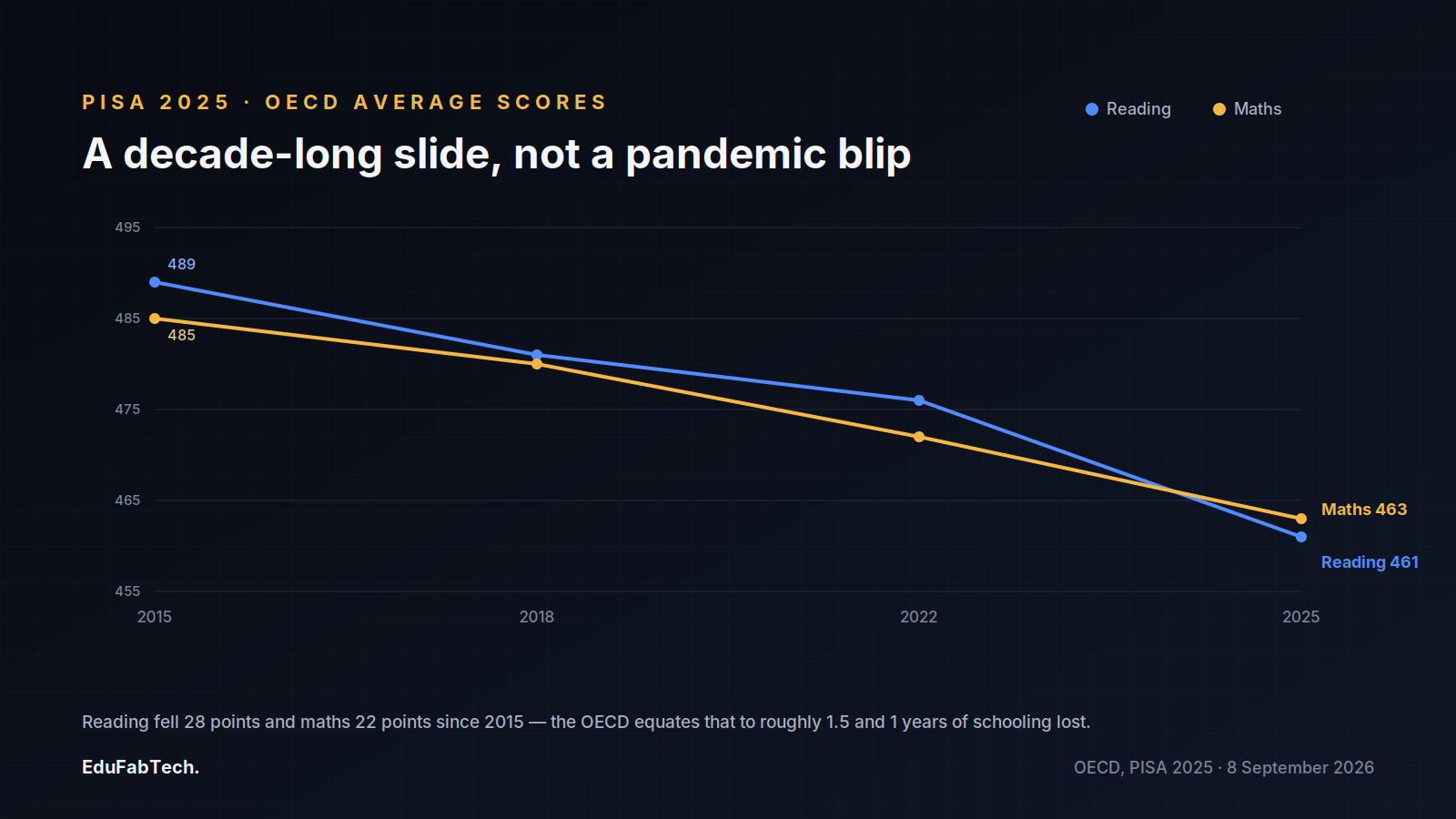
The headline numbers are stark. Across OECD countries, average reading scores fell by 28 points between 2015 and 2025, which the organisation equates to roughly a year and a half of schooling; mathematics fell by 22 points, about a year of schooling. Science held closer to steady, declining only modestly over the same decade after a sharper fall between 2009 and 2022. Non-OECD participants saw smaller but still real drops — 16 points in reading and 8 points in mathematics since 2015.
Who is ahead, who fell furthest
The 2025 OECD averages were 482 in science, 463 in mathematics and 461 in reading. Beijing-Shanghai-Jiangsu-Zhejiang (B-S-J-Z, China) and Singapore remained the highest-performing systems across all three domains, though the OECD is careful to note that the Chinese sample covers four provincial-level jurisdictions rather than a national one. B-S-J-Z's own reading score dropped from 555 in 2018 to 527 in 2025 — evidence that even top performers are not immune to the trend.
| System | Reading | Mathematics | Science |
|---|---|---|---|
| B-S-J-Z (China) | 527 | 612 | 597 |
| Singapore | 535 | 563 | 560 |
| Australia | 491 | 478 | 509 |
| United States | 490 | 463 | — |
| OECD average | 461 | 463 | 482 |
Some of the sharpest national declines were reported in Europe. Spain recorded its worst results since PISA began in 2000, and the Netherlands' education ministry says almost four in ten Dutch children are now at risk of leaving school with a low level of literacy, prompting a promised national action plan this autumn. In the United States, students scored at exactly the OECD mathematics average (463) and above it in reading (490); 24 other countries and economies outscored the US in mathematics, ten of which also outscored it in reading.
More low performers, a narrower but uneven equity gap
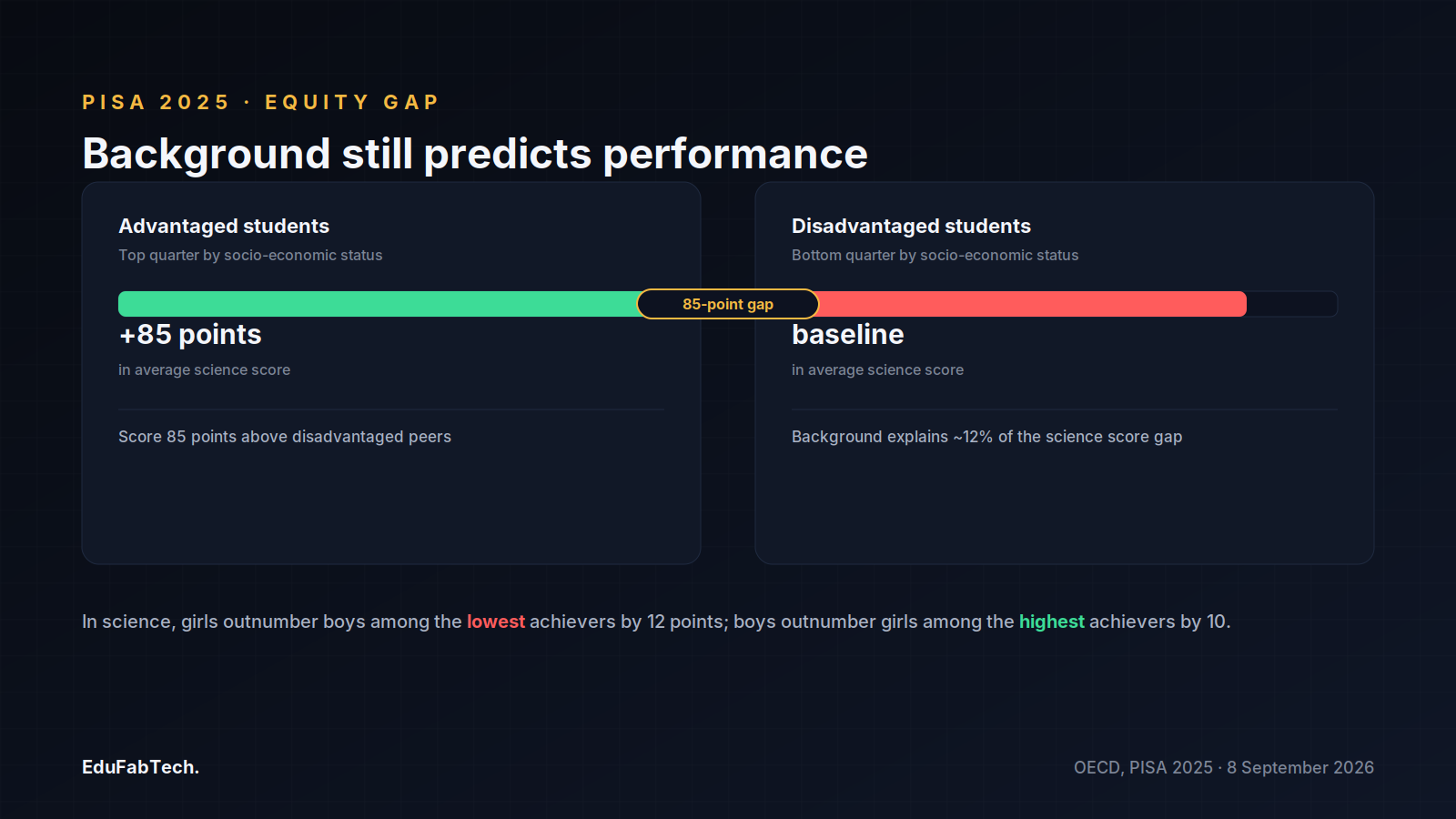
Across OECD countries, one in five 15-year-olds is now a low performer across science, mathematics and reading combined, up from 16% in the 2022 cycle. Socio-economic background remains one of the strongest predictors of achievement: advantaged students scored 85 points higher in science than disadvantaged students on average across the OECD, and that background accounts for about 12% of the within-country variation in science scores. The gap between advantaged and disadvantaged students did narrow since 2022 — but the OECD attributes this mainly to advantaged students scoring worse, not to disadvantaged students catching up. Gender differences also shifted: in science, girls outnumber boys among the lowest achievers by 12 points, while boys outnumber girls among the highest achievers by 10 points.
National data adds detail the OECD averages can hide. In Australia, students from the highest socio-economic quarter outscored those from the lowest quarter by 74 to 83 points depending on subject, and First Nations students scored 72 to 76 points below their peers, according to analysis published by Teacher Magazine, produced by the Australian Council for Educational Research.
A new domain built for the digital classroom
Learning in the Digital World is the first PISA domain built specifically around how students learn using computational tools — not just whether they can operate software, but whether they can regulate their own problem-solving inside an open-ended digital environment with feedback and scaffolding. Test units ran for 30 minutes each, with students working through increasingly complex tasks that required them to reason, adjust strategy and use digital resources without step-by-step instructions. The OECD average on this new scale was 500; Australia scored 532, a wider margin above the OECD average than in any of the three traditional subjects.
The domain matters beyond this single cycle: it is the OECD's first direct attempt to measure whether 15-year-olds can learn independently in the kind of interactive, tool-rich settings — generative AI assistants included — that are now common in and out of classrooms. Because it was assessed for the first time in 2025, there is no trend line yet; the number to watch will be whether this score moves the way reading and mathematics have.
What countries are doing about it
Government responses announced alongside the results have so far been modest and national rather than coordinated. France says it will direct proven teaching practices toward middle schools. Spain points to cooperation programmes it has run since 2024. The Netherlands has promised an autumn 2026 action plan aimed specifically at reversing its literacy slide. None of these responses yet addresses what several education researchers interviewed by Euronews flagged as contributing factors: rising phone and screen use during the school day, a decline in recreational reading, and less consistent parental engagement with schools.
The three-year gap until the next PISA cycle in 2028 will be the real test of whether any of these measures change the trend line — or whether, as has now happened across two consecutive cycles, the scores keep falling.
- OECD. PISA 2025: Students' reading and mathematics performance declined sharply across the OECD. OECD, 2026. link
- OECD. PISA 2025 Results (Volume I). OECD Publishing, 2026. doi:https://doi.org/10.1787/73451bc5-en
- Marta Rodriguez Martinez. Calls for action in Europe as PISA results show fall in child literacy. Euronews, 2026. link
- Teacher Magazine. PISA 2025: Australian students perform above OECD average in all domains. Teacher Magazine (Australian Council for Educational Research), 2026. link