Predatory Journals Used AI to Publish Papers Under Stanford and Berkeley Names
A Times Higher Education investigation published 9 November 2026 found three obscure journals fabricating AI-generated papers under real academics' names, with an editorial board based mostly in India.
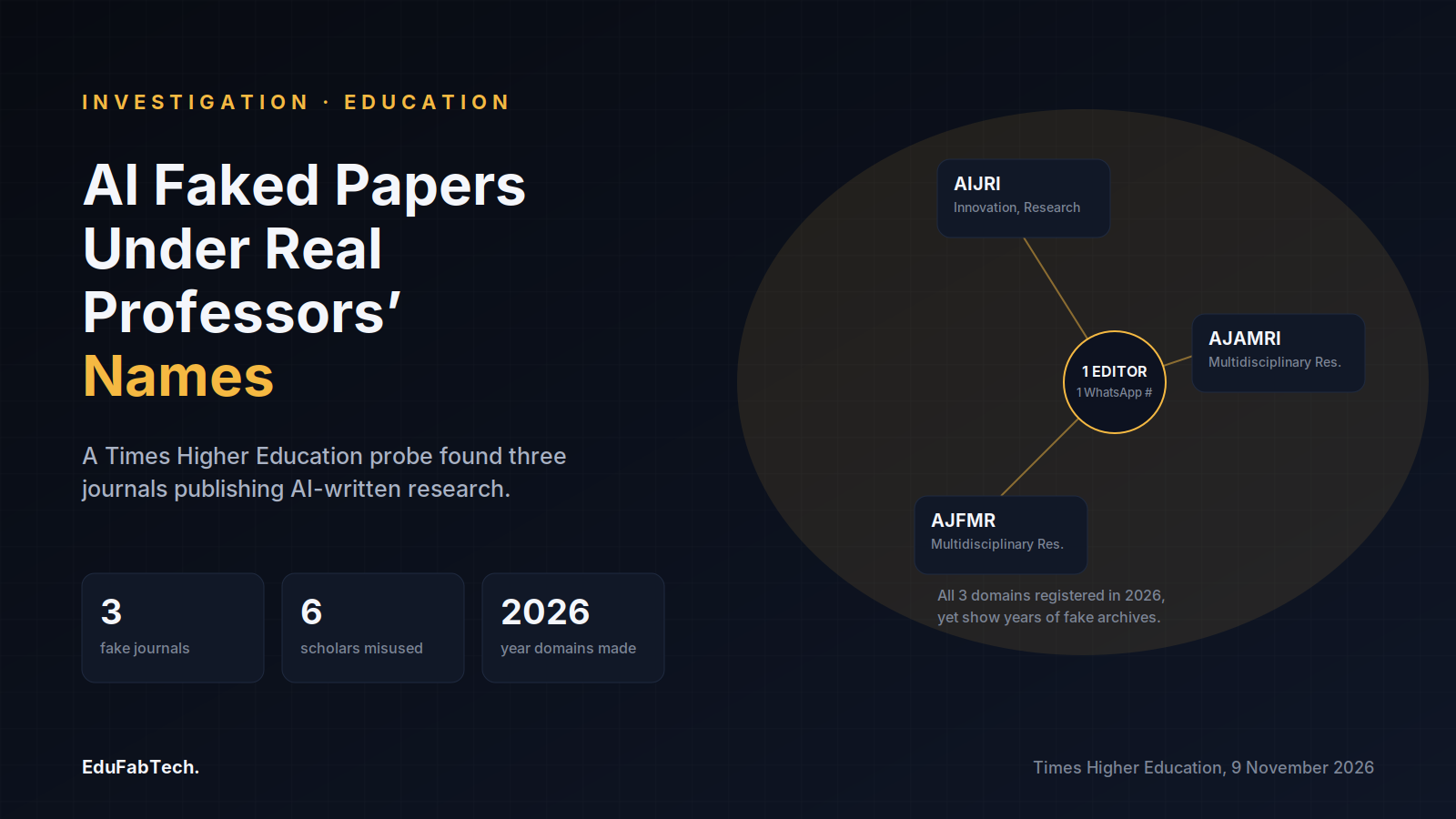
Three little-known academic journals have been publishing AI-generated papers under the names of researchers who never wrote them, according to a Times Higher Education investigation published on 9 November 2026. The journals listed computer scientists from Stanford University and the University of California, Berkeley as authors without their knowledge, while most of the editorial board members named on the journals' sites are affiliated with Indian institutions.
The pattern surfaced when Alan Said, a professor of computer science at the University of Gothenburg, received a Google Scholar notification about a paper attributed to him in the American International Journal of Research and Innovation (AIJRI), titled "Intelligence Systems Supporting Sustainable Global Development." Said told Times Higher Education the paper "looks AI-generated" and "has no content, it's like slop," noting that while the topic was plausible for his field, he had never written or submitted it.
Said traced two sister titles sharing the same layout, editor-in-chief and editorial board: the American Journal of Advanced Multidisciplinary Research and Innovation (AJAMRI) and the American Journal For Multidisciplinary Research (AJFMR). All three list Denish Brown as editor-in-chief and share a WhatsApp contact number with a US area code, Times Higher Education reports. The domains for all three were registered in 2026, yet their websites display archives of papers purportedly published years earlier.
Names borrowed without consent
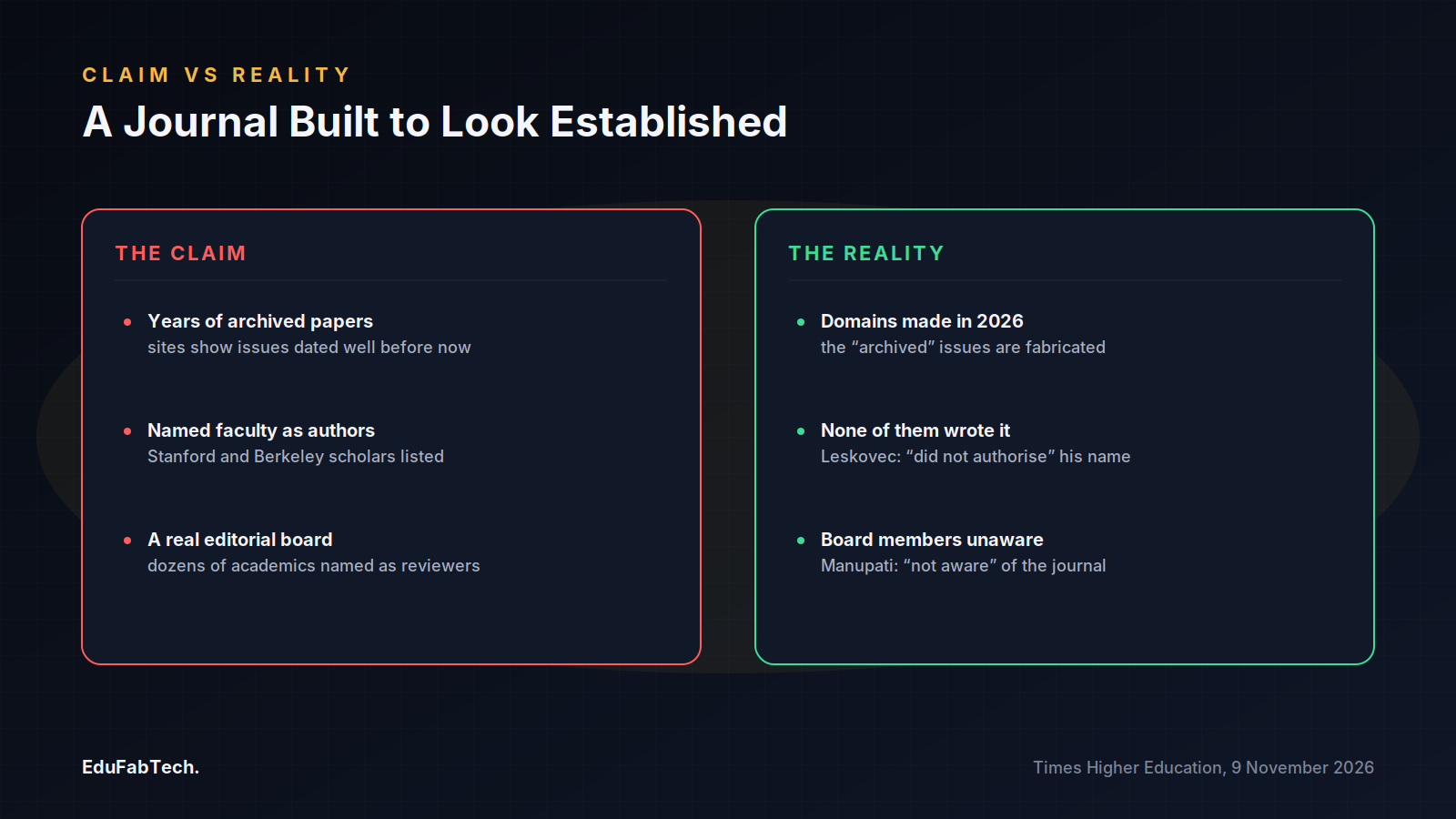
AJAMRI listed papers attributed to Stanford computer scientists Fei-Fei Li, Christopher Manning and Jure Leskovec, and to Berkeley professors Michael I. Jordan and Stuart Russell, according to the investigation. Leskovec told Times Higher Education: "I can confirm that I did not write this paper, was not involved in its submission and did not authorise the use of my name." He said he only learned the paper existed when the publication contacted him.
An editorial board that says it never agreed
The journals list dozens of editorial board members, mostly affiliated with Indian higher education institutions, Times Higher Education found. One of them, Kanakaraju Manupati, a postdoctoral researcher at Virginia Commonwealth University, said: "I was not aware of the existence of this journal and was not associated with it." He said he was surprised to see his own name on the editorial board when he checked the site.
The three journals also charge differently depending on where authors are based. AIJRI and AJAMRI charge $200 for papers with five or more authors who are not based in India, Times Higher Education reports, while AJFMR charges $80 for one to four authors and $10 for papers with five or more authors.
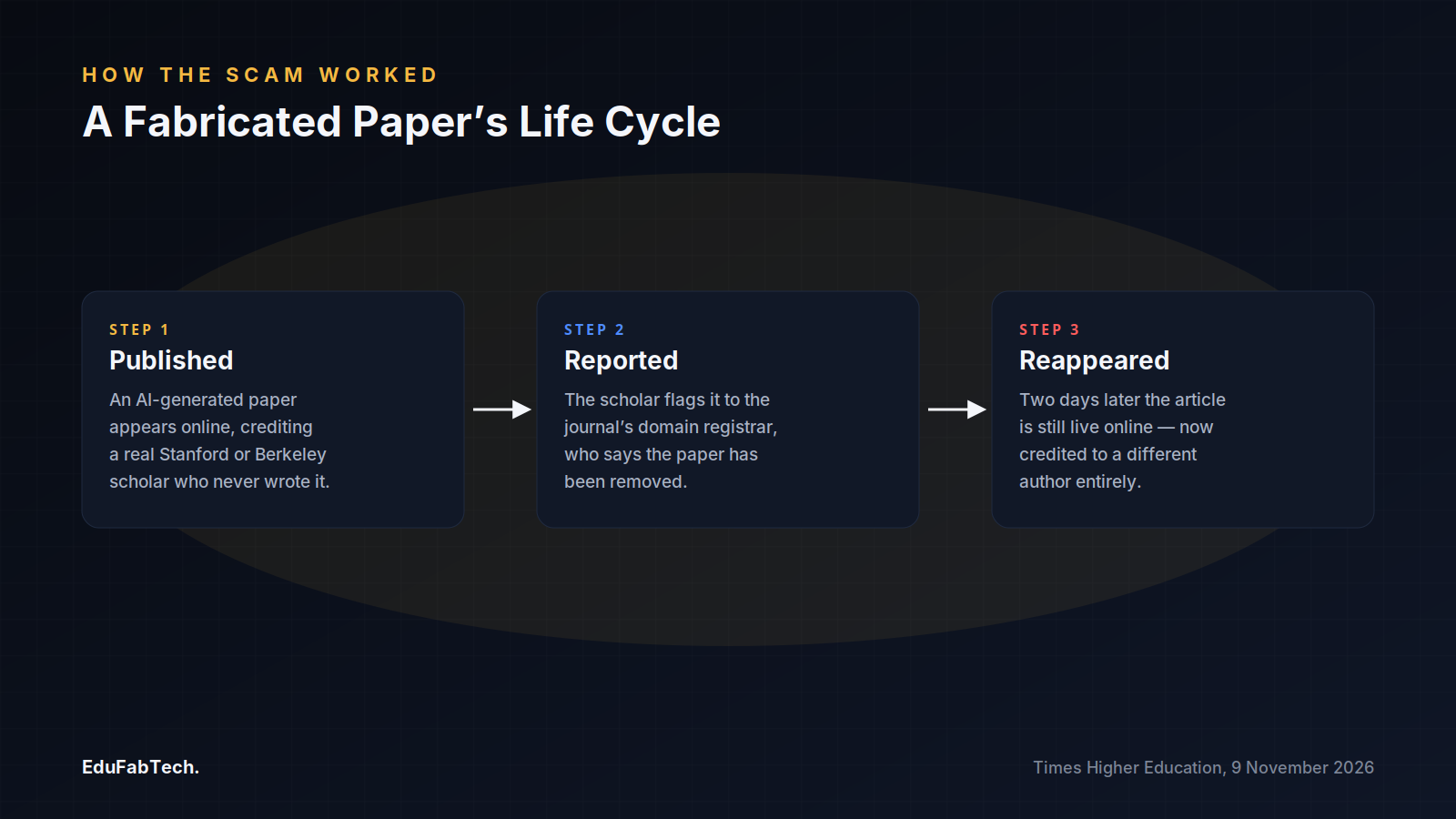
When Said reported the fraudulent paper to the journal's domain registrar, he was told the article had been removed. It had not: the paper stayed online with the credited author's name swapped out, and within two days the same text had been attributed to three different authors in separate versions, according to the investigation.
What it means for students and researchers
Said said his concern extends beyond his own name being misused. "If a new PhD student were to see my name in this journal, they might think it's OK to submit there too," he told Times Higher Education. For early-career researchers who rely on citation counts and journal listings to judge where to publish, or for hiring and tenure committees scanning a candidate's record, a title that mimics a real journal's branding while fabricating authorship by senior names is harder to screen out than conventional paper-mill schemes already flagged in other fields.
Times Higher Education contacted all three journals for comment but had not received a response by the time of publication.
A quick question for readers
Which study method makes things stick for you until the exam?
Research says some methods work far better than others. Vote first, then see whether students agree with the evidence.
Pick an answer, create a free account in a minute, and your vote counts. Already a member? Sign in
Comments 3
Comment-
The part that undercuts the whole takedown is the registrar response: Said reported the fraudulent paper and was told it had been removed, b…
-
The $200-versus-$80-versus-$10 pricing split by author country and headcount is the detail I'd want explained, not just reported. That's not…
-
The detail that'd stick with early-career researchers is the pricing split: charging more for non-India-based authors on AIJRI/AJAMRI but ke…
Join free to read the full comments and reply Comments are between members; an account takes a minute.
Source: Times Higher Education
Sources (2)
- Seher Asaf. 'AI slop' papers published under prominent academics' names. Times Higher Education, 2026. timeshighereducation.com ↗ · checked 11 Nov 2026
- University of Gothenburg. Alan Said, staff profile. University of Gothenburg, 2026. gu.se ↗ · checked 11 Nov 2026