PyTorch 2.14 Adds a Fault-Tolerant Distributed Backend and Native Linear Algebra for Apple Silicon
The open-source framework's newest release lets large training jobs recover from a failed machine without restarting, while extending compiled execution and native GPU kernels across NVIDIA, AMD, Intel and Apple hardware.
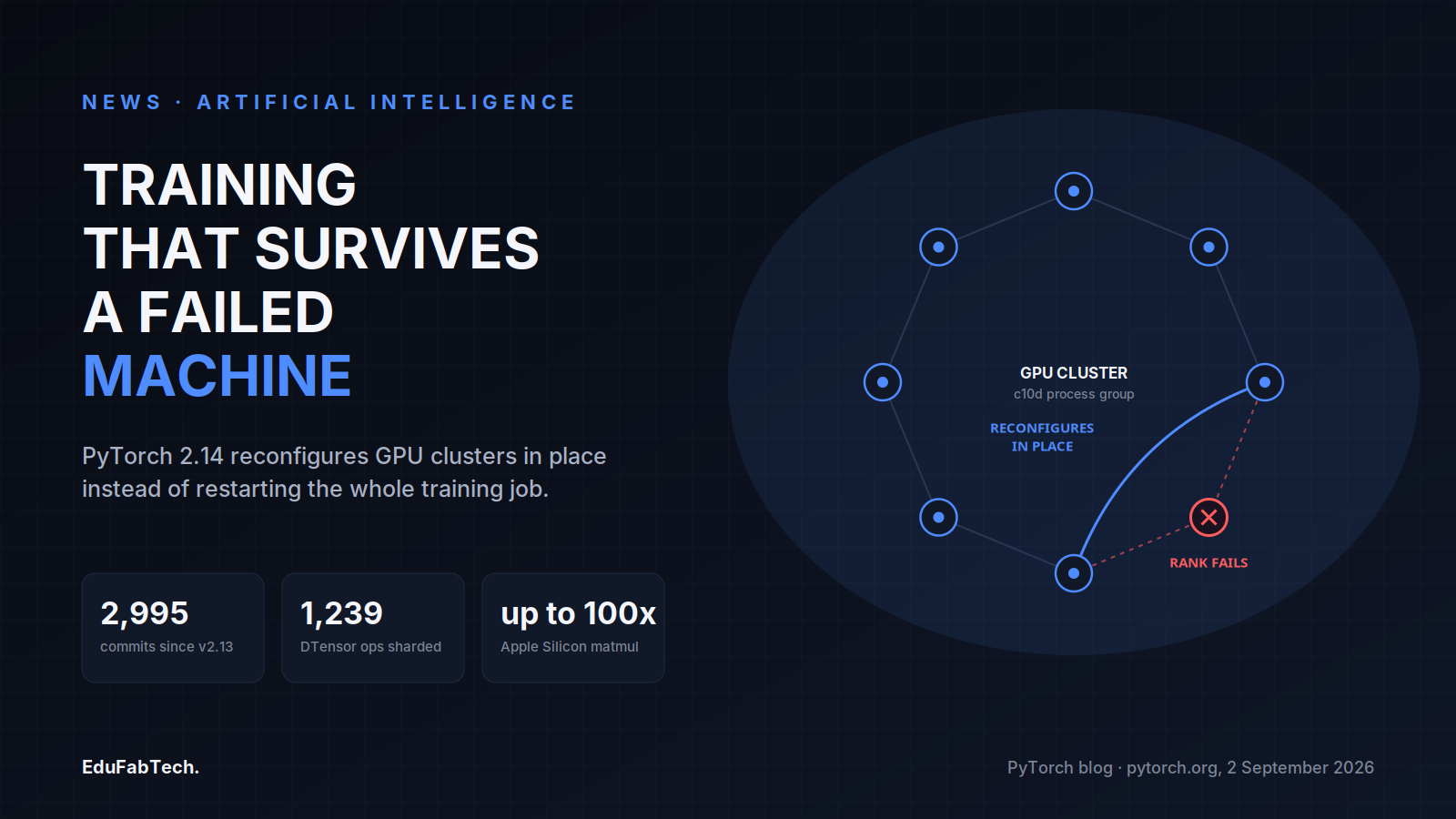
PyTorch 2.14 became generally available on September 2, 2026, and the project walked through the release in a live Q&A on September 17, 2026, featuring maintainers from Meta and Reflection AI. The release itself is large: 2,995 commits from 487 contributors since version 2.13, according to the official PyTorch blog. The headline change is not a speed record but a resilience one — distributed training jobs can now survive a single machine failing without discarding the whole run.
What changed
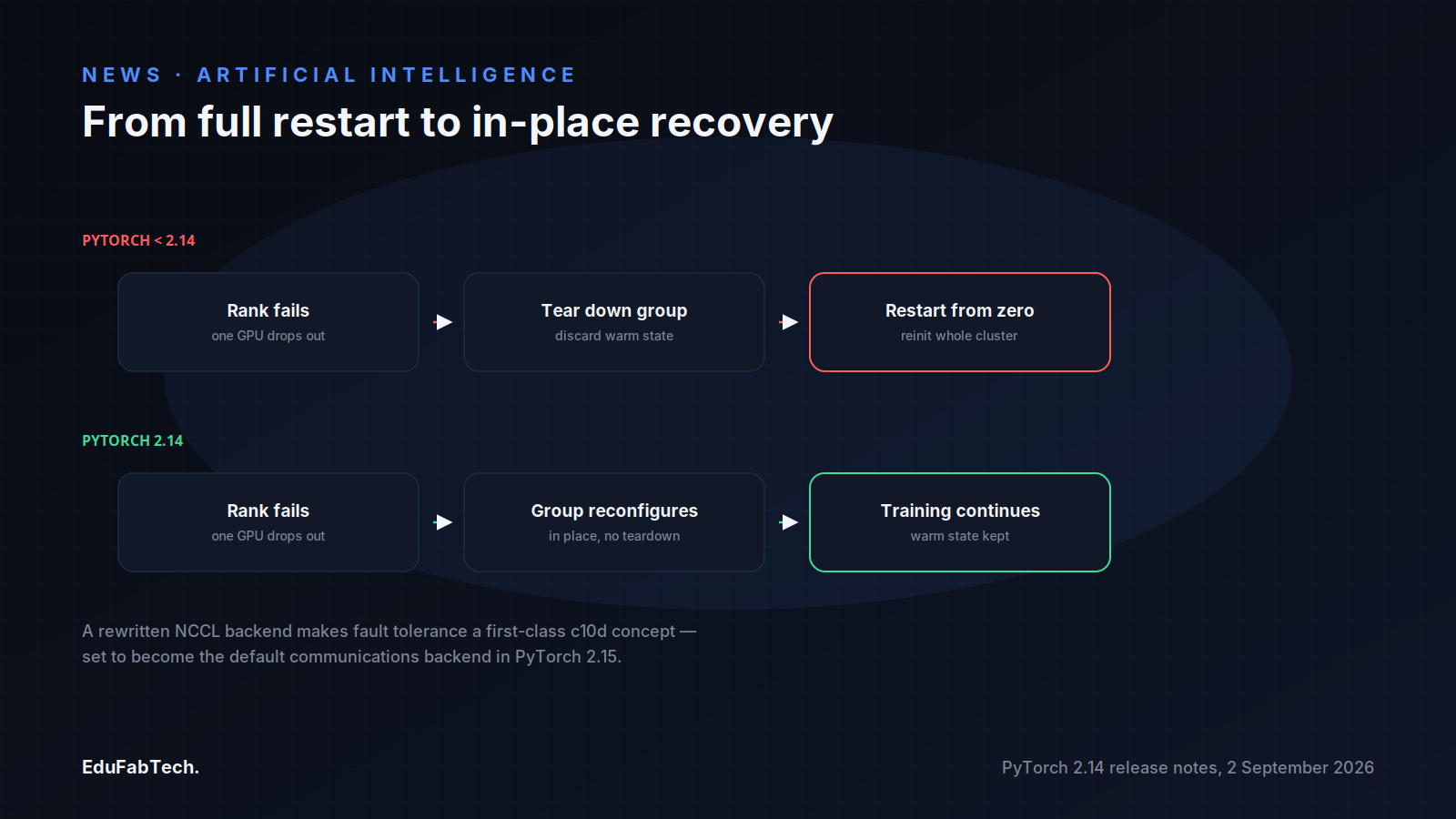
Large model training runs on hundreds or thousands of GPUs coordinated through a communications library, historically NVIDIA's NCCL. Until now, if one machine in that job dropped out, PyTorch's standard response was to tear down the entire communication group and restart it, discarding whatever "warm" state — cached buffers, established connections — the rest of the cluster had built up. PyTorch 2.14 ships a preview of a rewritten NCCL backend, ported from the project's torchcomms effort, that lets a process group reconfigure itself in place after a rank fails, rather than restart from zero. The release notes describe this as making fault tolerance "a first-class c10d concept" rather than a backend-specific detail, and note the new backend is slated to become the default in PyTorch 2.15.
The same release also makes the project's Flight Recorder — a trace buffer used to diagnose hung or mismatched collective operations — work across any communications backend instead of only NCCL, and extends basic fault-tolerance support to the older Gloo backend as well.
Why the resilience matters more than the speed numbers
Training runs that occupy large GPU clusters for weeks are exposed to hardware failures simply by scale and duration; a job spanning thousands of accelerators will statistically lose individual nodes over its lifetime. A full-group restart after each failure wastes both the compute already spent and the time needed to reinitialize communication across the whole cluster. In-place reconfiguration is the kind of change that shows up as fewer wasted GPU-hours rather than as a benchmark number, which is why it sits alongside more visible performance work in this release rather than being the loudest headline.
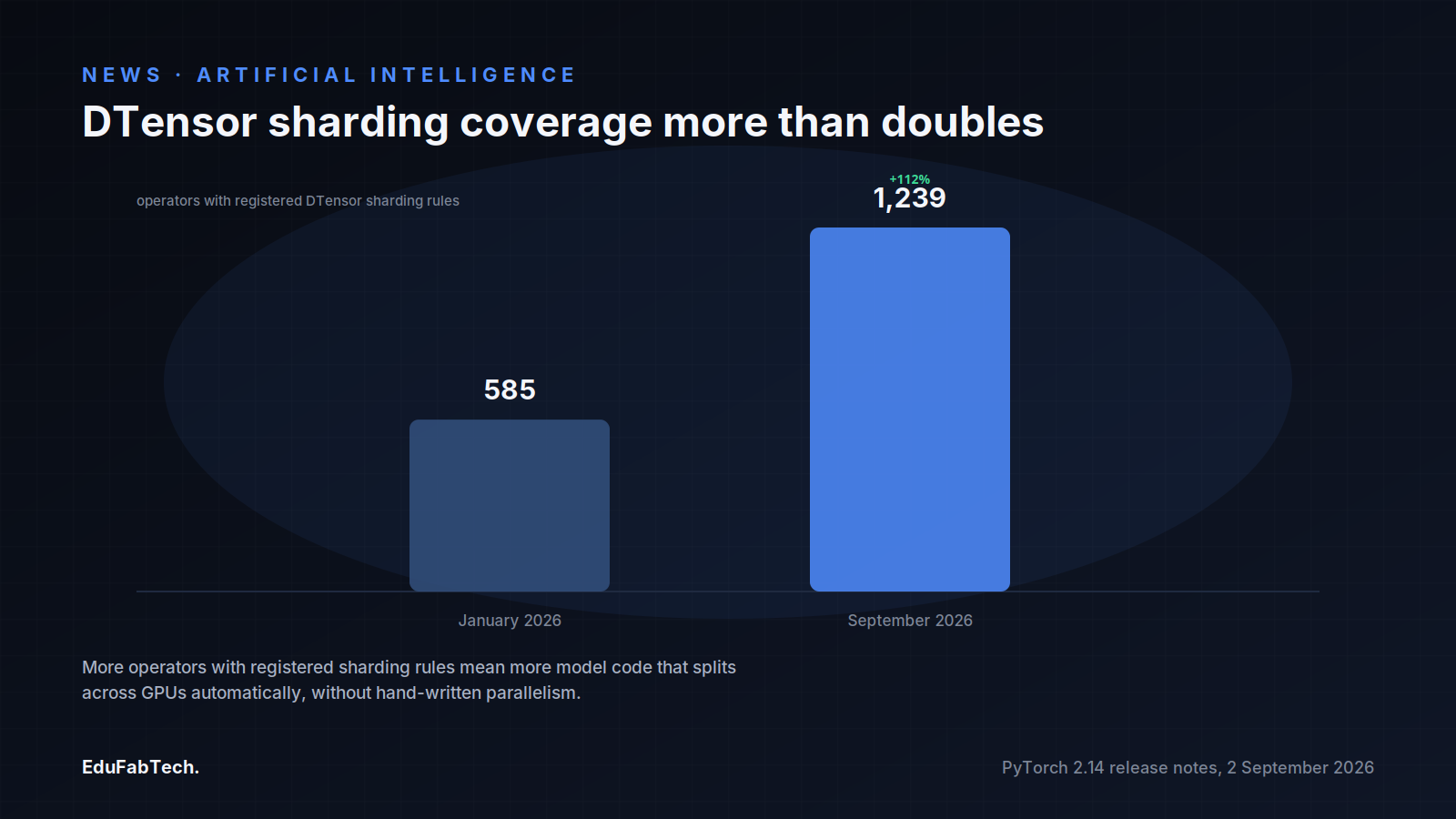
PyTorch 2.14 also adds one-sided remote-memory-access ("RMA") operations to its distributed layer, letting one machine read or write another's memory directly instead of requiring both sides to participate in a synchronized collective call — useful for irregular access patterns such as expert routing in mixture-of-experts models. Separately, the framework's tensor-sharding system for splitting models across many devices, called DTensor, now has registered sharding rules for 1,239 operators, up from 585 in January 2026, according to the same release notes.
Kernel fusion and non-NVIDIA hardware
On the compute side, PyTorch's Inductor compiler gains NVGEMM, a matrix-multiplication backend generated with NVIDIA's CuTeDSL toolchain, and this release extends it to "epilogue fusion" — folding the operations that typically follow a matrix multiply, such as adding a bias or applying an activation function, into the same kernel instead of writing the result to memory and reading it back for a separate step. AMD's ROCm platform gains Triton-compiled grouped matrix multiplication for mixture-of-experts models, previously limited to newer NVIDIA hardware, plus an analytical tile-size selector AMD calls Origami that is now on by default for ROCm's autotuning path. Intel's XPU backend adds symmetric-memory support for scale-up deployments and per-process GPU memory tracking.
Apple Silicon receives the most user-visible jump: SVD, eigendecomposition, QR and Cholesky decompositions now run as native Metal kernels rather than falling back to the CPU or routing through Apple's higher-level MPSGraph framework. The independent outlet AlphaSignal, summarizing the release on September 11, 2026, highlighted the project's own reported gains of up to 100x on small batched matrices and 2-4x on a new attention kernel built for Apple's newer Metal Performance Primitives, while cautioning that "many additions carry the API Unstable label" and that teams should pin PyTorch and companion package versions before upgrading production systems.
What is not finished yet
The release adds binary wheels for Python 3.15, including its free-threaded ("no-GIL") build, but support is eager-mode only: calling torch.compile under Python 3.15 raises an error immediately rather than silently falling back to a slower path, and the PyTorch blog advises staying on Python 3.14 or earlier for any workload that depends on the compiler. A new higher-order operation, torch.switch, generalizes the existing two-way torch.cond branch to multi-way dispatch, aimed at simplifying traced graphs for mixture-of-experts architectures that previously required nested conditionals.
PyTorch is maintained under the PyTorch Foundation, part of the Linux Foundation, with contributions in this release credited to engineers at Meta, NVIDIA, AMD, Intel, Hugging Face, IBM, Cisco and Red Hat, among others, reflecting the framework's role as shared infrastructure across competing hardware vendors rather than a single company's product. The project's next public checkpoint is the PyTorch Conference in San Jose on October 20-21, 2026, where distributed communication, compiler work and hardware portability are listed as session topics.
- PyTorch Team. PyTorch 2.14 Release Blog. PyTorch, 2026. link
- atalman (PyTorch Release Team). PyTorch 2.14.0 General Availability. PyTorch Dev-Discuss, 2026. link
- PyTorch Project. PyTorch 2.14.0 Release Notes. GitHub, 2026. link
- AlphaSignal Newsroom. PyTorch 2.14 Ships Faster Apple Silicon and 100x GPU Speedups. AlphaSignal, 2026. link