QS's 2027 Sustainability Rankings Keep Lund on Top as Cambridge Climbs 260 Places
Published 17 November 2026, QS's table scores more than 2,000 universities across 107 locations on environmental, social and governance measures.
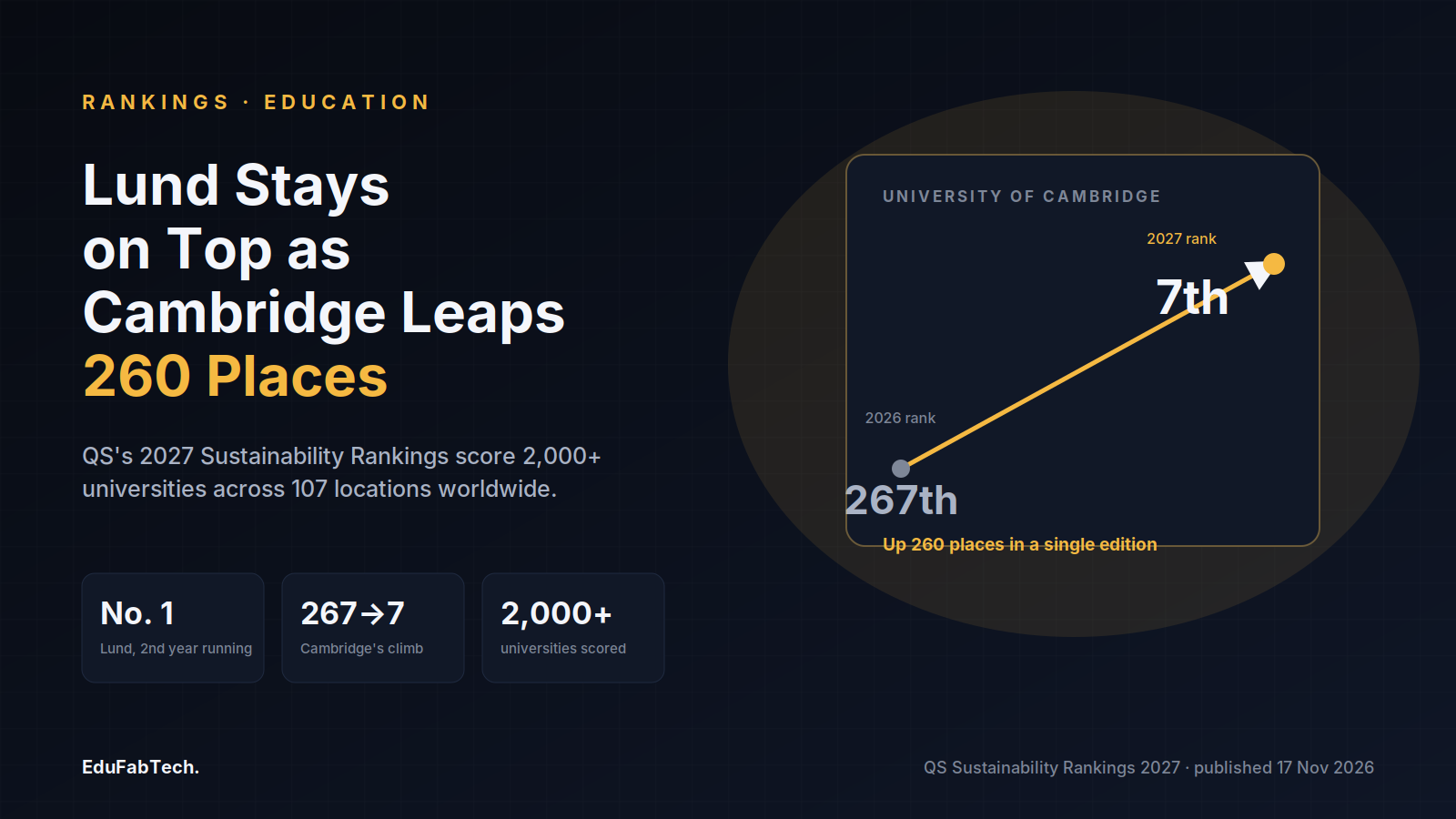
QS, the UK-based higher education analytics company, published its 2027 Sustainability Rankings on 17 November 2026, scoring more than 2,000 universities across 107 locations on environmental, social and governance measures, according to the release QS distributed through PR Newswire (2026). Lund University in Sweden holds first place for a second consecutive edition. The sharpest move inside the top ten belongs to the University of Cambridge, which rises to seventh place this year from 267th in the 2026 edition.
Who leads the table
QS's top ten for 2027, with each university's rank in the 2026 edition in brackets, reads: Lund University, Sweden (1st); ETH Zurich, Switzerland (11th); University of Toronto, Canada (2nd); University of British Columbia, Canada (5th); UNSW Sydney, Australia (7th); Stanford University, United States (13th); University of Cambridge, United Kingdom (267th); University of California, Berkeley, United States (11th); and a tie for ninth between the University of Melbourne, Australia, and University College London, United Kingdom (PR Newswire, 2026). Toronto and UBC both scored above 99 out of 100, at 99.2 and 99.1 respectively, according to a report on the rankings by CIC News (2026), which examined Canada's showing in the new edition.
How the score is built
The ranking weights Environmental Impact and Social Impact at 45% each and Good Governance at 10%, a three-category structure QS introduced for the rankings' second edition, released on 5 December 2023 and covering 1,397 institutions across 95 countries and territories, according to University World News. QS added the Good Governance category to reward universities working strategically toward the United Nations' Sustainable Development Goals, QS Rankings Manager Dr Andrew MacFarlane told the publication at the time, pointing to practices such as equality, diversity and inclusion policies, sustainable procurement and student representation on university councils. The 2027 edition, at more than 2,000 universities, is more than double the size of that second edition.
Where the big moves came from
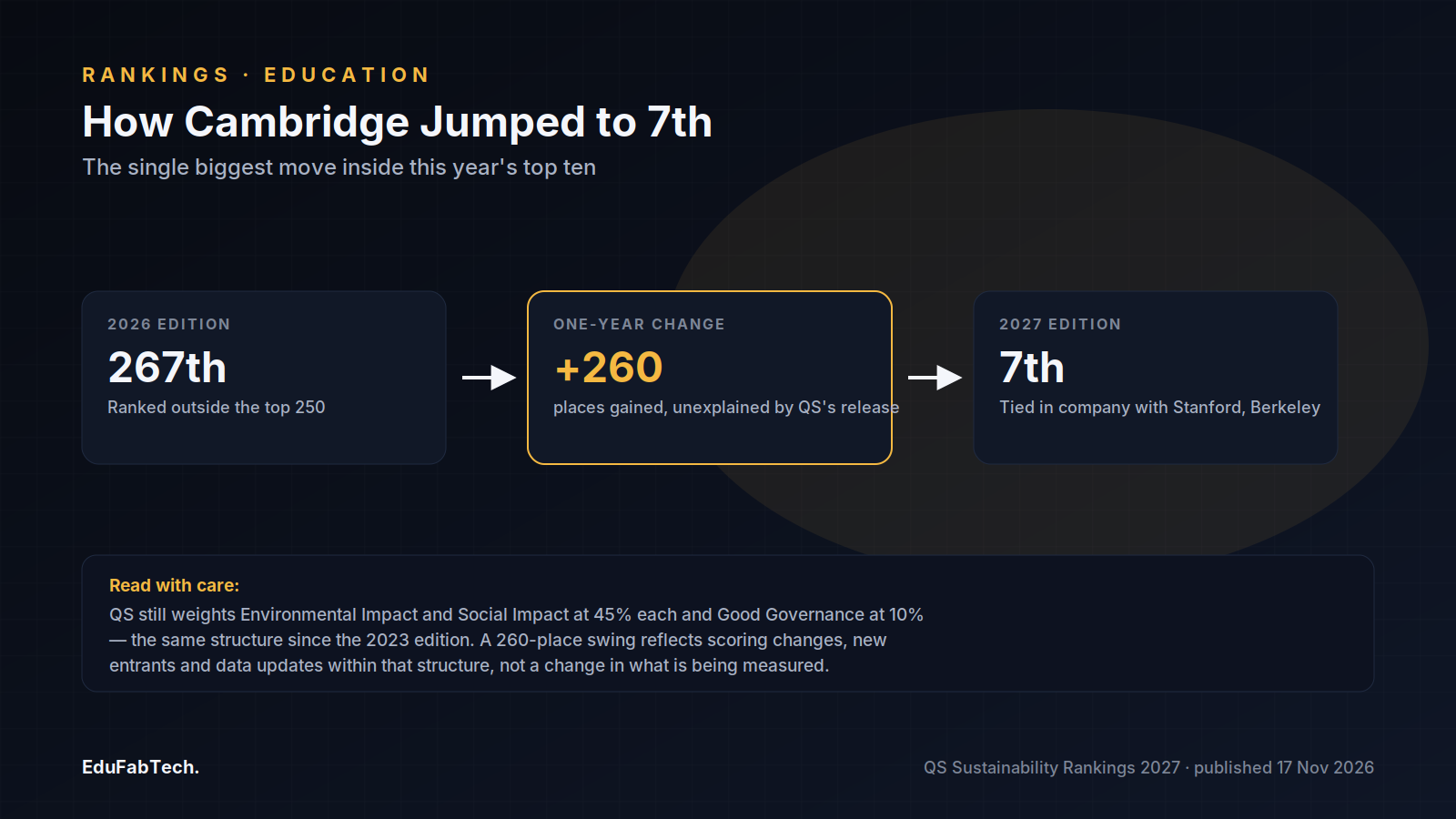
A jump of 260 places for a single institution, as Cambridge recorded this year, is unusual for a ranking built on the same weighting structure used in prior years. QS's own release does not explain the Cambridge change beyond publishing the scores, so readers comparing editions should treat large single-year swings as a reason to check the underlying category scores rather than the headline rank alone. Toronto, which led the rankings in the 2024 and 2025 editions before slipping to second behind Lund in 2026, fell to third in 2027 even though the three universities above and around it — Lund, ETH Zurich and UBC — all held or improved their positions, underscoring that movement inside a fixed methodology can still be large from one edition to the next.
How countries compare
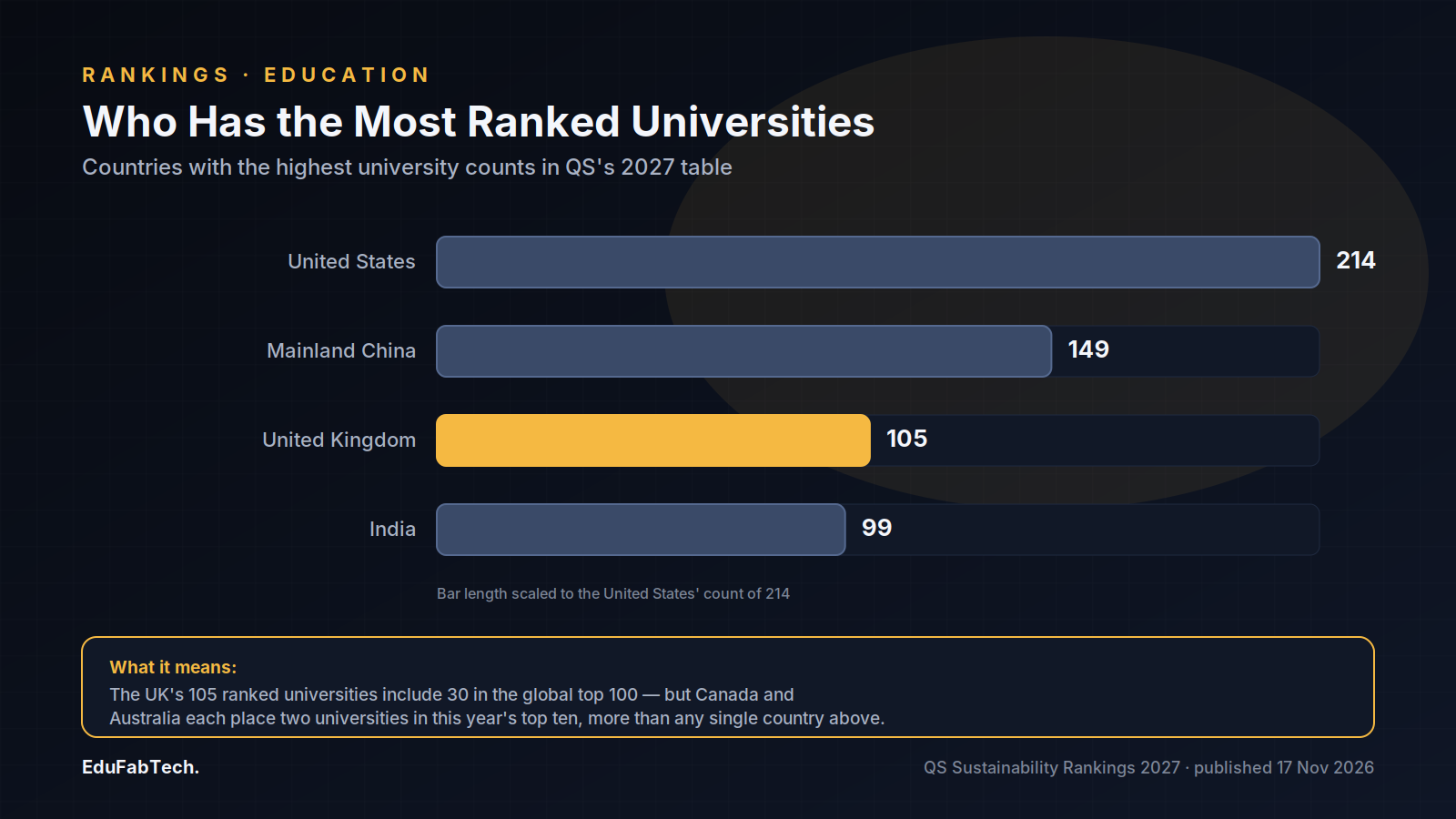
QS's release gives country-level counts rather than averages: the United States has 214 ranked universities, the most of any country; mainland China has 149; the United Kingdom has 105, including 30 in the global top 100; and India has 99 (PR Newswire, 2026). Measured by top-ten places rather than overall count, Canada and Australia each hold two spots in this year's global top ten, more than the United States, China, India or any single European country on its own.
What it means for students and researchers
Sustainability rankings of this kind are increasingly cited by prospective students weighing where to study and by university sustainability offices benchmarking their own institutions, alongside subject-specific and research-output rankings. Because the QS table scores research and operations together with governance and student outcomes, a strong rank does not by itself indicate which part of an institution's sustainability work is strongest — a university's Environmental Impact score and its Good Governance score can diverge even where the overall rank looks stable. Readers using the table to compare specific programmes or research groups, rather than whole institutions, should look at QS's published category breakdowns rather than the composite rank alone.
Reading the table with care
QS introduced the Environmental Impact, Social Impact and Good Governance categories, weighted 45%, 45% and 10% respectively, for the rankings' second edition in December 2023, and its 2027 release still refers to the same categories. On that basis, the large swings recorded this year — Cambridge's rise, Toronto's fall, ETH Zurich's climb from 11th to 2nd — look like changes in how institutions scored on the same measures rather than a change in what is being measured. For a field this size, 2,000-plus universities across 107 locations, that still leaves room for data updates, new participants and shifting peer groups to move a rank by dozens of places without any change in an institution's actual sustainability practice in a single year.
A quick question for readers
Which format do you learn best from?
Lecturers and course designers read results like these. Tell them what works for you.
Pick an answer, create a free account in a minute, and your vote counts. Already a member? Sign in
Comments 3
Comment-
The line that caught me is QS admitting Cambridge's 260-place jump isn't explained anywhere in their own release, just handed to readers as…
-
The number that should have made the cut here is zero — zero explanation from QS for Cambridge's 260-place jump. You don't get a swing that…
-
What jumps out is Toronto dropping to third despite nothing around it changing rank-wise - Lund, ETH Zurich and UBC all held or improved, so…
Join free to read the full comments and reply Comments are between members; an account takes a minute.
Source: QS Quacquarelli Symonds (via PR Newswire)
Sources (3)
- QS Quacquarelli Symonds. QS Sustainability Rankings 2027. PR Newswire, 2026. prnewswire.com ↗ · checked 21 Nov 2026
- Caroline Minks. Two Canadian universities crack global top 10 in 2027 QS sustainability ranking. CIC News, 2026. cicnews.com ↗ · checked 21 Nov 2026
- Nic Mitchell. Governance category shakes up QS sustainability rankings. University World News, 2023. universityworldnews.com ↗ · checked 21 Nov 2026