A Single-Cycle Gate Method Could Cut Quantum Error-Correction Time by Over 1,000x
Chalmers and Tianjin University physicists show, in a peer-reviewed paper, how bosonic quantum codes can be built and controlled in one driving cycle instead of thousands.
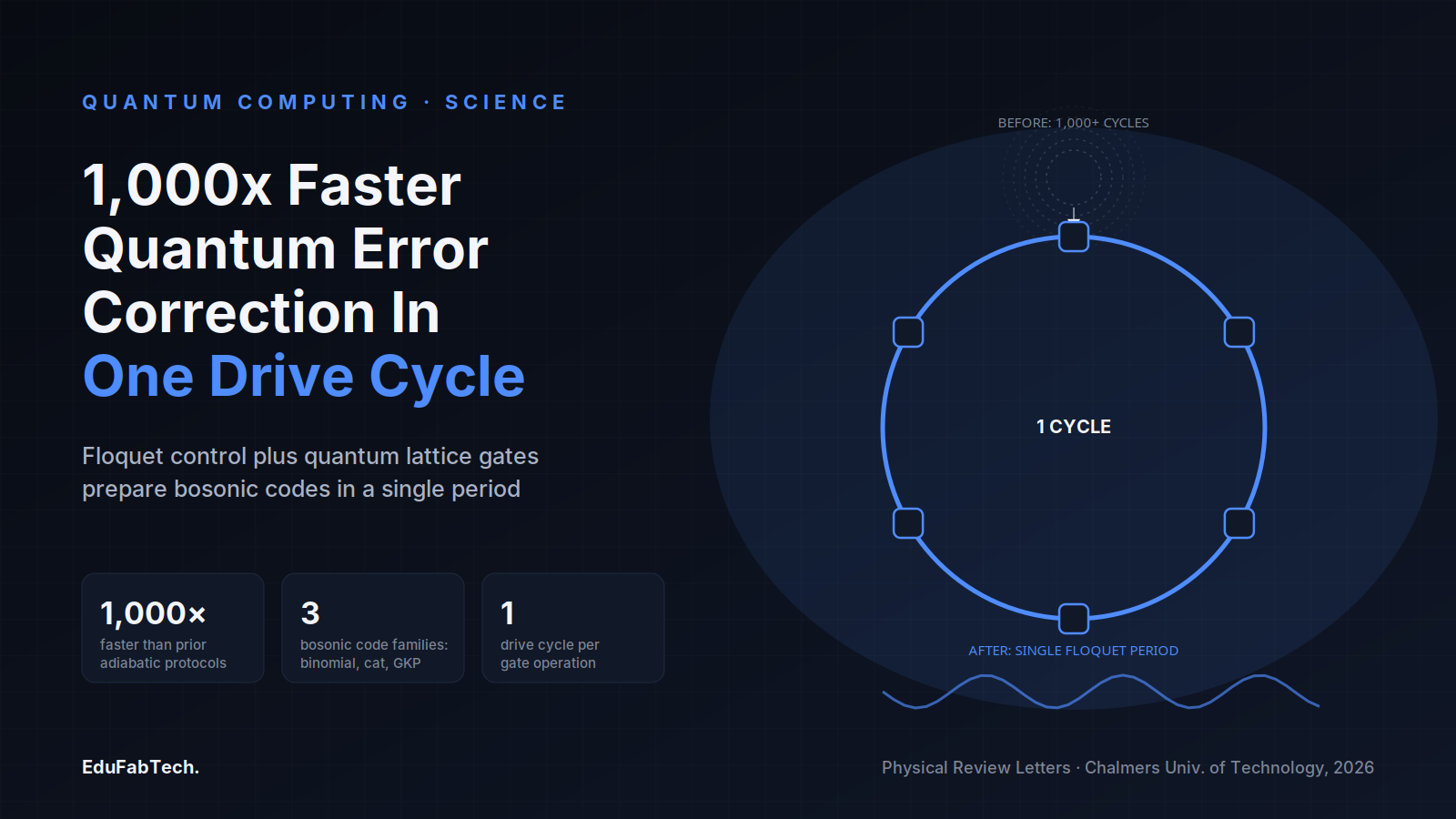
A team at Chalmers University of Technology in Sweden, working with a collaborator at Tianjin University in China, has published a gate-control method that lets certain quantum error-correction operations run in a single driving cycle instead of the thousands of cycles that comparable techniques have needed until now. The paper, "Single-Period Floquet Control of Bosonic Codes with Quantum Lattice Gates," appeared in Physical Review Letters in 2026, authored by Tangyou Huang, Lei Du and Lingzhen Guo.
The result is theoretical and numerical, not an experimental demonstration on hardware. But it targets a specific, well-known bottleneck in building fault-tolerant quantum computers: the time it takes to prepare and manipulate the fragile quantum states that error-correcting codes rely on.
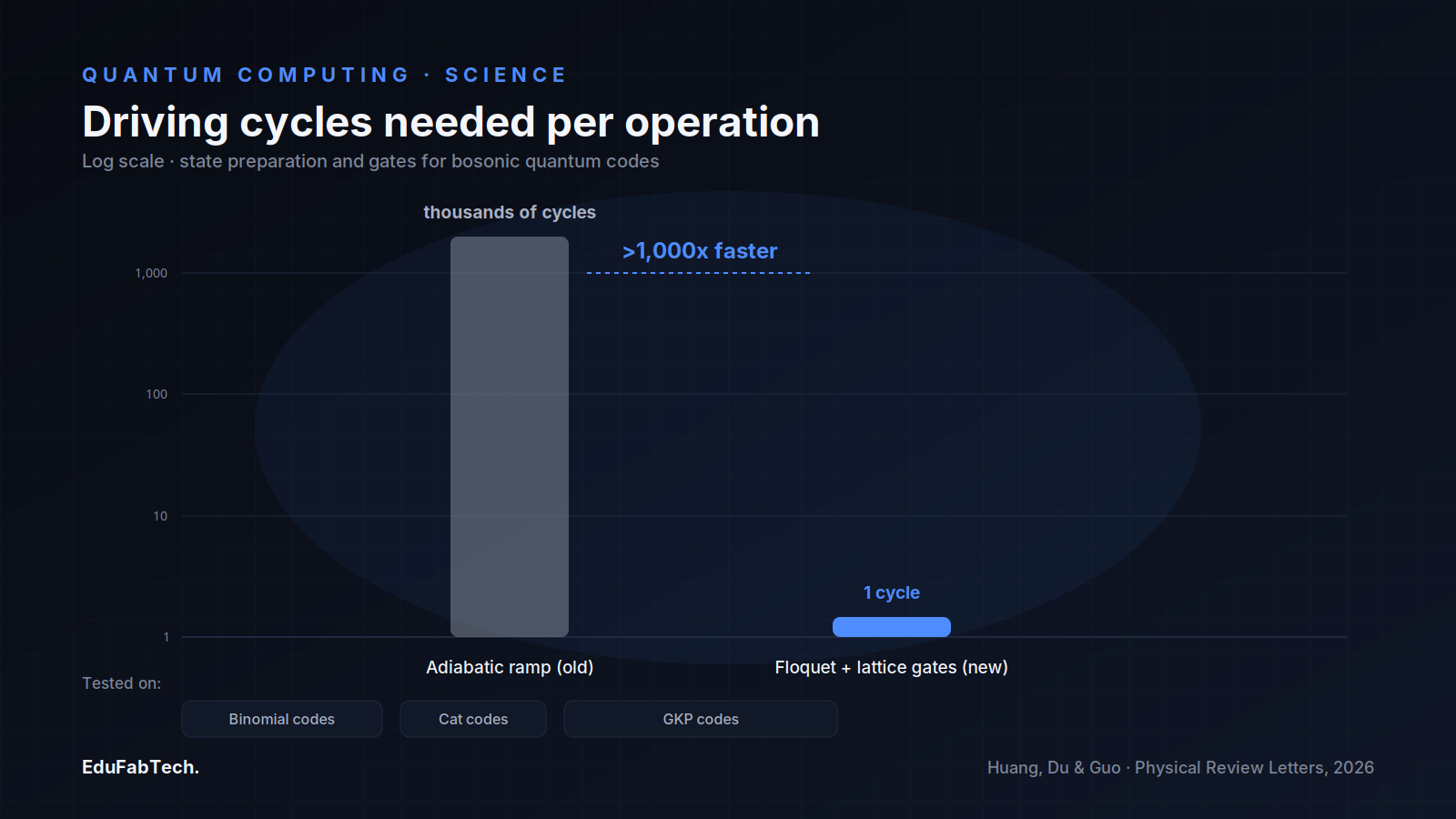
Quantum bits lose their information when disturbed by stray electrical noise, cosmic radiation or heat. The longer an operation takes, the more of these disturbances it is exposed to. Bosonic codes — which store quantum information in the shape of a microwave field inside a superconducting resonator, rather than in a single physical qubit — are one of the leading strategies for building in error protection at the hardware level. Preparing and controlling them, however, has typically required "slow adiabatic ramps with thousands of driving periods," as the authors describe existing methods in their paper.
What the method changes
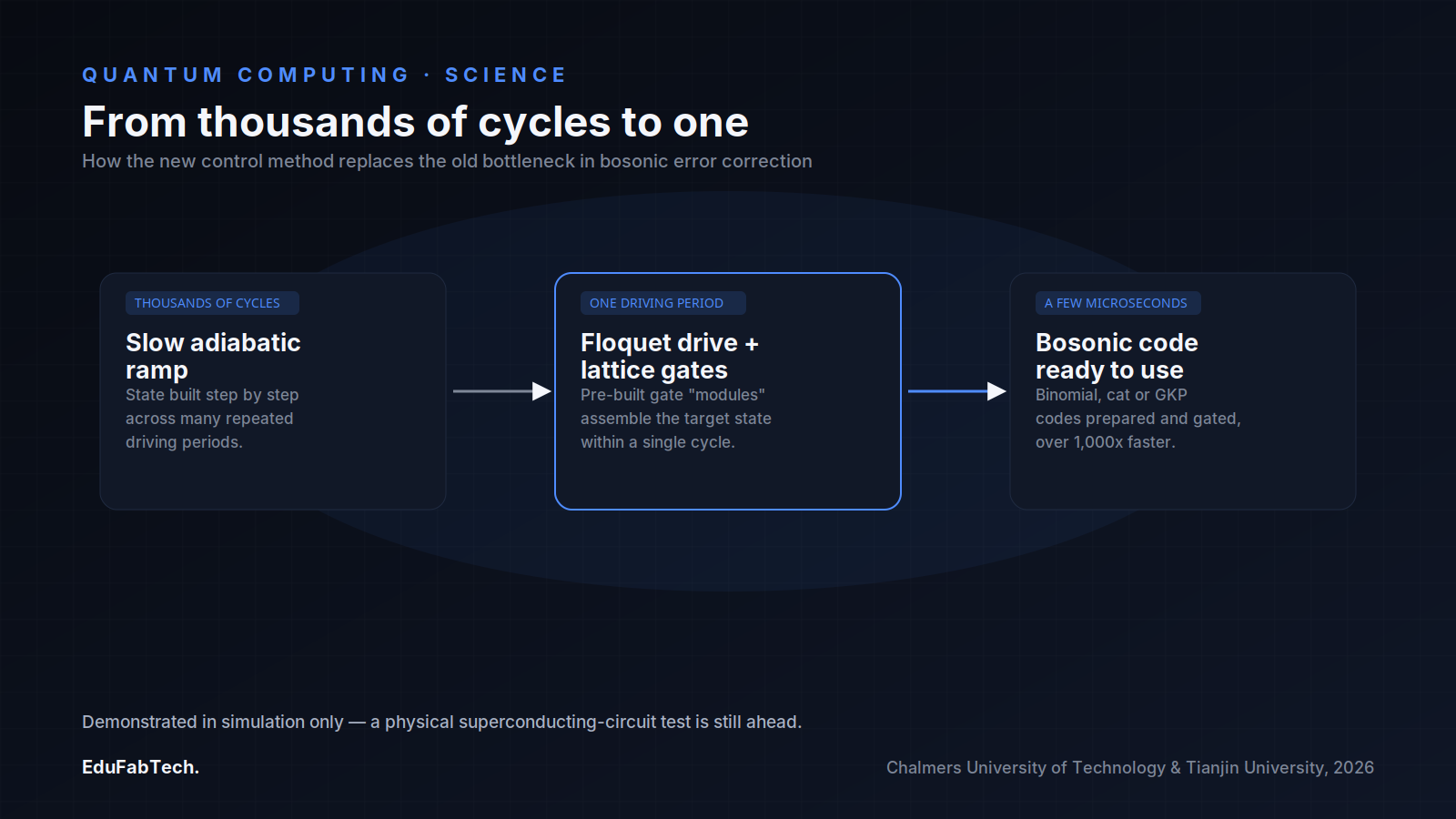
The Chalmers and Tianjin University team's approach combines two ingredients: Floquet control, which uses a periodically repeating drive signal, and what they call quantum lattice gates — a set of building blocks for manipulating bosonic states that had been proposed previously but not used this way. Instead of building a target quantum state step by step across many repeated cycles, the new method synthesizes the operation within a single period of the drive.
Chalmers describes the intuition through an analogy from co-author Tangyou Huang: "You can think of it like building a large Lego castle. Instead of assembling it brick by brick and risking mistakes along the way, quantum lattice gates act like pre-built Lego modules that can be connected quickly and efficiently," according to the Chalmers University of Technology account of the 2026 study. Lead author Lei Du is quoted making the stakes explicit: "Our results address one of the major bottlenecks in the field: how to quickly and reliably create and control the error-correcting quantum states that could play an important role in future quantum computers."
In simulation, the researchers demonstrated the technique across three families of bosonic codes — binomial, cat and Gottesman-Kitaev-Preskill (GKP) codes — and used it to implement logical quantum gates as well as state preparation. The paper reports a speedup of more than 1,000 times relative to prior adiabatic protocols for the operations tested, with some operations completing in a few microseconds; the 1,000-times figure is also stated in the accompanying Chalmers University of Technology release.
Why the distinction between simulation and hardware matters
None of this has yet been run on a physical quantum processor. The Phys.org account of the 2026 paper is explicit that the result is a peer-reviewed theoretical proposal, with experimental realization still ahead; Chalmers says its researchers are already in discussion with colleagues about testing the approach on existing superconducting quantum circuit platforms. A shorter operation window is only useful if it survives contact with the actual noise sources — flux noise, photon loss in the resonator, control-line crosstalk — that the simulations abstract away or approximate.
Where this sits in the broader effort
Bosonic error correction is one of several parallel tracks in the push toward fault-tolerant quantum computing, alongside surface-code approaches built from many physical qubits per logical qubit. Its appeal is that a single resonator mode, if engineered correctly, can already carry some built-in resilience to certain error types — which is also why the control overhead for preparing and manipulating these states has mattered so much. A method that removes several orders of magnitude of drive time from that overhead, if it holds up experimentally, would shrink the window during which a bosonic-code qubit is vulnerable between one operation and the next.
The authors' own framing, echoed by Chalmers, is appropriately narrow: this is a control-theory result that clears one obstacle — slow, multi-cycle state synthesis — rather than a claim about a working fault-tolerant machine. Chalmers is separately developing a 100-qubit superconducting quantum computer, a project the university cites as context for why faster, more reliable control methods matter to its own roadmap, though the paper's method has not yet been tested on that or any other hardware.
What to watch next
The open questions are the ones any theoretical control scheme faces before it changes what real machines can do: whether the single-cycle protocol remains robust once realistic gate errors, calibration drift and resonator loss are included, and whether an experimental group demonstrates it on a physical superconducting circuit. The preprint version of the paper is publicly available for readers who want to check the numerical results directly, ahead of any hardware follow-up.
- Tangyou Huang, Lei Du, Lingzhen Guo. Single-Period Floquet Control of Bosonic Codes with Quantum Lattice Gates. Physical Review Letters, vol. 137, article 060602, 2026. doi:10.1103/tnb8-3m8m
- Chalmers University of Technology. 1,000 times faster operations bring reliable quantum computing a step closer. Chalmers University of Technology, 2026. link
- Science X Network. 1,000 times faster operations bring reliable quantum computing a step closer. Phys.org, 2026. link
- Tangyou Huang, Lei Du, Lingzhen Guo. Single-Period Floquet Control of Bosonic Codes with Quantum Lattice Gates (preprint). arXiv, 2026. link