Research England to Close Three Targeted Research Funds From 2027-28, After £390m in Six Years
Research England confirmed on 4 November 2026 it will end its research-culture, participatory-research and policy-support funds, replacing them with a smaller, sector-wide collaboration network while keeping core research funding intact.
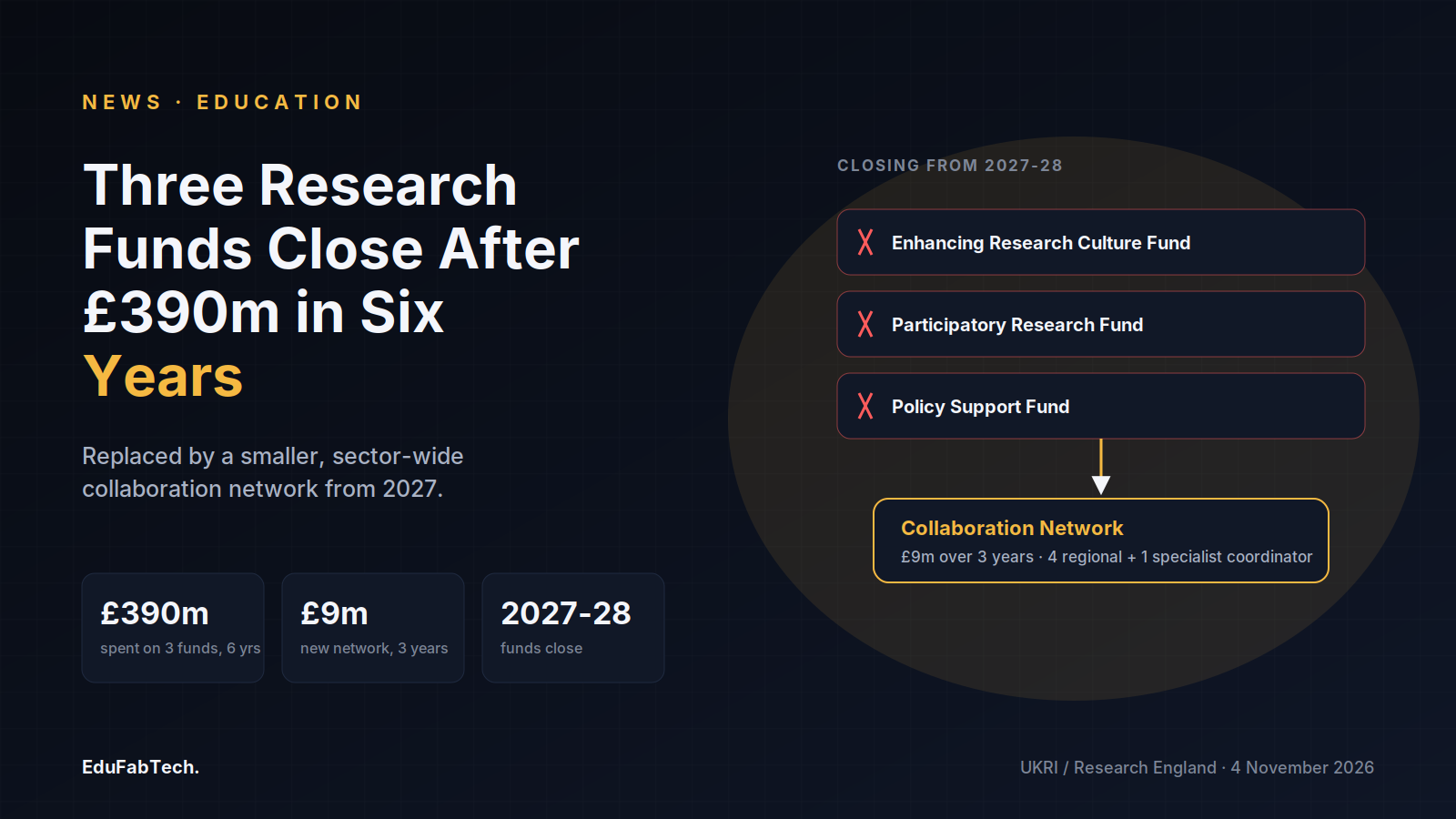
Research England, the part of UK Research and Innovation that funds universities in England, confirmed on 4 November 2026 that it will close three ring-fenced funding streams from the start of the 2027-28 academic year: the Enhancing Research Culture Fund, the Participatory Research Fund and the Policy Support Fund. The three funds have allocated £390 million between them over the past six years, according to the announcement.
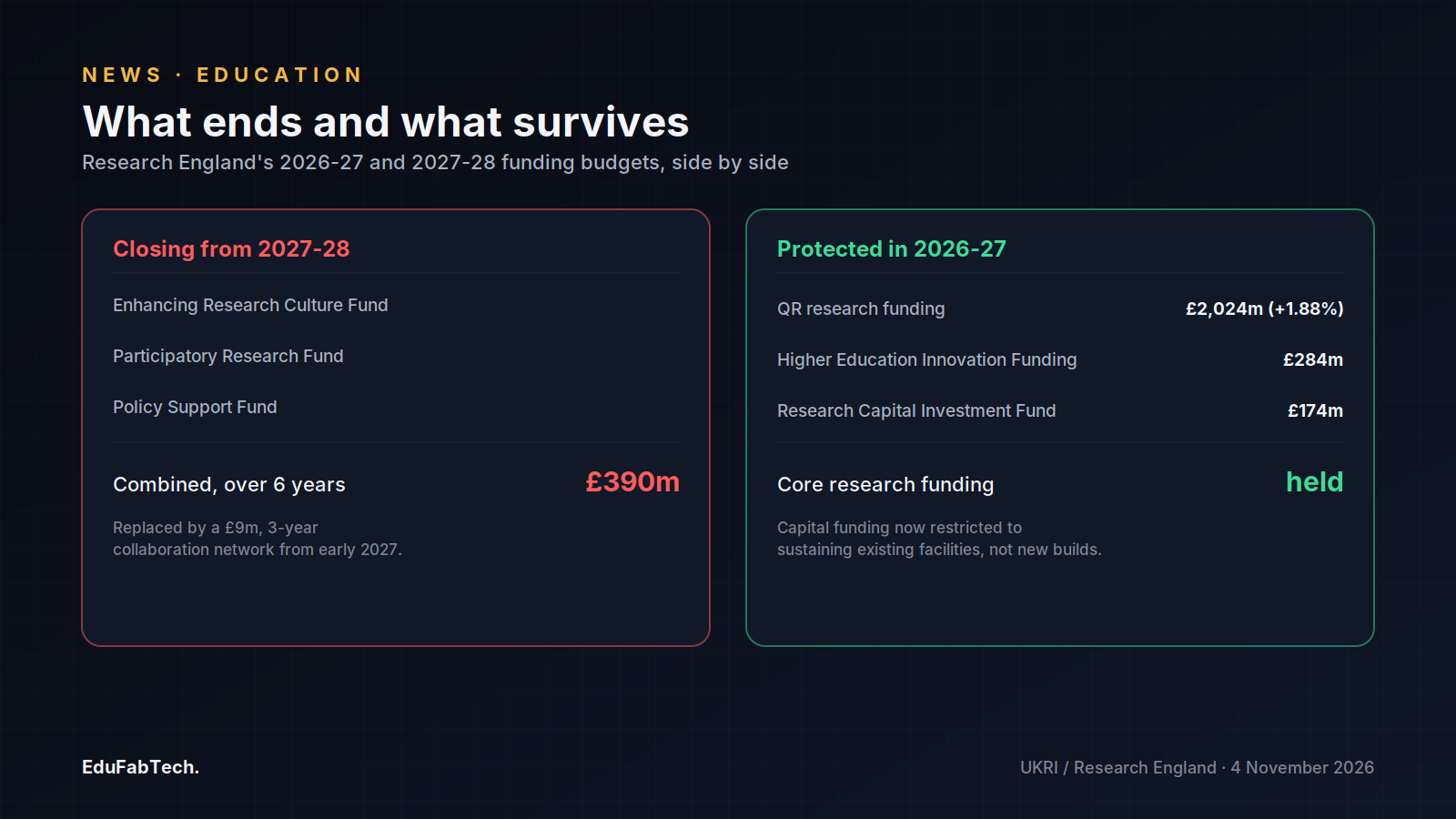
Core funding is not affected by the change. Research England's quality-related (QR) research funding and Higher Education Innovation Funding (HEIF) continue, and both rose for the 2026-27 academic year: QR funding increased from £1,987 million in 2025-26 to £2,024 million in 2026-27, a 1.88% rise, while HEIF stood at £284 million, according to Research England's funding budgets document published on 17 July 2026.
Capital funding is also changing shape rather than shrinking outright. The Research Capital Investment Fund stays at £174 million in both years, but from the 2026-27 financial year it must be directed toward sustaining existing research facilities rather than new infrastructure, the same July 2026 document states.
A smaller, shared network instead of named funds
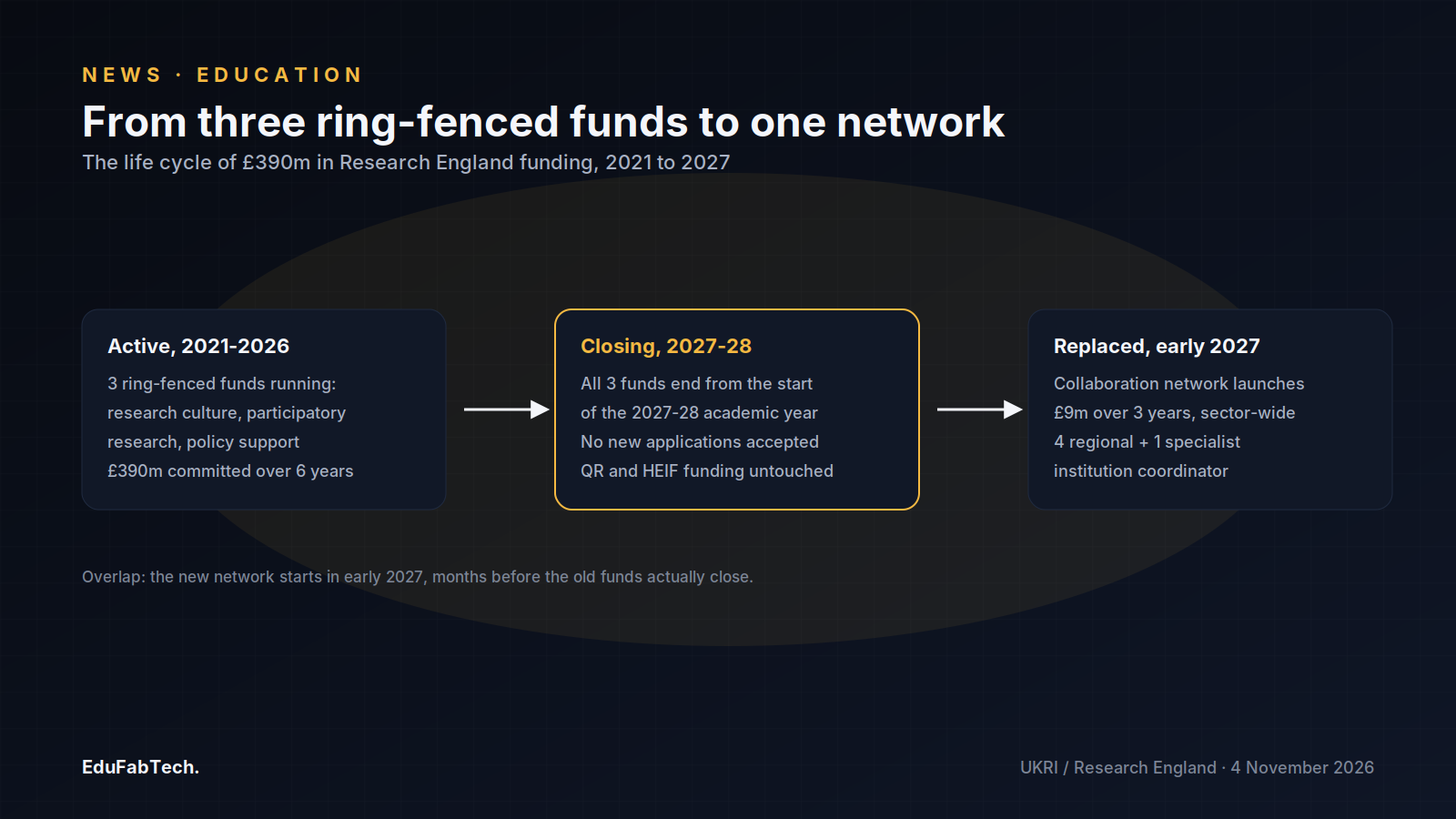
In place of the three closing funds, Research England is launching, in early 2027, what it calls a research culture collaboration network, with up to £9 million committed over three years. The network will have four regional coordinators and a coordinator for specialist institutions, intended to support "collective action at regional and national levels" rather than funding individual university schemes, the UKRI announcement says.
Writing on the sector website Wonkhe, Research England's executive chair, Professor Dame Jessica Corner, said the guiding test applied to each ring-fenced programme was "has it done its job?" She also disclosed a separate, newly launched programme, the £19.75 million Collaboration for a Sustainable Future fund, and confirmed that a consultation on the future of HEIF itself is open until 15 January 2027.
A mixed reaction from universities
Libby Hackett, chief executive of the Russell Group, told Times Higher Education that protecting QR and HEIF funding was "a statement of intent that will help ensure research excellence remains at the core of the government's strategy for growth," while cautioning that the narrower terms attached to capital infrastructure funding would be "more challenging" for institutions. Corner, in her Wonkhe piece, acknowledged unevenness in how research-culture work has taken hold across the sector, writing that "practice is not yet equally established everywhere."
What it means for researchers and students
The funds being closed were aimed at work that often sits outside conventional grant funding: building research culture inside institutions, supporting participatory approaches to research, and funding policy engagement by academics. Their closure means universities in England can no longer apply for money earmarked specifically for those purposes; instead, support shifts to a shared, regionally coordinated structure with a far smaller combined budget than the £390 million spent on the three funds over six years.
Research England says institutions will be supported through the shift via the new network's regional and specialist coordinators, per the UKRI announcement, but neither that announcement nor Corner's own account of the changes sets out how early-career researchers — often the intended beneficiaries of research-culture and participatory-research spending — were consulted on the shift. For specialist and smaller institutions, the appointment of a dedicated specialist-institutions coordinator within the new network is the clearest signal of how their position has been treated differently from larger, multi-faculty universities. Students and staff attached to current projects funded under the three closing streams have until the end of the 2026-27 academic year before those funding lines disappear; the replacement network is due to launch earlier, in early 2027, overlapping with the final months of the closing funds.
A quick question for readers
Which study method makes things stick for you until the exam?
Research says some methods work far better than others. Vote first, then see whether students agree with the evidence.
Pick an answer, create a free account in a minute, and your vote counts. Already a member? Sign in
Comments 3
Comment-
The bit that jumps out is the timeline overlap: the new network launches early 2027 while the old funds don't actually disappear until the e…
-
The capital funding change is the detail that'll actually bite: £174m held flat but now restricted to sustaining existing facilities rather…
-
What's quietly telling is the capital funding line: the Research Capital Investment Fund isn't losing money, it's losing freedom, now locked…
Join free to read the full comments and reply Comments are between members; an account takes a minute.
Source: UK Research and Innovation (Research England)
Sources (3)
- UK Research and Innovation. Research England confirms university funding changes from 2027-28. UKRI, 2026. ukri.org ↗ · checked 4 Nov 2026
- Jessica Corner. What comes next for Research England. Wonkhe, 2026. wonkhe.com ↗ · checked 4 Nov 2026
- Frances Jones. Research England to close schemes in overhaul of targeted funding. Times Higher Education, 2026. timeshighereducation.com ↗ · checked 4 Nov 2026