Shanghai AI Lab Releases a 744-Billion-Parameter Open-Weight Research Agent, Paper Later
Atria Dawn Preview's weights appeared on GitHub before any technical report, and the self-reported benchmarks that followed show strength in research tasks but a wide coding gap against closed rivals.
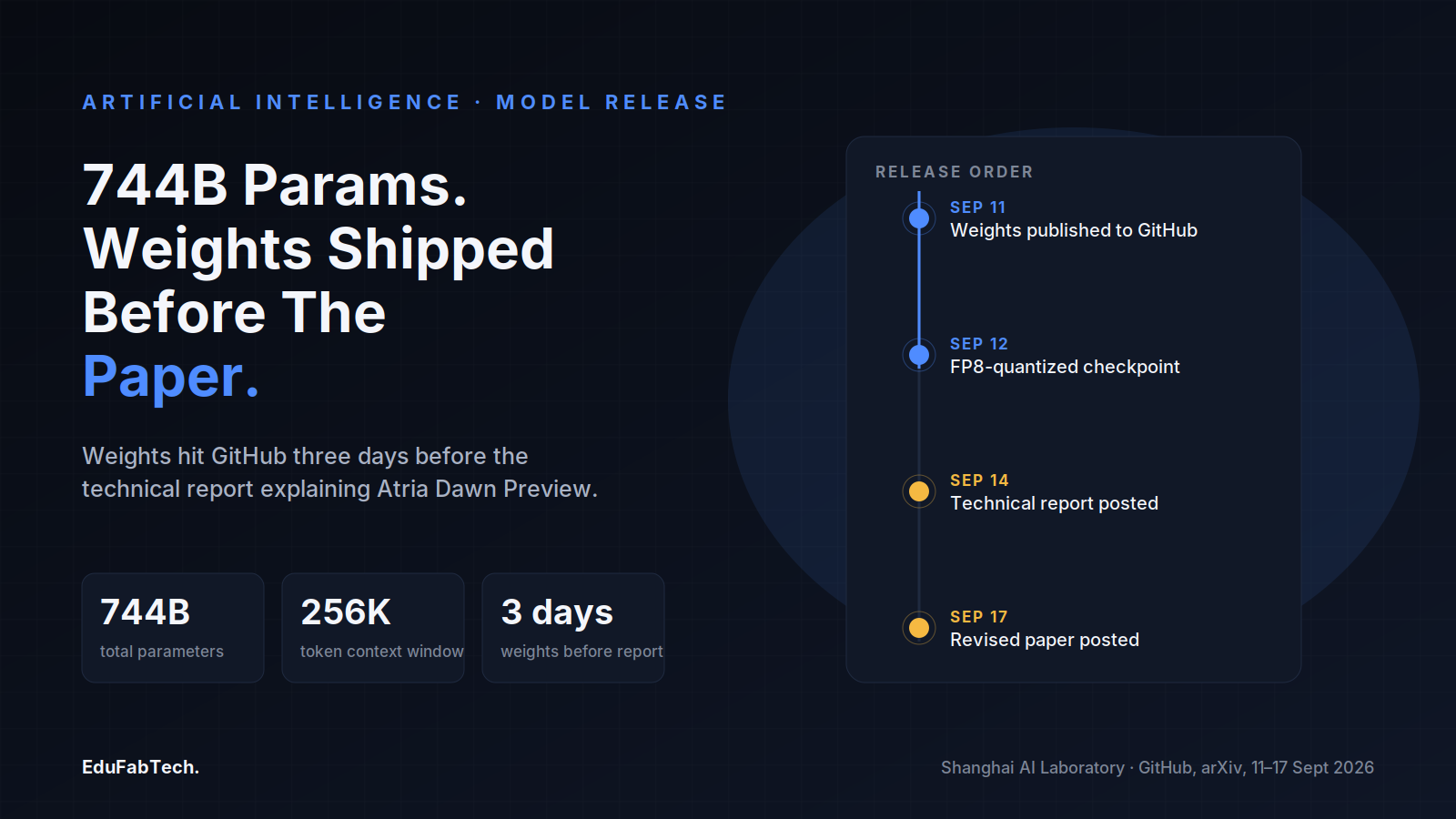
On September 11, 2026, a GitHub repository belonging to Shanghai Artificial Intelligence Laboratory went live with no announcement, no blog post, and no accompanying paper. It contained the weights for Atria Dawn Preview, a 744-billion-parameter mixture-of-experts model built for long, tool-using research and engineering tasks rather than single-turn chat. An FP8-quantized checkpoint followed on September 12, and the technical report explaining what the model actually is arrived three days later, on September 14, 2026, with a revised version posted September 17, according to the paper's own submission history on arXiv.
The sequence is unusual enough that it has become part of the story. Model releases from major labs typically ship with a paper, a benchmark table and a pricing page on the same day. Atria Dawn Preview shipped as weights first, with the Hugging Face model card functioning as the only public documentation for three days. The independent newsletter AI Weekly flagged this reversal of the usual disclosure order in its September 15, 2026 coverage, noting that the training data, the reinforcement-learning pipeline and the model's active-parameter count (as distinct from its 744-billion-parameter total) went undocumented until the paper appeared.
What the model is built to do
Atria Dawn Preview sits on top of GLM-5.2, an open foundation model, and is released under an MIT license with a 256,000-token context window, according to its GitHub repository. Rather than optimizing for conversational answers, the paper describes a "Verifiable Experience Pipeline" in which every training task is tied to a real execution environment: the model observes a state, calls a tool, produces an artifact, and is scored against an executable test, an experiment metric, or another checkable outcome. Shanghai AI Laboratory frames the model's target use as carrying a method from a paper through to an executable experiment, a reproducible result and a report that a colleague could check — a workflow the authors group into four areas: research discovery, software and system creation, document delivery, and cybersecurity validation.
Where the benchmarks land
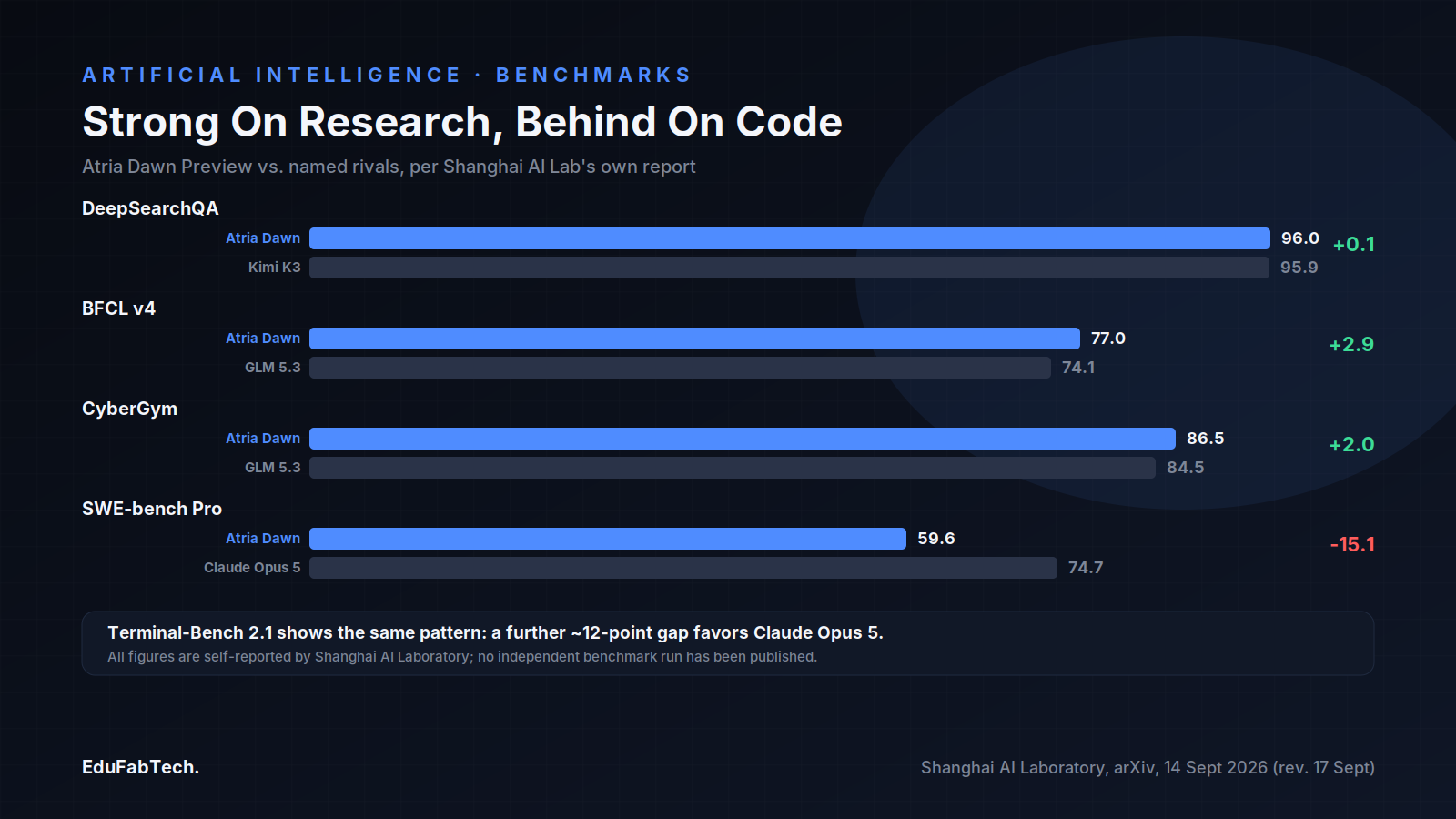
Shanghai AI Laboratory's own report, posted to arXiv in September 2026, lists results across 16 benchmarks and states that Atria Dawn Preview posts the top score on five of them. On DeepSearchQA it scores 96.0, narrowly ahead of Kimi K3's 95.9; on BFCL v4 it scores 77.0 against GLM 5.3's 74.1; on CyberGym, a security-validation benchmark, it scores 86.5 against GLM 5.3's 84.5. Those are the categories — research retrieval, tool-calling, browser-grounded search, security testing — the model was built around.
The same report shows a different picture on general coding work. On SWE-bench Pro, Atria Dawn Preview scores 59.6, compared with 74.7 for Anthropic's Claude Opus 5, a gap of more than 15 points. On Terminal-Bench 2.1 the gap is nearly 12 points in Claude Opus 5's favor. None of these figures, on either side of the comparison, have been reproduced by an independent evaluator; as AI Weekly's coverage notes, the numbers are vendor-reported, and no outside benchmarking group had published its own run of the model at the time of writing.
A study of who does the work
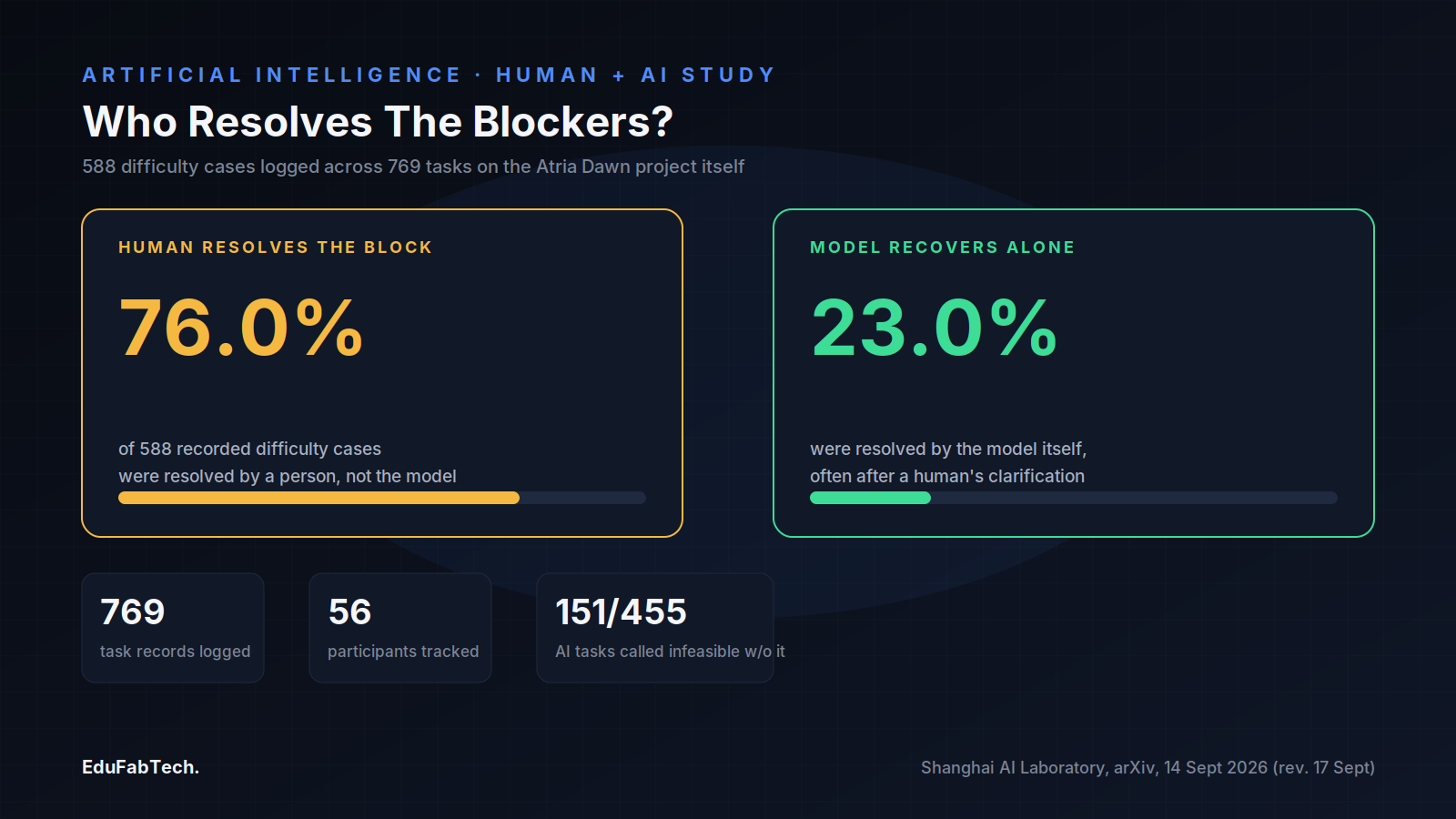
The more unusual section of the paper is not about the model's scores but about how it was built. The authors logged 769 task records from 56 participants working on the Atria Dawn project itself and report that AI involvement was present in the large majority of tasks. Of 455 completed AI-assisted tasks with a usable response, 151 — about a third — were reported by participants as infeasible without AI. When a task ran into trouble, human intervention resolved the problem in 76.0% of the 588 recorded difficulty cases; the model recovered on its own in the remaining 23.0%, most often after a human supplied clarification or suggested a different method rather than editing code directly. Over four weeks of the project, from August 7 to September 4, 2026, the median ratio of agent actions to human prompts rose from 11.0 to 28.5, which the authors read as agents taking on more of the execution work while people continued to decide what was worth pursuing.
Why the release order matters
The interest here is not only the model itself but what its release says about the pace of open-weight development. A 744-billion-parameter model with a coherent agentic training method reached a public repository before any outside party could check its claims — a pattern that has become more common as open-weight labs compete on release speed. For researchers and engineers deciding whether to build on Atria Dawn Preview, the practical takeaway is that its strengths in retrieval, browsing and security testing are documented by the lab that built it, while its coding performance, on the one benchmark where a direct comparison to a widely used closed model exists, trails by a wide margin. Independent evaluation, through community testing on the released weights, is the step that has not yet happened.
- Honglin Guo et al.. Atria Dawn: The Dawn of Agentic Superintelligence. arXiv preprint, 2026. link
- Shanghai AI Laboratory (internlm). Atria-Dawn-Preview model card. Hugging Face, 2026. link
- Atria ASI. Atria-Dawn-Preview repository. GitHub, 2026. link
- Alexis Dufresne. Shanghai AI Lab Ships Atria Dawn Preview, a 744B Agentic MoE. AI Weekly, 2026. link