A Year After the Santiago Consensus, Teacher Shortages Are Still Widening, OECD and UNESCO Data Show
Comparable data from OECD and UNESCO show teacher attrition and unfilled posts rising across very different school systems, twelve months after governments pledged to fix the profession.
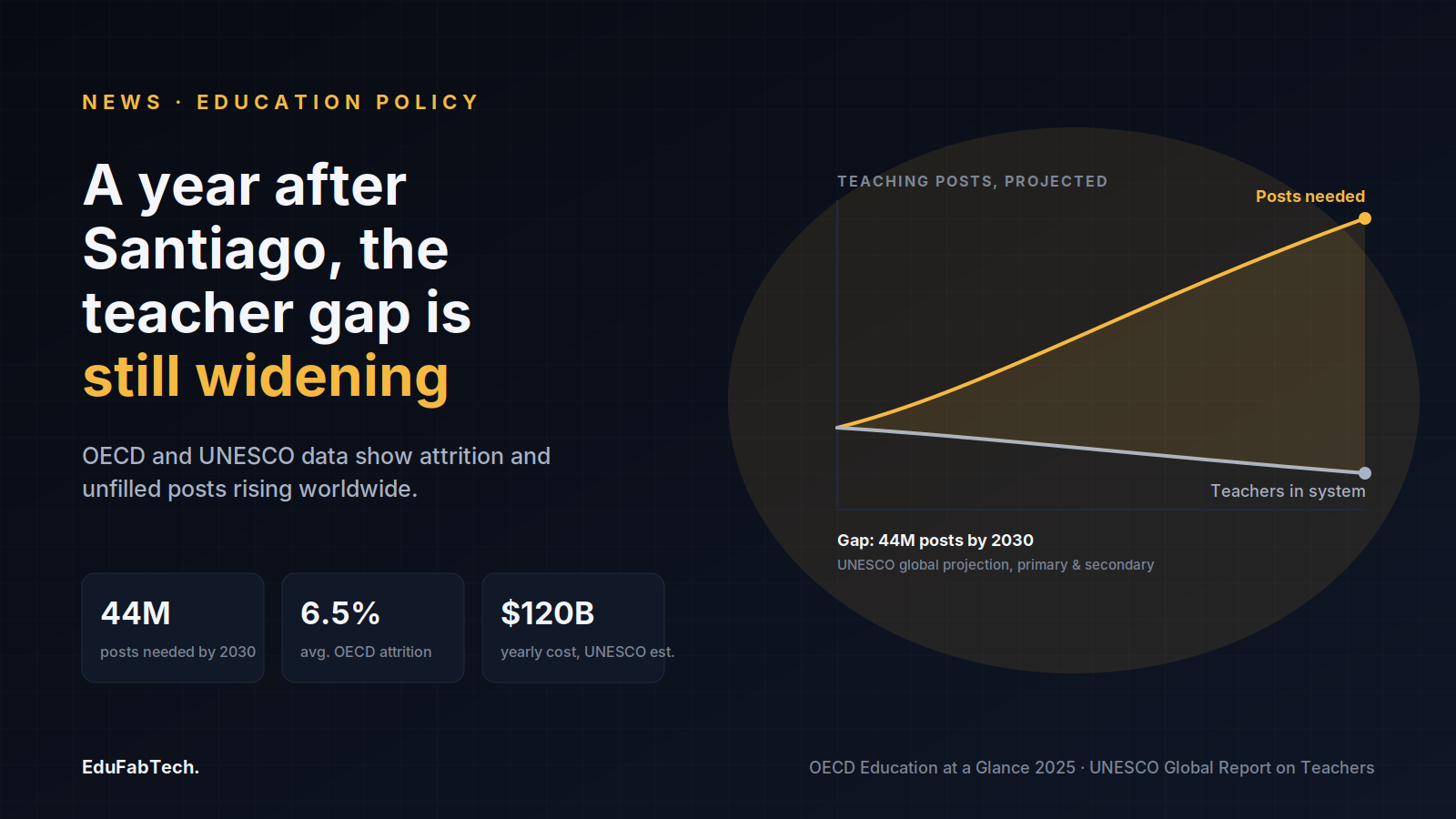
In September 2025, two organisations that rarely publish on the same week produced strikingly similar warnings. The OECD's Education at a Glance 2025 devoted its special chapter to teacher shortages across its member countries. Days earlier, at the first UNESCO World Summit on Teachers in Santiago, Chile, governments adopted a set of commitments — the Santiago Consensus — built around a single number: a global shortfall of 44 million primary and secondary teaching posts by 2030, according to UNESCO's Global Report on Teachers.
A year on, with the OECD's next edition due to launch on 29 September 2026, it is worth asking what the comparable data actually says, and how differently the shortage shows up depending on where a school system sits.
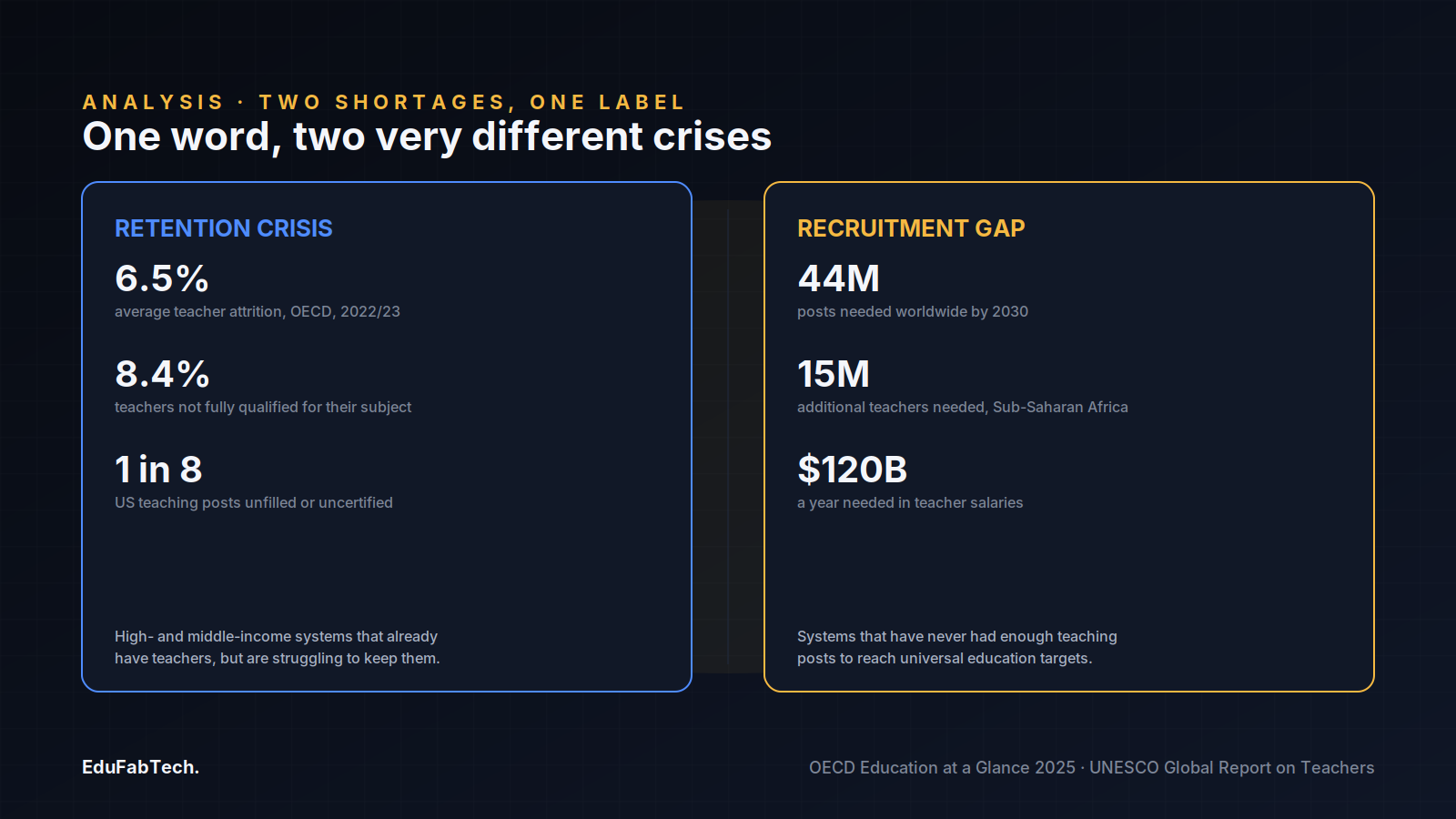
The two reports measure different things. The OECD's figures cover mostly high- and middle-income member and partner countries, tracking how many qualified teachers leave the profession and how many posts go unfilled. UNESCO's figures are global and forward-looking, projecting how many new teachers are needed to reach universal primary and secondary education targets. Read together, they describe the same problem from opposite ends: retention in systems that already have teachers, and recruitment in systems that never had enough.
Where attrition is highest — and lowest
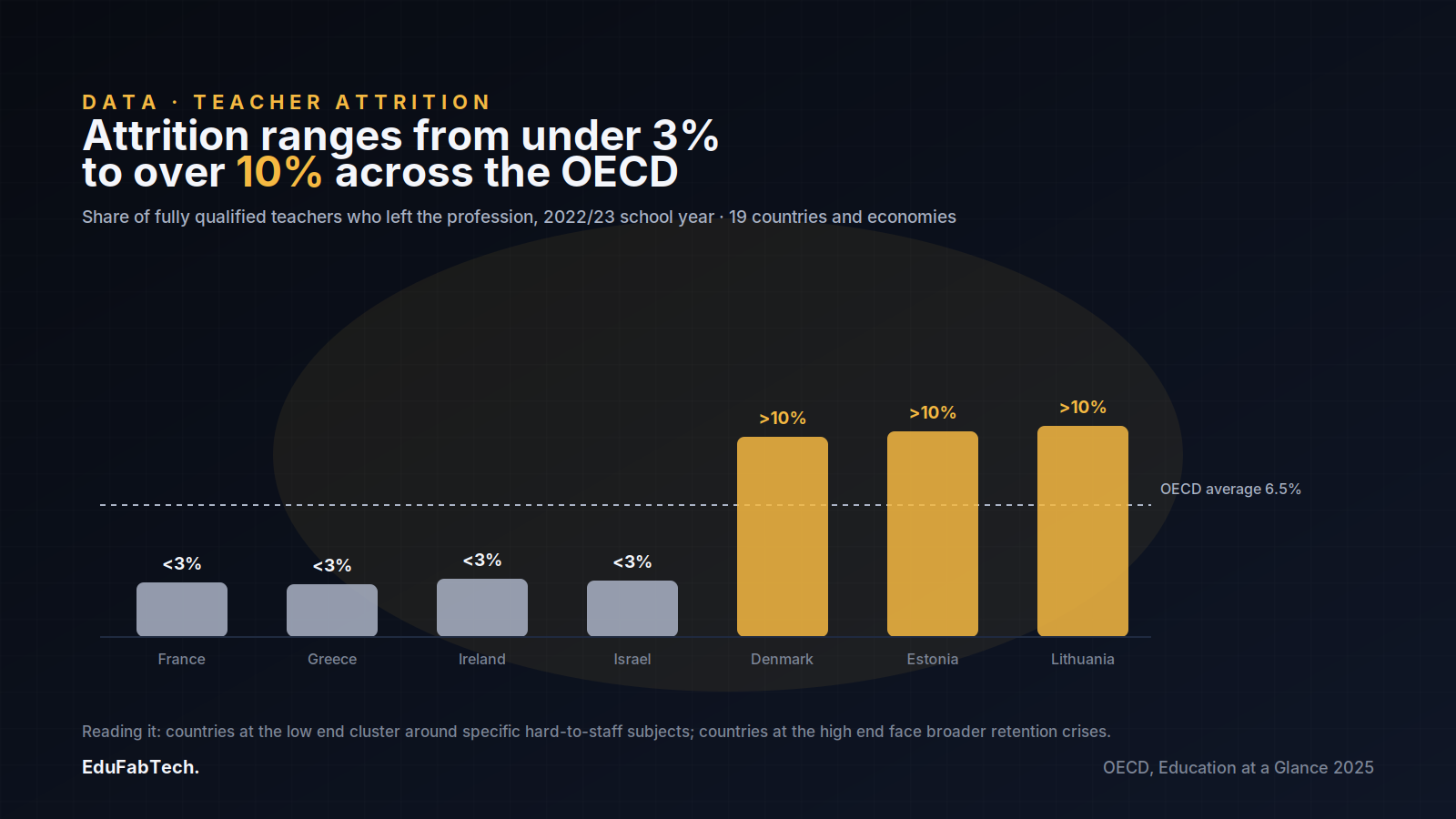
Across 19 countries and economies with comparable data, an average of 6.5% of fully qualified teachers from pre-primary to upper secondary level left the profession in the 2022/23 school year, the OECD found. The spread is wide: under 3% in France, Greece, Ireland and Israel, compared with more than 10% in Denmark, Estonia and Lithuania. On unfilled vacancies, a separate group of 14 countries and economies reported posts open at the start of the school year staying below 3% of all teaching positions in every case except Austria and Sweden — and shortages were consistently worse in secondary schools than in primary ones. Across a broader sample of 22 countries and economies, 8.4% of teachers at pre-primary, primary and secondary level were not fully qualified for the subject or grade they taught.
In the United States, the Learning Policy Institute counted 365,967 teaching assignments filled by staff who were not fully certified and 45,582 unfilled positions in the 2024–25 school year — together, about one in eight of all teaching posts nationally, and roughly 4,600 more than the year before. Special education, science and mathematics were the hardest subjects to staff. In England, a September 2026 analysis from the Education Policy Institute found that only 55% of physics teaching hours were delivered by a teacher with a relevant degree, prompting the institute to compare the cost of retraining existing teachers against raising recruitment bursaries as competing fixes for a single-subject shortage. The pattern across all three is the same: the aggregate numbers look manageable, but specific subjects and specific school types absorb almost all of the shortfall.
A funding gap measured in billions
UNESCO's global projection is starker because it includes systems that have never had enough teachers to begin with. Sub-Saharan Africa alone needs an estimated 15 million additional teachers by 2030, and primary teachers' annual attrition rate worldwide has nearly doubled, from 4.62% in 2015 to more than 9% in 2022, according to the Global Report on Teachers. UNESCO estimates that recruiting and paying for the needed teachers would cost around $120 billion a year in salaries over five years, broken down by EdSurge's reporting on the underlying UNESCO regional figures into roughly $35 billion for sub-Saharan Africa, $25 billion for Southern Asia and $5.4 billion combined for Europe and North America — at a time when UNESCO's Global Education Monitoring Report projects that international aid to education will fall by more than a quarter between 2023 and 2027.
What Santiago promised, one year on
The Santiago Consensus, adopted at the close of the August 2025 summit, set out priority areas covering teacher pay and working conditions, professional development, social dialogue with the profession, sustainable financing, and preparing teachers for AI and digital tools in the classroom. It asked governments to report progress through UNESCO's SDG4 Knowledge Hub and floated a follow-up summit to take stock before 2030. Twelve months later, the documented national response is uneven and mostly small-scale: Education Week's reporting on the UNESCO findings cites Australia's 20% student-loan reduction for teachers and additional debt forgiveness for those in remote schools, and China's move to raise rural teacher pay to match local civil-service wages. Neither measure was designed as a response to Santiago specifically, and no country has yet published a comprehensive accounting against the consensus's six priority areas.
Same crisis, different symptoms
What the two reports agree on is that "teacher shortage" describes several distinct problems wearing one label. In a country like France or Ireland, the issue is a handful of hard-to-staff subjects and regions, addressable with the kind of retrain-versus-recruit cost comparison the Education Policy Institute ran for England. In Denmark, Estonia or Lithuania, it is closer to a system-wide retention crisis, showing up in the OECD's attrition figures. In much of sub-Saharan Africa and Southern Asia, it is a question of whether enough teaching posts exist to be filled at all, which is why UNESCO frames its number in billions of dollars rather than percentage points.
What comes next
The next comparable data point arrives on 29 September 2026, when the OECD launches Education at a Glance 2026, again with a special focus on teacher shortages. UNESCO's Teacher Task Force, meanwhile, is finalising a 2026–2029 strategic plan and continues to track country commitments made in Santiago. Whether that plan closes the gap between pledges and staffed classrooms will only be visible in the next round of attrition and vacancy figures — the same indicators that made the shortage measurable in the first place.
- OECD. How severe are teacher shortages across countries?: Education at a Glance 2025. OECD, 2025. link
- UNESCO and International Task Force on Teachers for Education 2030. Global Report on Teachers: Addressing Teacher Shortages and Transforming the Profession. UNESCO, 2025. link
- Madeline Will. The United Nations Says Teacher Shortages Are a Global Problem. Education Week, 2025. link
- Lucia Maldonado. The World's Classrooms Are Short 44 Million Teachers. EdSurge, 2025. link
- Learning Policy Institute. An Overview of Teacher Shortages: 2025. Learning Policy Institute, 2025. link
- James Zuccollo. Retrain or Recruit? Comparing Routes to More Specialist Teachers. Education Policy Institute, 2026. link
- OECD. Education at a Glance 2026 (forthcoming, launch 29 September 2026). OECD, 2026. link
- Global Education Monitoring Report Team. Aid to Education: Time for Tough Decisions. UNESCO, 2025. link