THE's 2027 Rankings: Tsinghua Passes All of Continental Europe, US and UK Shares Hit Lows
Published 30 September 2026, Times Higher Education's table of 2,297 universities in 118 countries shows Tsinghua University outranking every continental European institution, while the US and UK post their lowest-ever shares of the global top 200.
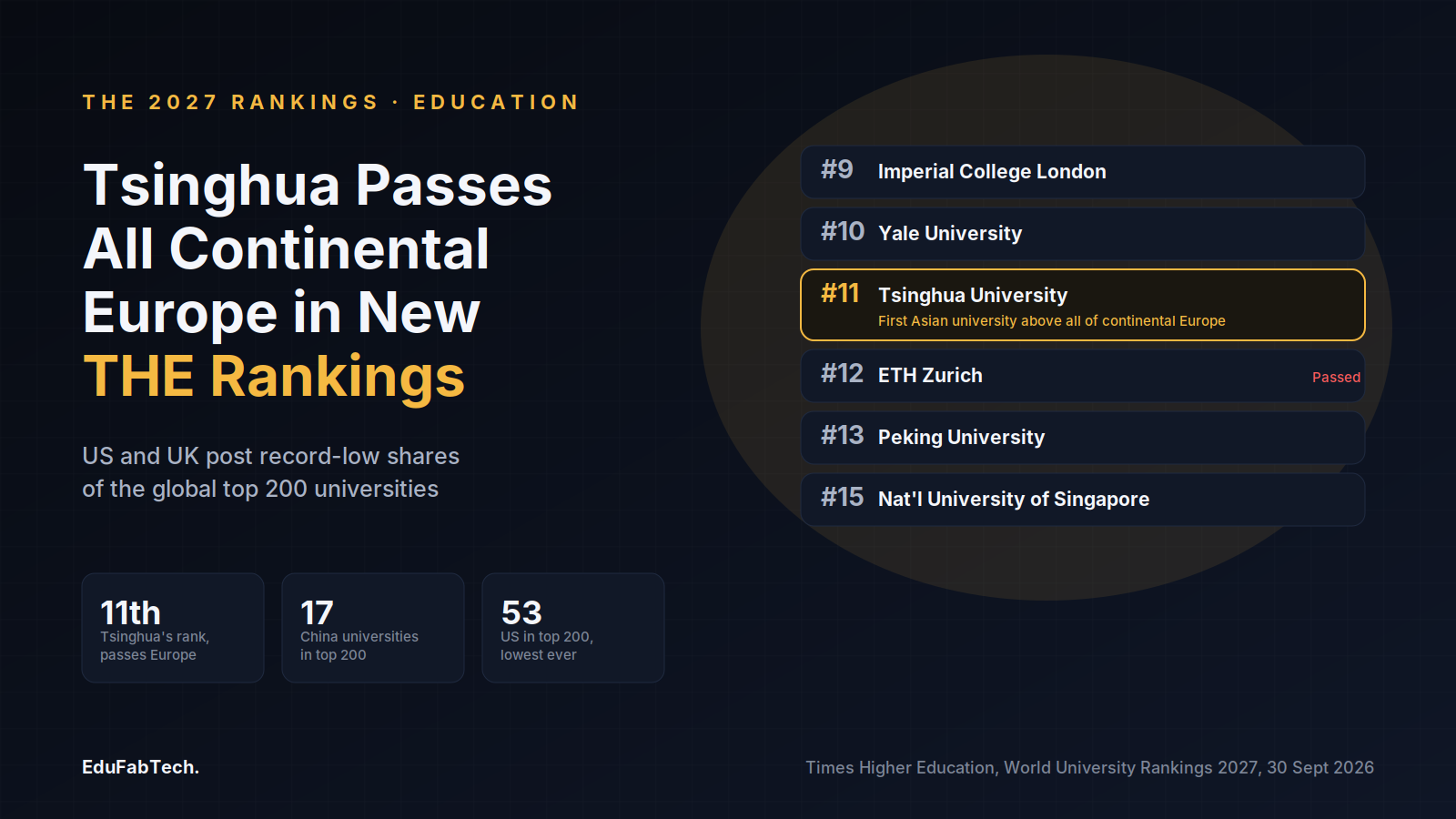
Times Higher Education (THE) published its World University Rankings 2027 on 30 September 2026, rating 2,297 institutions from 118 countries and territories, up from 2,191 institutions in 115 countries and territories a year earlier, according to THE's own account of the expansion. Albania and Malawi appear in the table for the first time and Ethiopia returns after an absence, the publisher reports.
At the top, little moved: the University of Oxford holds first place for an eleventh consecutive year, with the Massachusetts Institute of Technology second by a margin of just 0.1 points on THE's composite score, THE reports. Princeton and Stanford tie for third, Cambridge is fifth, and Harvard, Caltech, Imperial College London, UC Berkeley and Yale round out the top ten — a group that, as in previous years, is held entirely by universities in the United States and the United Kingdom.
Asia's rise above continental Europe
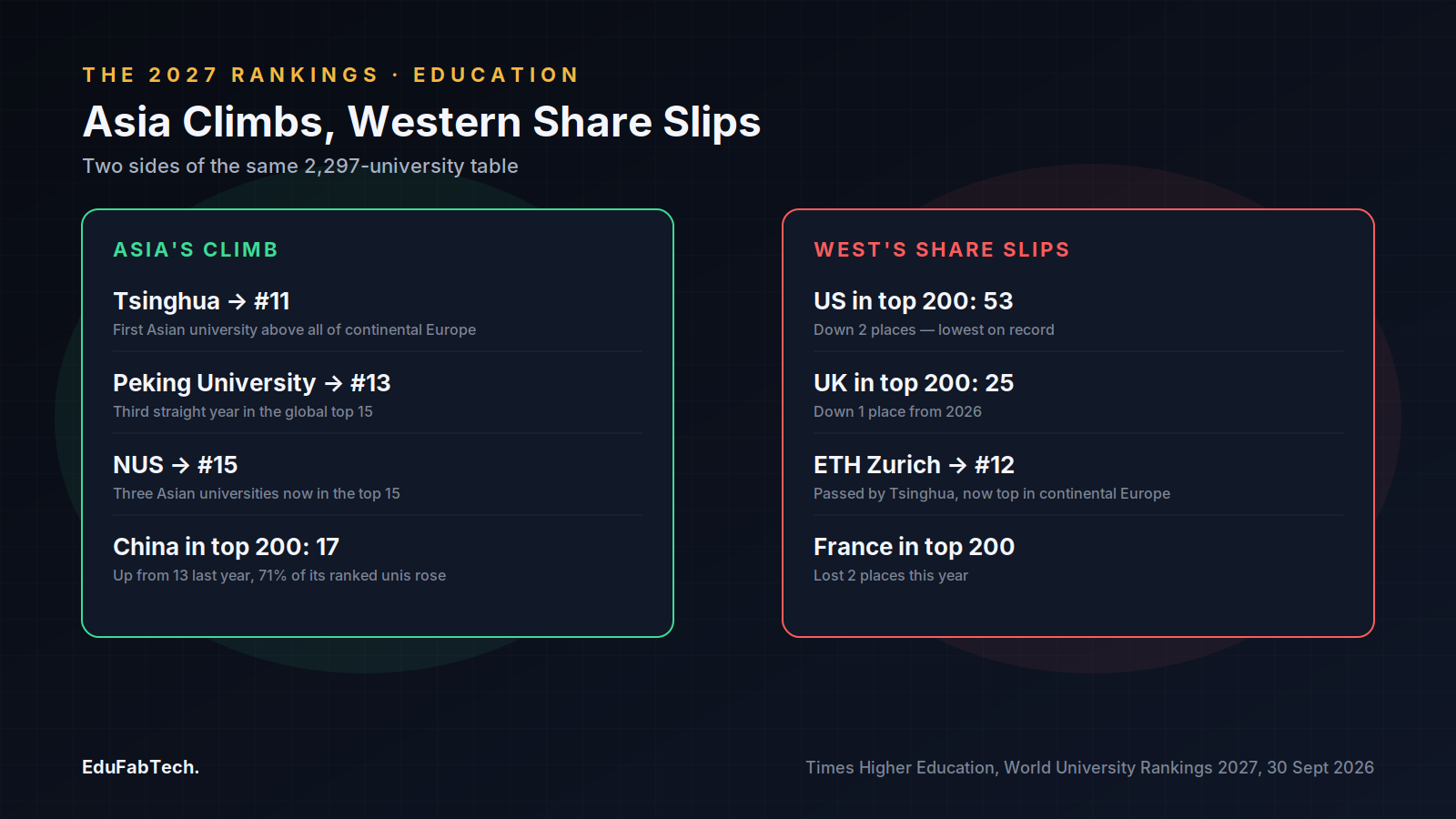
Below that top ten, the ordering has shifted. Tsinghua University climbed to 11th place, overtaking ETH Zurich to become the first Asian university ranked above every university in continental Europe, THE reports. Peking University held 13th for a third straight year, and the National University of Singapore reached 15th, putting three Asian universities in the global top 15 for the first time, according to the results announcement. China now has 17 universities in the top 200, up from 13, breaking a three-year stall at that total, and 71% of its ranked institutions improved their position this year, THE reports.
China's remaining gap to the very top is concentrated in one metric. THE's analysis of the data finds Tsinghua and Peking score strongly on teaching, research and industry links — Tsinghua and Peking both post perfect industry-pillar scores — but trail badly on international co-authorship, at 25.0 and 25.5 out of 100 respectively, which drags down their overall international-outlook scores. Boston College's Philip Altbach, quoted in that analysis, attributes China's climb to the government investing "boatloads of money" in its universities, while "political interference" disrupts research in the United States and "severe budgetary problems" constrain universities in the United Kingdom and Australia.
The West's shrinking share of the top 200
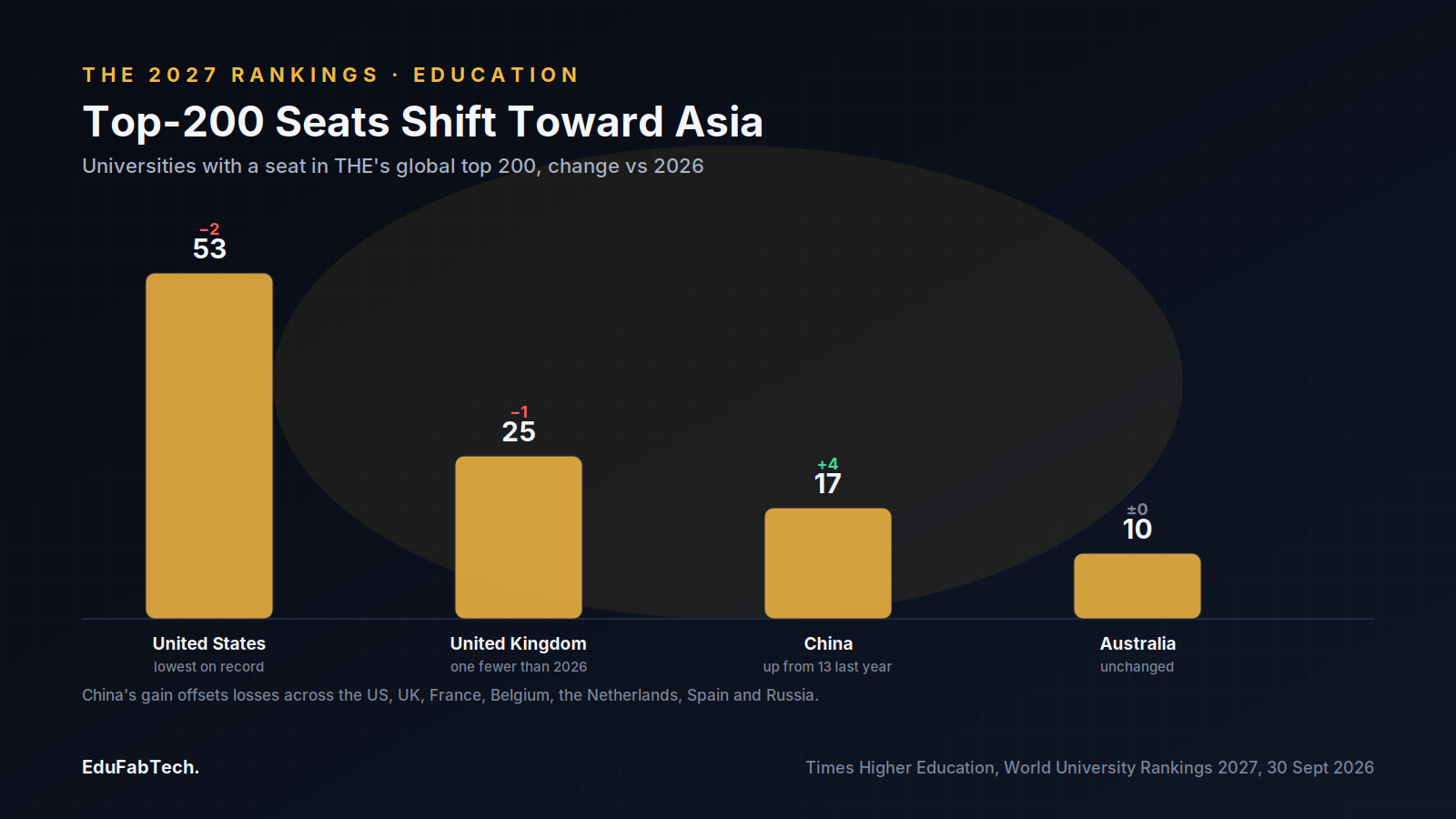
The United States and United Kingdom still hold every seat in the global top ten, but their presence further down the table has thinned. The UK now has 25 universities in the top 200, one fewer than last year, and the US has 53, two fewer and its lowest count on record, according to THE's regional breakdown. France lost two top-200 places, Belgium, the Netherlands, Spain and Russia each lost one, while Germany and Italy each gained one. Australia held its ground, keeping ten universities in the top 200 and six in the top 100, with the University of Melbourne and the University of Sydney both improving a handful of places.
Oxford researcher Simon Marginson, quoted in the same results announcement, frames the pattern as a funding story rather than a sudden loss of academic quality: "The iron law of higher education, especially in research, is that stellar performance is only sustainable with funding and especially public funding."
A larger, more global table
Beyond the leaderboard, THE's count of ranked institutions by country shows how broad participation has become: the US has 168 ranked universities in total, India 143 for a second consecutive year in second place, Turkey 124 (up to third from a tie for fourth), Japan 112, and the UK 110, per THE's participation data. To accommodate the larger field, THE expanded its published bands from 10 to 18, now naming individual ranks up to 300 before grouping institutions into bands of 25, 50, 100 and 200. THE's Phil Baty said the rankings are "more inclusive and more diverse than they've ever been," with "more detail and clarity in the published tables."
What the table means outside the top 50
For most of the world's students and researchers, the news sits well below the top 50. The Philippine Star's coverage of the same release illustrates this: Ateneo de Manila University lands in the 1001–1200 band, the University of the Philippines in 1200–1400, the University of Santo Tomás in 1600–1800, and De La Salle University, Mapúa University and Mindanao State University–Iligan Institute of Technology further down still, according to its report. Marianne V. Go, writing in that paper's Business Snippets column, calls the showing "a cause for concern," arguing the country is "losing our educational edge" relative to neighbours whose universities have risen.
That is the pattern researchers and prospective graduate students should read past the top ten for: a ranking built on 17 indicators of teaching, research volume and quality, industry income and international links reflects where public research funding and international collaboration are growing or shrinking, not a single, stable hierarchy. The institutions gaining ground this year — concentrated in China and parts of Southeast Asia — are doing so on sustained research investment and output, while the ones losing ground are doing so on the same two measures, according to THE's own reporting on the data. For anyone choosing where to study or where to seek a research position, that funding trajectory is now part of the table itself.
A quick question for readers
Which study method makes things stick for you until the exam?
Research says some methods work far better than others. Vote first, then see whether students agree with the evidence.
Pick an answer, create a free account in a minute, and your vote counts. Already a member? Sign in
Source: Times Higher Education
Sources (3)
- Times Higher Education. World University Rankings 2027 out now. Times Higher Education, 2026. timeshighereducation.com ↗ · checked 3 Oct 2026
- Times Higher Education. World University Rankings 2027: participation hits new heights. Times Higher Education, 2026. timeshighereducation.com ↗ · checked 3 Oct 2026
- The Philippine Star. World University Rankings 2027. The Philippine Star, 2026. philstar.com ↗ · checked 3 Oct 2026