UK's 2026 Budget Keeps the Two-Year Graduate Visa, But Only at 'High-Compliance' Universities
The 28 October 2026 budget rolls back a planned cut to the UK's post-study work visa, but only graduates of universities judged "high-compliance" with strong labour-market outcomes keep two years.
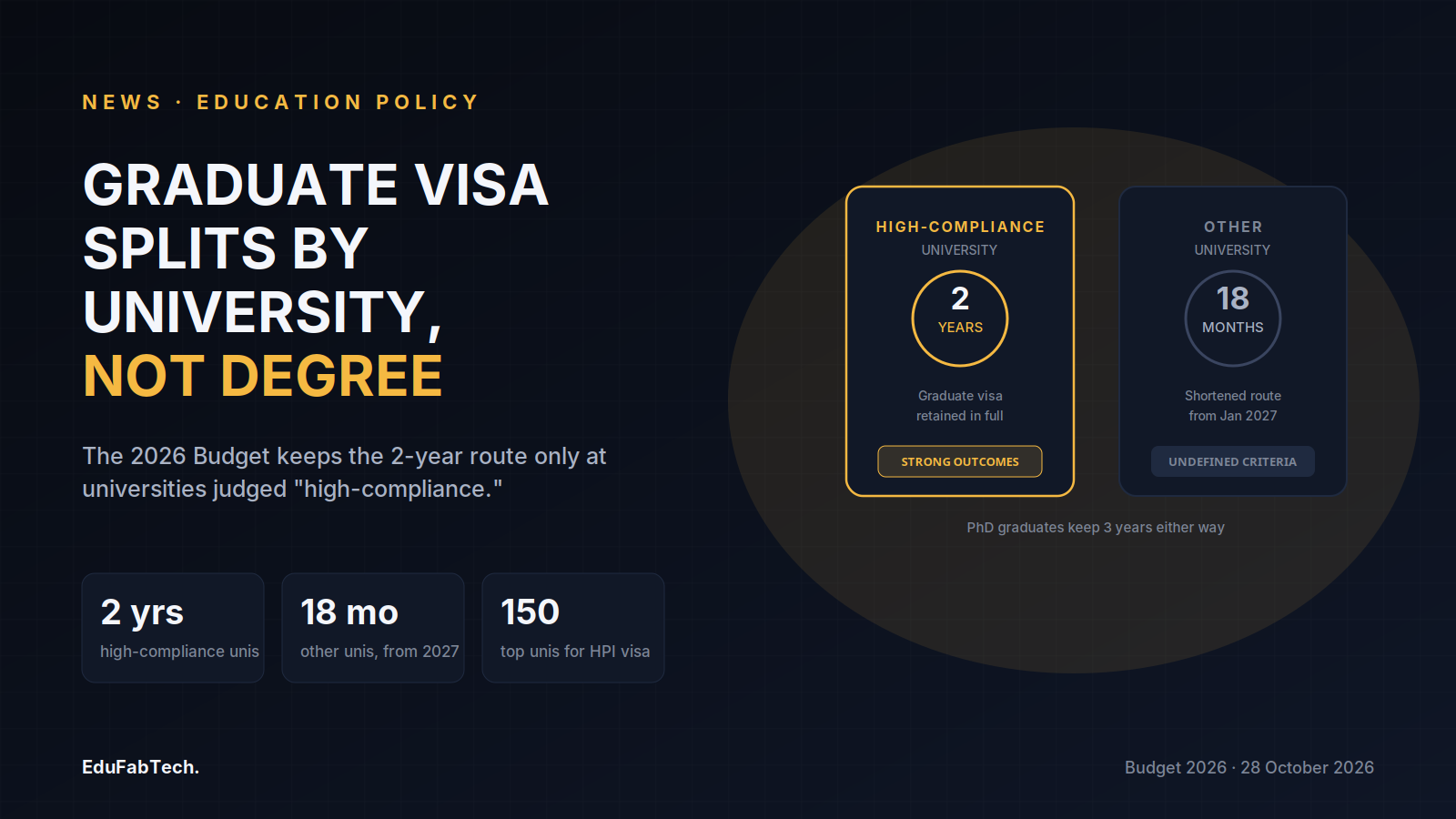
The UK government's Budget, published on 28 October 2026, reverses part of a planned cut to the Graduate visa, the UK's main post-study work route for international students. Graduates of universities that the government judges "high-compliance" and that show "strong labour market outcomes" will keep a two-year visa, according to the Budget document quoted by Times Higher Education (2026). Graduates of other institutions still face a shorter visa from next year.
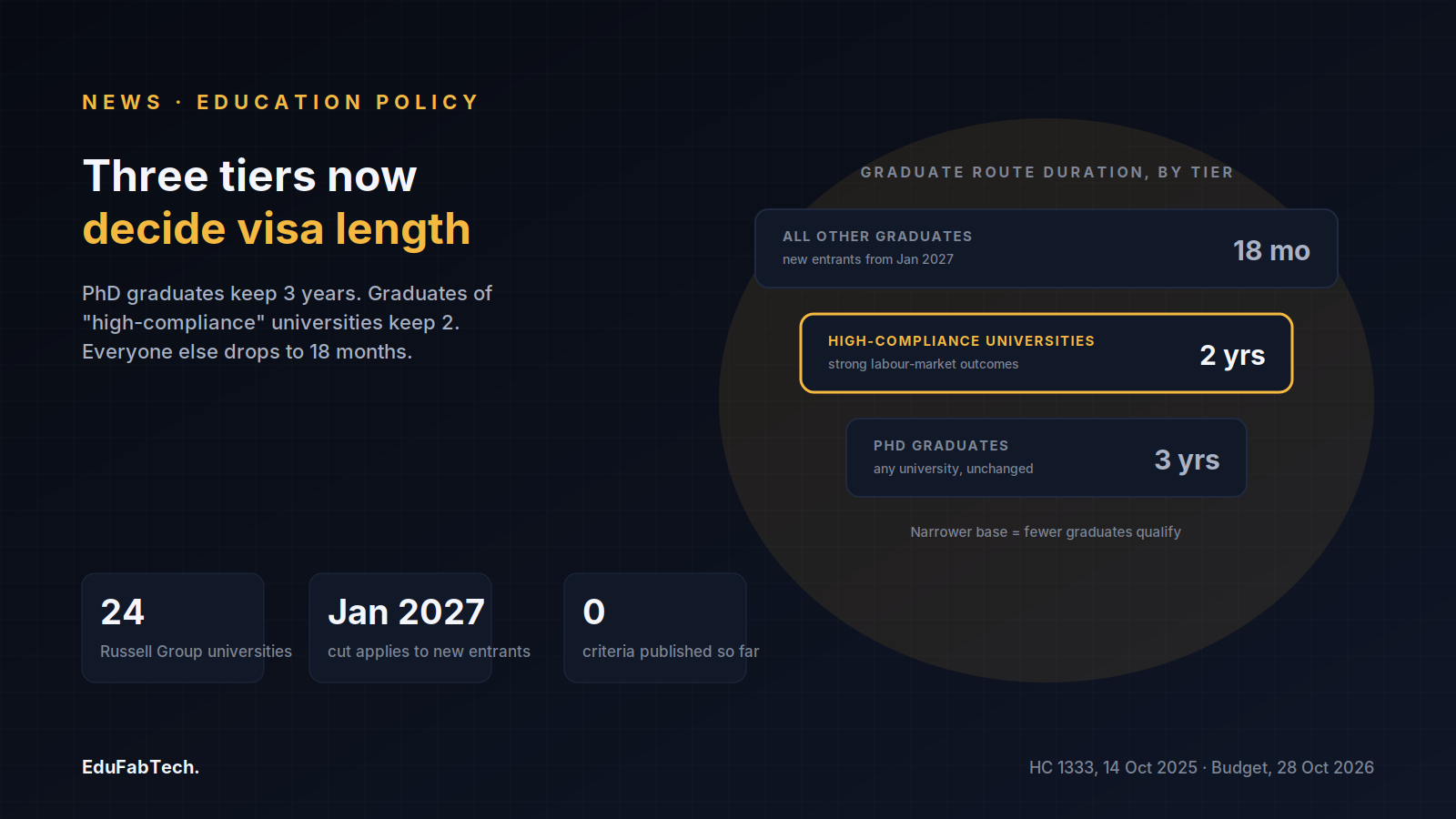
The change the Budget partly reverses was set out earlier. A Statement of Changes to the Immigration Rules (HC 1333), laid on 14 October 2025, states the intention to "reduce the Graduate route duration from 2 years to 18 months (while retaining 3 years for PhD graduates) for new entrants to the route from January 2027," according to the Home Office's impact assessment (2025). Under that plan, graduates already on the route keep their current terms, and the 18-month limit applies only to new entrants joining the Graduate route from January 2027, with PhD graduates still exempt at three years.
The 2026 Budget adds a second exemption on top of the PhD one: graduates of "high-compliance" universities with "strong labour market outcomes" also keep two years, rather than dropping to 18 months. The same Budget expands a separate route, the High Potential Individual visa, so that it covers graduates with qualifications from the top 150 of the world's highest-ranked institutions, up from the top 80 previously, with "a proportional increase to the cap under the scheme," Times Higher Education reports.
What "high-compliance" leaves open
The Budget text does not define either exempting condition. It does not say which body will certify a university as "high-compliance," what counts as a "strong" labour-market outcome, or how many of the UK's degree-awarding institutions are expected to qualify. Times Higher Education and The PIE News both reported that detailed eligibility criteria were still being worked out between the Home Office and the Department for Education at the time of the Budget, with further announcements expected.
Hollie Chandler, the Russell Group's director of strategic policy, welcomed the move but kept the focus on reputation rather than detail: "Avoiding the planned reduction in the length of the graduate visa for highly compliant universities will help protect our reputation as a global study destination," she said, quoted by The PIE News (2026). The Russell Group represents 24 research-intensive UK universities; whether all of them meet whatever "high-compliance" ends up meaning is not yet confirmed.
How the policy compares elsewhere
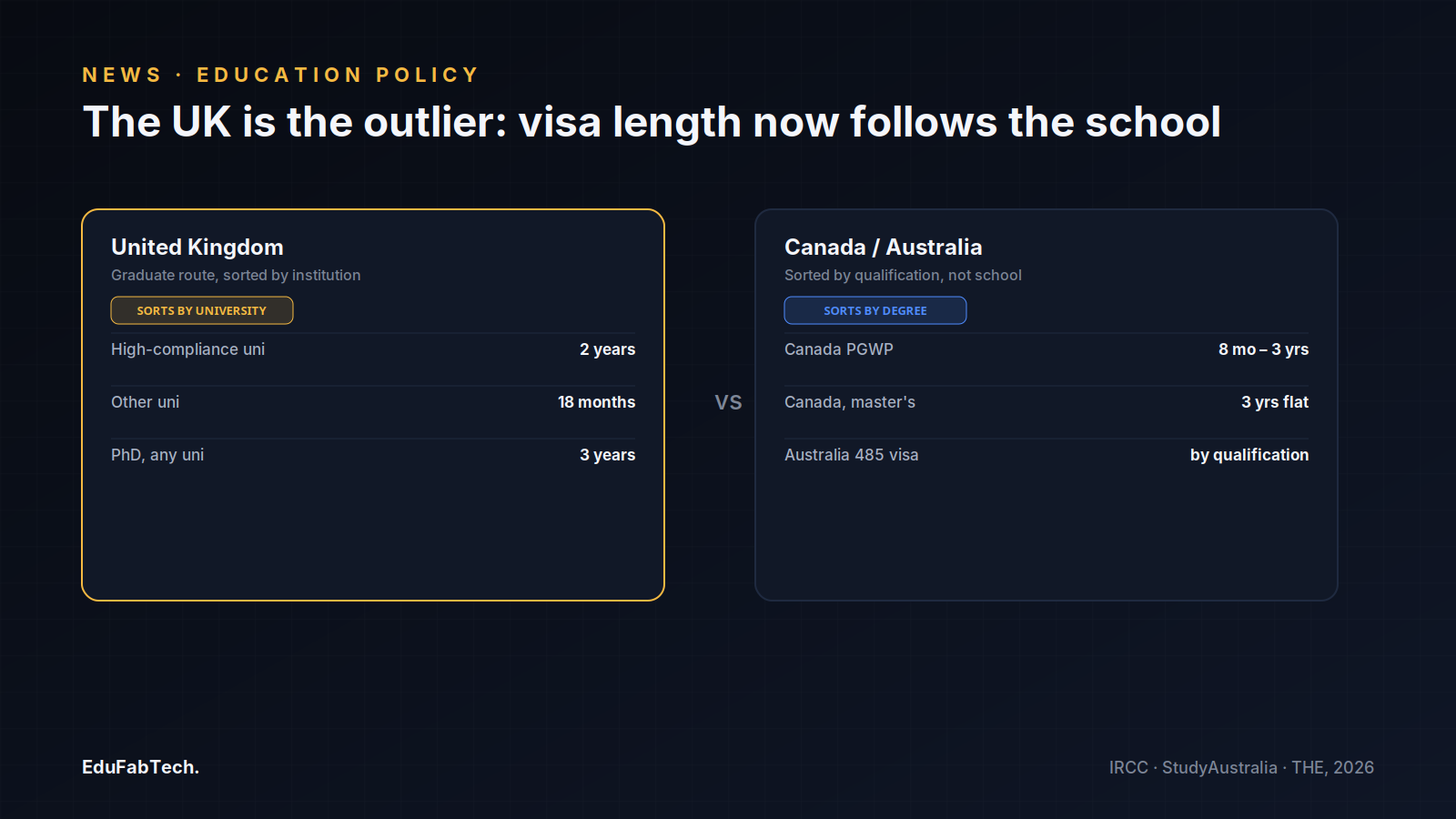
Other major study destinations run their post-study work permits on different logic. In Canada, the Post-Graduation Work Permit "may be valid anywhere between 8 months and up to 3 years," with length normally tied to the length of the study programme completed, except that graduates of master's programmes qualify for the 3-year permit regardless of how short the programme was, according to Immigration, Refugees and Citizenship Canada.
In Australia, the Temporary Graduate visa (subclass 485) is also tiered by qualification rather than by institution: the length of the Post-Higher Education Work stream "depends on your qualification and circumstances," while the Post-Vocational Education Work stream is capped at 18 months, according to the Australian government's StudyAustralia portal. Neither system sorts graduates by which institution they attended, as the UK's new exemption does.
What it means for students and universities
For a prospective student choosing where to apply now, the practical length of a UK post-study work visa depends on an institutional classification that does not yet exist in public form. Vivienne Stern, Universities UK's chief executive, said "the rules need to be stable and fair" as the detail is worked out, pointing to the scale of what is at stake: a single cohort of international students is estimated to generate a net economic benefit of over £833m in the Leeds Central and Headingley constituency and £806m in Manchester Rusholme, supporting more than 6,000 jobs in each, according to The PIE News (2026).
Until the Home Office and the Department for Education publish the compliance and outcomes thresholds, applicants cannot know in advance whether their chosen university will qualify for the two-year route or the 18-month one. Current students and recent graduates are unaffected either way: the 18-month limit, where it applies, only bites for new entrants to the Graduate route from January 2027 onward, and PhD graduates keep three years regardless of which university they attended.
---END---A quick question for readers
Which study method makes things stick for you until the exam?
Research says some methods work far better than others. Vote first, then see whether students agree with the evidence.
Pick an answer, create a free account in a minute, and your vote counts. Already a member? Sign in
Comments 3
Comment-
The part that undercuts the whole announcement is that 'high-compliance' and 'strong labour market outcomes' aren't defined anywhere in the…
-
The part that stands out is what's absent: no definition of "high-compliance," no named certifying body, no threshold for "strong labour mar…
-
The part that jumps out is that the Budget creates a two-tier system but still hasn't published the test for either tier. "High-compliance"…
Join free to read the full comments and reply Comments are between members; an account takes a minute.
Source: Times Higher Education
Sources (3)
- Times Higher Education staff. Budget: longer graduate visas at 'high compliance' universities. Times Higher Education, 2026. timeshighereducation.com ↗ · checked 30 Oct 2026
- The PIE News staff. Breaking: UK to extend graduate visa to two years for graduates of "high-compliance universities". The PIE News, 2026. thepienews.com ↗ · checked 30 Oct 2026
- UK Home Office. Autumn 2025 Immigration Rules: impact assessment (accessible version). GOV.UK, 2025. gov.uk ↗ · checked 30 Oct 2026