UK Confirms Erasmus+ Return from 1 January 2027, With Applications Opening in November 2026
Minister Hamish Falconer told Parliament on 27 October 2026 that the UK will reassociate with Erasmus+, ending the Turing Scheme and reopening EU-wide exchanges to apprentices, school groups and staff as well as university students.
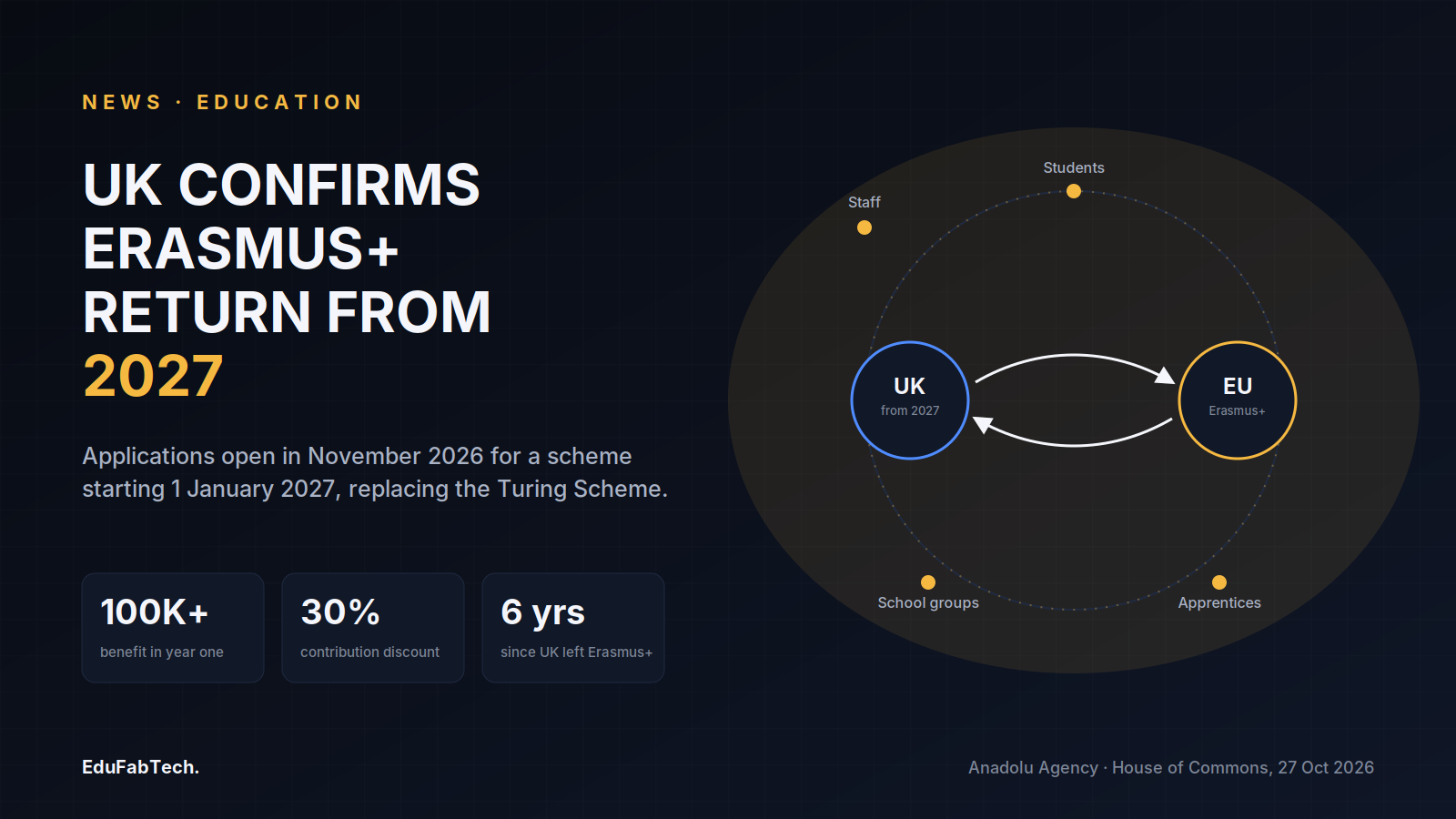
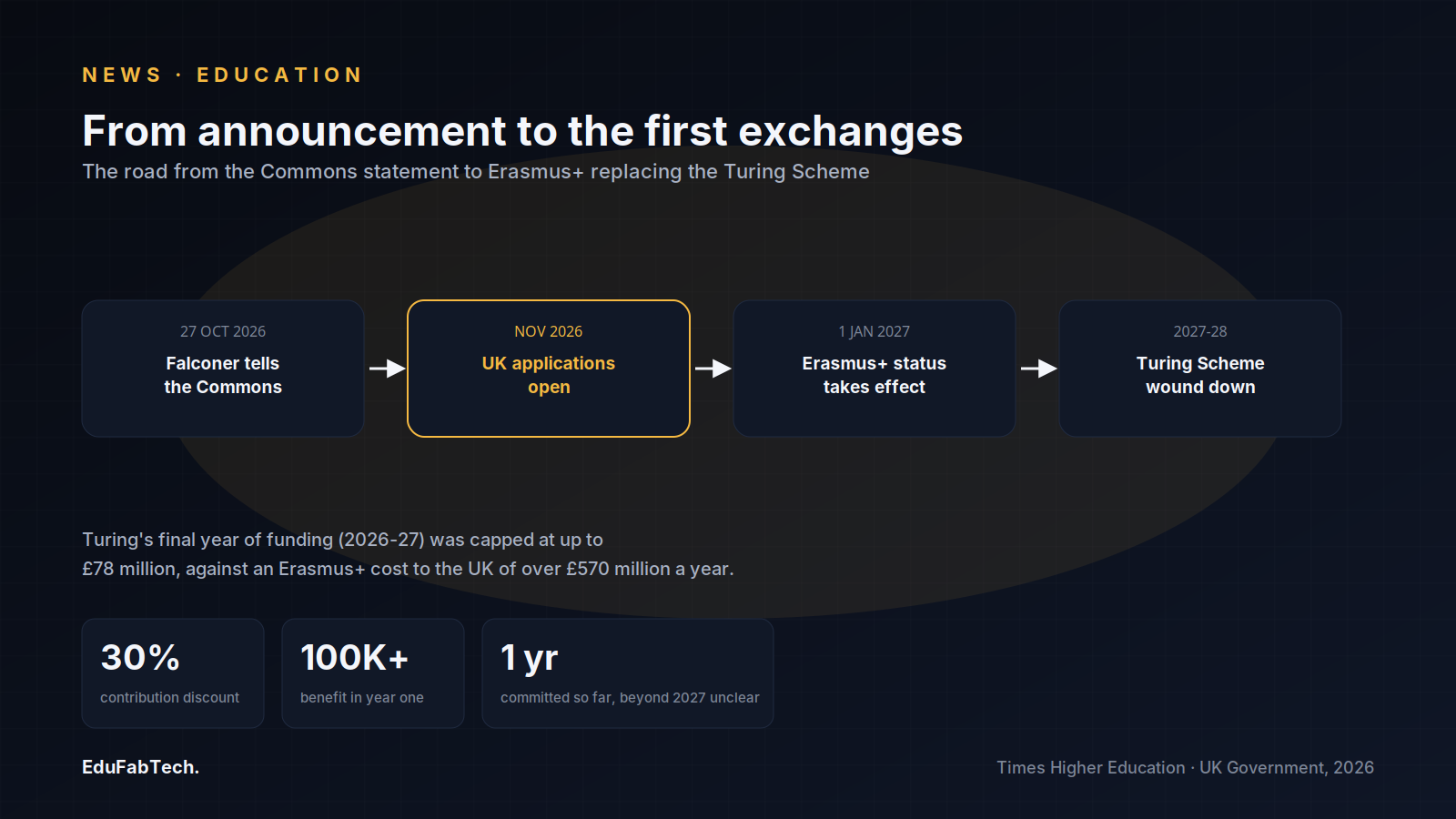
The United Kingdom will reassociate with the European Union's Erasmus+ programme from 1 January 2027, Foreign Office minister Hamish Falconer told the House of Commons on 27 October 2026, with applications for the first UK funding round opening in November 2026. The confirmation sets a working start date for an agreement in principle reached between the UK and the EU earlier in 2026, and ends a six-year absence from the programme since the UK left after Brexit.
Falconer told MPs that the programme would not be limited to undergraduate study exchanges. According to reporting on the statement by Anadolu Agency (2026), he said applications would open in November and that the scheme extends beyond university students to educational institutions of all kinds. The UK government's announcement lists apprentices on placements, school groups taking part in cultural exchanges, and educators among those it expects to take part, alongside university students.
What the UK government has committed to
The UK government's announcement says the UK secured a 30% discount on the default contribution rate that non-EU associated countries normally pay, and that the British Council has been appointed as the UK's National Agency to run the scheme domestically. The same announcement puts the number of people the government expects to benefit in the programme's first year at more than 100,000.
Replacing the Turing Scheme
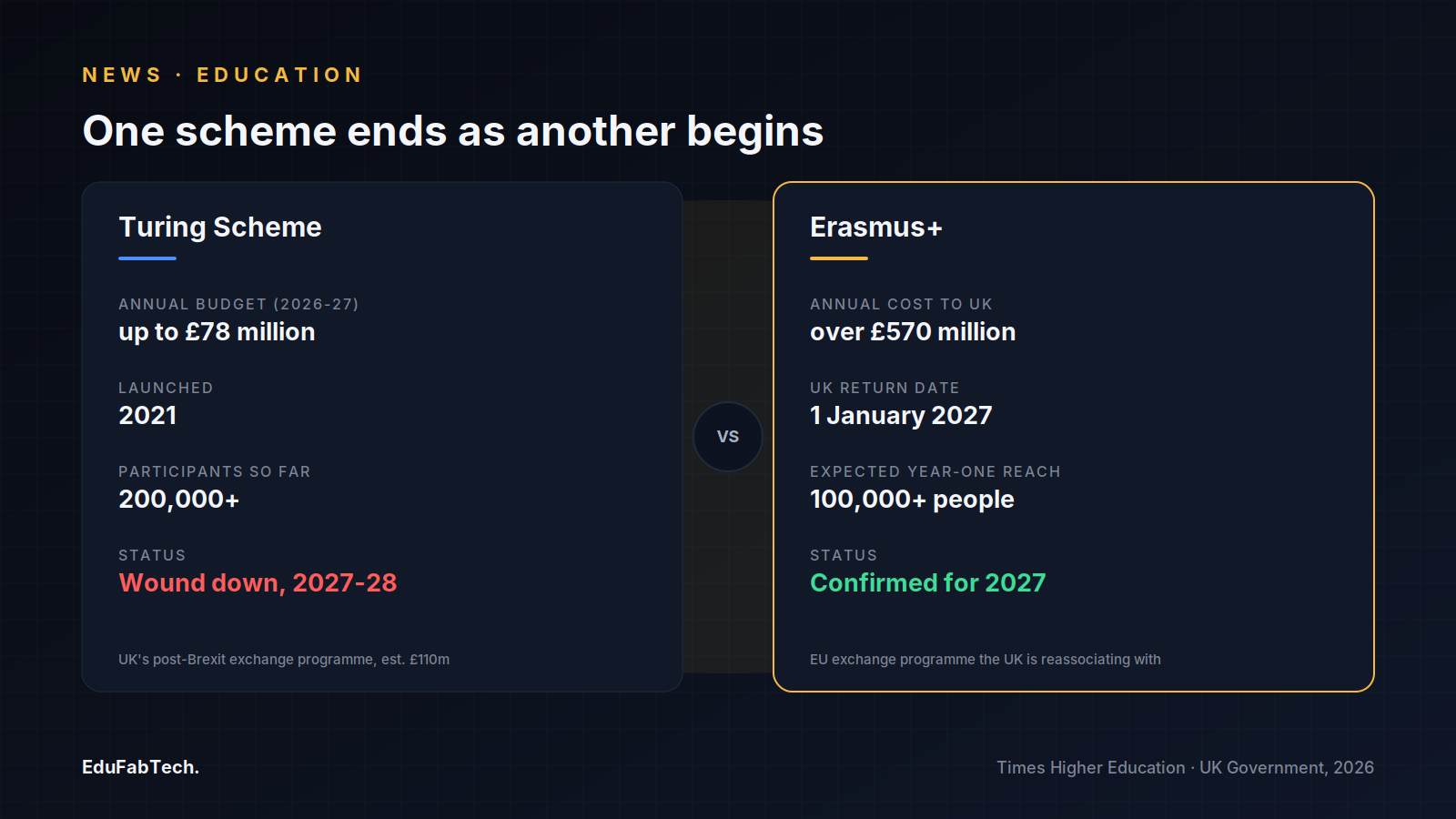
The UK's own post-Brexit exchange programme, the Turing Scheme, will be wound down as Erasmus+ placements begin in the 2027-28 academic year, according to Times Higher Education (2026), which reported that Turing's sixth and final year of funding, 2026-27, was set at up to £78 million, against an annual Erasmus+ cost to the UK of more than £570 million. Turing, launched in 2021 with an initial £110 million budget, has supported more than 200,000 participants since then, the same report said.
Universities UK International's director, Jamie Arrowsmith, welcomed the move but flagged that the UK has so far only committed to one year of Erasmus+ participation. "Looking beyond 2027, we would strongly welcome the UK's continued participation in Erasmus+," he said, according to The Brussels Times (2026). "Long-term certainty would allow students, staff and universities on both sides to plan ahead, deepen partnerships and create more opportunities for international study, training and collaboration."
A youth sector reaction, and a caveat
European Youth Forum president Caillum Hedderman struck a similar note of qualified welcome, saying the move "restores UK youth organisations' access to European funding, so they can reconnect with partners across Europe and create projects with and for young people," but added: "One year is a start, not a guarantee. Young people need to know these opportunities are here to stay, and the next EU budget must invest far more in Erasmus+," as quoted by The Brussels Times (2026). EU Commissioner Maroš Šefčovič said the agreement "will enable tens of thousands of citizens to learn, study and train on the other side of the Channel and foster person-to-person ties," the same article reported.
What changes for students and institutions
For EU students and staff, the practical change is that UK universities, colleges and youth organisations become eligible destinations and partners for Erasmus+-funded mobility again from 1 January 2027. For UK applicants, the opening of applications in November 2026 is the first concrete date in the calendar: institutions wanting to take part need to register with the British Council as the national agency ahead of the funding calls that follow.
The one-year commitment that Arrowsmith and Hedderman both flagged leaves open what happens after 2027. The current agreement covers the UK's association for 2027; it does not by itself guarantee participation in the years beyond that, which will depend on further negotiation between London and Brussels.
A quick question for readers
Have you thought about studying abroad?
The answers show what really stops students — cost, language or something else.
Pick an answer, create a free account in a minute, and your vote counts. Already a member? Sign in
Comments 0
CommentNo comments yet. Members start the conversation.
Source: UK Government (GOV.UK)
Sources (3)
- UK Government. UK and EU finalise agreement to bring UK into Erasmus+ in 2027. GOV.UK, 2026. gov.uk ↗ · checked 4 Nov 2026
- Anadolu Agency. UK confirms rejoining EU's Erasmus student exchange program starting Jan. 1, 2027. Anadolu Agency, 2026. aa.com.tr ↗ · checked 4 Nov 2026
- Christopher Richards. UK to rejoin EU's youth exchange programme in 2027. The Brussels Times, 2026. brusselstimes.com ↗ · checked 4 Nov 2026