UK Student Visa Grants Fall 23% as Refusal Rate Hits Highest Since 2015
Home Office data for the year to September 2026 show sponsored study visa grants down sharply, with refusal rates rising far more for some nationalities than others.
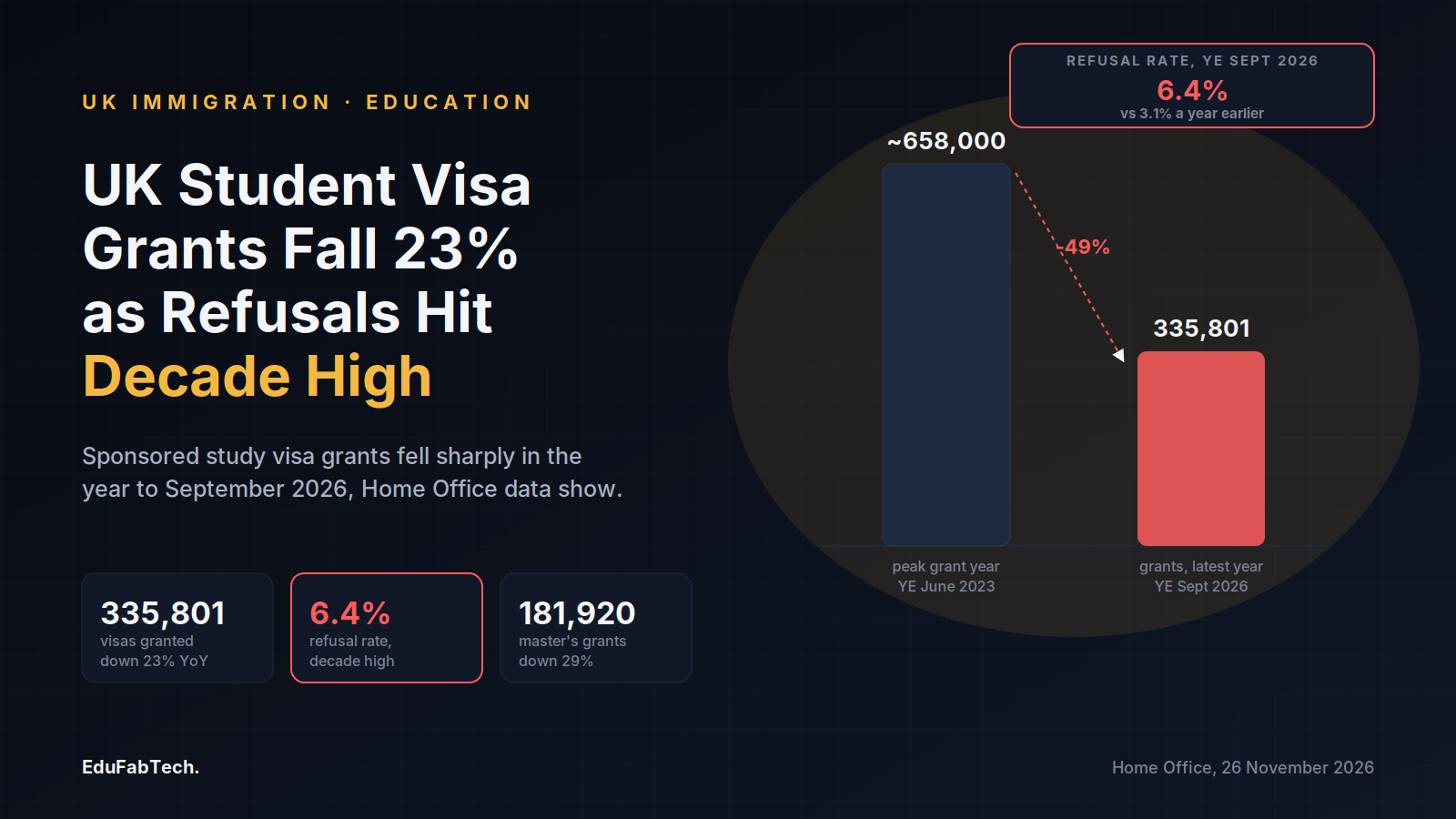
The UK's Home Office published its quarterly immigration statistics on 26 November 2026, and the study-route figures show a system granting far fewer visas while refusing a far larger share of applications than a year earlier. In the year ending September 2026, 335,801 sponsored study visas were granted overall, 23% fewer than the previous year and 49% fewer than the peak reached in the year ending June 2023, according to the Home Office release.
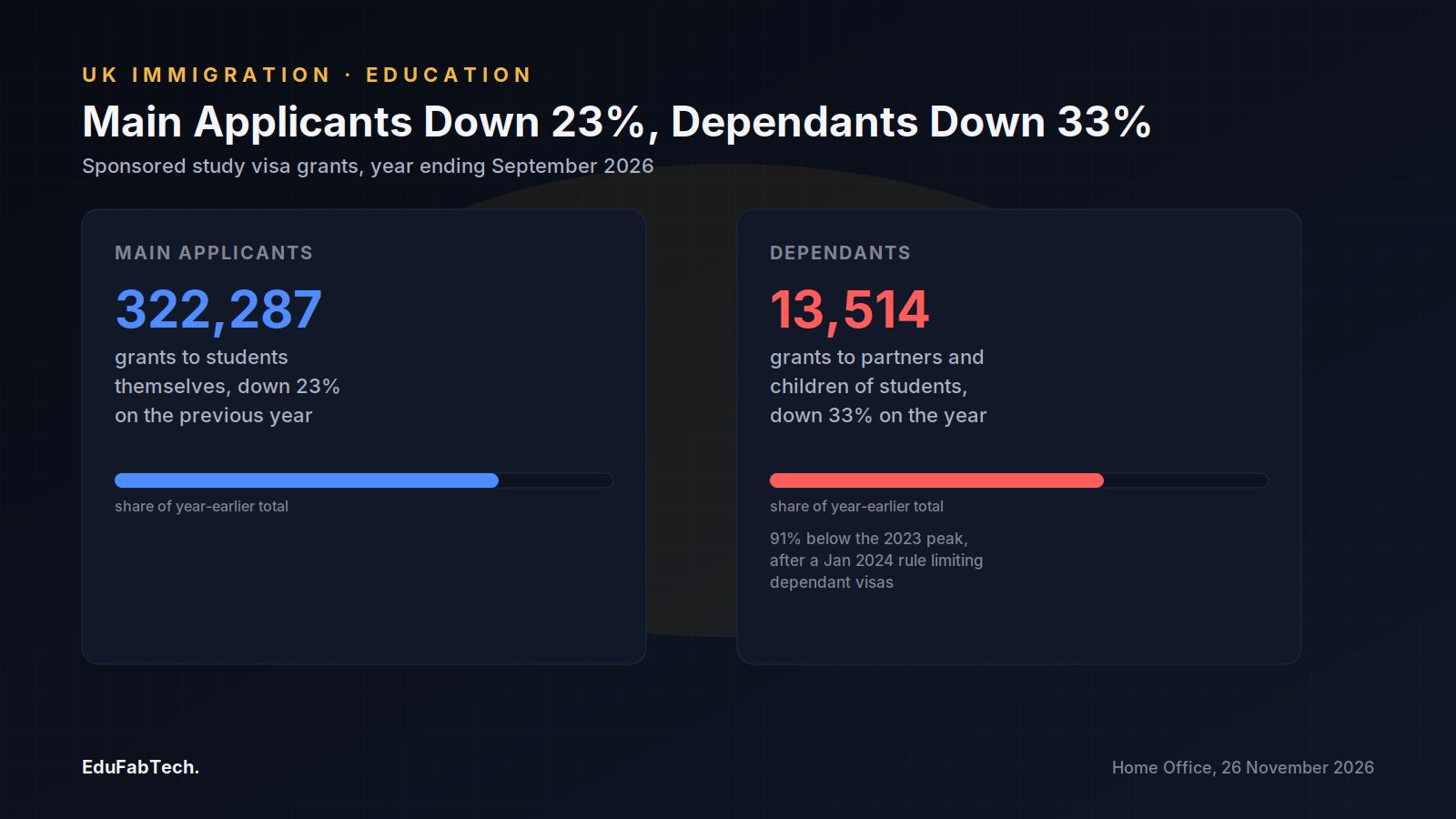
Of that total, 322,287 grants went to main applicants, also down 23% on the year, while grants to dependants of students fell faster, down 33% to 13,514, the Home Office data show. The sponsored study route covers visas issued to people coming to the UK specifically to study at a licensed institution, separate from short-term visit visas.
The decline is not new, but it continues a multi-year slide from the record levels reached in 2023. Visas for master's-level courses, the largest single category, fell to 181,920, down 29% on the previous year and 42% below the peak of 314,929 recorded in the year ending September 2023, the same release shows.
Refusal rates vary sharply by nationality
Alongside fewer grants, a larger share of applications are being turned down. The rolling refusal rate for the year to September 2026 rose to 6.4%, the highest since the year ending September 2015, up from 3.1% a year earlier, according to an analysis of the Home Office figures by The PIE News. Withdrawn applications in the third quarter of 2026 reached 3,682, up from 779 in the same quarter of 2025, the same analysis found.
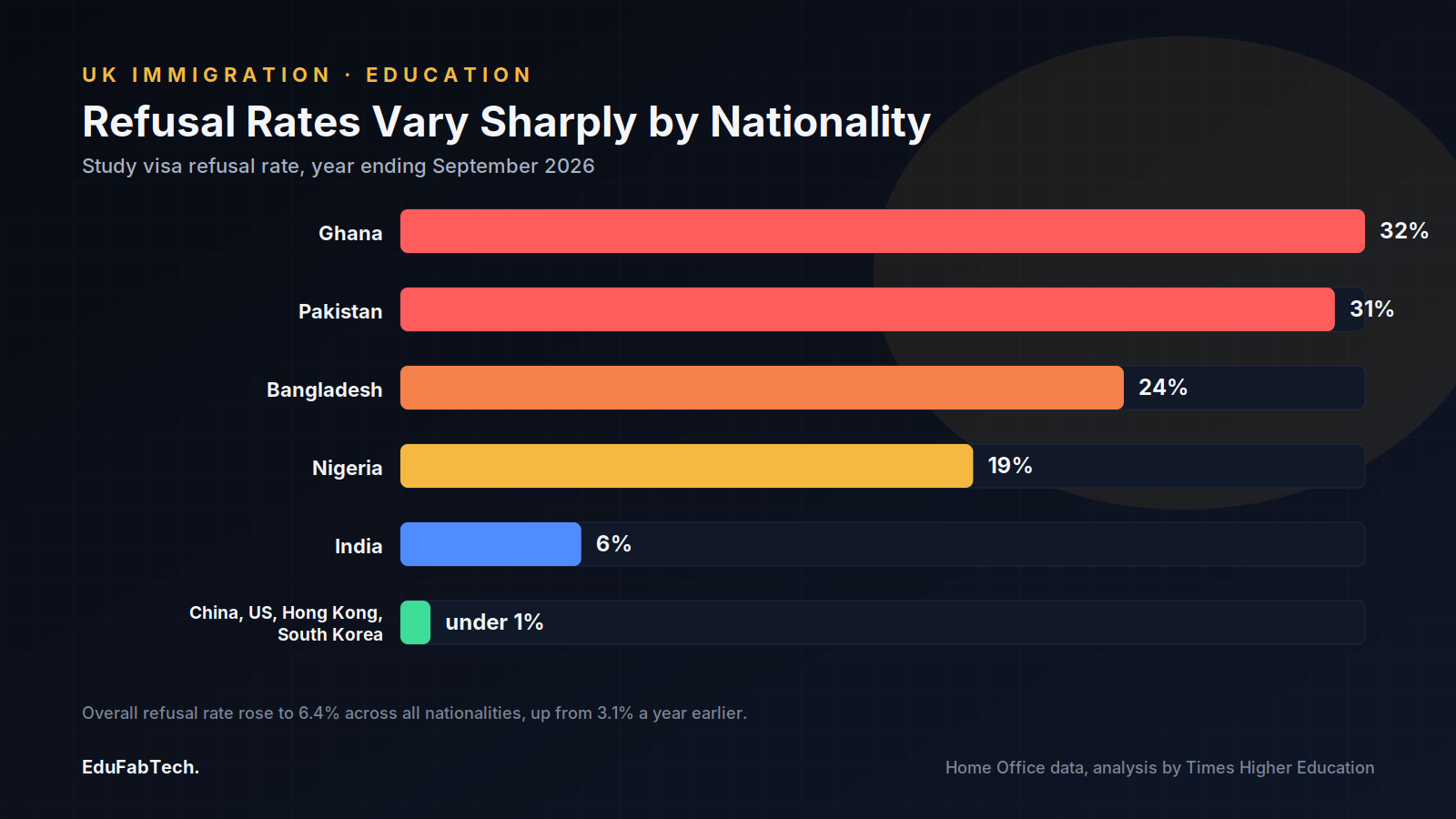
The rate differs enormously by the applicant's nationality. A breakdown of the Home Office data by Times Higher Education found refusal rates of 32% for Ghanaian applicants, 31% for Pakistani applicants, 24% for Bangladeshi applicants and 19% for Nigerian applicants, against 6% for Indian applicants and under 1% for applicants from China, the United States, Hong Kong and South Korea. India remained the second-largest source of sponsored study visas after China, with 69,855 granted to main applicants, down 29% on the year, while China accounted for 80,932, or 25% of the total, the Home Office release shows.
| Nationality | Refusal rate, YE Sept 2026 |
|---|---|
| Ghana | 32% |
| Pakistan | 31% |
| Bangladesh | 24% |
| Nigeria | 19% |
| India | 6% |
| China, US, Hong Kong, South Korea | under 1% |
What changed, and why
The Home Office release attributes part of the fall in dependant numbers to a policy change introduced in January 2024 that restricted most international students from bringing dependants; it says dependant grants dropped immediately after the change and have since stabilised at a much lower level, 91% below the peak reached in the year ending June 2023. Grants of extensions onto the Graduate route, the post-study work permission open to former students, fell 31% to 162,881 in the year ending September 2026, with Indian nationals the largest group at 66,552, followed by Pakistani nationals at 24,768 and Nigerian nationals at 20,478, the release states.
Zaid Kadhum, policy manager at the Russell Group, which represents 24 research-intensive UK universities, said of the rise in refusals: "A robust immigration system is in everyone's interests, but decisions must be fair and transparent, and we should be careful not to deter genuine students in the process," according to The PIE News.
What it means for students and universities
For prospective students, the figures point to a visa system in which nationality now correlates with very different odds of approval: an applicant from Ghana or Pakistan faced roughly a one-in-three refusal rate in the year to September 2026, against roughly one-in-sixteen for an applicant from India and under one-in-a-hundred for applicants from China, the US, Hong Kong or South Korea, based on the rates reported by Times Higher Education. Students from the nationalities with the sharpest rises in refusals may need to budget more time and documentation for credibility checks, and to weigh the risk of a refused application against non-refundable deposits and visa fees already paid.
For universities, the fall in master's-level grants, which make up more than half of all sponsored study visas, is the figure with the most direct effect on income and planning, since postgraduate international fees are a larger share of revenue for many institutions than undergraduate ones. The 31% fall in Graduate route extensions is a second figure for recruitment and careers teams to watch in next year's equivalent release.
A quick question for readers
Would you choose the same field of study again?
One of the most honest questions a student can answer — and one of the most useful for those still choosing.
Pick an answer, create a free account in a minute, and your vote counts. Already a member? Sign in
Comments 3
Comment-
The breakdown by nationality is the part that needed more scrutiny than it got: a one-in-three refusal rate for Ghanaian and Pakistani appli…
-
The breakdown by nationality is the part that actually needs scrutiny, not the 23% headline fall. A 32% refusal rate for Ghanaian applicants…
-
The breakdown by nationality is the thing I'd want students to actually sit with: a Ghanaian or Pakistani applicant faced roughly a one-in-t…
Join free to read the full comments and reply Comments are between members; an account takes a minute.
Source: UK Home Office (GOV.UK)
Sources (3)
- UK Home Office. Immigration system statistics, year ending September 2026: Why do people come to the UK? Study. GOV.UK, 2026. gov.uk ↗ · checked 27 Nov 2026
- The PIE News. UK study visa refusals hit highest rate in over a decade as withdrawals soar. The PIE News, 2026. thepienews.com ↗ · checked 27 Nov 2026
- Times Higher Education. UK student visa approvals crash by 96,000 as refusal rates soar. Times Higher Education, 2026. timeshighereducation.com ↗ · checked 27 Nov 2026