UNEP's 2026 Emissions Gap Report Says 1.5°C Overshoot Is Now Unavoidable
The UN Environment Programme's 21 October 2026 report says holding warming below 1.5°C without overshoot is no longer achievable, and sets out what cutting emissions 18% by 2030 would take.
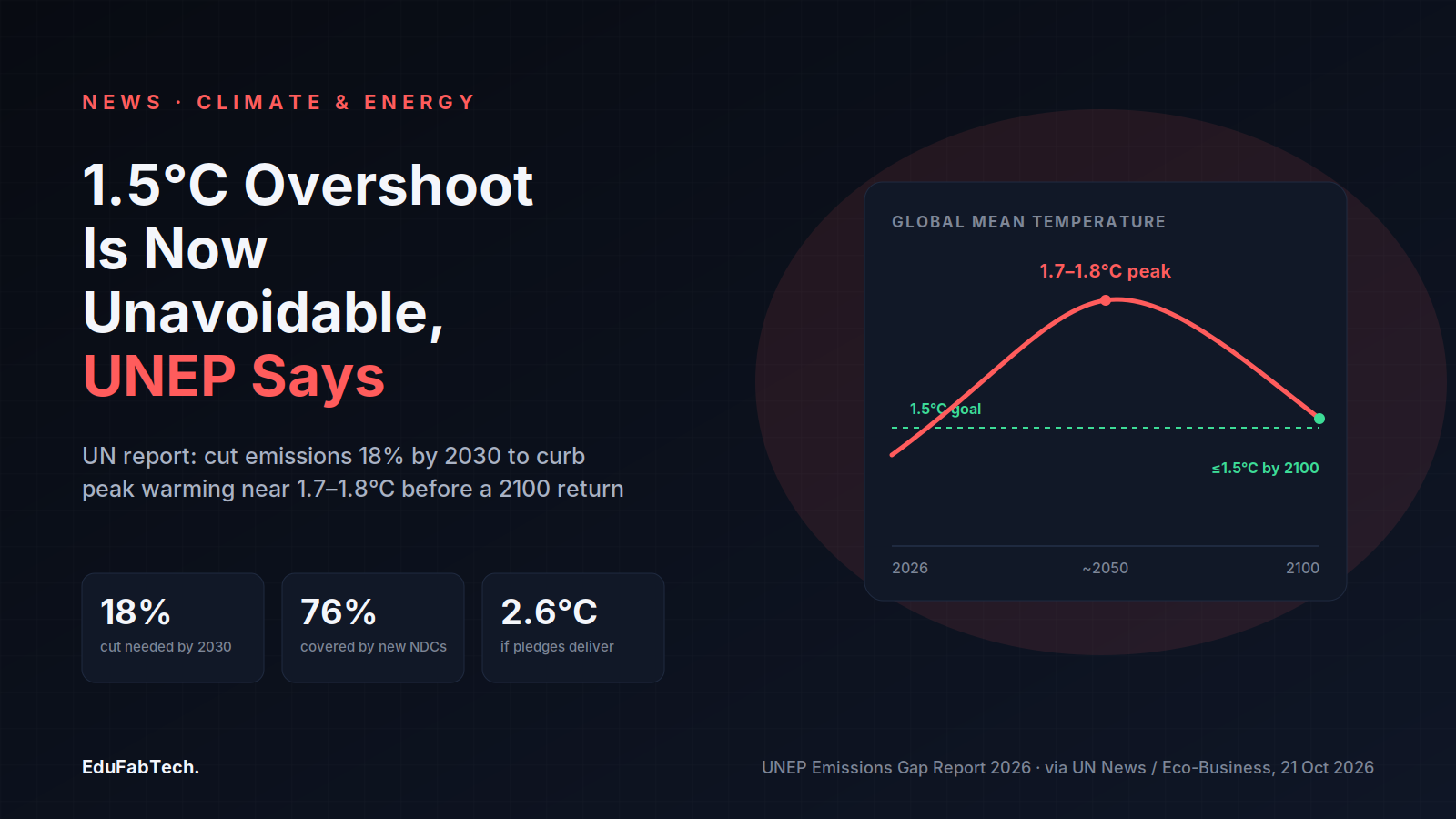
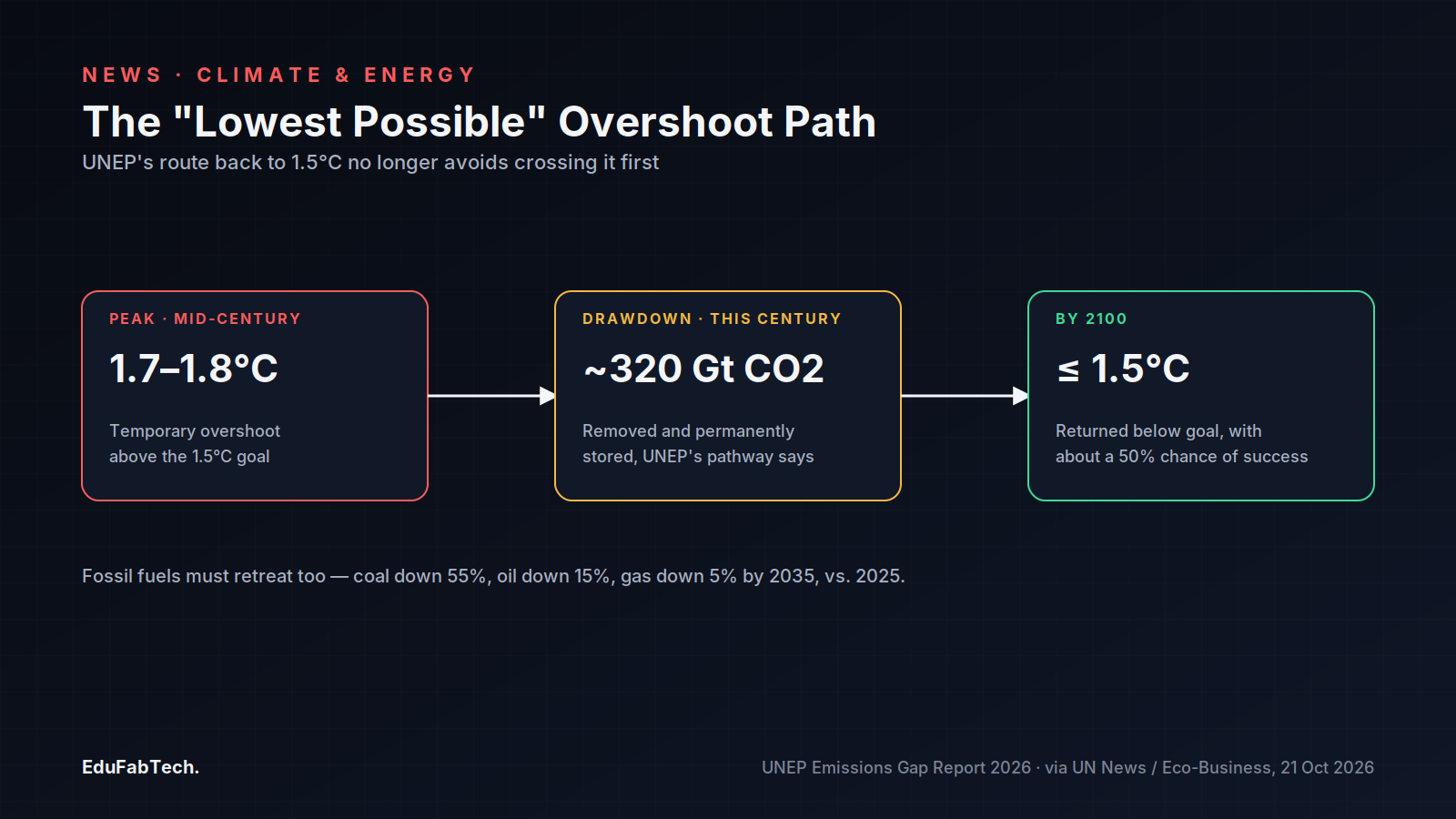
The United Nations Environment Programme published its Emissions Gap Report 2026: The Point of Return on 21 October 2026, concluding that holding global warming below 1.5°C without first overshooting it is no longer achievable. The report, UNEP's annual assessment of the distance between countries' climate pledges and what the Paris Agreement requires, instead sets out what it calls a "lowest possible" overshoot pathway: one in which peak warming around the middle of the century is limited to 1.7–1.8°C before temperatures are brought back to or below 1.5°C by 2100, with about a 50 percent chance of success, according to Eco-Business's report on the findings.
What the report measures
The Emissions Gap Report series compares the greenhouse gas emissions countries say they will achieve under their Nationally Determined Contributions (NDCs) — the national pledges submitted under the Paris Agreement — against the emissions trajectory needed to meet the agreement's temperature goals. As of 1 September 2026, 124 parties to the Paris Agreement, covering around 76 percent of global emissions, had submitted new NDCs, up from 57 parties covering 63 percent the year before, Eco-Business reported on the same findings.
The numbers behind the gap
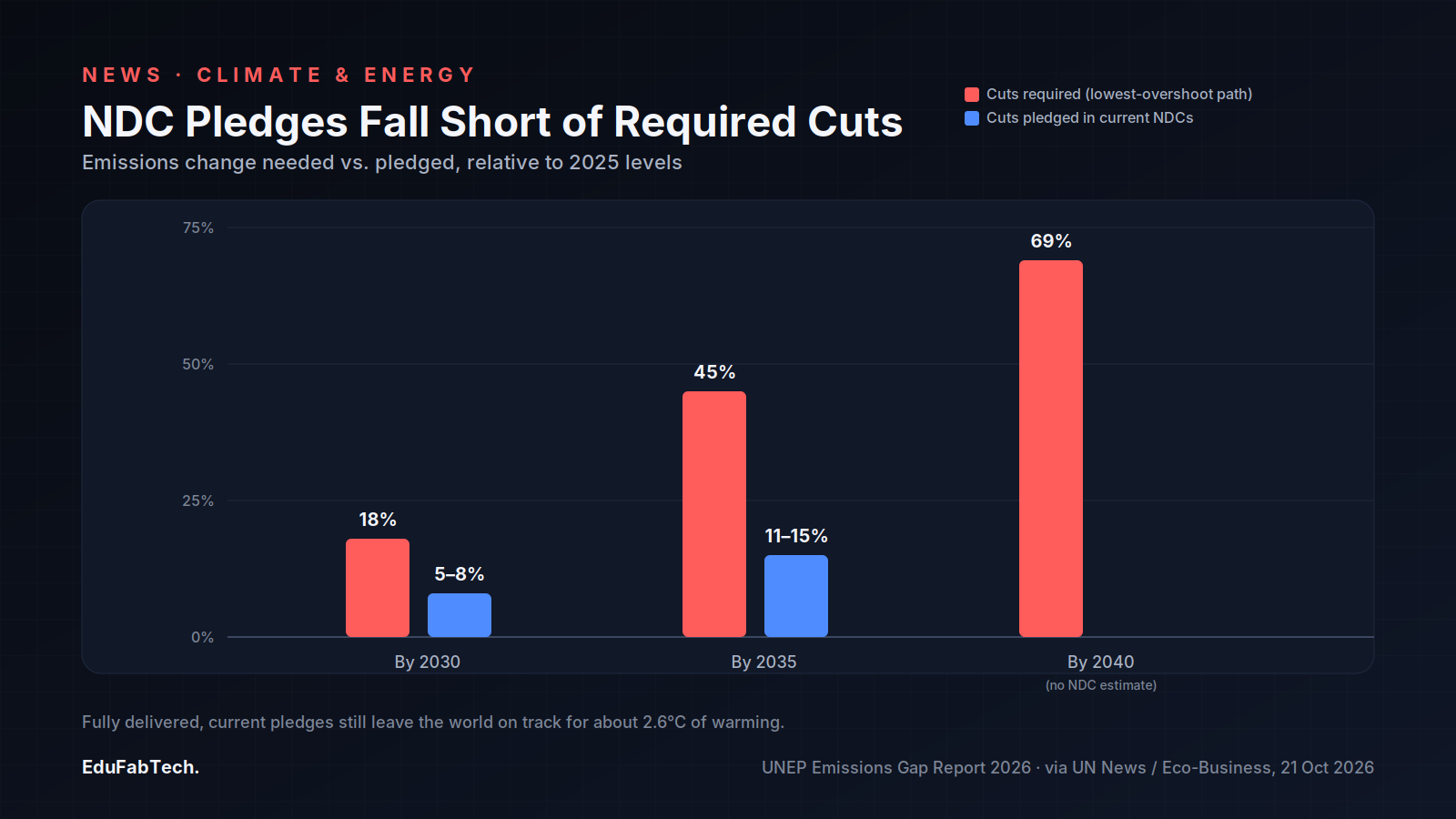
To reach the lowest possible overshoot pathway, the report finds that global greenhouse gas emissions would need to fall 18 percent by 2030, 45 percent by 2035 and 69 percent by 2040, all relative to 2025 levels, according to UN News's coverage of the report. Current NDCs fall far short of that: fully implemented, all current pledges would cut emissions by only 5–8 percent by 2030 and 11–15 percent by 2035 against the same 2025 baseline, Eco-Business reported.
Translated into temperature outcomes, full delivery of existing NDCs would leave the world on track for around 2.6°C of warming this century, while continuing under current policies alone would produce roughly 2.8°C, Eco-Business reported. The lowest-overshoot pathway also requires a sharp retreat from fossil fuels: coal, oil and gas use would need to fall 55, 15 and 5 percent respectively by 2035, relative to 2025, according to UN News. Eco-Business additionally reported that coal-fired power generation specifically would need to fall by at least 75 percent by 2035 and at least 95 percent by 2040.
A role for carbon dioxide removal
Because the lowest-overshoot scenario accepts a temporary breach of 1.5°C, it also depends on pulling carbon back out of the atmosphere afterward. UNEP's pathway calls for removing and permanently storing roughly 320 gigatonnes of CO2 over the course of the century — a scale the report itself calls uncertain, given the socioeconomic and technological barriers to scaling up removal methods, according to Eco-Business's coverage of the report.
Where the report sees progress
The report does not present only shortfalls. Since the Paris Agreement was adopted in 2015, global renewable electricity capacity has grown three times faster than the report's own earlier projections anticipated, and solar photovoltaic build-out has expanded seven times faster, Eco-Business reported. UNEP Executive Director Inger Andersen said the report "shows that the world can still attain the goals of the Paris Agreement, but we must understand that the point of return begins now – with the implementation of fast, deep and sustained emissions reductions," according to Eco-Business's account of the launch.
What it means for researchers and students
For climate scientists and policy researchers, the report's finding changes the live question: a 1.5°C pathway with no overshoot at all is no longer on the table, and the open research and policy question is how large and how long an overshoot will be, not whether one happens. That shifts emphasis toward overshoot dynamics — carbon budget accounting that includes a drawdown phase, the scalability and permanence of carbon removal methods, and the ecological and social risks of temporarily exceeding thresholds that ecosystems and infrastructure were assumed to stay under.
UN Secretary-General António Guterres framed the finding in similar terms at the report's release, saying "overshoot is not surrender" and that the world "can still keep it as small and as short as possible – and bring temperatures back below 1.5 degrees by the end of the century," UN News reported. The report arrives ahead of the next UN climate conference, giving negotiators a baseline figure — the 18-45-69 percent reduction sequence through 2040 — against which any new pledges made there can be measured.
The primary source
The full report, Emissions Gap Report 2026: The Point of Return, is published by the United Nations Environment Programme and is the primary document behind all the figures above; news agencies' coverage cited here reports on its findings and quotes from its launch.
A quick question for readers
How much do you spend on books and course materials per term?
Amounts in US dollars. The results help show how much course materials really cost students.
Pick an answer, create a free account in a minute, and your vote counts. Already a member? Sign in
Comments 3
Comment-
The part that jumps out is the carbon removal number: 320 gigatonnes pulled out and permanently stored over the century, and the report itse…
-
The 320 gigatonnes of CDR is the number that should worry people more than the 1.7–1.8°C peak figure, because the report itself flags it as…
-
The number that actually does the work here is 18% versus 5-8% — that's the 2030 cut needed against what current NDCs deliver even if every…
Join free to read the full comments and reply Comments are between members; an account takes a minute.
Source: United Nations Environment Programme
Sources (3)
- UN Environment Programme. Emissions Gap Report 2026: The Point of Return. UNEP, 2026. unep.org ↗ · checked 23 Oct 2026
- UN News. Global warming will breach 1.5°C, UN report finds. United Nations, 2026. news.un.org ↗ · checked 23 Oct 2026
- Eco-Business. Countries' climate plans point to 2.6°C as 1.5°C limit set to be breached: UN. Eco-Business, 2026. eco-business.com ↗ · checked 23 Oct 2026