UNESCO's 2026 Gender Report Finds Enrolment Parity, but Child Marriage Still Pushes Girls Out
Launched in Paris on 9 October 2026, UNESCO's Global Education Monitoring Gender Report finds girls now match boys in school enrolment worldwide, but child marriage and early pregnancy still drive millions out of secondary school.
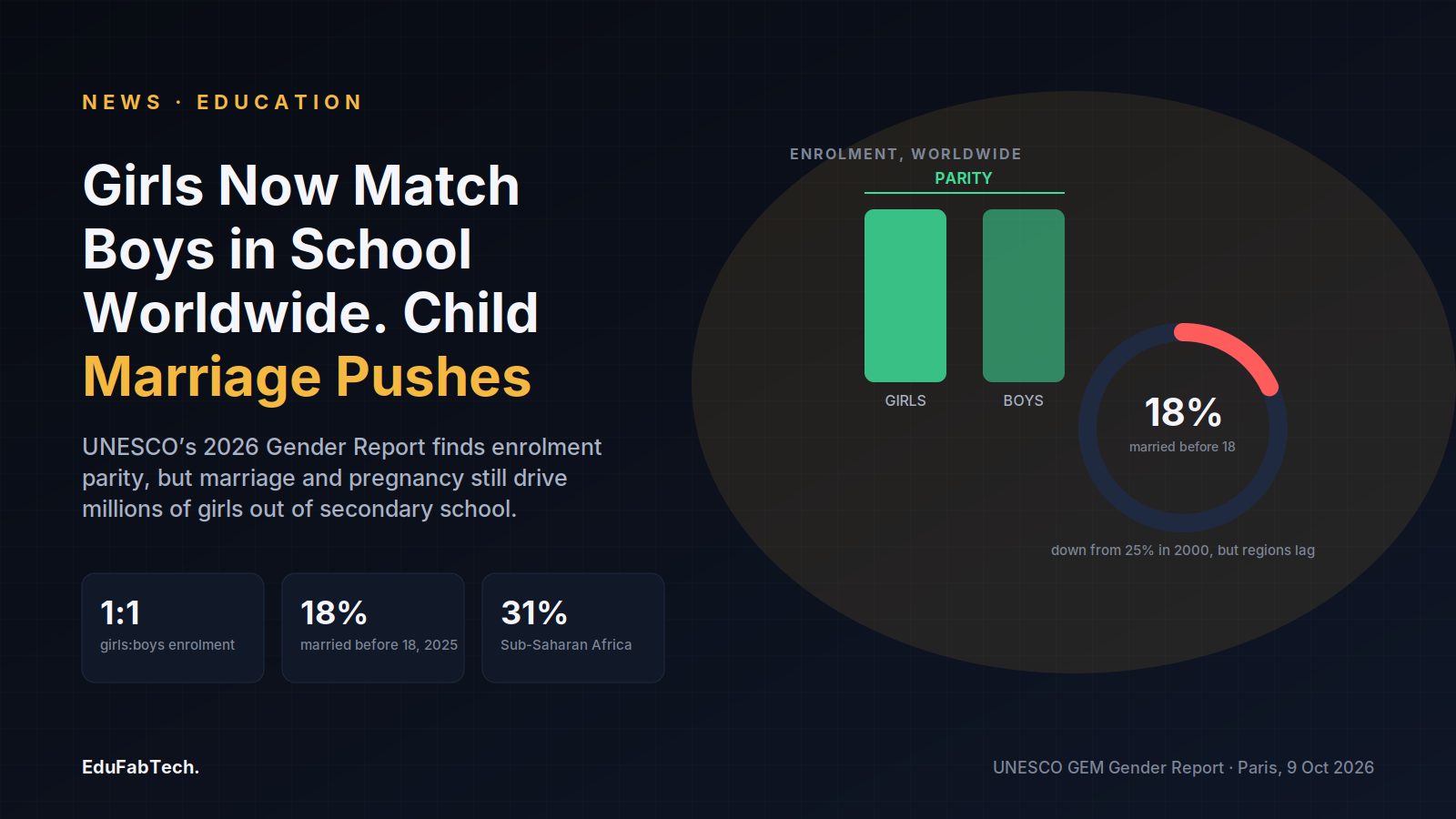
UNESCO launched its 2026 Global Education Monitoring (GEM) Gender Report in Paris on 9 October 2026, at an event that also presented the annual UNESCO Prize for Girls' and Women's Education. The report's headline finding is that as many girls as boys are now enrolled in school worldwide, from pre-primary through secondary education — progress UNESCO describes as major, while cautioning that too many girls still face barriers to accessing, completing and thriving in school.
The same report finds that enrolment parity hides large differences in who actually finishes school, and why. According to UNESCO, the global share of girls married before age 18 fell from 25% in 2000 to 18% in 2025, but that average conceals sharply uneven regional progress: the rate stayed at 25% in Central and Southern Asia and 31% in Sub-Saharan Africa over the same period.
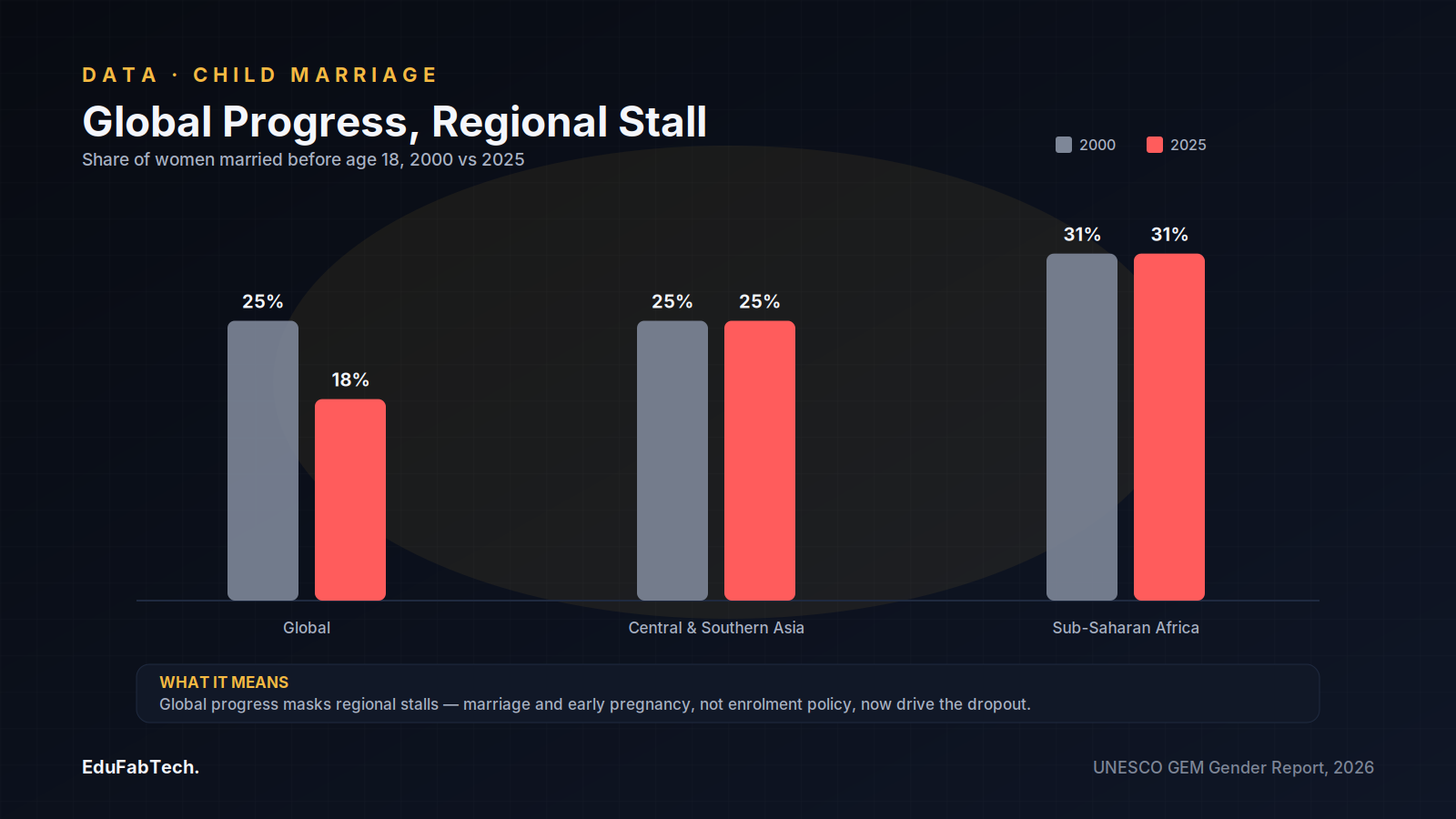
Those regional averages matter for how the data should be read. UNESCO's report ties the persistence of child marriage directly to interrupted schooling, arguing that early marriage and early pregnancy, not enrolment policy, are now the main forces keeping adolescent girls out of secondary classrooms in the hardest-hit regions.
Where country trajectories diverge
The report's country-level data show gender gaps closing at very different speeds. UNESCO reports that Nepal closed a 33-percentage-point gender gap in lower-secondary completion between 1990 and 2024, while Cambodia moved from girls trailing boys by 22 points to leading by 11 points in primary completion between 1981 and 2024. Saudi Arabia cut its tertiary-enrolment gender gap by 75% between 2006 and 2022, and Costa Rica narrowed a secondary-completion gap that favours girls — from 12 points to 7 points between the 2011–17 and 2018–24 periods, UNESCO says.
Read together, these trajectories show gender gaps closing at different speeds in different places, shaped by national policy rather than by income level or region alone.
Gaps that persist within countries
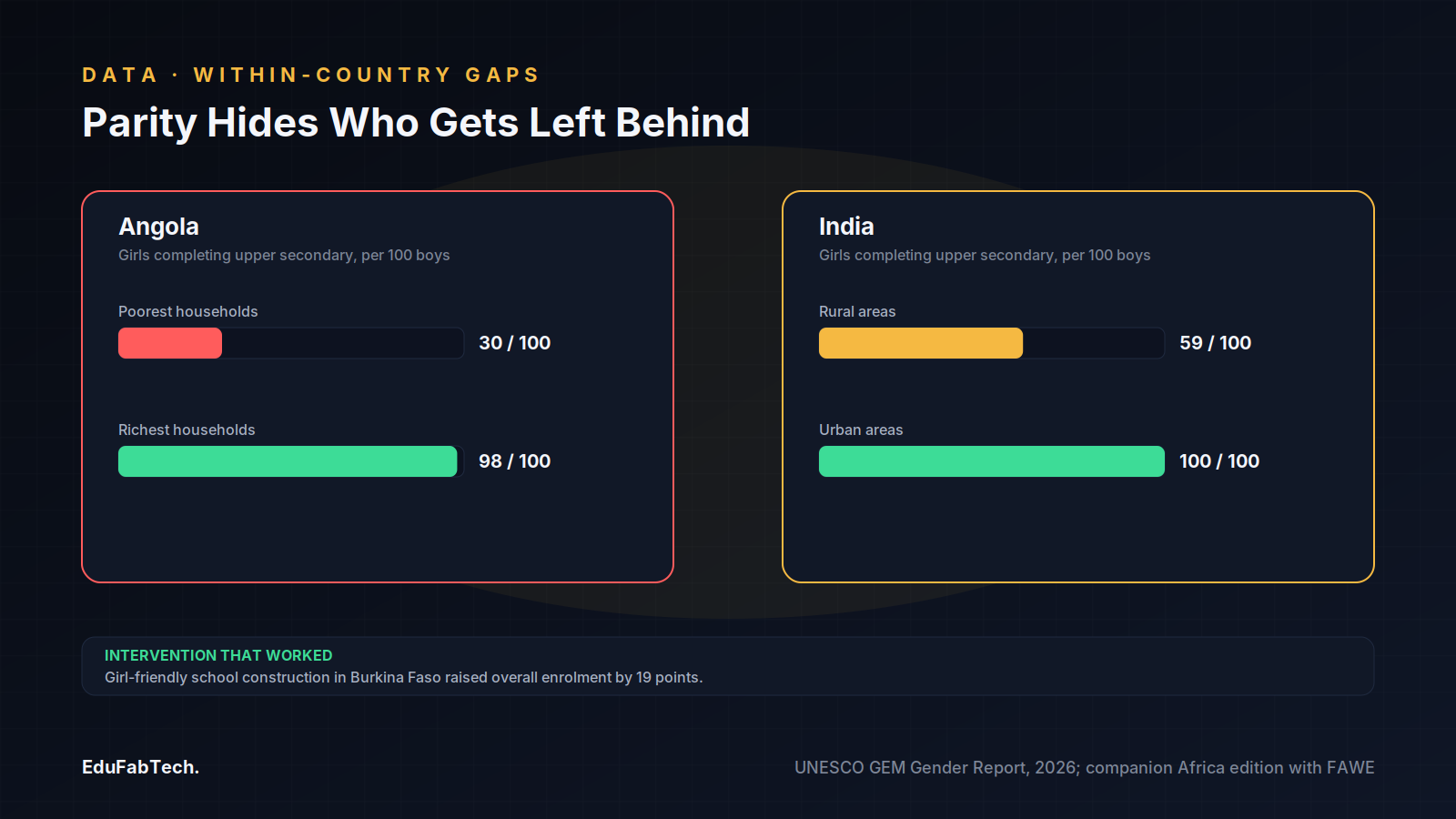
The report's more striking numbers sit below the national level. In Angola, UNESCO finds that only 30 girls complete upper secondary school for every 100 boys in the poorest households, compared with roughly equal numbers among the richest. In India, the report records 59 girls completing upper secondary for every 100 boys in rural areas, against parity already reached in urban areas. UNESCO credits one intervention with narrowing such gaps directly: girl-friendly school construction in Burkina Faso raised overall enrolment by 19 percentage points.
Early motherhood and the law
On early motherhood, UNESCO's report states that six million pregnant girls and young mothers aged 10 to 19 were out of school in Sub-Saharan Africa in 2024, and that fewer than 5% of pregnant or parenting girls in the region return to school. The report also assesses legal protection: UNESCO finds that 58% of countries guarantee education rights without sex or gender discrimination as of 2026, but only 35% explicitly protect the education rights of pregnant and parenting girls. UNESCO reports that nine in ten surveyed Eastern and Southern African countries have nonetheless adopted policies allowing pregnant and parenting adolescents to continue their education. A separate 2026 UNICEF review of school re-entry policies across the same region, The Right to Return, examines how far those policies reach in practice.
What it means for researchers and institutions
For researchers tracking progress toward Sustainable Development Goal 4, the report's disaggregation by wealth, location and marital or parental status — not only by sex — matters because aggregate "gender parity" figures can mask gaps like those found in India and Angola. UNESCO's data for the report, including the companion edition on Africa prepared with the Forum for African Women Educationalists, are published through the GEM Report's online platform, giving education researchers and statisticians a country-by-country base to check against national administrative data.
For institutions and donors, the report's findings carry a direct implication: investment aimed only at enrolment access will miss the groups it most needs to reach, since the remaining gaps are concentrated among the poorest, the rural and those who marry or become mothers before finishing school, not among girls generally.
A quick question for readers
Would you choose the same field of study again?
One of the most honest questions a student can answer — and one of the most useful for those still choosing.
Pick an answer, create a free account in a minute, and your vote counts. Already a member? Sign in
Comments 0
CommentNo comments yet. Members start the conversation.
Source: UNESCO Global Education Monitoring Report
Sources (3)
- UNESCO Global Education Monitoring Report team. 2026 Gender Report: Gender equity in access to education. UNESCO, 2026. unesco.org ↗ · checked 9 Oct 2026
- UNESCO. Gender gaps in education narrow globally, yet early marriage remains a major barrier to girls' education, new UNESCO report finds. UNESCO, 2026. unesco.org ↗ · checked 9 Oct 2026
- Devdiscourse. Child Marriage and Early Pregnancy Put Global Progress in Girls' Education at Risk. Devdiscourse, 2026. devdiscourse.com ↗ · checked 9 Oct 2026