UNESCO's 2026 Monitoring Report Finds Out-of-School Numbers Rising for a Seventh Straight Year
The first report in UNESCO's new Countdown to 2030 series puts 273 million children and youth outside formal education in 2024, with country-level data showing sharply divergent paths since 2000.
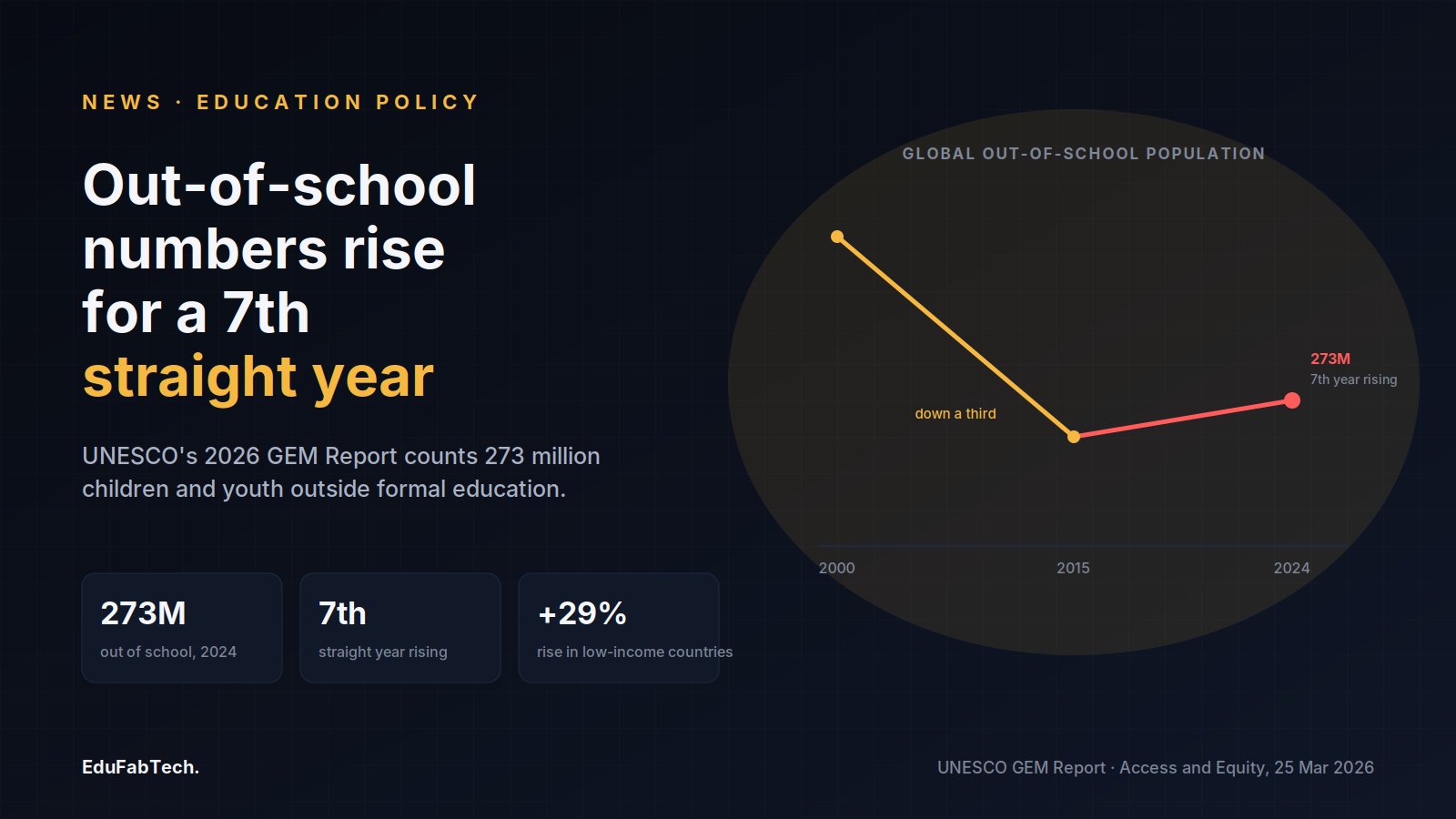
UNESCO's Global Education Monitoring Report team launched its 2026 edition, Access and Equity, on 25 March 2026 in Paris, opening a new three-part series called Countdown to 2030 that will track progress toward Sustainable Development Goal 4 through 2029. The headline number is a discouraging one: 273 million children, adolescents and youth were out of school in 2024, split roughly into 79 million of primary age, 64 million of lower-secondary age and 130 million of upper-secondary age.
That total matters less as a snapshot than as a trend line. The global out-of-school population fell by a third between 2000 and 2015, then reversed, rising for a seventh consecutive year and climbing 3% since 2015. In low-income countries specifically, the report finds the out-of-school population grew 29% over the same period, a gap driven largely by school-age population growth in sub-Saharan Africa, where the building of new schools stagnated or declined across much of the region between 2010 and 2020.
Enrollment growth elsewhere has been real. Since 2000, 327 million more children have entered school, primary enrollment rose 19%, lower-secondary 28% and upper-secondary 73%. Sub-Saharan Africa more than doubled primary enrollment and more than tripled secondary enrollment over the same period — but pre-primary participation there still sits below 25%, against roughly 90% in Europe, a gap the report attributes to financing rather than demand.
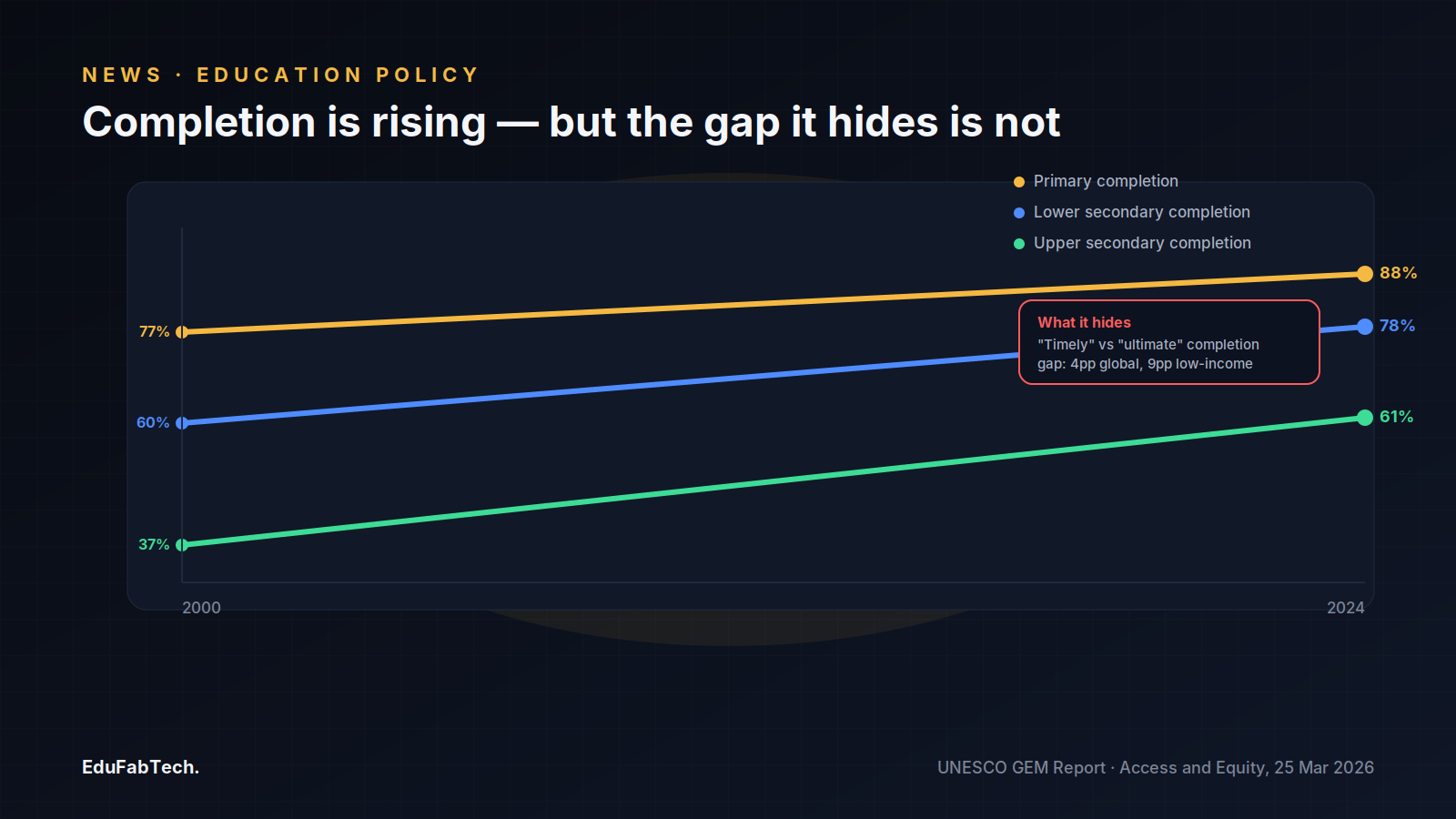
Completion figures hide a widening gap
Completion rates have climbed steadily: primary completion rose from 77% to 88% between 2000 and 2024, lower-secondary from 60% to 78%, and upper-secondary from 37% to 61%. But the report separates "timely" completion — finishing within three to five years of the official graduation age — from "ultimate" completion, counting students who finish later. The gap between the two is four percentage points globally for lower secondary, but nine percentage points in low-income countries, and the report notes this gap has been widening since 2005 rather than closing.
Wealth compounds the effect. In Africa and Asia, the report measures a roughly 30-percentage-point gap in pre-primary participation between the richest and poorest households, a gap that has not narrowed even as overall enrollment rose. Across the 42 countries with data, children from the richest households are ten times more likely to attend private school than children from the poorest.
Divergent national trajectories
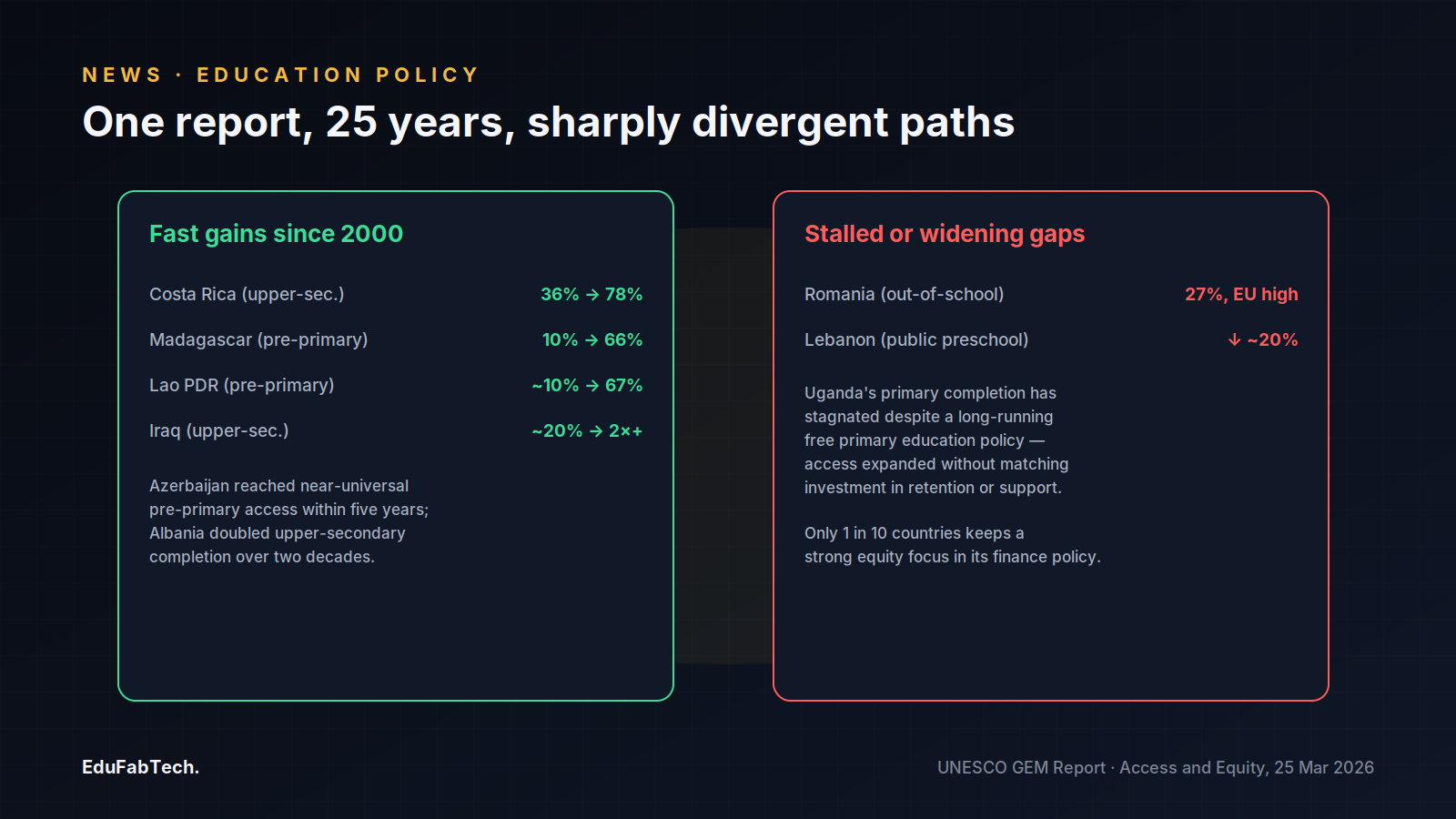
Because the report spans a 25-year window, it can show which countries moved fastest and which stalled. A handful of examples from the country-level data:
| Country | Indicator | Earlier value | Recent value |
|---|---|---|---|
| Costa Rica | Upper-secondary completion | 36% (2000) | 78% (2024) |
| Iraq | Upper-secondary completion | ~20% (2000) | more than doubled (2024) |
| Lao PDR | Pre-primary enrollment, age 5 | ~10% (2000) | 67% (2023) |
| Madagascar | Pre-primary enrollment, age 5 | 10% (2000) | 66% (2024) |
| Romania | Youth out-of-school rate | — | 27% (2023, highest in Europe) |
Azerbaijan is cited for reaching near-universal pre-primary access within five years, while Albania is reported to have doubled upper-secondary completion over two decades. On the other side, the public share of preschool enrollment in Lebanon fell to only around 20% by 2023/24, and Uganda's primary completion rate has stagnated despite a long-running free primary education policy — the report frames this as a case where access expanded without a matching investment in retention or learning support.
Finance policy lags behind equity rhetoric
The report's finance chapter is blunt about the disconnect between stated priorities and budget allocation. Only 1 in 10 countries maintains a sufficiently strong equity focus in its education finance policy, despite 83% of countries having submitted national or regional targets for at least one SDG 4 indicator. Pre-primary education, the level most linked in the report to later completion, remains the most underfunded: only 10 countries spend at least 1% of GDP on it, though the global median has risen from 0.29% to 0.43% of GDP.
Legislative commitments have moved faster than spending. The share of countries with laws broadening inclusive education beyond disability rose from 75% in 2020 to 82% in 2025, and countries guaranteeing at least one year of free pre-primary education rose from 46 to 69 among the 119 countries tracked. The report's authors read this as evidence that legal frameworks are outpacing the financing needed to make them operative — a pattern the InterAcademy Partnership's coverage of the report singled out as its central call to action, urging closer coordination between education ministries and finance ministries rather than treating equity as a standalone policy goal.
Access and Equity is the first of three planned reports in the Countdown to 2030 series; the 2027 edition will turn to learning quality, and a 2028/29 edition will examine relevance. Read together with this year's data, the series is designed to let researchers and policymakers track the same set of countries against the same benchmarks across three consecutive editions, rather than relying on the periodic country snapshots that have characterized earlier SDG 4 monitoring.
- UNESCO Global Education Monitoring Report Team. Global Education Monitoring Report 2026: Access and Equity — Countdown to 2030. UNESCO, 2026. link
- UNESCO. 2026 GEM Report: Access and equity. UNESCO, 2026. link
- UNESCO. More children out of school for the 7th year in a row, up to 273 million. UNESCO, 2026. link
- InterAcademy Partnership. New UNESCO report calls for urgent action on equity and access in education. InterAcademy Partnership (IAP), 2026. link