UNESCO's First Arab States Report Finds Enrollment Near 15 Million, Jobs Gap at 26%
Published 3 November 2026, UNESCO's first regional review finds enrollment across 19 Arab States nearly tripled in 25 years while youth unemployment holds at twice the global rate.
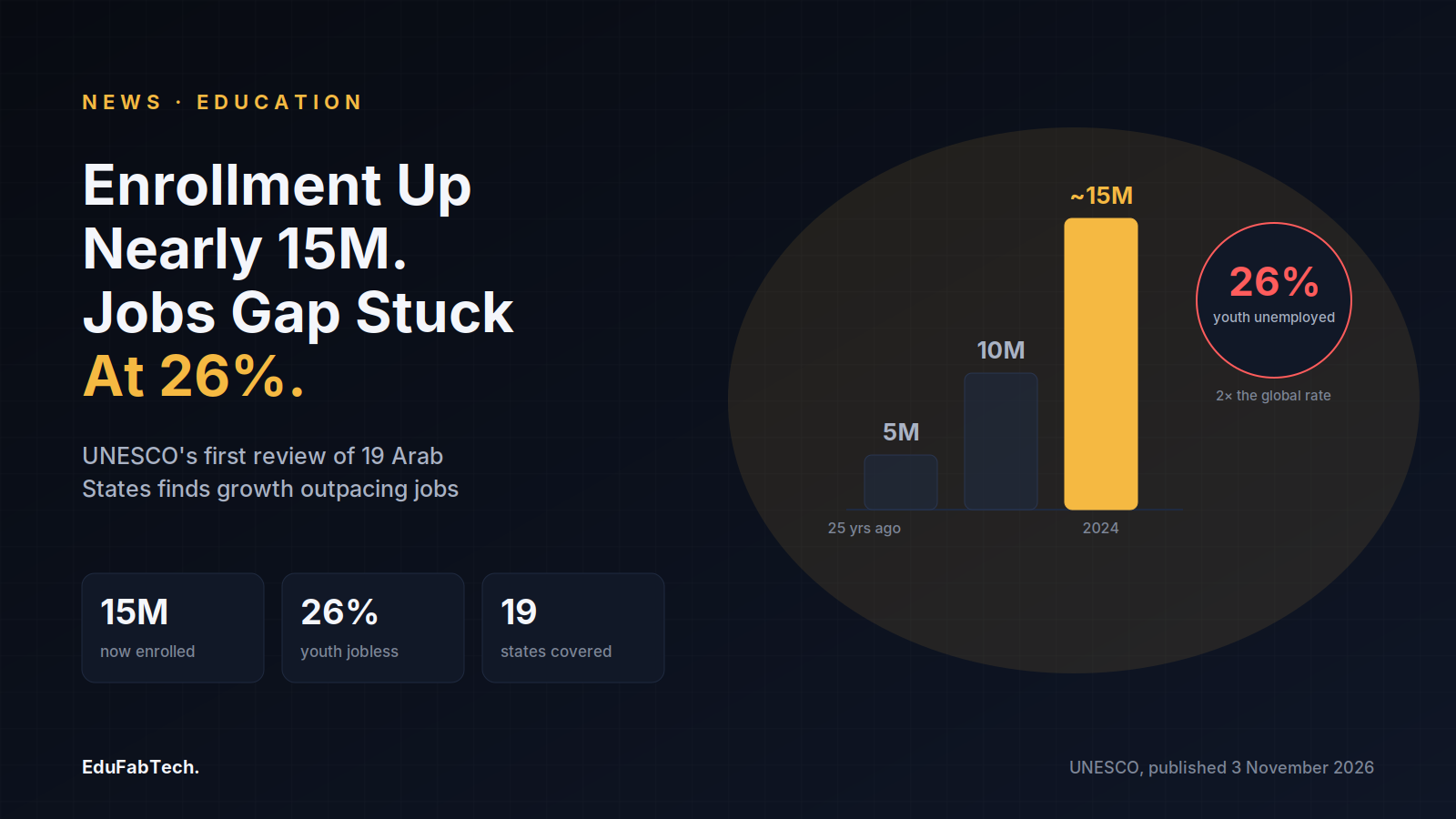
UNESCO published its first regional review of higher education across the Arab States on 3 November 2026, finding that enrollment has nearly tripled over 25 years to almost 15 million students, even as graduates face a youth unemployment rate twice the global average. The report, "The State of Higher Education in the Arab States," was presented a day later, on 4 November 2026, at the first session of the Committee of the UNESCO Revised Convention on the Recognition of Studies, Diplomas and Degrees in Higher Education in the Arab States, held in Doha, Qatar.
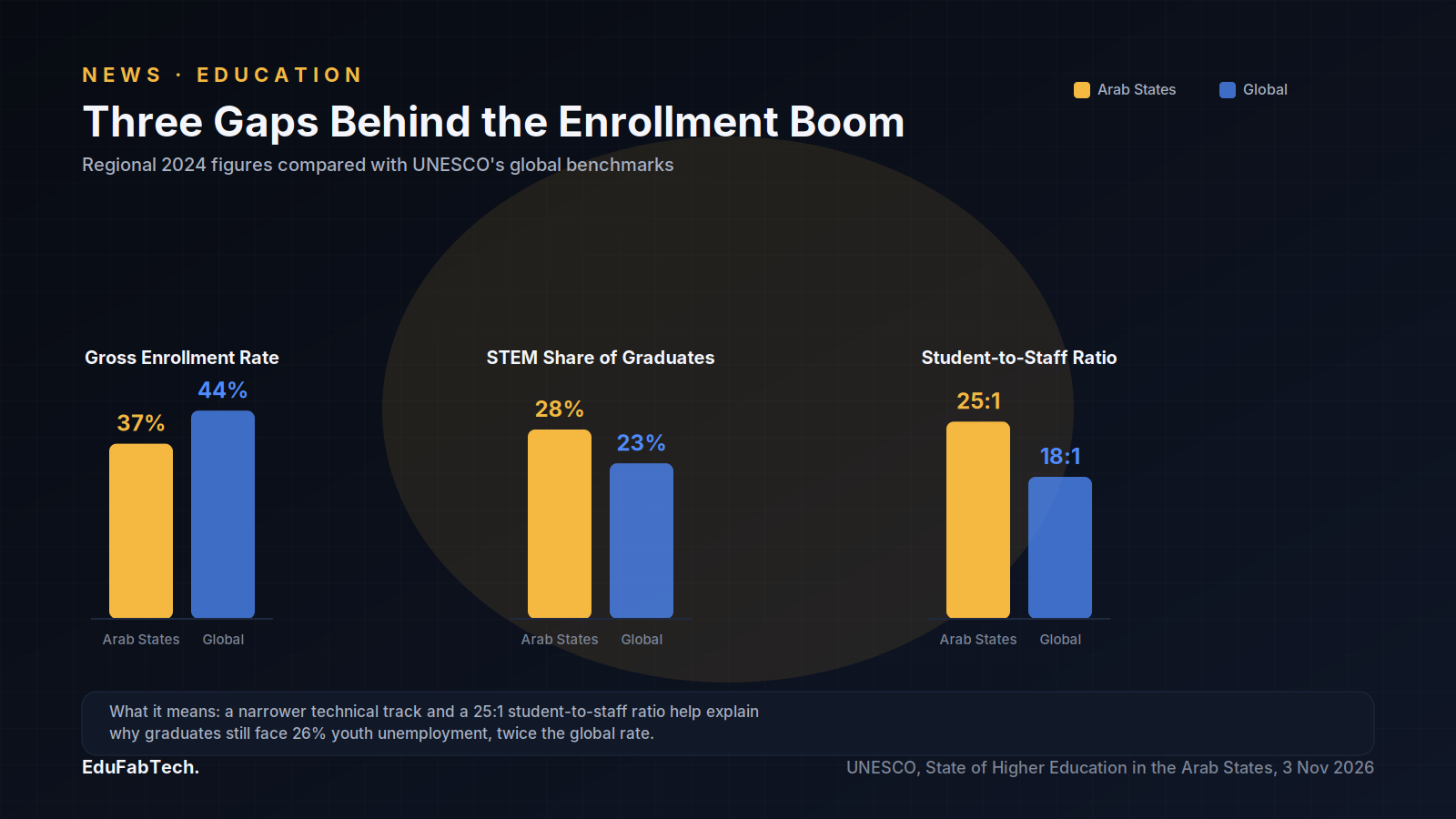
The review covers 19 Arab States and draws on UNESCO's Higher Education Policy Observatory. It finds the regional gross enrollment rate reached 37% in 2024, still below the global average of 44% reported by UNESCO (2026). More than 80% of students are enrolled in bachelor's-level programs (ISCED level 6), while short-cycle technical and professional diplomas (ISCED level 5) account for only 7% of enrollment, a far smaller share than the rest of the world, according to the report.
Women now outnumber men in both enrollment and completion across the region, a pattern UNESCO (2026) says has held since 2007. Women also make up nearly half of all STEM graduates in the Arab States, compared with just over a third globally, and STEM fields account for 28% of all graduates in the region against 23% worldwide, the report finds.
A persistent jobs gap
The expansion in enrollment has not translated into employment. Youth unemployment across the Arab States stands at 26%, roughly twice the global average, UNESCO (2026) reports. "UNESCO welcomes the remarkable expansion of higher education across the Arab States in recent decades," said Qun Chen, UNESCO Assistant Director-General for Education, though the report itself frames graduate employability as the region's central unresolved challenge. Expanding the region's short-cycle technical and professional programmes, which enroll a far smaller share of students than elsewhere in the world, could strengthen the link between higher education and the labour market, as graduates currently struggle to find jobs, UNESCO (2026) finds.
Mobility and degree recognition
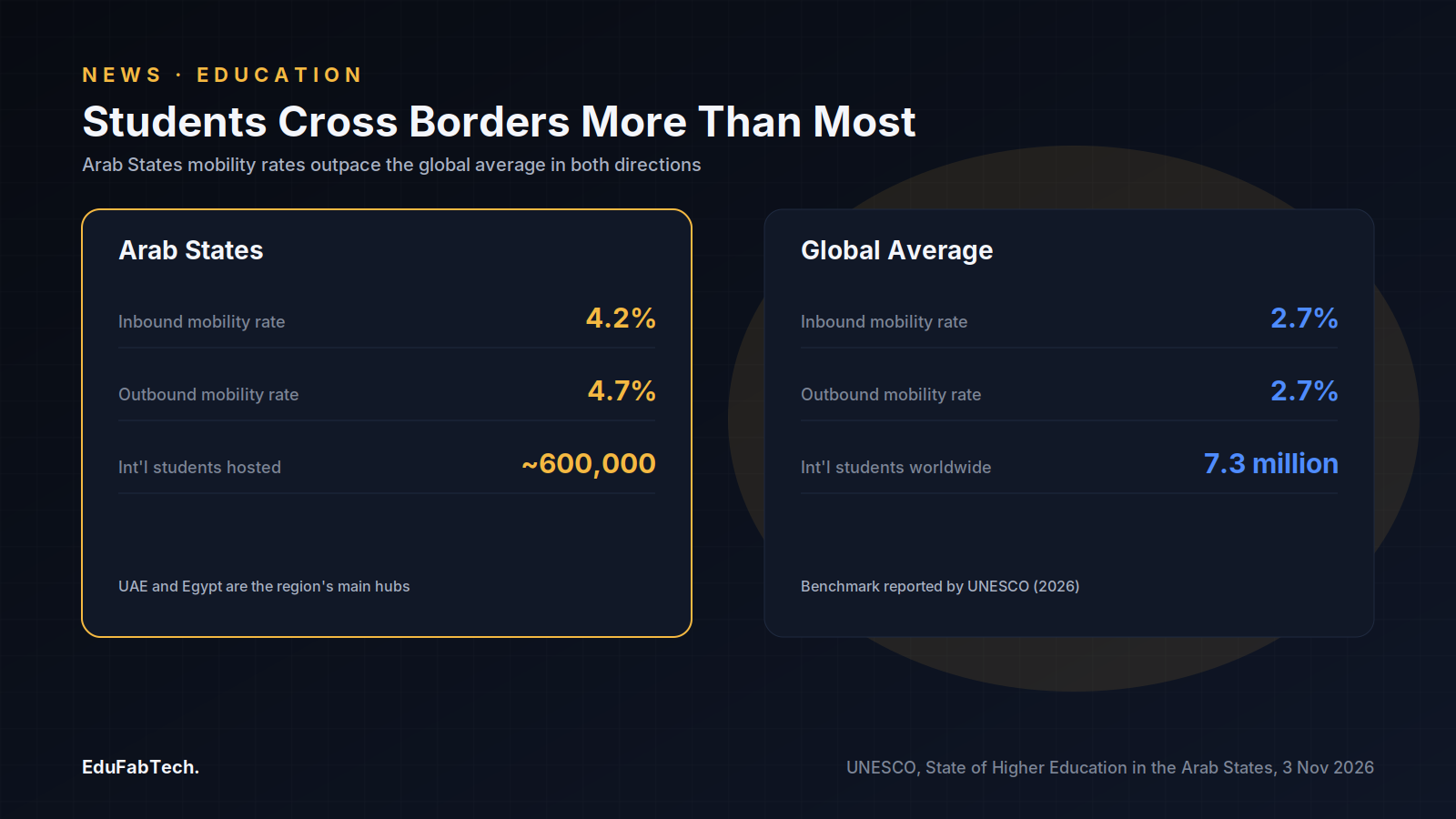
Arab States host nearly 600,000 of the world's 7.3 million international students, with the United Arab Emirates and Egypt emerging as the region's main hubs, UNESCO (2026) finds. Both the inbound mobility rate (4.2%) and the outbound rate (4.7%) exceed the global average of 2.7%, meaning students in the region are more likely both to host peers from abroad and to study abroad themselves than the world average.
That mobility is the backdrop to the Doha meeting where the report was presented. The committee convened there oversees the UNESCO Revised Convention on the Recognition of Studies, Diplomas and Degrees in Higher Education in the Arab States, adopted in 2019 and in force since April 2026, the regional framework for whether a degree earned in one Arab State is recognized for further study or employment in another, according to UNESCO and University World News. For students moving between universities in the region, or arriving from outside it, the pace of that framework's implementation shapes whether credits and degrees transfer cleanly.
Funding has not kept pace
Governments in the region spend a median of 0.8% of GDP on higher education, UNESCO (2026) reports, a figure in line with the global median. The region's student-to-academic-staff ratio stands at 25:1, against a global figure of 18:1, pointing to larger classes and less staff time per student than the world average.
What it means for students and researchers
For students already enrolled, the report's figures describe a system with a higher student-to-staff ratio than the global average and a narrow share of short-cycle technical programmes, a combination the report ties to the difficulty graduates face finding work that matches their training. For students and researchers moving across borders, the Doha committee session is the more immediate marker to watch: its decisions on implementing the Arab States Convention will determine how smoothly degrees and transcripts earned in one of the 19 states carry over elsewhere in the region or beyond it.
A quick question for readers
Which study method makes things stick for you until the exam?
Research says some methods work far better than others. Vote first, then see whether students agree with the evidence.
Pick an answer, create a free account in a minute, and your vote counts. Already a member? Sign in
Comments 3
Comment-
The number that jumps out is the mismatch between 80% of students in bachelor's programs and only 7% in short-cycle technical diplomas, way…
-
The number that actually contradicts the narrative here is the funding one: median spend is 0.8% of GDP, right in line with the global media…
-
The line that jumps out is the mismatch between the enrollment share and the jobs gap: over 80% of students are stuck in bachelor's programm…
Join free to read the full comments and reply Comments are between members; an account takes a minute.
Source: UNESCO
Sources (2)
- UNESCO. Number of students in higher education triples across the Arab States, but graduate employability remains a challenge. UNESCO, 2026. unesco.org ↗ · checked 8 Nov 2026
- Borhene Chakroun, Mathias Bouckaert and Vanja Gutovic. New challenges as higher education expands in Arab States. University World News, 2026. universityworldnews.com ↗ · checked 8 Nov 2026