UNESCO Climate-Education Alliance Reaches 100 Countries Ahead of COP31
Türkiye's accession makes the Greening Education Partnership a 100-country, 2,000-organisation network, as UNESCO and the OECD launch a tracker meant to fix patchy data on climate teaching.
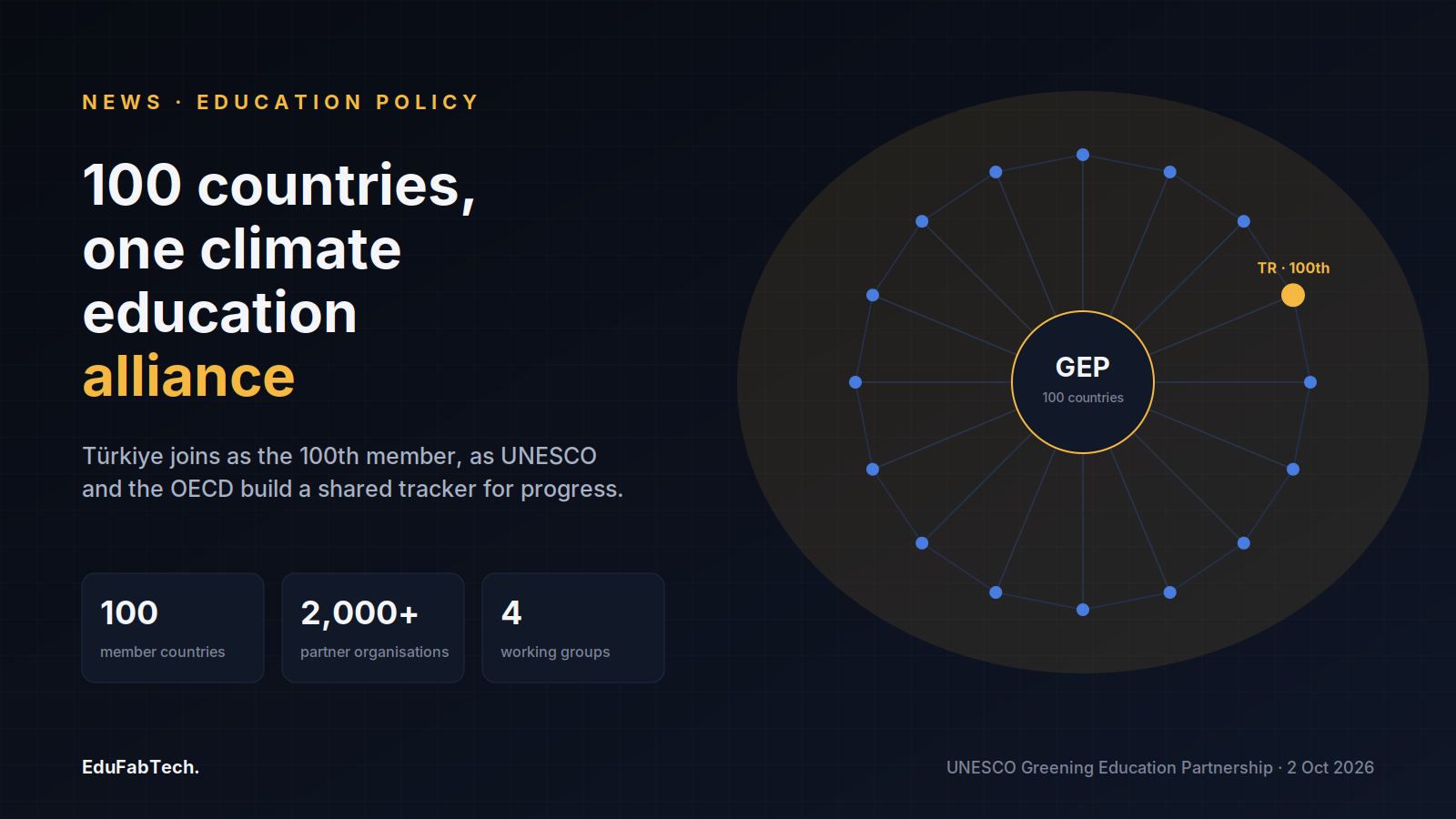
UNESCO announced on October 2, 2026, that its Greening Education Partnership has reached 100 member countries, with Türkiye joining as the 100th, weeks before it hosts the United Nations climate conference COP31 in Antalya. Alongside the membership milestone, UNESCO said it is launching a Monitoring and Evaluation Working Group with Türkiye's Ministry of National Education and the OECD, meant to give the partnership's four years of commitments a common way of tracking progress for the first time.
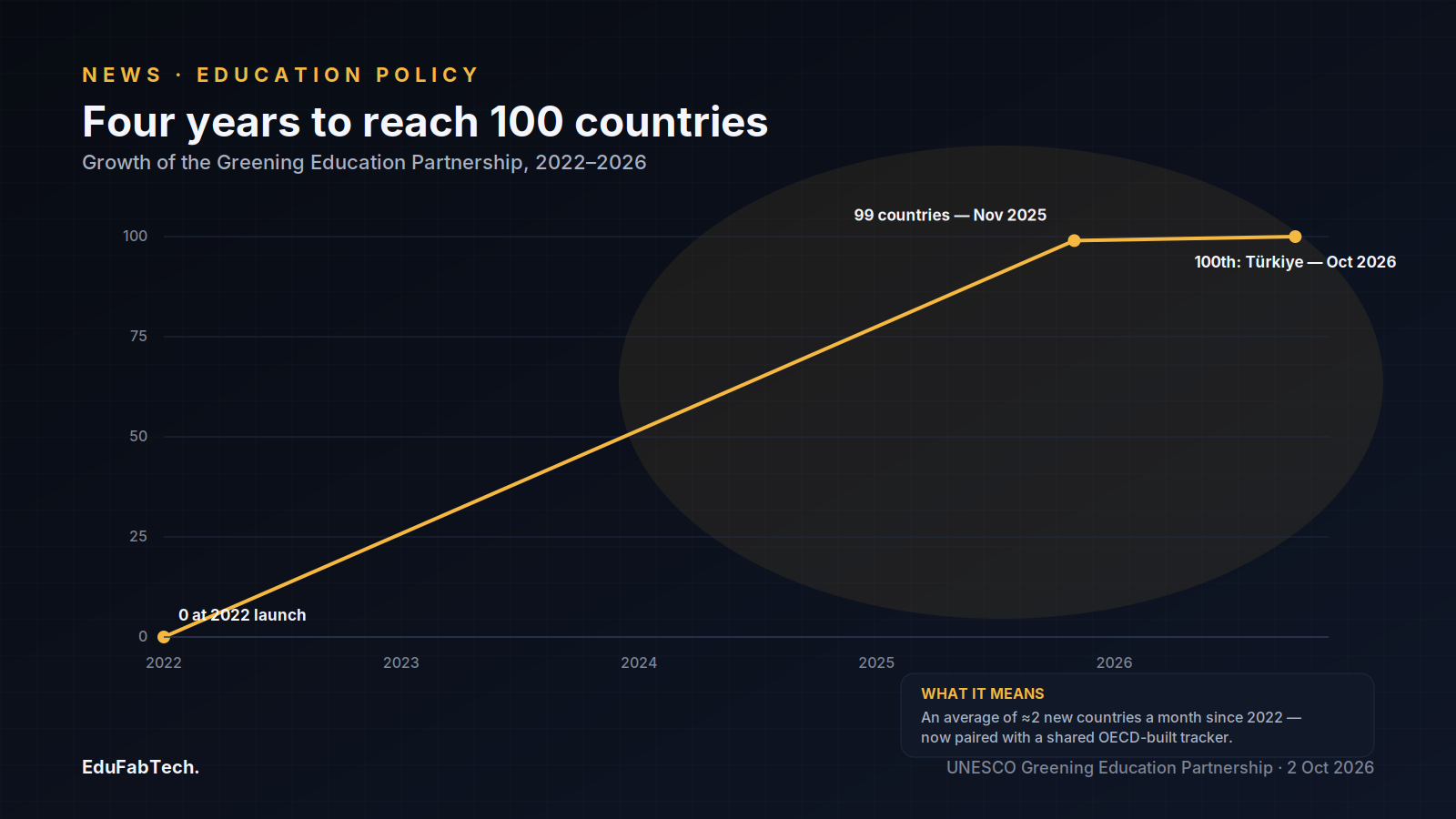
The Partnership was created at the 2022 UN Transforming Education Summit as a coalition of governments and organizations working to put climate change into school buildings, lesson plans, teacher training and community programmes. As of November 2025, UNESCO's own partnership page listed 99 member states and more than 2,000 partner organizations, spanning countries from Albania and Argentina to Cameroon and the Cook Islands. Türkiye's accession, confirmed in UNESCO's October 2 article, brings that total to 100 countries and over 2,000 organizations, which the agency describes as the largest global alliance for climate education.
Türkiye's Ministry of National Education confirmed its own role in a separate account of preparatory talks with UNESCO's Turkish National Commission, describing the Greening Education Partnership as covering "green schools, green curriculum, teacher empowerment, education system capacity building and green community creation," and saying its innovative applications can be shared as best-practice examples at COP31, which the ministry's directorate says runs November 9 to 20, 2026, in Antalya. UNESCO's article sets November 14 as the conference's thematic day on Children, Youth, Education and Skills, the session at which the 100-country milestone and the new working group will be formally presented.
Four working groups, one missing piece
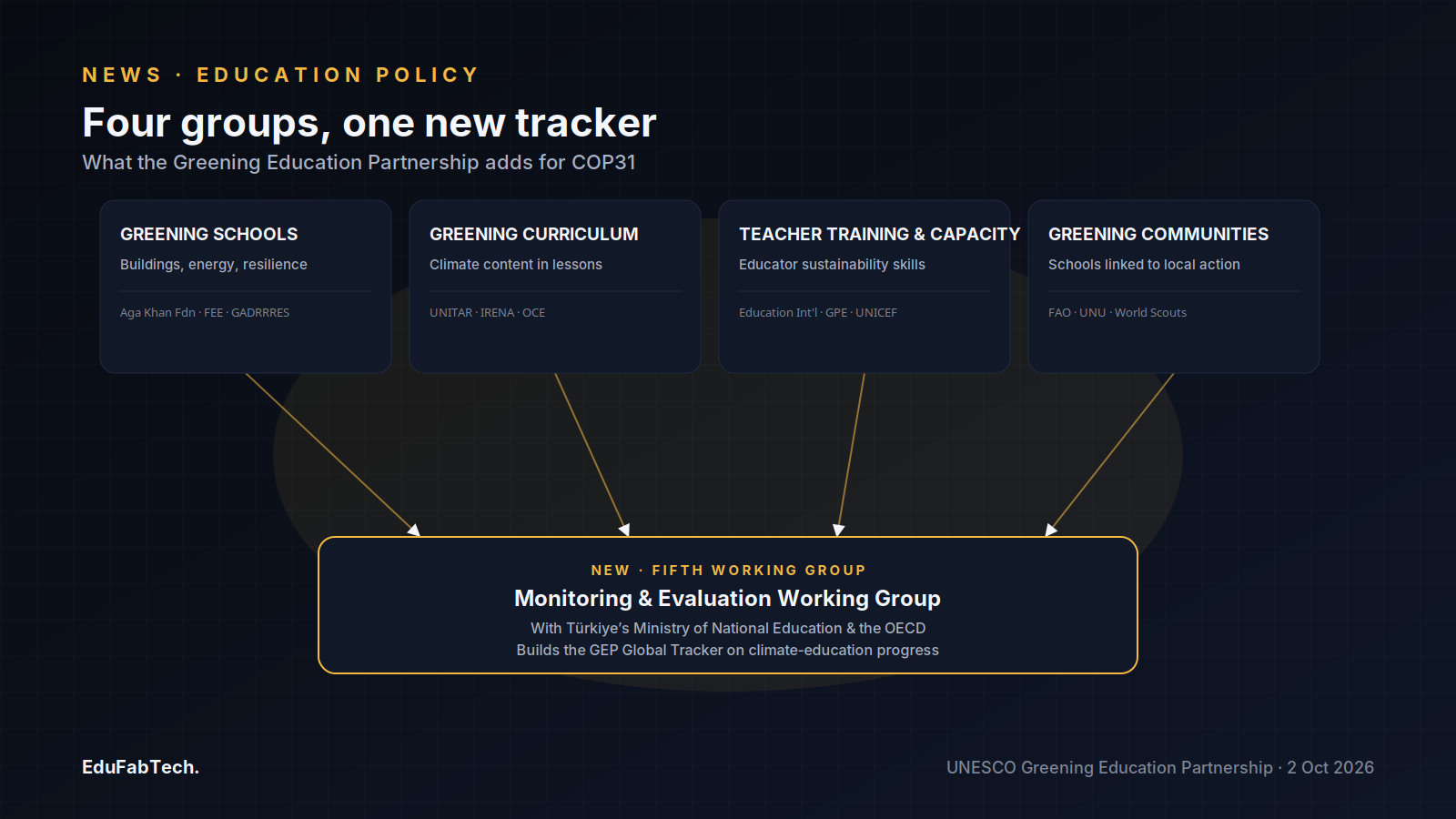
The Partnership organizes its members into four standing working groups, each co-coordinated by a different set of institutions, according to UNESCO's partnership page:
| Working group | Focus | Co-coordinators |
|---|---|---|
| Greening Schools | Facilities, energy and resilience of school buildings | Aga Khan Foundation, Foundation for Environmental Education, GADRRRES |
| Greening Curriculum | Climate content in subjects taught to students | UNITAR, IRENA, Office for Climate Education |
| Greening Teacher Training and Education System Capacities | Educator capacity for sustainability instruction | Education International, Global Partnership for Education, UNICEF |
| Greening Communities | Linking schools to local climate action | FAO, United Nations University, World Organization of the Scout Movement |
What none of the four groups had, until this announcement, was a shared mechanism for checking whether a member country's commitments translate into classroom practice. That is the gap the new Monitoring and Evaluation Working Group is designed to close. UNESCO says the group will work with the OECD to strengthen "data, evidence and accountability" through a new instrument called the GEP Global Tracker, which it describes as a global observatory on climate change education, though the October 2 article does not specify which indicators the tracker will collect or when it will publish its first figures.
What GEP 2.0 changes
UNESCO frames the next phase, which it calls GEP 2.0, as a shift from signing up countries to following through inside them, with "a stronger focus on country-level implementation and regional cooperation," per the same article. For a network that grew from zero to 100 member countries in a little over four years since its 2022 launch — an average of roughly two new countries a month — reaching country-level follow-through across 100 education systems of very different sizes and resources is a different kind of task than recruiting signatories.
Türkiye's Minister of National Education, Yusuf Tekin, framed the country's accession in terms of visibility and exchange rather than new funding: "We see this as an important step, it will allow us to share with the world the work we have pursued with determination for many years and to build on it through new partnerships," he said, as quoted in UNESCO's announcement.
Why this matters beyond the summit
For researchers studying climate education policy, the practical significance sits less in the round number of 100 countries than in the OECD's involvement in measurement. International comparisons of what students are taught about climate change, and what training teachers receive to teach it, have been difficult to assemble consistently across education systems with different curricula, school calendars and reporting standards. A tracker run jointly by a UN agency and the OECD's statistical apparatus would, if it delivers comparable country-level indicators, give teacher-training programmes and ministries a dataset to benchmark against rather than relying on self-reported commitments.
For students and teachers inside member countries, the near-term effect is likely to be organizational rather than immediate: a national ministry signing onto the Partnership commits it to working-group participation and, from COP31 onward, to reporting through the new monitoring structure, not to a specific curriculum change by a set date. UNESCO's own account leaves the tracker's first data release and indicator set unspecified, so whether GEP 2.0 produces comparable, usable country data will only be testable once the Monitoring and Evaluation Working Group publishes its first results.
A quick question for readers
Are group projects good for learning?
Loved by some, dreaded by many. What is your real experience?
Pick an answer, create a free account in a minute, and your vote counts. Already a member? Sign in
Source: UNESCO
Sources (3)
- UNESCO. UNESCO at COP31: Putting education at the heart of climate action. UNESCO, 2026. unesco.org ↗ · checked 4 Oct 2026
- UNESCO. Greening Education Partnership: Who we are and how we work. UNESCO, 2025. unesco.org ↗ · checked 4 Oct 2026
- Directorate General for Teacher Training and Education, Ministry of National Education. COP31 preparations: evaluation meeting with UNESCO Türkiye National Commission representatives. T.C. Milli Eğitim Bakanlığı, 2026. dhgm.meb.gov.tr ↗ · checked 4 Oct 2026