Tasmania and Startup Proudly Human Launch an Audited "AI-Free" Degree Standard
From late October 2026, the University of Tasmania is auditing assessments against a new "assured assessment standard" meant to certify that graduates did the work themselves.
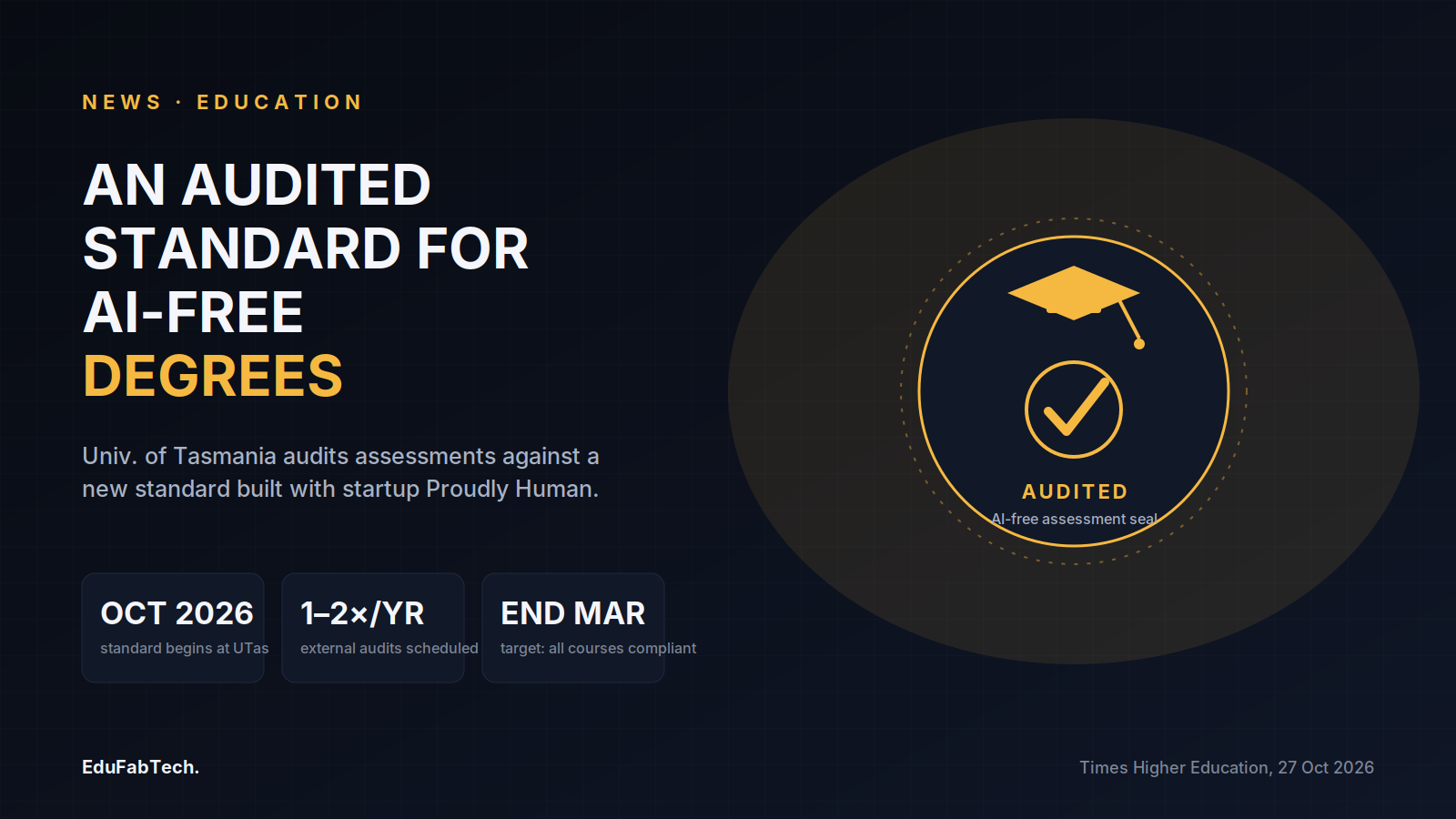
The University of Tasmania (UTas) has begun applying a new, externally audited assessment standard designed to certify that students' degrees were "personally earned" rather than produced with undisclosed help from AI tools. The arrangement, built with the Australian startup Proudly Human and reported by Times Higher Education on 27 October 2026 and by ABC News on 28 October 2026, applies first to UTas's new and redesigned courses, with the university aiming for all its courses to meet the standard by the end of March.
What the "assured assessment standard" actually checks
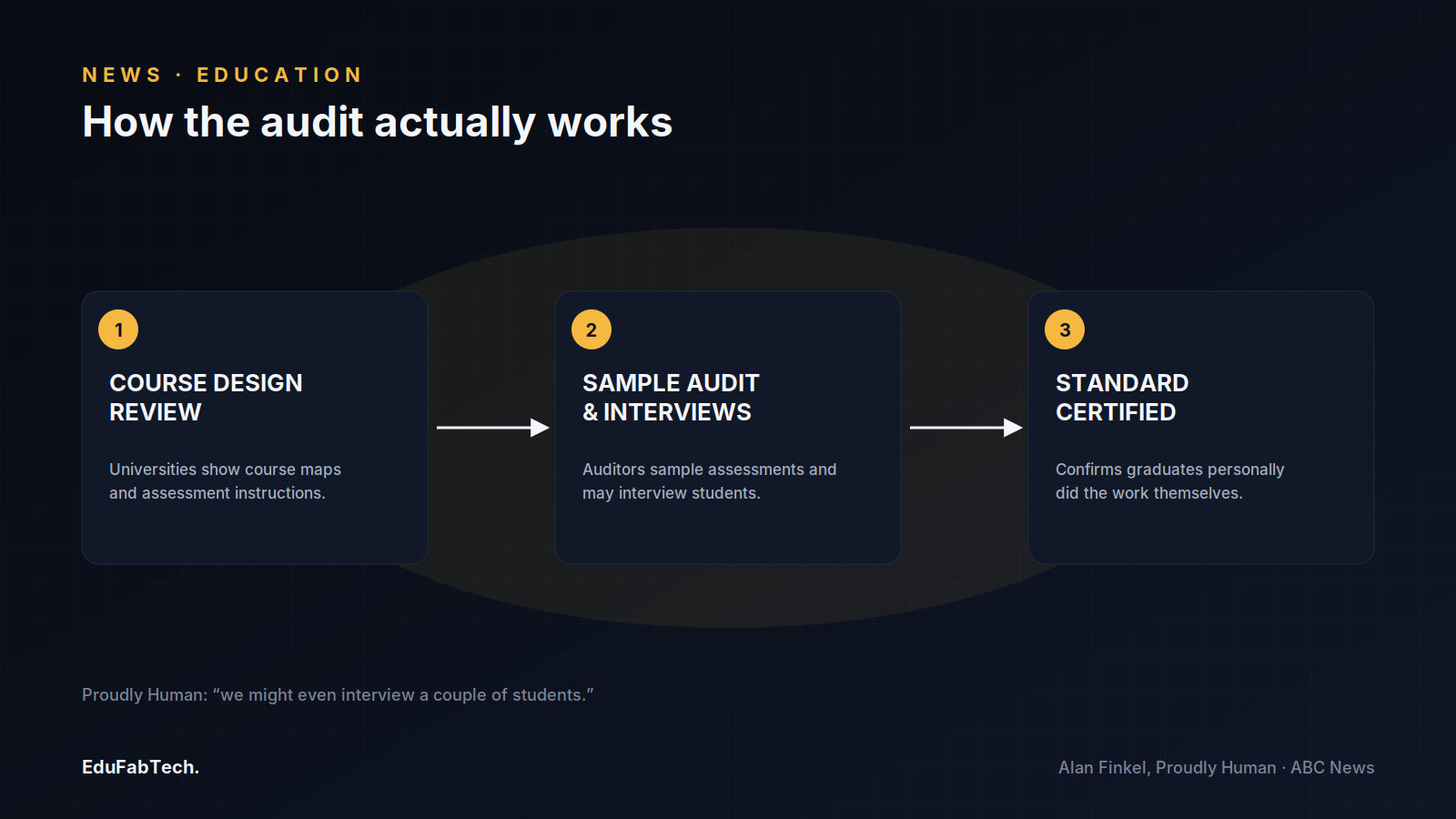
Proudly Human was founded by Alan Finkel, Australia's chief scientist from 2016 to 2020, who had previously worked on verifying human authorship in creative industries such as film, books, art and music. Finkel himself compares the university standard to an existing certification model: he described Proudly Human's purpose as providing "a voluntary certification of…human creation, just like an organic food stamp." Under the university version, he described the audit process: "We'll basically say, 'show us your course designs. Show us how you've mapped the courses to be consistent with the requirements in the assured assessment standard. Show us…how you've designed your assessments. Show us the instructions you have internally, so that academics follow these requirements.'" He added that auditors will "do some sample assessments of some of the course designs; some of the assessment procedures," and said "we might even interview a couple of students."
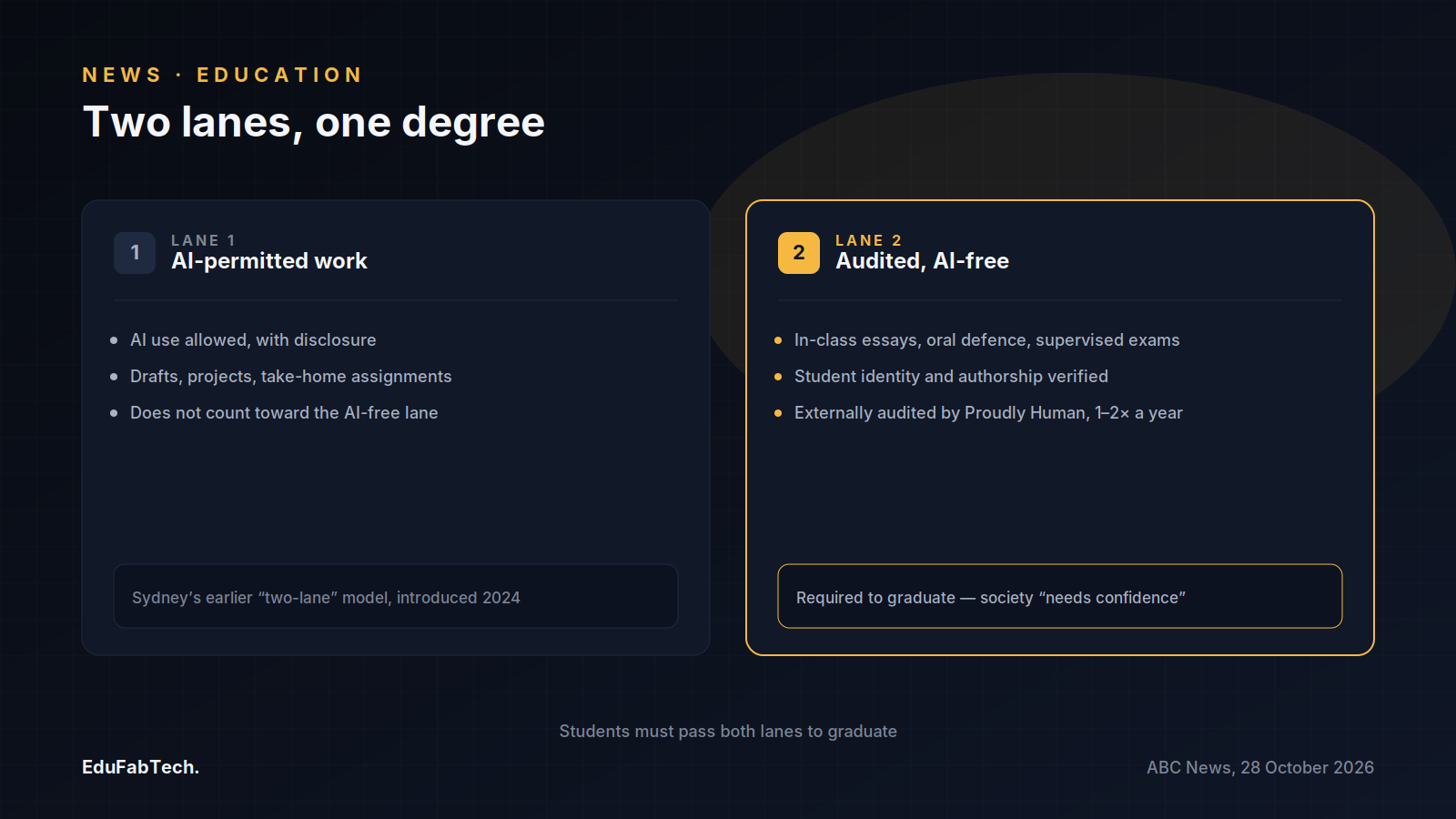
The standard does not ban AI from study altogether. Universities remain free to run assessments where AI use is permitted with acknowledgement, but students must separately pass an audited, AI-free "summative assessment" stream to graduate, Times Higher Education reports. UTas vice-chancellor Rufus Black said the standard is being made available to other institutions as well, framing the issue in sector-wide terms: "Society needs confidence in the sector and all our qualifications, not just in individual universities."
What changes inside Tasmania's classrooms
Describing the practical effect on campus, UTas pro vice-chancellor Luke Bereznicki told ABC News that under current practice, "a student can attain an award and we don't actually know if the student themselves has done the work or whether they've used AI tools to do the work." The university's response is to increase in-person and supervised assessment in some courses and to require external audits, held once or twice a year, that check students have met key learning outcomes under what Bereznicki called a verified process: "It's the student themselves, so the identity of the person has been verified to be the enrolled student. It's the authorship, which means it's the student that produced the work and was observed doing the work."
Finkel told ABC News that the model leans on older assessment formats precisely because they are harder for AI to fake: "Secure assessment conditions are a little bit old fashioned, but it's the human assessment. Writing an essay in class or giving an oral defence or sitting a supervised exam or for law students who could be doing practice court." For assessments that remain online or unsupervised, he said institutions "have to set up procedures that they can defend as ensuring that the student does the work authentically themselves." Proudly Human's own role, he said, is to "come in once or twice a year … as an auditor."
Why universities say this matters now
Finkel framed the push as a response to collapsing outside confidence in degrees, telling Times Higher Education: "Across the…developed world, communities, regulators [and] especially employers have lost faith in the meaning of a university degree, because there are so many stories of cheating." He went further: "The assumption by employers is that everybody's cheating and the degree is not an indication of achievement." He also argued that for many students the temptation to cheat is "virtually impossible to overcome," because an honest student who spends extra time writing an essay unaided risks being outscored by classmates who use AI to get a higher mark — the pressure he said makes independent, recurring audits necessary rather than a one-off check.
Tasmania is not the first Australian university to restructure assessment around this problem. Both Times Higher Education and ABC News cite the University of Sydney's "two-lane" assessment approach, which ABC News reports was introduced in 2024, as an earlier model separating AI-permitted work from secured, AI-free assessment. What UTas and Proudly Human add is an external, recurring audit intended to let employers and regulators trust the result without re-checking each university themselves.
What it means for students
For students, the most direct consequence is more in-person, supervised and orally defended assessment inside courses that adopt the standard, alongside continued access to AI-permitted assessment elsewhere in the same course. Jack Oates Pryor, president of the Tasmanian University Student Association, told ABC News that students already worry about how their degrees will be perceived: "Certainly, a general fear about what university degrees mean when other students are abusing AI," adding, "I've talked to some who are concerned about how industry will perceive the quality of their degree when graduating." The initiative is pitched as a direct answer to that concern — an auditable signal, rather than an individual university's own assurance, that a given qualification reflects a student's own work.
Because the standard is being offered to other institutions beyond Tasmania, its reach will depend on how many universities choose to adopt it and how employers and regulators respond once UTas's own courses are audited against it after the end-of-March target. Neither Times Higher Education nor ABC News report any other university having yet signed on to the audited standard itself.
A quick question for readers
Is using AI to help write an assignment cheating?
Universities are still writing their rules. Where do students draw the line?
Pick an answer, create a free account in a minute, and your vote counts. Already a member? Sign in
Comments 3
Comment-
The tell is at the end: no other university has signed on, and the UTas rollout itself is only hitting "new and redesigned courses" with a M…
-
"We might even interview a couple of students" is doing a lot of load-bearing work for a standard meant to restore trust across an entire se…
-
The part I'd push on is Finkel's own framing of the old-fashioned formats as the fix: supervised exams, in-class essays, oral defence. Fine,…
Join free to read the full comments and reply Comments are between members; an account takes a minute.
Source: Times Higher Education
Sources (2)
- John Ross. New 'trust mark' promises to certify 'personally earned' degrees. Times Higher Education, 2026. timeshighereducation.com ↗ · checked 28 Oct 2026
- Rani Fletcher. More supervision of exams at UTAS to combat AI cheating. ABC News, 2026. abc.net.au ↗ · checked 28 Oct 2026