US Finalizes Accreditation Overhaul, Denies Exemptions for Religious, Tribal and Other Colleges
A rule published 30 October 2026 adds intellectual-diversity reviews and eases entry for new accreditors, binding on US-recognized agencies from 1 July 2027.
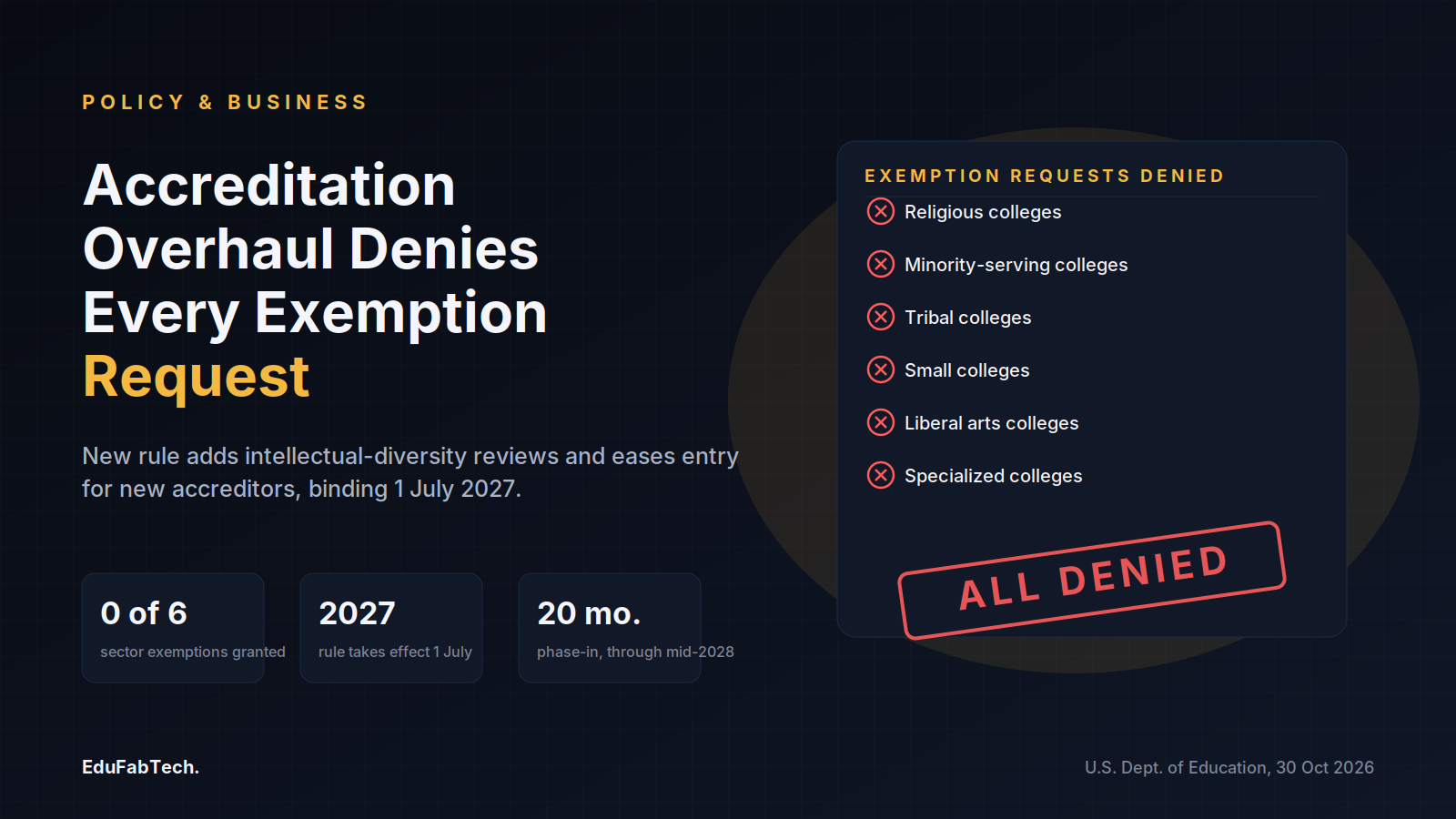
The US Department of Education published a final rule on 30 October 2026 that rewrites how the federal government recognizes the private accrediting agencies that colleges need in order to keep their students eligible for federal student aid. The rule, titled Accreditation, Innovation, and Modernization, takes effect 1 July 2027, and it implements Executive Order 14279, "Reforming Accreditation to Strengthen Higher Education," which the president signed on 23 April 2025.
The rule applies only to accrediting agencies recognized by the US Department of Education, not to quality-assurance bodies in other countries, which operate under their own national rules and are not affected by this change.
What changes for accreditors
Under the final text, accreditors must now consider whether an institution has policies on academic freedom, freedom of inquiry and what the rule calls "intellectual diversity and the free exchange of ideas amongst faculty," according to a summary of the rule reported by Higher Ed Dive. Colleges that have no formal policy on the subject do not automatically fail a review over that gap alone, the same report says. At the same time, accreditors are barred from enforcing what the Department calls "illegal diversity, equity, and inclusion requirements," while the Department has said the rule does not force accreditors to adopt any specific standard of its own.
No exemptions granted
During the rulemaking process, several groups of institutions asked to be carved out of parts of the new framework. The Department refused all of them: according to a client alert from Nixon Peabody, it "declined exemption requests for religious, minority-serving, tribal, small, liberal arts, and specialized institutions," saying it intended "to standardize how the accreditation framework is applied." No sector of college, in other words, is treated differently under the new rules.
A lower bar for new accreditors
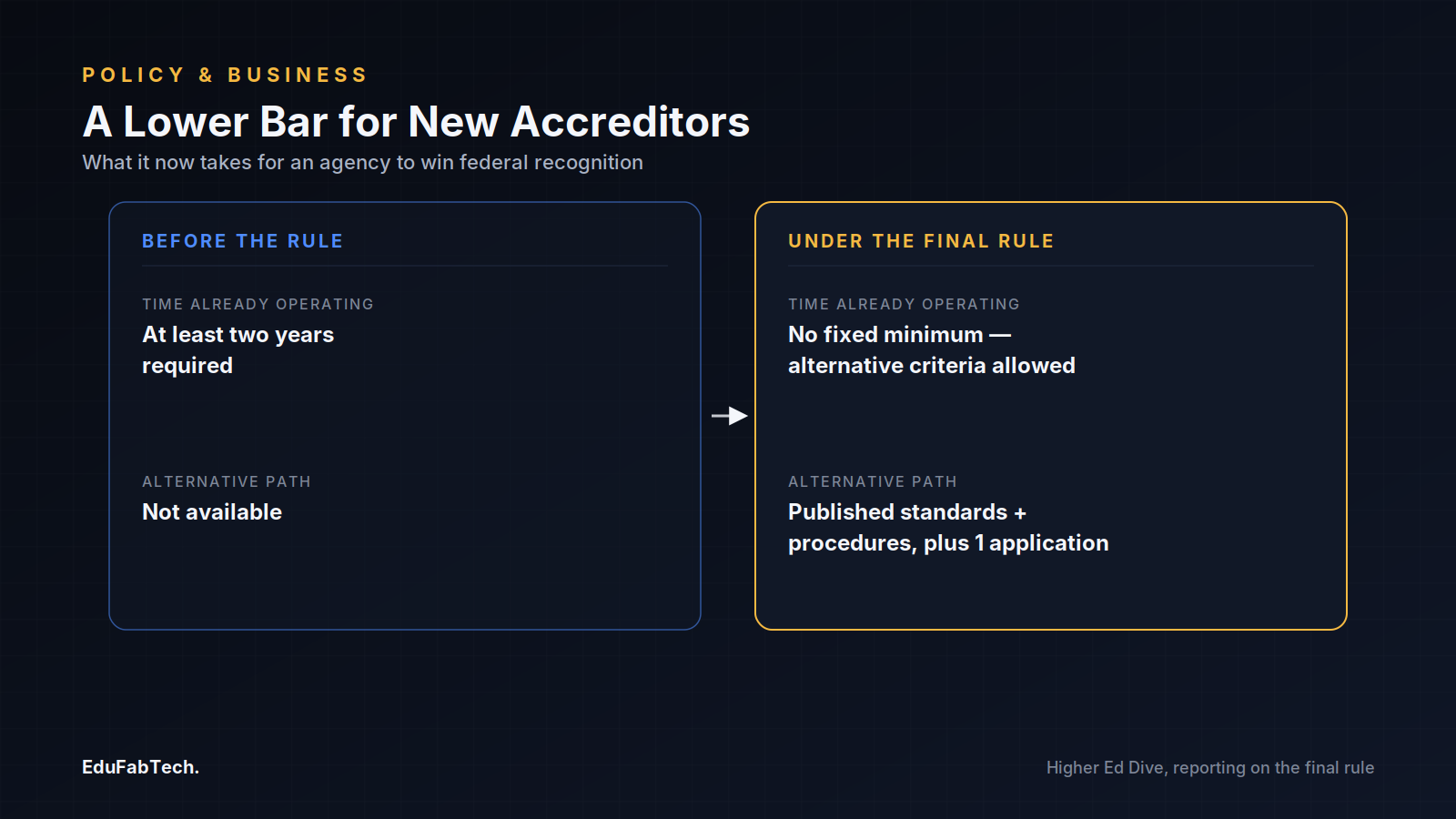
The rule also changes who can become a federally recognized accreditor in the first place. Previously, a new accrediting agency needed to have been operating for at least two years before it could apply for federal recognition. Under the final rule, it can instead qualify by meeting alternative criteria, such as establishing its own accreditation standards and operating procedures and receiving at least one application from a college or program seeking accreditation, Higher Ed Dive reports.
| Requirement for a new accreditor | Before the rule | Under the final rule |
|---|---|---|
| Time already operating | At least two years required | No fixed minimum; alternative criteria allowed |
| Alternative path | Not available | Published standards and procedures, plus at least one accreditation application received |
According to the Department's own notice, carried on its Federal Student Aid partner site, the regulation is meant to "reduce regulatory burden" and increase competition among accrediting agencies, which is also one of the directives set out in Executive Order 14279.
Timeline and transition
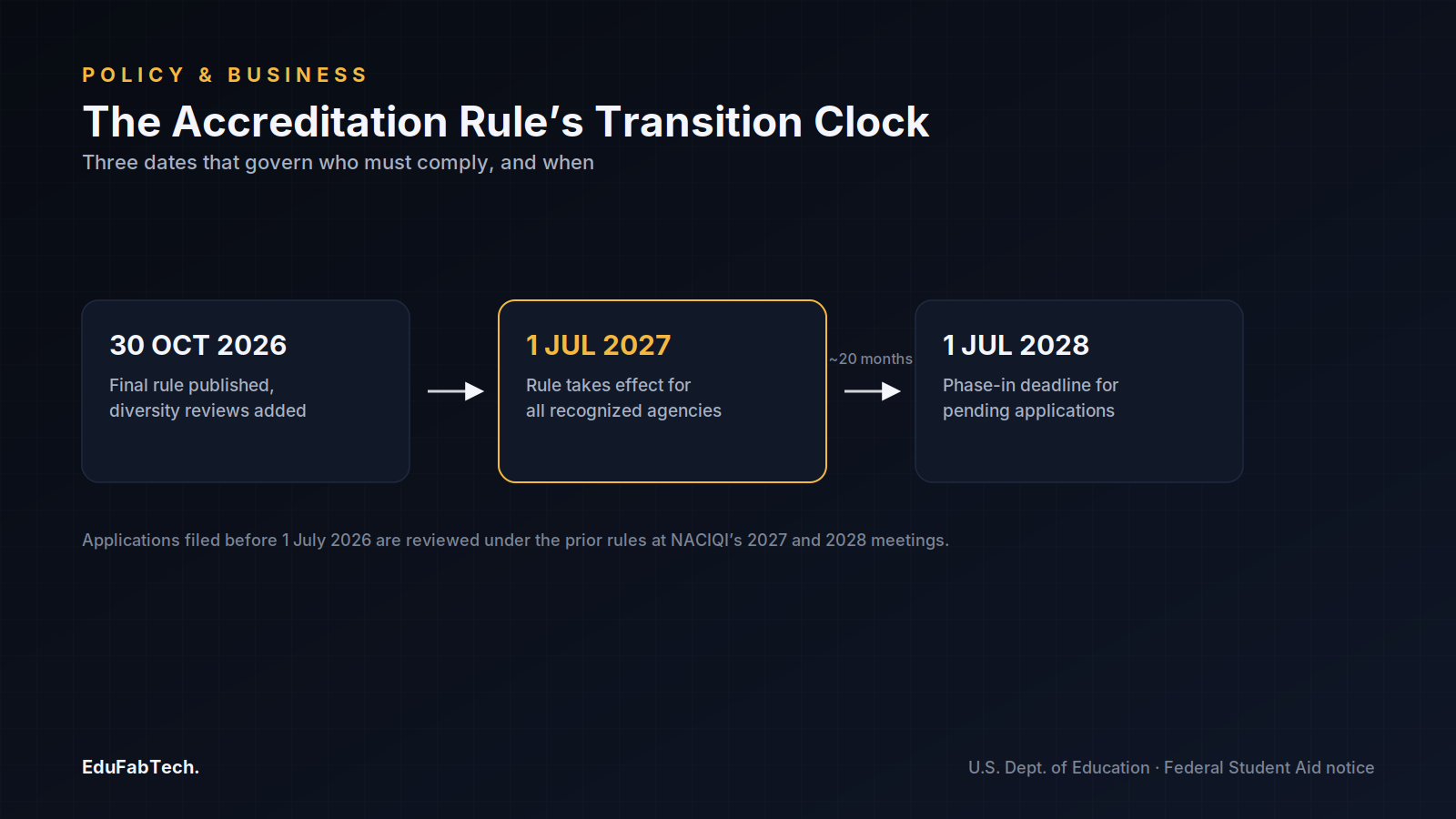
Existing accreditors whose recognition applications were filed before 1 July 2026 will be reviewed under the prior rules, with final staff reports going to the Department's advisory committee, the National Advisory Committee on Institutional Quality and Integrity, at its 2027 meetings and the first scheduled meeting of 2028, according to Nixon Peabody's alert. New accreditors applying after that date are reviewed under the new framework immediately. For agencies with applications pending during the transition period, the Department has said the phase-in gives them roughly 20 months, through 1 July 2028, to make the changes needed for recognition, the same alert says.
Reactions
Under Secretary of Education Nicholas Kent said in a statement that "accreditors have effectively served as a cartel to protect their interests, rather than the educational value that institutions of higher education are expected to deliver for students," according to Higher Ed Dive's report. The reaction from the sector's main trade group was more guarded: Nasser Paydar, president of the Council for Higher Education Accreditation, said "many of the central concerns raised by CHEA and the higher education community remain largely unresolved," the same report says. Community college representatives raised a related objection during the rulemaking process: comments filed by the American Association of Community Colleges pushed back on the rule's expansion of federal oversight into areas such as First Amendment compliance and intellectual diversity, arguing these go beyond what accreditors should be asked to police, according to a column by AACC's David Baime published by Community College Daily.
What it means for students and researchers
For students already enrolled, the rule changes nothing before 1 July 2027: accreditors cannot impose new requirements on institutions ahead of that date. After it, students and the researchers who study quality assurance in higher education will be watching two things — whether a wave of new, more ideologically varied accreditors actually emerges under the eased entry rules, and whether the intellectual-diversity reviews change how accreditors treat institutions that have no formal policy on the subject, since the rule stops short of making that an automatic failure. Because the change applies strictly to accreditors recognized by the US Department of Education, it has no direct bearing on how institutions are accredited or reviewed in other national systems.
A quick question for readers
Do you work part-time while you study?
Many students work to pay the bills. See how common it is — and how many hours people really do.
Pick an answer, create a free account in a minute, and your vote counts. Already a member? Sign in
Comments 3
Comment-
The part that stands out is the rule stopping short of making a missing intellectual-diversity policy an automatic failure. That's a wide ga…
-
The part worth noticing is what the rule doesn't require: no formal intellectual-diversity policy isn't an automatic failure. That's a real…
-
The part that stands out is the 20-month phase-in for agencies with applications already pending, through 1 July 2028, while anyone applying…
Join free to read the full comments and reply Comments are between members; an account takes a minute.
Source: U.S. Department of Education (Federal Register notice)
Sources (3)
- U.S. Department of Education. Accreditation, Innovation, and Modernization (Final Rule). Federal Register, via Federal Student Aid, 2026. fsapartners.ed.gov ↗ · checked 2 Nov 2026
- Laura Spitalniak. Final accreditation rule sets the stage for system overhaul. Higher Ed Dive, 2026. highereddive.com ↗ · checked 2 Nov 2026
- Nixon Peabody LLP. Education Dept. issues final rule on higher education accreditation. Nixon Peabody Insights, 2026. nixonpeabody.com ↗ · checked 2 Nov 2026