US Judge Vacates Rule That Would Have Capped F-1 and J-1 Visas at Up to Four Years
A 16 November 2026 summary judgment sets aside the DHS rule in full, keeping open-ended "Duration of Status" in place for F-1 and J-1 holders while the government weighs an appeal.
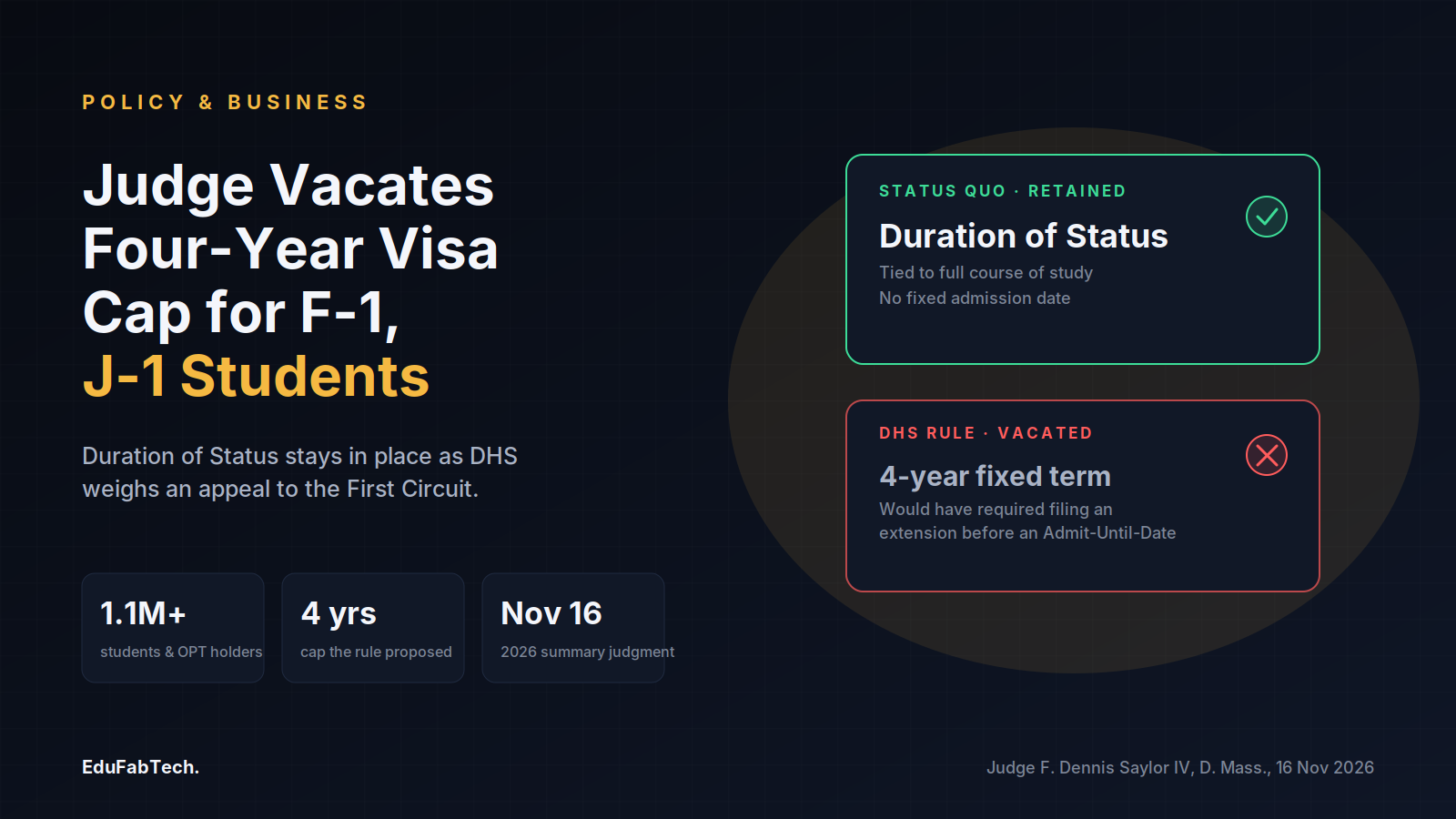
A federal judge in Boston vacated, in full, the US rule that would have ended "Duration of Status" for international students and exchange visitors, Inside Higher Ed reported on 16 November 2026. Judge F. Dennis Saylor IV of the US District Court for the District of Massachusetts granted the plaintiffs' motion for summary judgment and set aside the Department of Homeland Security rule in its entirety, meaning F-1 students and J-1 exchange visitors remain under the decades-old framework that lets them stay in the country for as long as they maintain their course of study, rather than a fixed term.
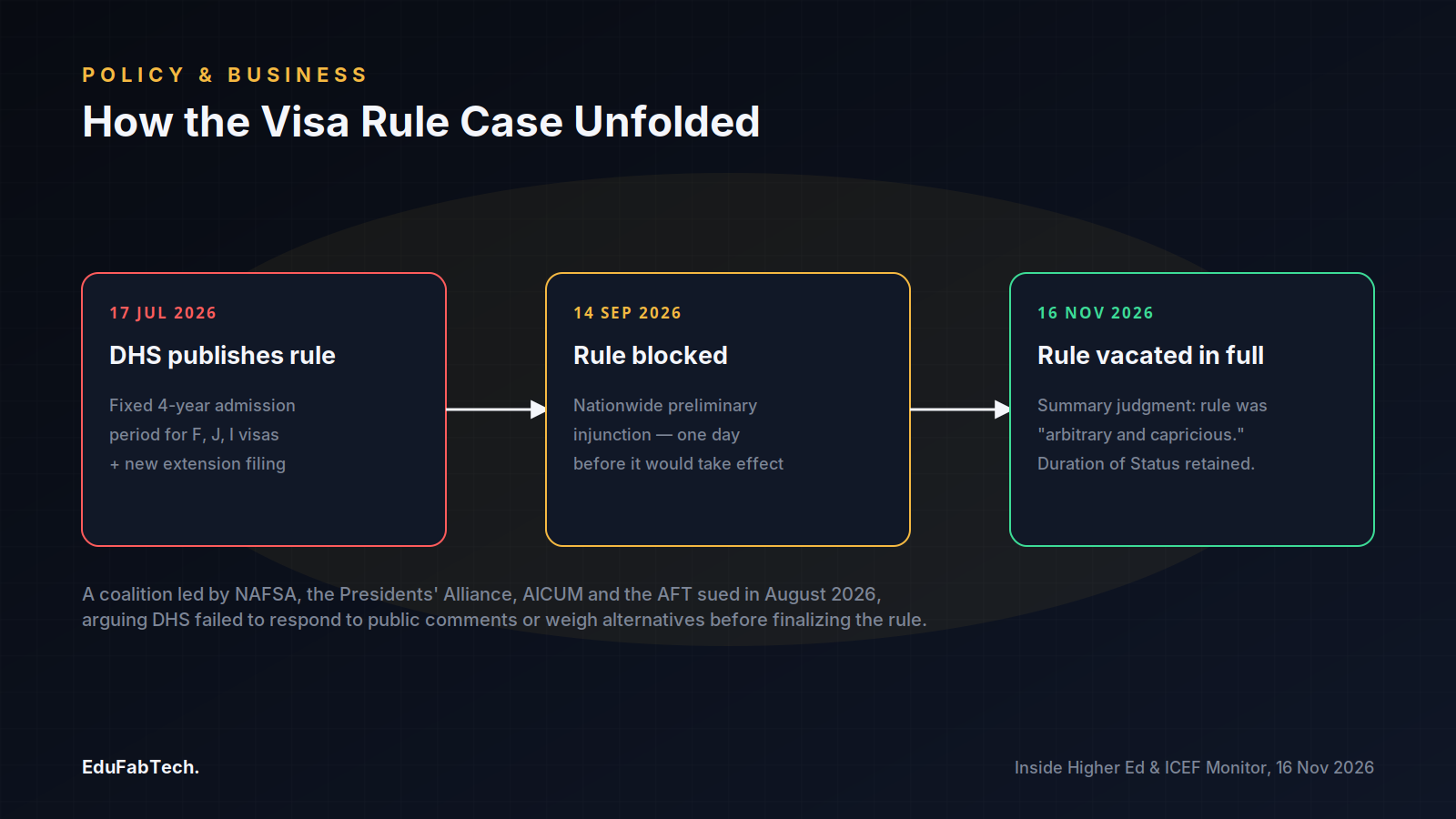
The rule the judge vacated was published in the Federal Register on 17 July 2026 and would have replaced Duration of Status with a fixed admission period of up to four years for F, J and I nonimmigrants — students, exchange visitors and representatives of foreign media — plus a new extension-of-stay procedure requiring a federal application before that period ran out, according to a summary by the National Law Review. It was due to take effect on 15 September 2026.
Inside Higher Ed's account of the ruling says Judge Saylor found that DHS had failed to adequately respond to public comments and had not considered alternative options before finalizing the rule, and that its restrictions on changing academic programs or pursuing joint degrees were "not reasonably related to the nature and purpose of the F-1 visa program," because, as the judge put it, DHS was "seeking to prevent or discourage the very activity—providing educational opportunities for foreign students in the United States—that Congress sought to permit and encourage." ICEF Monitor reported that the court held the rule to be "arbitrary and capricious" under the Administrative Procedure Act.
How the case reached a final judgment
The rule never took effect. A coalition led by NAFSA: Association of International Educators, the Presidents' Alliance on Higher Education and Immigration, the Association of Independent Colleges and Universities in Massachusetts, the American Federation of Teachers and several affiliated labor unions sued in August 2026, and Judge Saylor granted nationwide preliminary relief blocking the rule on 14 September 2026, one day before it was due to begin. The 16 November 2026 decision converted that block into a permanent vacatur after both sides moved for summary judgment, according to Inside Higher Ed and ICEF Monitor.
NAFSA's chief executive, Fanta Aw, said of the ruling, "the judge has sent an unequivocal and resounding message: the longstanding Duration of Status policy is retained," according to ICEF Monitor. American Federation of Teachers president Randi Weingarten said the order "will have resounding impacts for generations of scientists and scholars," the outlet reported.
Who the rule would have affected
ICEF Monitor, citing US enrollment figures for 2025/26, put the number of international students and participants in post-study Optional Practical Training at over 1.1 million (1,146,160). Under the vacated rule, each of them would have received an individual "Admit Until Date" rather than the current open-ended status tied to their program, and would have had to file for an extension with US Citizenship and Immigration Services before that date if their studies ran longer than planned — a process the National Law Review's summary of the rule noted relies on USCIS processing times that are, in its words, unpredictable.
What happens next
The Trump administration had already appealed the September preliminary injunction to the US Court of Appeals for the First Circuit before the final ruling came down, and ICEF Monitor said it is widely expected that the government will also challenge the 16 November 2026 vacatur. Unless a higher court stays or reverses the decision, the pre-2026 Duration of Status framework continues to apply, with no fixed admission date and no four-year limit for F-1 and J-1 holders.
A different approach from other countries
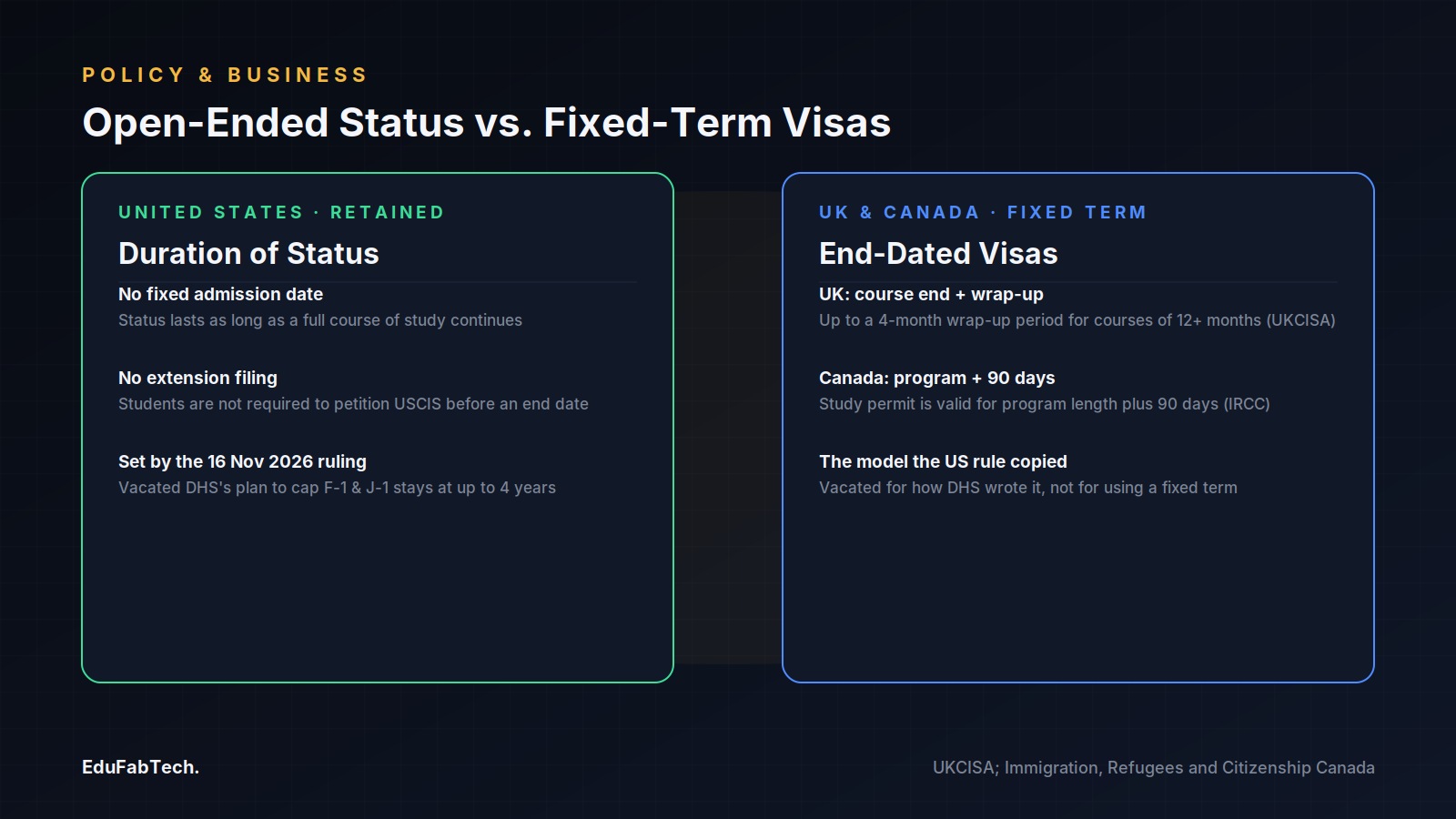
Several other major study destinations already tie student visas to a fixed end date rather than an open-ended status. UKCISA, the UK Council for International Student Affairs, says a Student route visa's expiry is set by the course end date plus a "wrap-up period" — four months for courses of 12 months or longer, shorter for briefer courses — built into the original grant rather than requiring a separate extension application. Canada's immigration department states that a study permit remains valid for the length of a study program plus 90 days, after which a graduate must leave, extend their permit or apply for a different status. The vacated US rule would have moved the United States toward a similar fixed-term model; the court's objection was to how DHS designed and justified that shift, not to fixed terms as such.
What it means for students and institutions
For now, international students and scholars already in the United States, and those applying for F-1 or J-1 status, continue under the existing rules: status tied to maintaining a full course of study, rather than a calendar deadline. Advisers at universities are likely to watch the First Circuit docket closely, since an appeal — if it succeeds — could revive some version of the fixed-term system that the district court has now twice blocked.
A quick question for readers
Do you work part-time while you study?
Many students work to pay the bills. See how common it is — and how many hours people really do.
Pick an answer, create a free account in a minute, and your vote counts. Already a member? Sign in
Comments 3
Comment-
What jumps out is the line that this ruling doesn't contest fixed terms in principle - the judge even noted other countries already run on a…
-
The part that stands out is the judge's actual legal reasoning, not just the outcome: he didn't rule against fixed terms in principle, he ru…
-
What stands out is that the judge didn't object to fixed-term status itself, just to how DHS justified it - the article is explicit that oth…
Join free to read the full comments and reply Comments are between members; an account takes a minute.
Source: Inside Higher Ed
Sources (3)
- Johanna Alonso. Judge Vacates International Student Visa Limits. Inside Higher Ed, 2026. insidehighered.com ↗ · checked 17 Nov 2026
- ICEF Monitor editorial team. Breaking News: US Court Strikes Down Rule That Would Have Ended Duration of Status (D/S) for International Students. ICEF Monitor, 2026. monitor.icef.com ↗ · checked 17 Nov 2026
- National Law Review staff. Department of Homeland Security Final Rule Eliminates Duration of Status for F-1 Students and Imposes Severe Academic Mobility Restrictions. National Law Review, 2026. natlawreview.com ↗ · checked 17 Nov 2026