US Defends Blocked Four-Year Student Visa Cap as Court Fight Continues
The Trump administration told a Massachusetts federal court on 2 November 2026 that its paused rule ending open-ended "Duration of Status" for F-1 and J-1 students is a national-security necessity, as litigation continues.
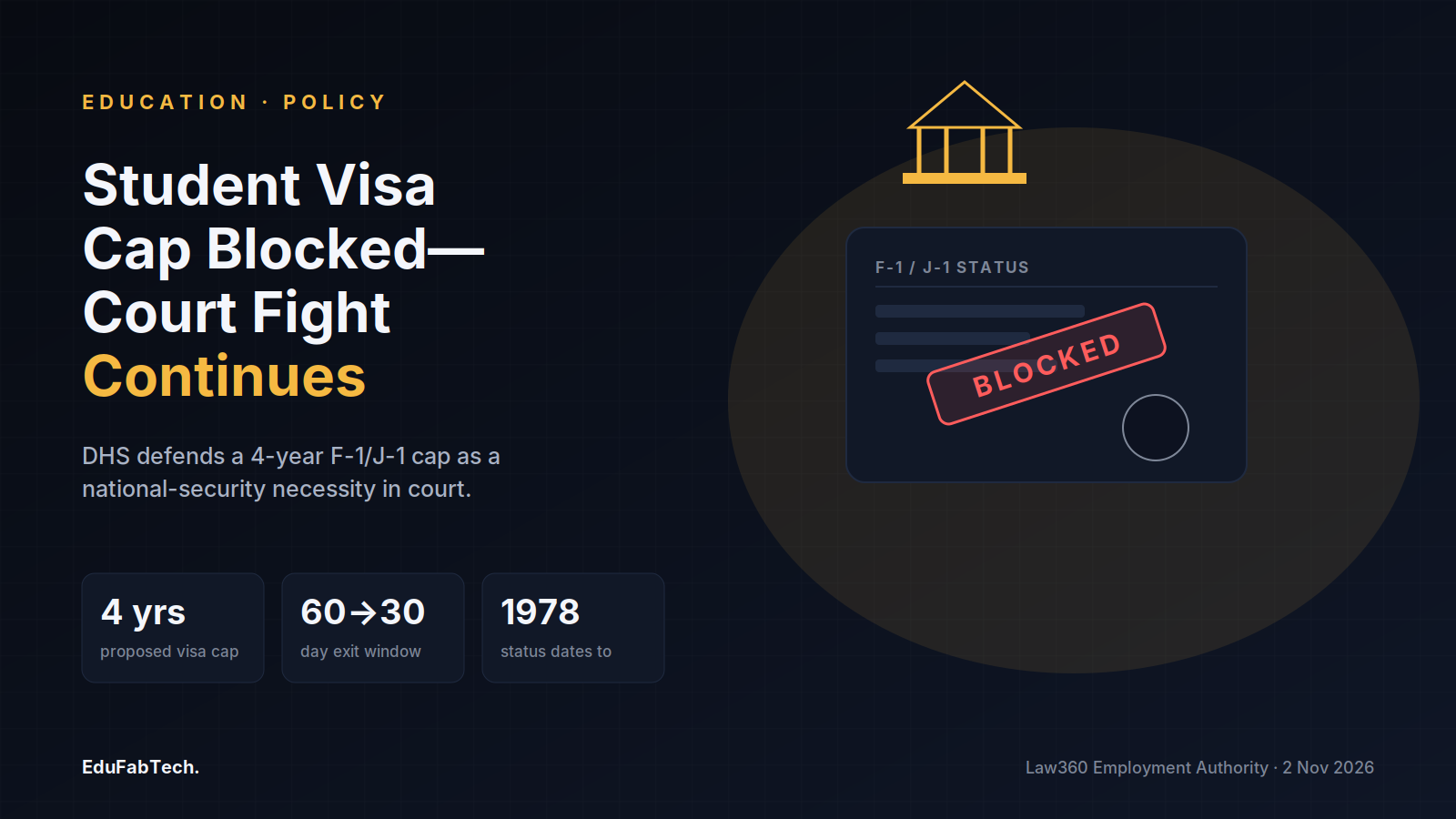
On 2 November 2026, the Trump administration told a federal court in Massachusetts that its blocked rule setting fixed time limits on F-1 student and J-1 exchange-visitor visas is "critical for national security," according to Law360 Employment Authority, which reviewed the government's brief. The filing is the government's latest brief defending the rule's legality in Presidents' Alliance on Higher Education and Immigration v. DHS, the case that has kept the rule frozen since mid-September.
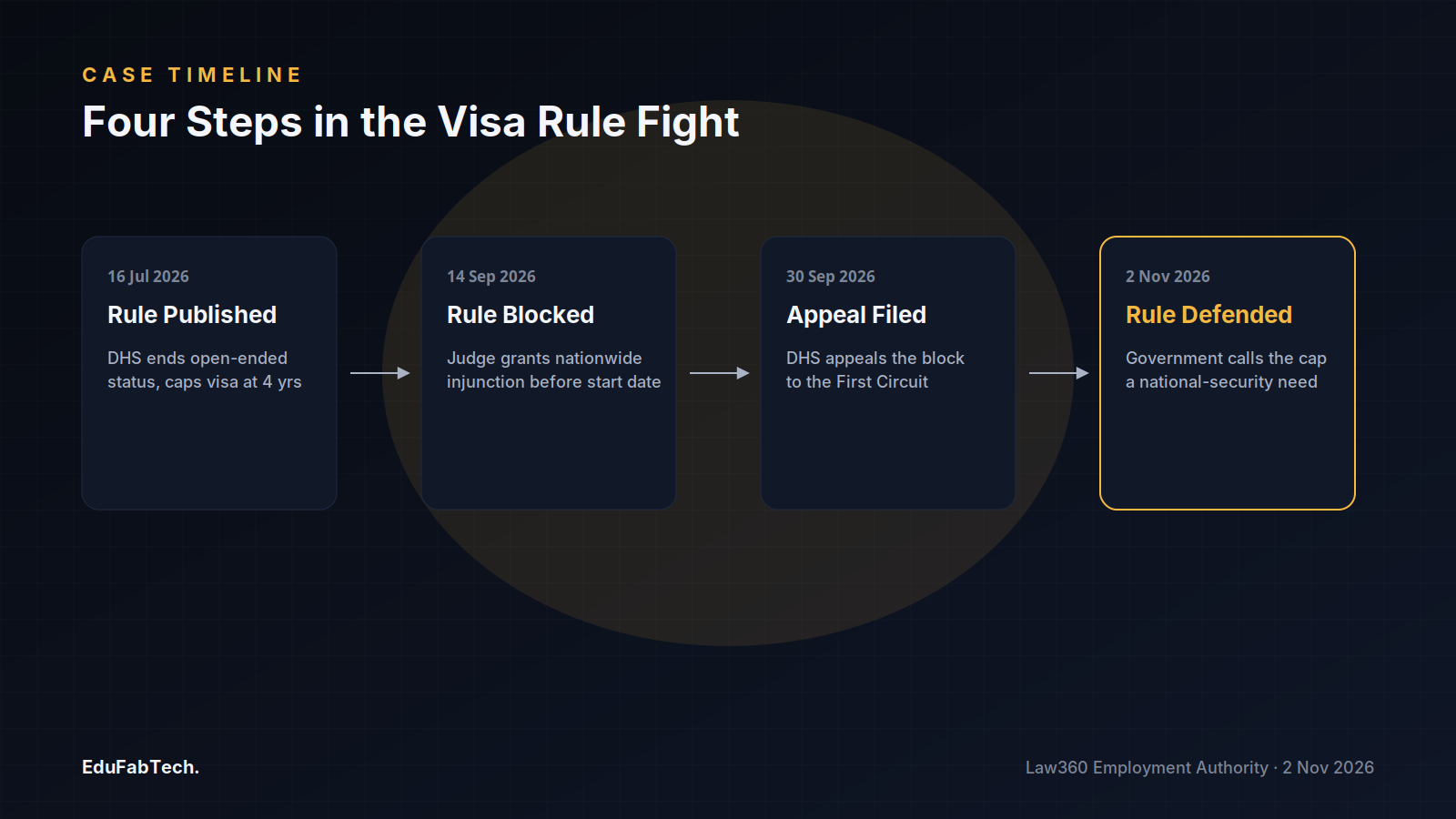
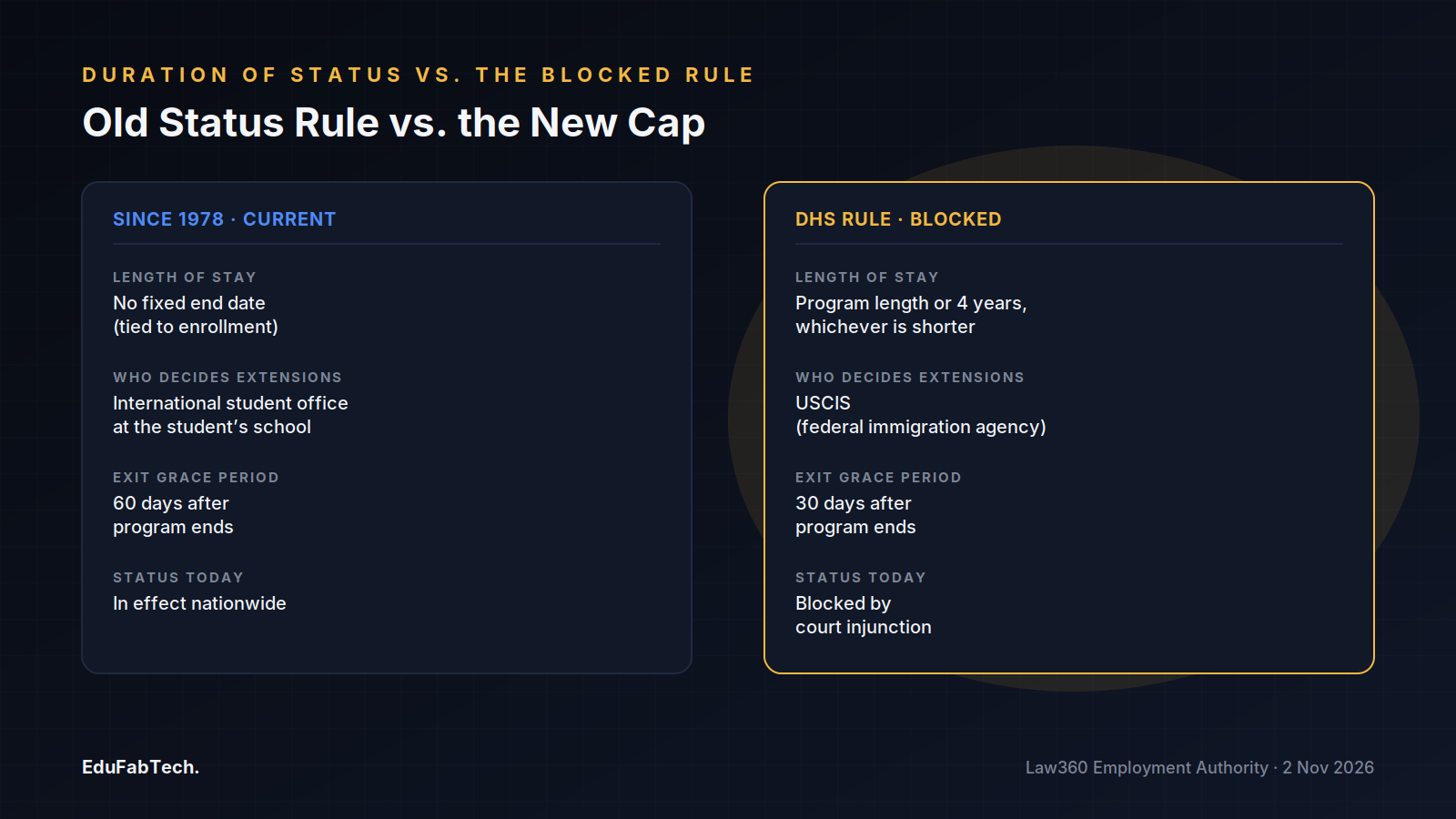
The rule itself dates to 16 July 2026, when the Department of Homeland Security published a final regulation ending "Duration of Status," the open-ended admission category that F, J and I nonimmigrants have held since 1978. DHS Secretary Markwayne Mullin said at the time that "for nearly half a century, the outdated 'duration of status' system has compromised national security and created an environment ripe for immigration fraud," according to the DHS announcement. In place of indefinite status tied to enrollment, the rule caps admission at the length of a student's program or four years, whichever is shorter, cuts the post-study departure window from 60 to 30 days, and moves extension decisions from university officials to US Citizenship and Immigration Services.
A Rule Blocked a Day Before It Took Effect
The rule was scheduled to take effect on 15 September 2026. It did not. On 14 September 2026, US District Judge F. Dennis Saylor IV granted nationwide preliminary relief, finding the plaintiffs likely to succeed on their claim that DHS violated the Administrative Procedure Act. The plaintiffs are NAFSA: Association of International Educators, the Presidents' Alliance on Higher Education and Immigration, the Association of Independent Colleges and Universities in Massachusetts, the American Federation of Teachers and its Graduate Labor Organization local, the United Automobile Workers and a UAW local, and the NewsGuild-CWA, according to a joint statement the groups issued the same day.
NAFSA chief executive Fanta Aw said the ruling was "an important step toward preserving a fair and predictable system for international students and scholars and the institutions that welcome them." Presidents' Alliance executive director Miriam Feldblum said the coalition "welcome[d] the court's decision to grant nationwide preliminary relief and block the rule from taking effect." American Federation of Teachers president Randi Weingarten called the injunction "proof positive that the Trump administration's proposed limits on how long international scholars have to complete their studies is arbitrary and hostile," the same statement said.
Why the Judge Was Skeptical
At a hearing days before his ruling, Judge Saylor pressed DHS on its national-security rationale. "I am just struggling to see a rational connection. A four-year cap does not have anything to do with national security," he said, adding that "a foreign student who wants to take a photo of a military base could do it in four years," according to reporting by The PIE News on the hearing.
Where the Case Stands Now
DHS filed a notice of appeal to the First Circuit Court of Appeals on 30 September 2026. At an October 2026 status conference, government lawyers said they wanted to pursue an expedited appeal while pausing further proceedings at the district court, while the plaintiff coalition argued for a prompt district-court judgment so both the rule's merits and the injunction could reach the appeals court together, The PIE News reported from that hearing. Judge Saylor ordered both sides to file their positions on next steps by 9 October 2026.
The 2 November 2026 filing reported by Law360 is the government's latest attempt to win on the merits at the district court rather than wait on the appeal. With that brief now filed, Judge Saylor could rule on the rule's legality in the coming months, independent of whatever the First Circuit eventually decides about the injunction itself.
What It Means for Students and Universities
For now, nothing has changed on the ground. Duration of Status remains in effect nationwide: F-1 students and J-1 exchange visitors already in the United States, and those arriving this academic year, are not subject to a fixed four-year exit date, and extension decisions still run through international-student offices rather than USCIS. But the underlying rule has not been struck down, only paused, so advisers at institutions represented by NAFSA and the Presidents' Alliance continue to warn students against assuming the matter is settled.
The dispute also highlights how unusual the open-ended US model has been among major host countries. Under the UK's Student visa rules, a visa's length is already tied to course level — up to five years for a degree-level course, up to two years below degree level — rather than granted for an indefinite "duration of status." The DHS rule would move the US toward that kind of fixed-term model, but with an additional four-year ceiling regardless of course length and a federal extension process that the plaintiffs say would strand students mid-degree, particularly in longer PhD and some engineering programs.
| Date | Development |
|---|---|
| 16 Jul 2026 | DHS publishes final rule ending Duration of Status |
| 14 Sep 2026 | Judge Saylor grants nationwide preliminary injunction |
| 30 Sep 2026 | DHS files notice of appeal to the First Circuit |
| 9 Oct 2026 | Deadline for both sides' positions on next procedural steps |
| 2 Nov 2026 | Government defends rule as summary-judgment briefing closes |
Until Judge Saylor rules on the merits, or the First Circuit moves on the appeal, researchers and current students on F-1 and J-1 visas keep operating under the pre-2026 rules — even as the government presses its case that those rules are no longer adequate.
A quick question for readers
Is using AI to help write an assignment cheating?
Universities are still writing their rules. Where do students draw the line?
Pick an answer, create a free account in a minute, and your vote counts. Already a member? Sign in
Comments 3
Comment-
The part that stands out is the judge's own line: a four-year cap doesn't stop someone taking a photo of a military base, and he's right tha…
-
The judge's question is the one worth sitting with: a four-year cap does not have anything to do with national security, and the government'…
-
The quote that undercuts the whole national-security framing is right there in the article: the judge's own line that "a foreign student who…
Join free to read the full comments and reply Comments are between members; an account takes a minute.
Source: Law360 Employment Authority
Sources (3)
- Ganesh Setty. Trump Admin Seeks Revival Of Blocked Fixed-Term Visa Rule. Law360 Employment Authority, 2026. law360.com ↗ · checked 7 Nov 2026
- U.S. Department of Homeland Security. Trump Administration Issues Final Rule to End Foreign Student Visa Abuse. DHS.gov, 2026. dhs.gov ↗ · checked 7 Nov 2026
- The PIE News. US to seek expedited appeal over blocked int'l student time limits. The PIE News, 2026. thepienews.com ↗ · checked 7 Nov 2026