US Student-Loan 'Earnings Test' Would Flag Programs Enrolling 2.5% of Aided Students
A report published 14 October 2026 by American University's PEER Center finds the Education Department's new earnings-based accountability rule would currently flag programs enrolling 2.5% of federally aided students, concentrated in for-profit and certificate programs.
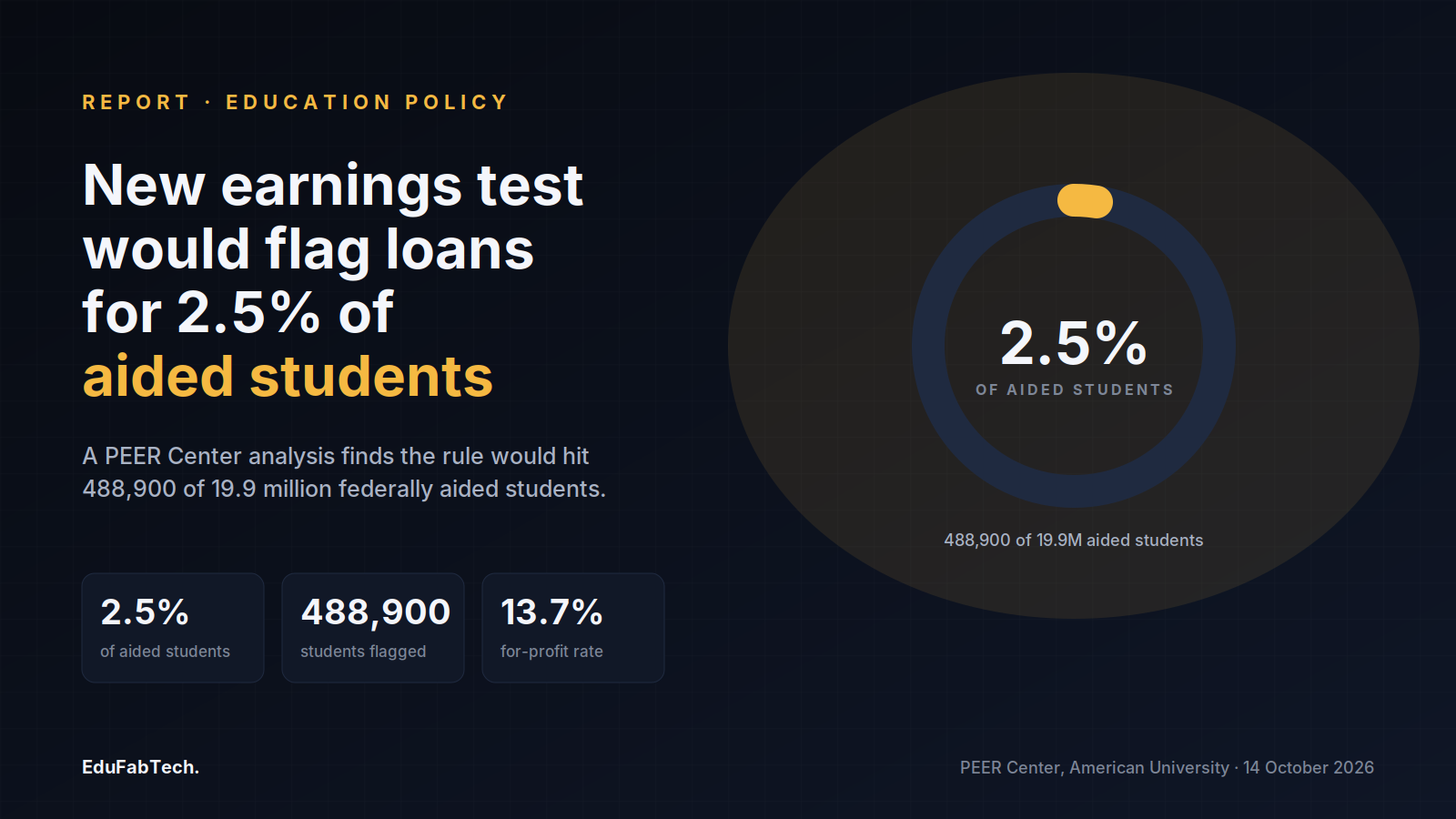
A report published on 14 October 2026 by the Postsecondary Education & Economics Research (PEER) Center at American University finds that the United States Department of Education's new "earnings test" for federal student loans would, if applied today, flag programs enrolling 2.5% of all students who receive federal student aid — about 488,900 of 19.9 million recipients, rising to 2.9% among students who specifically hold federal loans. The analysis, by Jordan Matsudaira, Kristen Allen and Clare McCann, is the first detailed look at which students and institutions the rule would actually touch.
The rule compares the earnings of a program's graduates against a benchmark: undergraduate certificate and bachelor's programs fail if their average graduate does not out-earn a high school graduate in the same state, in two of any three consecutive years; graduate programs fail against the earnings of bachelor's degree holders. A program that fails loses eligibility for federal Direct Loans, Nixon Peabody's summary of the finalized rule states.
Who the rule would flag
The PEER Center's report and accompanying data tool show the impact is concentrated rather than broad. Undergraduate certificate programs make up only 10% of Title IV (federal aid) enrollment nationally but account for 63% of enrollment in programs projected to fail. By sector, 13.7% of students at for-profit institutions are enrolled in a program expected to fail, compared with 2.3% at nonprofit institutions and 0.8% at public institutions, the center found.
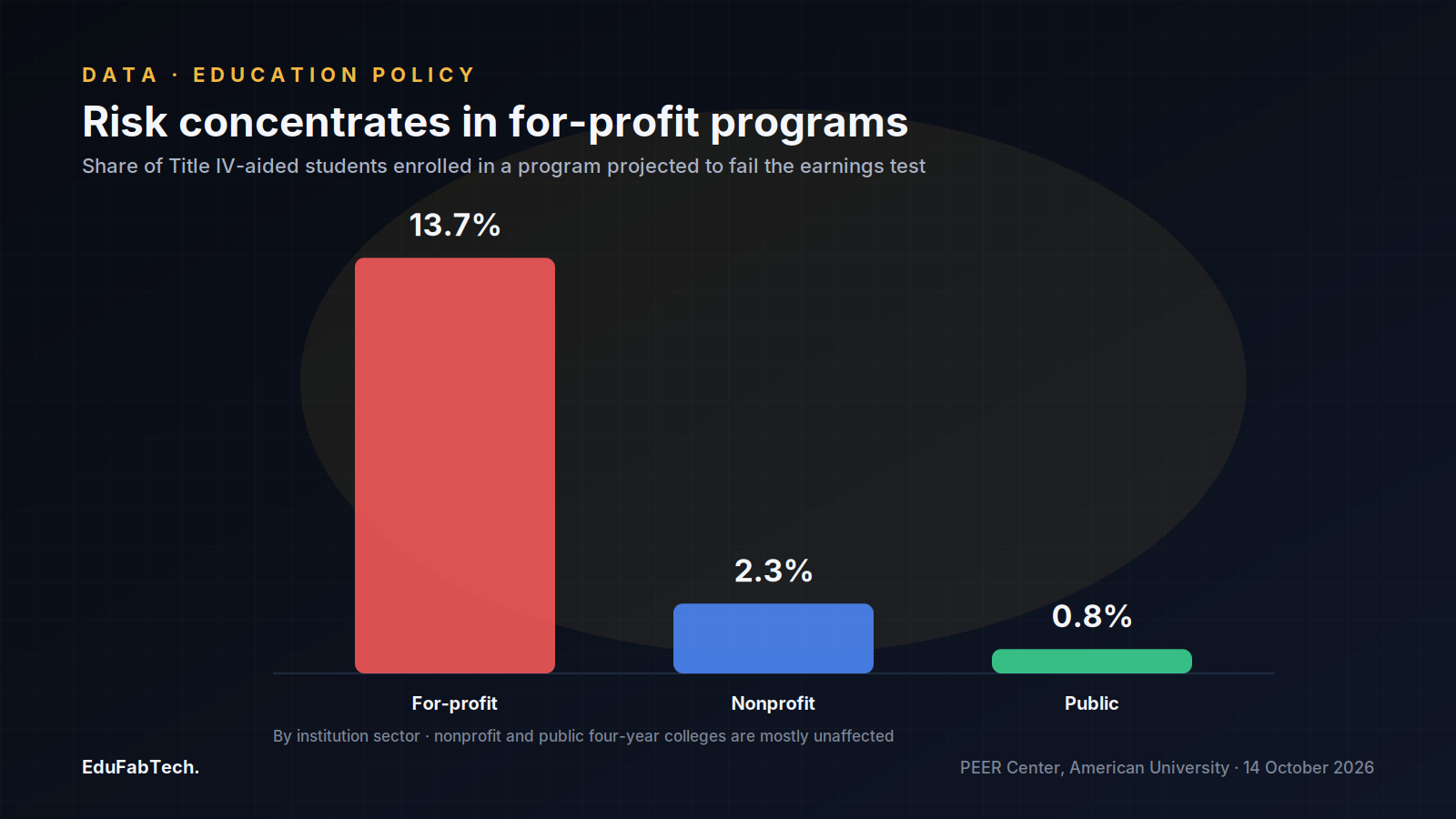
Seen from the institution side, most colleges would see no effect at all: 75% of public four-year colleges and 84% of private nonprofit four-year institutions have no students in a flagged program, and just under 70% of community colleges are unaffected, according to the report. Where failing programs do concentrate, it is in fields such as cosmetology, allied health and medical administration at the undergraduate level, and in graduate certificates, master's and professional degrees in mental health and social services — the largest of the latter offered by colleges that operate largely online, including Grand Canyon University, Capella University, Liberty University, Northcentral University (now part of National University) and Regent University. The report's own conclusion is that the rule "targets a thin slice" of the lowest-earning programs while leaving most of the sector untouched.
Dates and who is exempt
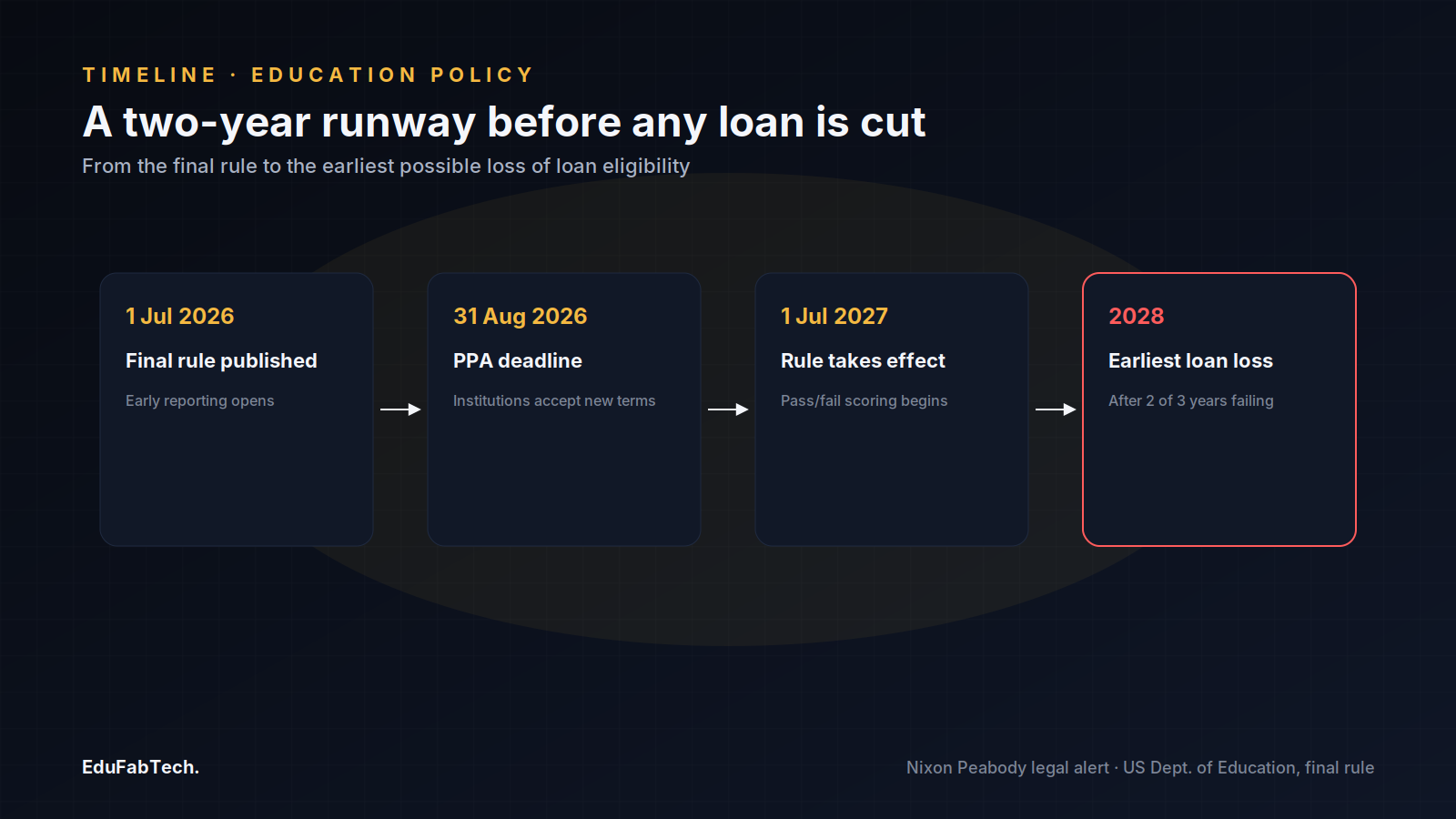
The Department of Education published the final rule on 1 July 2026. Under the timeline set out in Nixon Peabody's legal alert, institutions have the option to implement certain reporting provisions early from that same date; they must agree to the new framework through their Program Participation Agreements by 31 August 2026; and the substantive accountability provisions become generally effective on 1 July 2027 — a year later than the effective date the proposed rule had contemplated. Because a program must fail in two of three consecutive years, the earliest a program could actually lose loan eligibility is 2028.
Several categories are carved out. Institutions that have not participated in the Direct Loan program for the prior five award years are exempt from institution-level consequences, as are programs at institutions that exclusively enroll students with specific learning disabilities or autism spectrum disorder, and programs where an institution voluntarily bars Direct Loan borrowing for five years following a failure determination. Programs tied to roughly 20 tipped-income occupations — fields such as cosmetology, culinary arts and massage therapy — get a longer grace period: the department will not impose pass/fail consequences for any year that relies on tax year 2025 or earlier earnings data, which Nixon Peabody's alert ties to the phase-in of the OBBB Act's tax-free tipping provision and which pushes consequences for those programs out by at least one additional year beyond the general schedule.
A different approach, published elsewhere
The United States is not the only country publishing graduate earnings by field of study, though its approach is unusual in tying the data to loan eligibility. The United Kingdom's Department for Education publishes median graduate earnings by subject and provider through its Longitudinal Education Outcomes dataset, which released its 2023–24 update on 25 June 2026. That dataset is published for applicants and advisers to consult directly; it is a separate exercise from the US earnings test's role in determining which programs keep access to federal loans.
What it means for students and teachers
For now, the practical effect for most students, in the US and elsewhere, is limited: the PEER Center's figures show the large majority of institutions, including nearly all public and private nonprofit four-year colleges, have no programs anywhere near the threshold. Students and advisers weighing a certificate or graduate program in a flagged field — particularly online-concentrated programs in mental health, social services, cosmetology or allied health — have a two-to-three-year window before any loan eligibility could actually change, since the rule needs two full years of post-2027 earnings data before a program can fail. Teachers and advisers guiding students toward such programs can use the PEER Center's public data tool to check whether a specific program, rather than just its broad field, falls near the earnings benchmark before a student commits.
A quick question for readers
Is using AI to help write an assignment cheating?
Universities are still writing their rules. Where do students draw the line?
Pick an answer, create a free account in a minute, and your vote counts. Already a member? Sign in
Comments 0
CommentNo comments yet. Members start the conversation.
Source: PEER Center, American University
Sources (3)
- Jordan Matsudaira, Kristen Allen, Clare McCann. The Limited Impact of New Federal Earnings-Based Accountability Rules. PEER Center, American University, 2026. peer-center.org ↗ · checked 19 Oct 2026
- Inside Higher Ed. New Earnings Test Will Have Limited but Concentrated Impact. Inside Higher Ed, 2026. insidehighered.com ↗ · checked 19 Oct 2026
- Nixon Peabody LLP. Department of Education Finalizes OBBB Higher Ed Accountability Rule. Nixon Peabody, 2026. nixonpeabody.com ↗ · checked 19 Oct 2026