US Rule Requires Licenses for Remote Access to Advanced AI Chips From 19 November 2026
A Commerce Department rule closes a loophole that let firms in China and other restricted countries rent US-made AI computing power through overseas data centers.
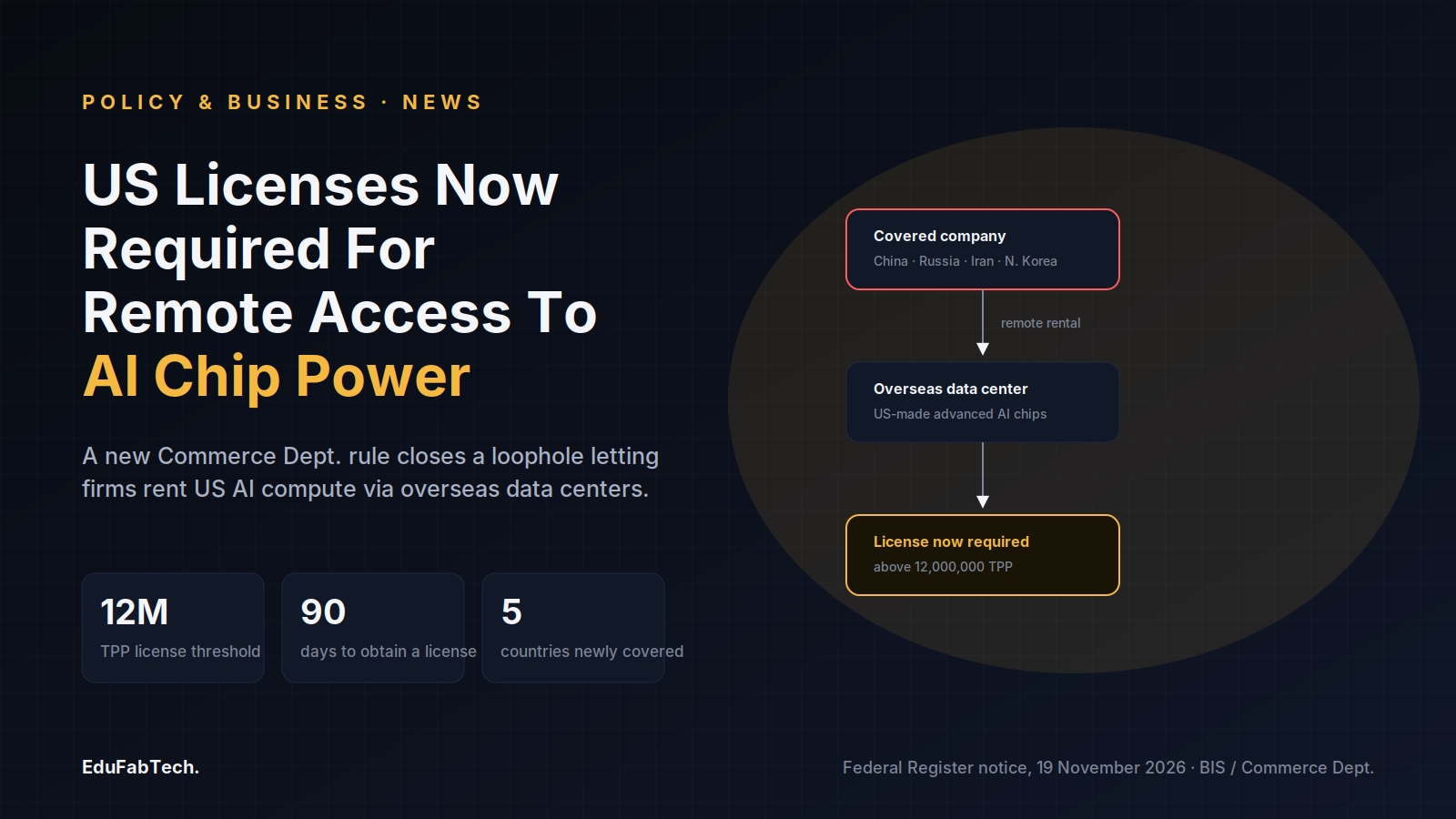
The US Department of Commerce's Bureau of Industry and Security (BIS) published a rule on 19 November 2026 requiring a license before an overseas data center can remotely supply large volumes of advanced AI computing power to companies headquartered in China, Russia, Iran, North Korea, Macau or other countries subject to the broadest US export controls, according to the rule as published in the Federal Register. The rule, titled "Addressing Remote Access to Advanced Semiconductors," took effect on its publication date and is open for public comment for 60 days, the Federal Register notice states.
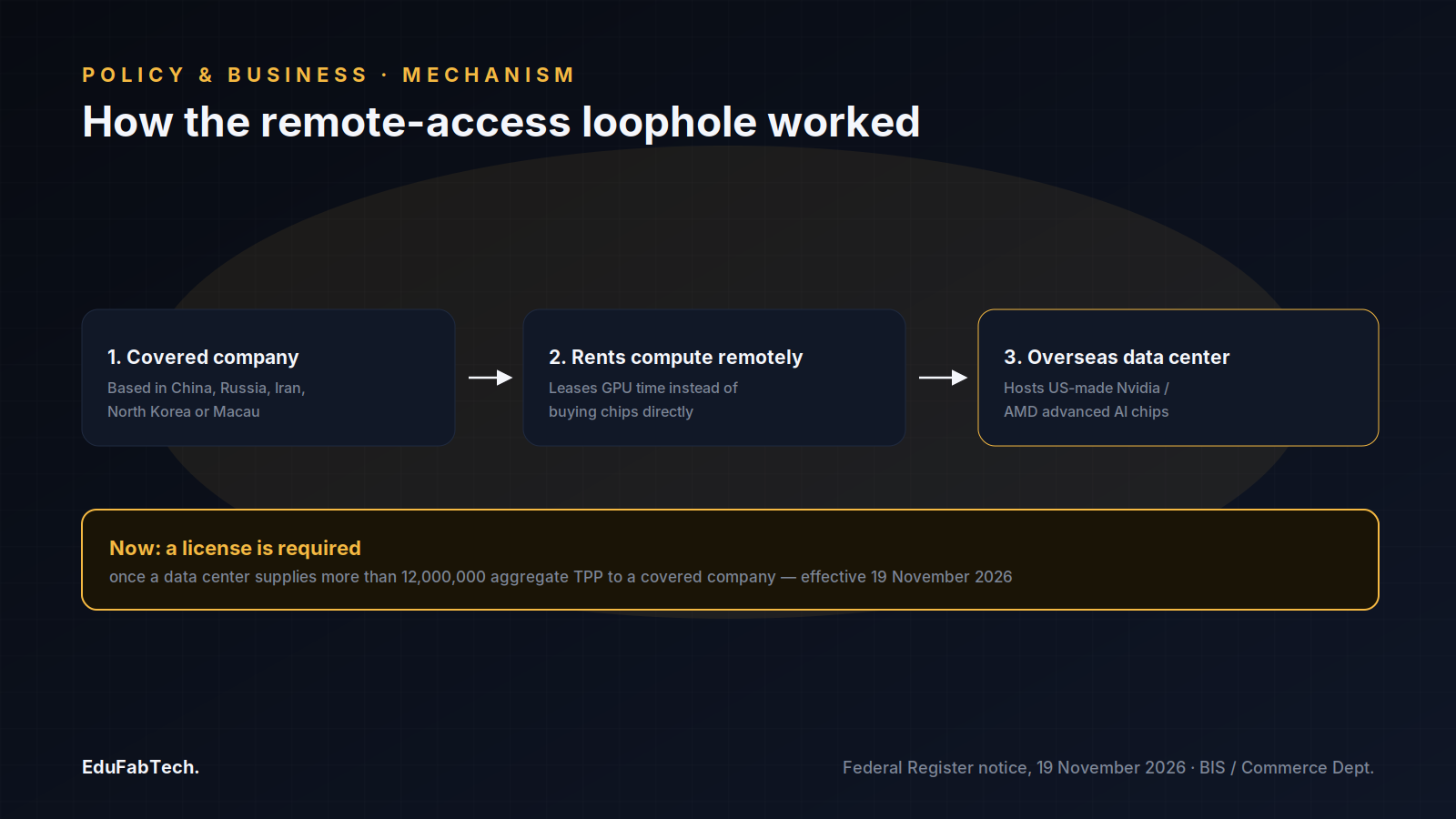
The rule targets a specific gap: a company based in a restricted country cannot buy advanced Nvidia or AMD chips directly, but it could previously rent compute time on those chips from a data center in a third country. BIS's stated aim, as summarized in a client alert from law firm WilmerHale (2026), is to stop that arrangement from being used to train advanced AI models outside the reach of existing chip export controls.
A threshold measured in aggregate processing performance
The license requirement is triggered by a specific figure: a data center or network providing more than 12,000,000 aggregate "total processing performance" (TPP), BIS's own metric for summing the computing power of a group of advanced chips, to a covered company now needs a license, according to WilmerHale's analysis of the rule (2026). Law firm Gibson Dunn (2026) notes that the rule carves out an exception: computing access that is exclusively designed and exclusively used for "commercial recommender systems" — ranking, filtering or suggesting commercial products, services or content, with no generative AI function — can continue without a license, provided the data center submits information to BIS identifying the covered company, the aggregate TPP involved and the diligence performed to confirm the exclusive use.
Five more countries now need a license
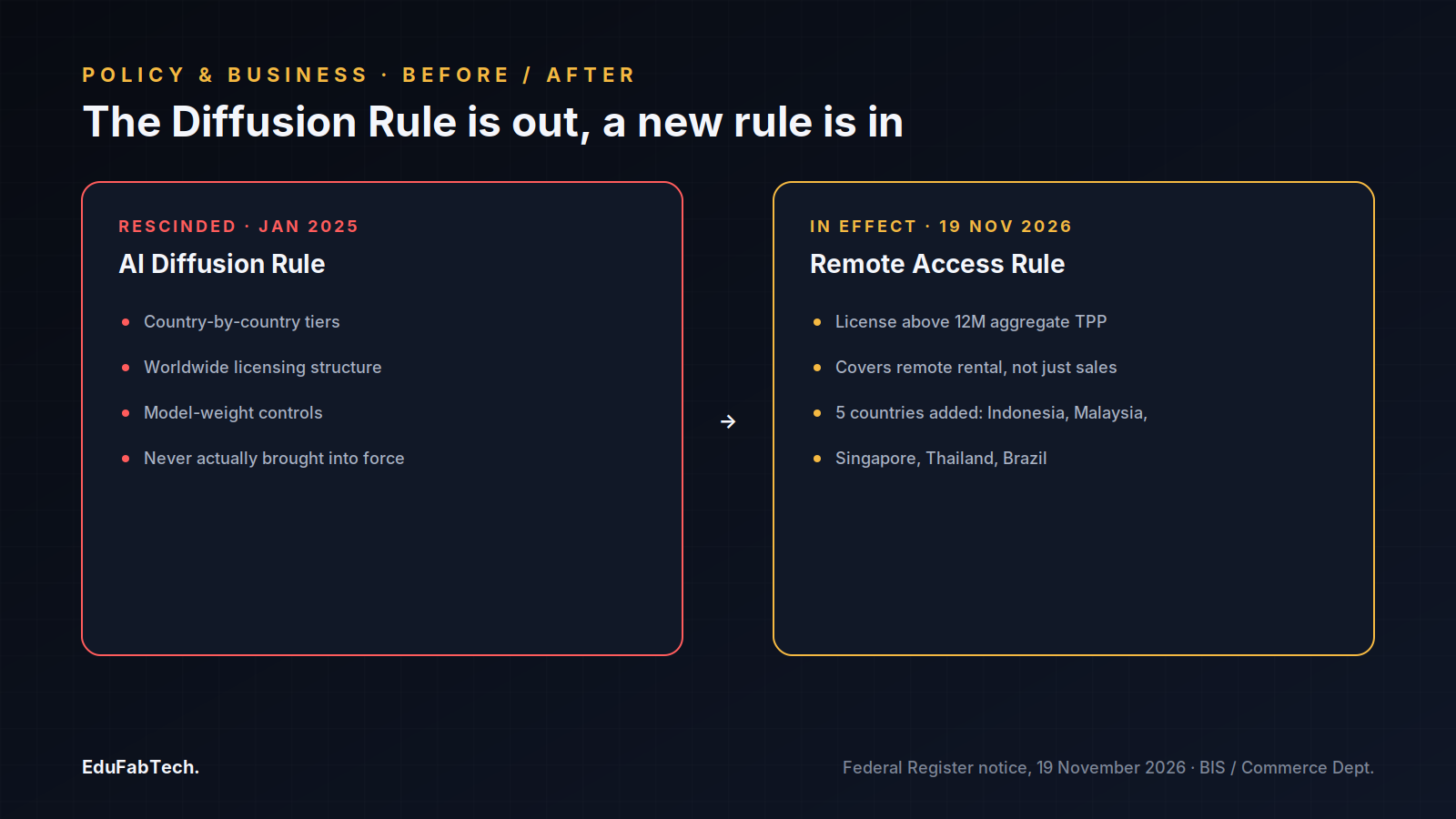
The rule also adds Indonesia, Malaysia, Singapore, Thailand and Brazil to the list of destinations that require a license for exports of advanced AI chips and servers, a change that Gibson Dunn (2026) attributes to BIS treating those countries as carrying a higher-than-normal risk that chips sent there could be diverted onward to restricted buyers. The requirement does not apply to exports destined for a company headquartered in the United States, provided the data center files monthly reports identifying the transaction parties, ultimate parents, destinations and product specifications, Gibson Dunn's summary states.
Data centers that were already supplying significant compute to covered companies before the rule's publication have 90 days from the effective date to obtain — not merely apply for — a license, or face restrictions on further exports, according to both law firm summaries.
The Biden-era AI Diffusion Rule is formally gone
The same rule rescinds the regulations that implemented the AI Diffusion Rule, issued in January 2025 under the Biden administration, which had set country-by-country tiers and a worldwide licensing structure for AI chip exports. WilmerHale's alert states that the rescission removes the Diffusion Rule's model-weight controls, its country groupings and its worldwide licensing requirement from the Export Administration Regulations, though the broader advanced-computing foreign direct product rule remains in place. BIS had never brought the Diffusion Rule's licensing structure into force before replacing it.
What changes for researchers and developers
The rule reaches further than export controls usually do, because it regulates access to compute rather than only the physical movement of chips. A university lab, a cloud provider or a startup that rents GPU time from a data center in one of the newly covered countries — or that operates such a data center and serves clients in restricted countries — now sits inside a licensing regime it did not face before 19 November 2026. For researchers who rely on rented cloud compute to train or fine-tune large models, the practical question is whether their provider's infrastructure, or its downstream customers, fall within BIS's new reporting and licensing requirements.
BIS has said it will actively monitor for countries that tolerate evasion and can respond with import restrictions, new licensing requirements, a downgrade of a country's status in the US export control regime, or Entity List designations and temporary export prohibitions for the people and firms involved, according to Gibson Dunn's summary of the rule. The 60-day comment period gives data center operators, chipmakers and cloud providers a formal channel to flag compliance problems before the rule is revisited, but it does not delay the licensing requirement itself, which is already in force.
A quick question for readers
How much do you spend on books and course materials per term?
Amounts in US dollars. The results help show how much course materials really cost students.
Pick an answer, create a free account in a minute, and your vote counts. Already a member? Sign in
Comments 3
Comment-
The TPP threshold is the part that'll actually matter and the article barely interrogates it. 12,000,000 aggregate TPP sounds precise, but "…
-
The 12,000,000 TPP threshold and the recommender-system carve-out are the two load-bearing details here, and the carve-out is the part worth…
-
The 90-day grace period is the part that actually bites: data centers that were already serving covered companies don't just need to apply,…
Join free to read the full comments and reply Comments are between members; an account takes a minute.
Source: US Bureau of Industry and Security, Federal Register
Sources (2)
- Gibson Dunn. BIS Expands Advanced Computing Controls to Address Data Center Remote Access and Third-Country Diversion. Gibson Dunn, 2026. gibsondunn.com ↗ · checked 24 Nov 2026
- WilmerHale. US Government Restricts Remote Access to Advanced AI Chips and Formally Rescinds the AI Diffusion Rule. WilmerHale, 2026. wilmerhale.com ↗ · checked 24 Nov 2026