Webb's Deepest Look at IC 348 Finds Brown Dwarfs Down to 2 Jupiter Masses and a New Spectral Class
A September 15, 2026 image release from the Space Telescope Science Institute anchors two 2026 papers testing whether these tiny objects are planets or failed stars.
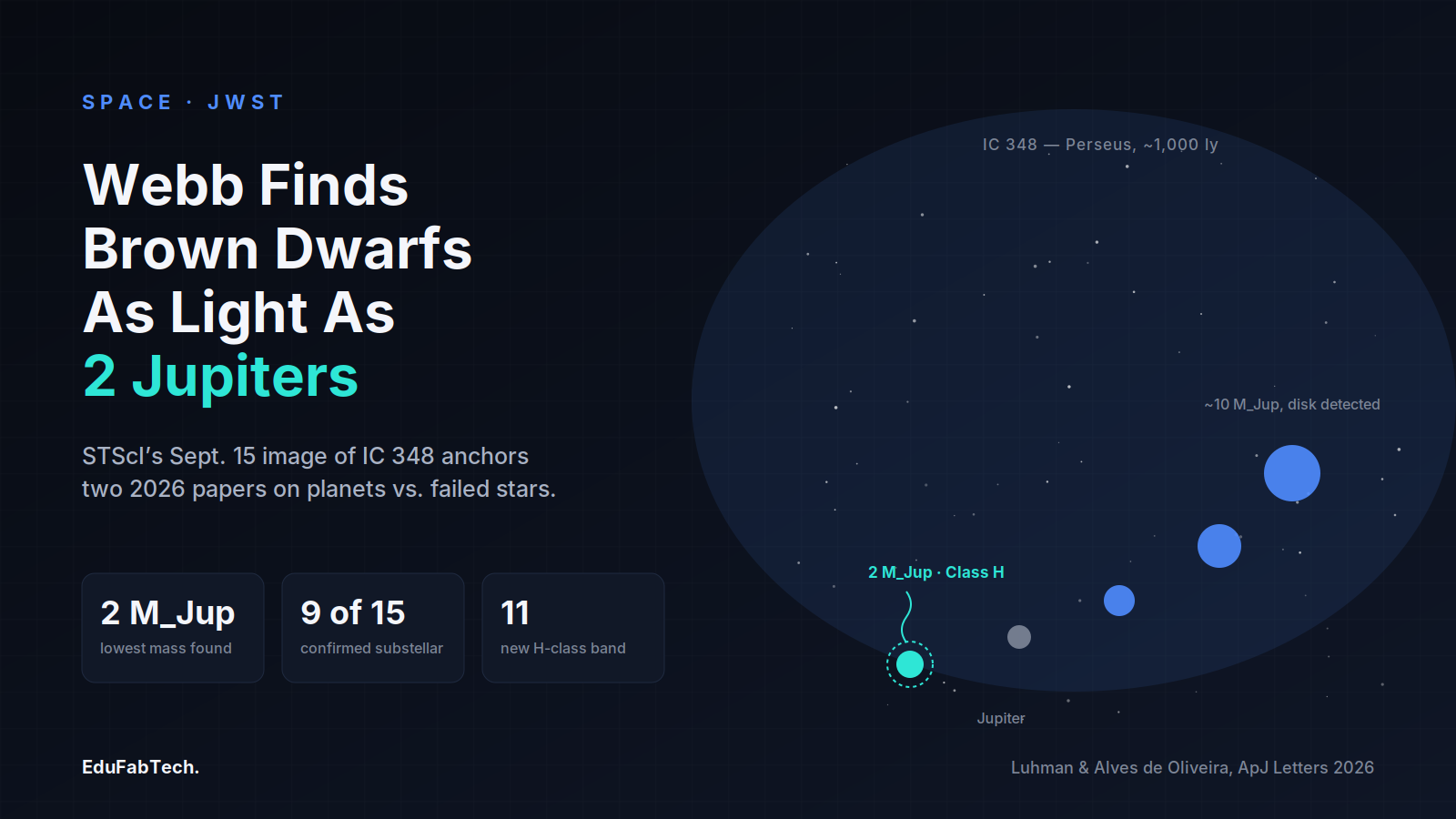
On September 15, 2026, the Space Telescope Science Institute (STScI) released one of the largest single images yet published from the James Webb Space Telescope: a near-infrared panorama of IC 348, a star-forming cluster about 1,000 light-years away in the constellation Perseus. Behind the picture is a set of findings that push the known lower mass limit of brown dwarfs down to roughly twice the mass of Jupiter and describe a spectral feature that has never been seen in an atmosphere outside the Solar System.
What Webb found in the cluster
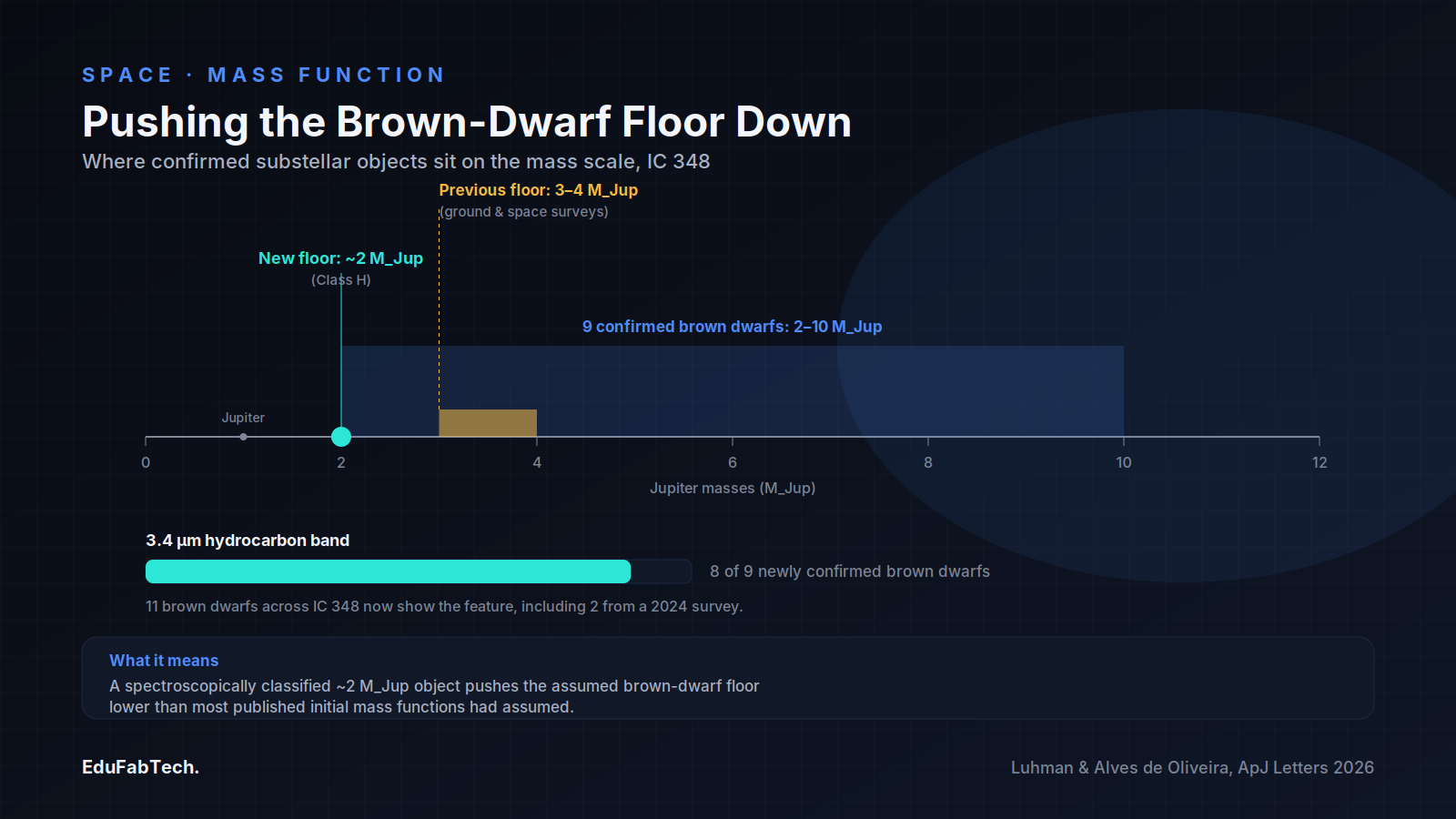
IC 348 is young, between 2 and 5 million years old, and holds around 400 stars. That youth makes it a useful place to look for brown dwarfs — objects too light to sustain hydrogen fusion but heavier than planets — because they are still warm enough from formation to be bright in infrared light. Using Webb's NIRCam instrument, an earlier survey by Kevin Luhman (Penn State University) flagged 39 candidate brown dwarfs in the cluster. Follow-up spectroscopy with Webb's NIRSpec instrument, reported by Luhman and Catarina Alves de Oliveira (European Space Agency) in The Astrophysical Journal Letters, confirmed 9 of 15 observed candidates as substellar cluster members, with masses estimated between roughly 2 and 10 Jupiter masses. The faintest of these, at about 2 Jupiter masses, is among the least massive brown dwarfs ever assigned a spectral classification, extending the previous floor of 3–4 Jupiter masses set by ground- and space-based surveys.
Two of the confirmed members, with estimated masses near 2 and 10 Jupiter masses, show excess infrared emission consistent with a surrounding disk of gas and dust — the kind of circumstellar material usually associated with planet formation around young stars, here found around objects barely heavier than a giant planet.
An unexpected molecule
The spectra also turned up something the atmospheric models did not predict. Eight of the nine newly confirmed brown dwarfs show an absorption band at 3.4 micrometers from what the authors describe as an unidentified aliphatic hydrocarbon, a class of molecule built from chains of carbon and hydrogen; a ninth object, a previously known cluster member observed with NIRSpec for the first time in this study, shows the same feature. Two further candidates with the same signature had already turned up in Luhman's 2024 NIRCam survey of the cluster, bringing the total to 11 brown dwarfs across IC 348 with a confirmed hydrocarbon detection. The feature strengthens toward fainter, lower-mass objects, which the authors take as evidence that it is a genuine atmospheric constituent of the coolest newborn brown dwarfs rather than an artifact of measurement. Luhman and Alves de Oliveira propose a new spectral class, designated "H," to describe substellar objects that show this band, since it does not fit into the established M, L, T and Y brown dwarf sequence.
Planet or failed star?
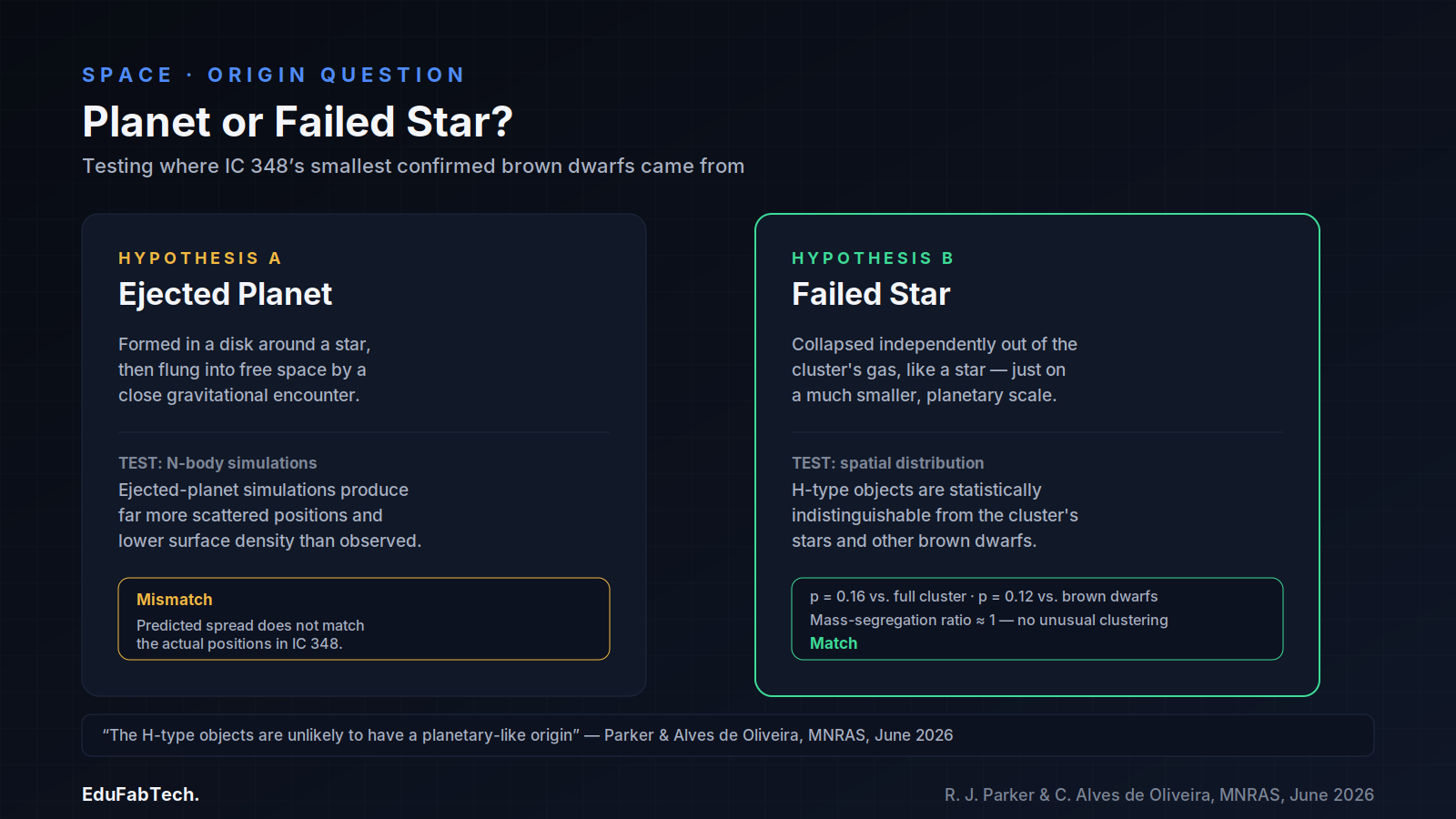
Finding planet-mass objects with disks and an odd spectral signature raises an obvious question: did some of these H-type objects form the way planets do, orbiting a star before being flung into free space by a close gravitational encounter, or did they collapse independently out of the cluster's gas like a star, just on a much smaller scale? A follow-up study by Richard J. Parker (University of Sheffield) and Catarina Alves de Oliveira, published in Monthly Notices of the Royal Astronomical Society in June 2026, tested this directly using the nine H-type objects' positions in the cluster.
Parker and Alves de Oliveira compared the spatial distribution of the H-type objects with that of the cluster's stars and other brown dwarfs, using local surface-density measures and Kolmogorov–Smirnov tests. They found the H-type objects statistically indistinguishable from the stellar and brown-dwarf population (p = 0.16 against the full sample, p = 0.12 against brown dwarfs alone), with mass-segregation ratios near unity showing no unusual clustering. N-body simulations of planets ejected from circumstellar disks, by contrast, produced a far more dispersed spatial pattern and lower surface densities than what is actually observed. The paper's authors conclude that "the H-type objects are unlikely to have a planetary-like origin" — a statistical inference from one cluster's geometry, not a settled classification of every H-type object individually.
Why the mass floor matters
The initial mass function — the statistical distribution of how many objects of each mass form in a given star-forming episode — is one of the basic inputs astronomers use to model star and planet formation across galaxies. Where that function actually stops, and whether it stops smoothly or with a distinct population of planet-mass interlopers, has been argued over for two decades. A confirmed, spectroscopically classified object at roughly 2 Jupiter masses forming through what looks like a scaled-down stellar process, rather than being kicked out of a planetary system, pushes that floor lower than most published mass functions assumed, and gives modelers an anchor point that did not exist before this observing program.
What is still open
The carrier of the 3.4-micrometer hydrocarbon band remains unidentified; the underlying papers describe candidate molecule classes but no confirmed match to laboratory or model spectra. The sample size behind the spatial-distribution argument is also small — nine H-type objects in one 1,000-light-year-distant cluster — so the Parker and Alves de Oliveira result is a constraint on formation scenarios for this population, not a general rule for every free-floating planetary-mass object found elsewhere. Further NIRSpec follow-up of fainter candidates from the original 39-object NIRCam survey, and searches for the same hydrocarbon signature in other young clusters, are the next steps the two teams point to for testing whether IC 348's H-type population is typical or unusual.
- Space Telescope Science Institute. NASA's Webb Reveals Dynamic Panorama of Star Formation. STScI News Release 2026-130, 2026. link
- K. L. Luhman and C. Alves de Oliveira. A New Spectral Class of Brown Dwarfs at the Bottom of the IMF in IC 348. The Astrophysical Journal Letters, 2025. doi:10.3847/2041-8213/addc55
- Richard J. Parker and Catarina Alves de Oliveira. Planet or brown dwarf? Constraints on the formation of H-type objects in IC 348. Monthly Notices of the Royal Astronomical Society, 2026. doi:10.1093/mnras/stag1014
- K. L. Luhman. A JWST Survey for Planetary Mass Brown Dwarfs in IC 348. The Astronomical Journal, 2024. doi:10.3847/1538-3881/ad00b7