Xiaomi Open-Sources a Trillion-Parameter Model That Tops Independent Open-Weight Rankings
MiMo-V2.6-Pro, released under an MIT license on September 21, 2026, scores highest among open-weight models on Artificial Analysis's Intelligence Index, with Xiaomi disclosing that the reinforcement-learning run behind it cost about $2.62 million.
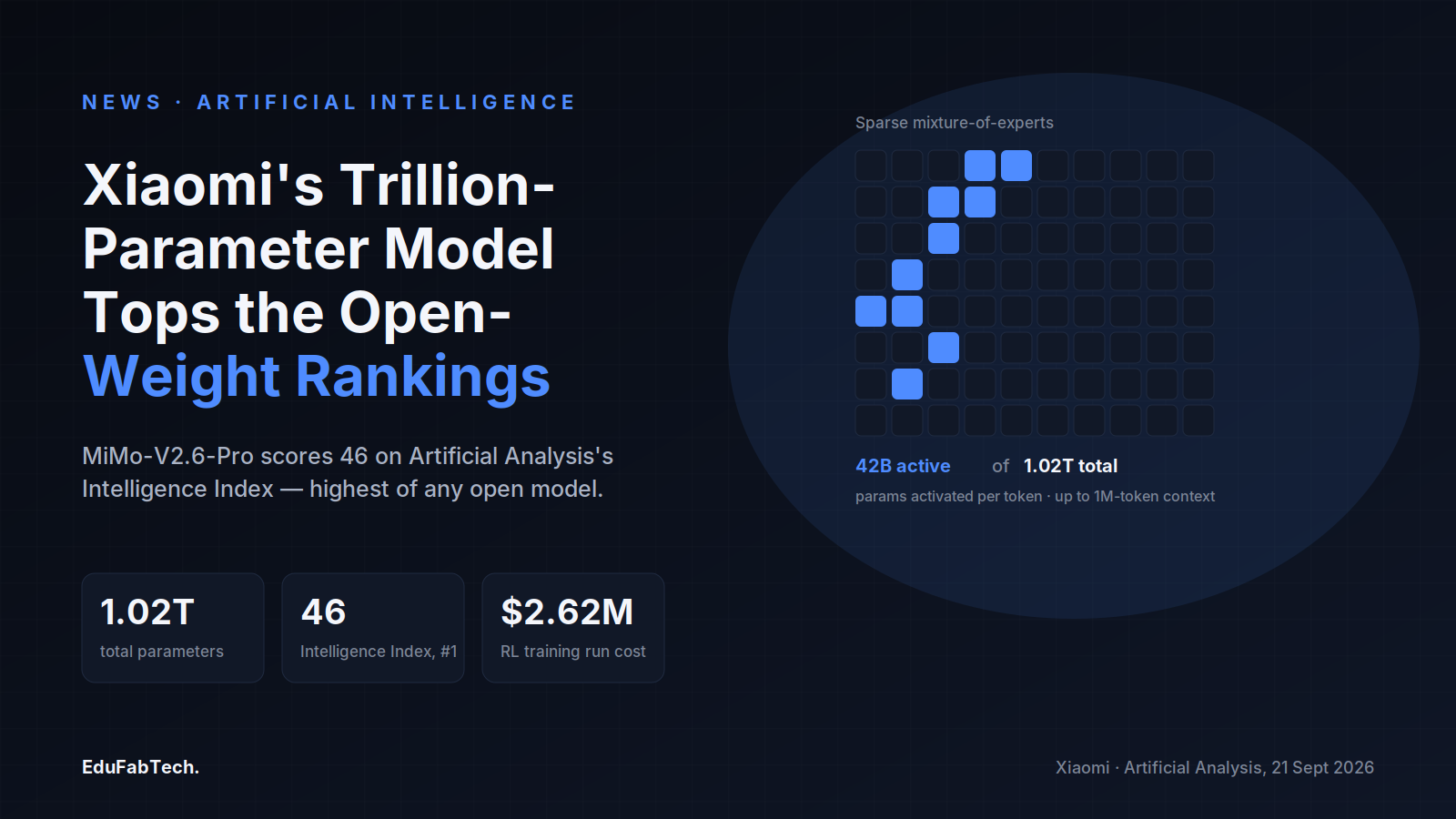
On September 21, 2026, Xiaomi published the weights for MiMo-V2.6-Pro and a smaller sibling, MiMo-V2.6-Flash, on Hugging Face under an MIT license. Within a day, the independent benchmarking group Artificial Analysis had placed MiMo-V2.6-Pro at the top of its Intelligence Index among open-weight models, a ranking that until then belonged to Zhipu's GLM-5.3 and Moonshot AI's Kimi K3.
What Xiaomi released
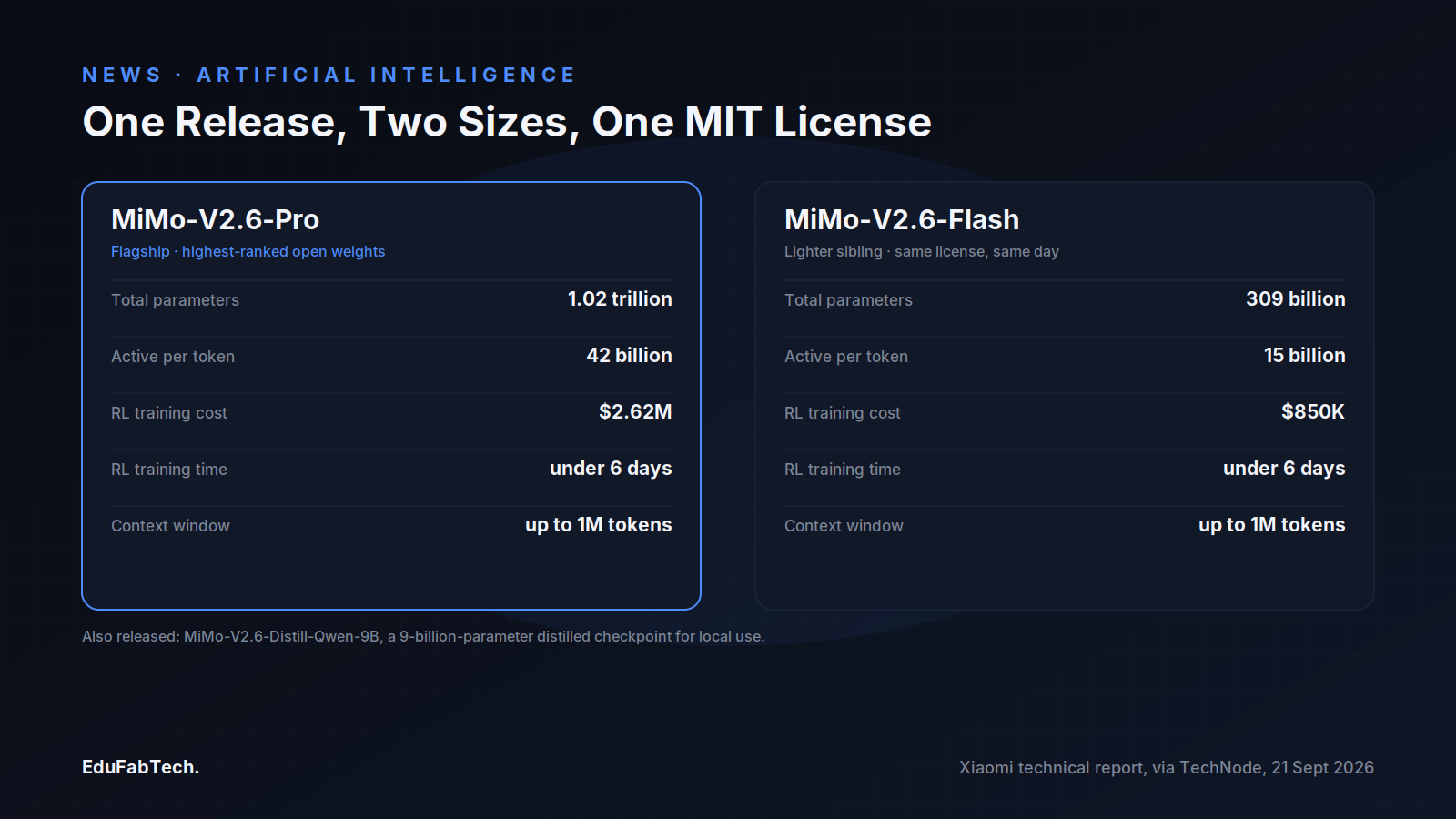
MiMo-V2.6-Pro is a sparse mixture-of-experts model with 1.02 trillion total parameters, of which 42 billion are activated for any given token, according to the model's technical report on Hugging Face. The Flash variant is smaller, at 309 billion total and 15 billion active parameters. Both are described by Xiaomi as "natively omnimodal," accepting text, image, video and audio input, with a context window of up to 1 million tokens aimed at long codebases, extended tool-use traces and multi-session agent runs. A distilled 9-billion-parameter version, MiMo-V2.6-Distill-Qwen-9B, was released alongside the two flagship checkpoints.
All of it, including training code, shipped under an MIT license, which places no restrictions on commercial reuse, fine-tuning or redistribution of the resulting weights.
How the benchmark claim was checked
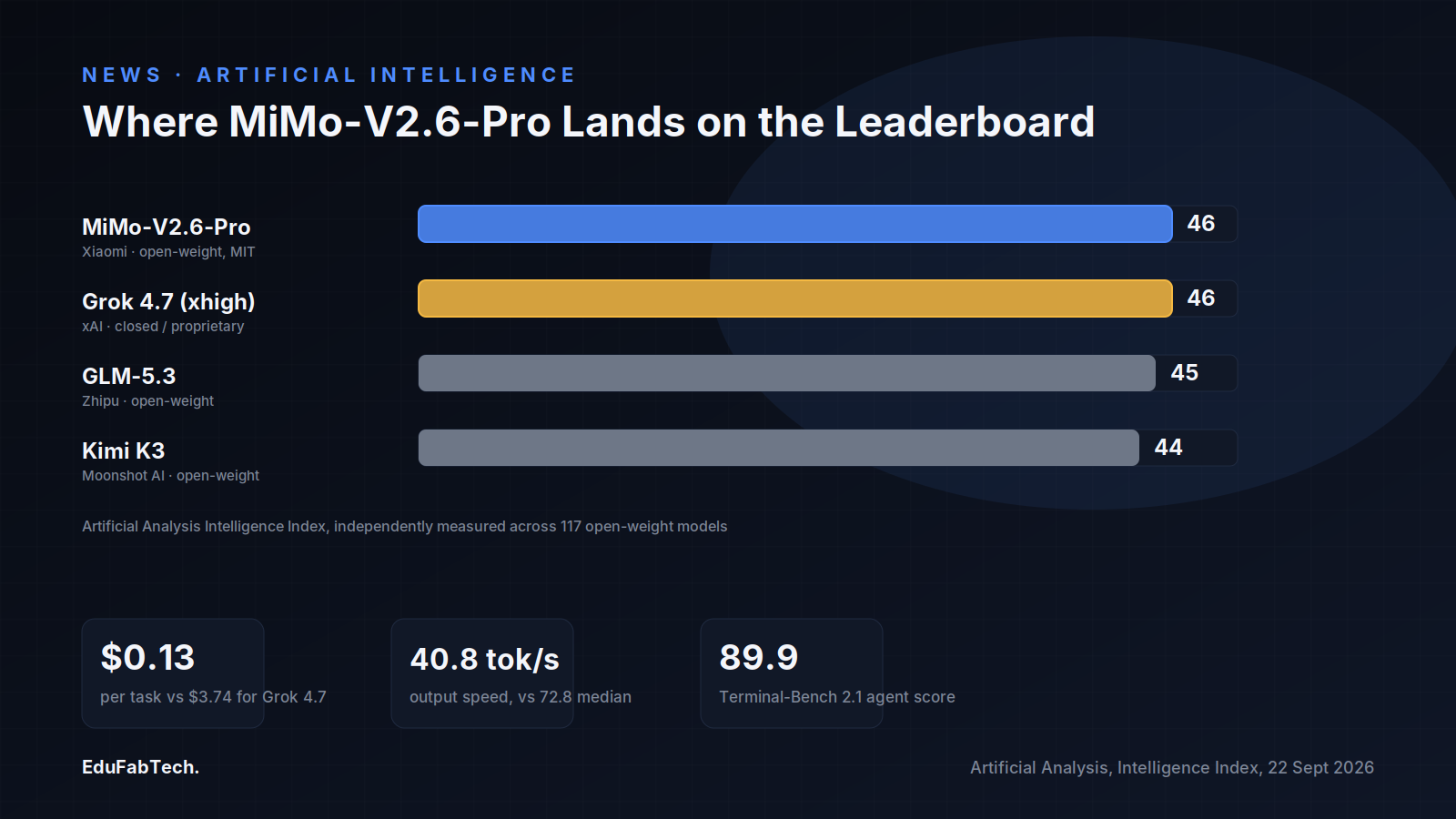
Xiaomi's own product page states that MiMo-V2.6-Pro reaches 46.32 on Artificial Analysis's composite Intelligence Index. That figure is not just a company claim: Artificial Analysis runs the same evaluation suite across vendors and independently lists MiMo-V2.6-Pro's score as 46, placing it first among 117 open-weight models it tracks, ahead of GLM-5.3 at 45 and Kimi K3 at 44, and level with xAI's proprietary Grok 4.7 (xhigh setting). In Artificial Analysis's combined ranking of open and closed models together, MiMo-V2.6-Pro placed sixth, behind flagship closed systems from Anthropic, OpenAI and Google.
Artificial Analysis also measured throughput and price directly rather than relying on Xiaomi's figures: MiMo-V2.6-Pro generated output at 40.8 tokens per second in its tests, well below the 72.8 token-per-second median for comparable models, while costing about $0.13 per weighted Intelligence Index task — cheaper than Grok 4.7 xhigh's $3.74 per task at the same intelligence score. Input tokens are priced at $0.43 per million and output at $0.87 per million through Xiaomi's API.
A cheap training run, by Xiaomi's own account
According to Xiaomi's technical report, as reported by TechNode, the reinforcement-learning phase for MiMo-V2.6-Pro ran for under six days and cost approximately $2.62 million, while the Flash variant's RL phase cost about $850,000. Xiaomi's report describes running Group Relative Policy Optimization asynchronously across large batches — 1,568 prompts with 16 rollouts each per step — over roughly 750,000 training trajectories combined across both models. These are the company's own disclosed figures rather than numbers verified by a third party, and they cover only the reinforcement-learning stage, not the cost of pretraining the base model beforehand.
On agentic benchmarks specifically, the model card lists a score of 89.9 on Terminal-Bench 2.1, 82.0 on OSWorld-Verified, and 76.9 on Toolathlon-Verified — tests that measure whether a model can operate a command line, a desktop environment, or chain together external tools to complete a task, rather than just answer questions.
Why this matters beyond one leaderboard
MiMo-V2.6-Pro is the latest in a run of large open-weight releases from Chinese labs through 2026, following models from DeepSeek, Moonshot AI, Zhipu and others. What distinguishes this release is less the raw score than the combination of an MIT license, a full technical report, and an independently reproduced ranking at the top of the open-weight tier — three things that are not always present together. Researchers and engineers who need to run, fine-tune or audit a model on their own infrastructure, rather than call a proprietary API, now have a documented option that Artificial Analysis measures as competitive with several closed frontier systems on agentic tasks specifically.
The caveats are also worth naming plainly. Output speed lags the field, the reported training cost is self-disclosed rather than externally audited, and Artificial Analysis's own ranking still places several proprietary systems above it on overall intelligence. What is verifiable, via Artificial Analysis's published methodology and Xiaomi's own released weights, is that a model of this scale and licensing was made freely available for the first time, and that its intelligence score, as of this Index update, sits where Xiaomi says it does.
- Xiaomi MiMo Team. MiMo-V2.6-Pro model card and technical report. Hugging Face, 2026. link
- Artificial Analysis. MiMo-V2.6-Pro: Intelligence, Performance & Price Analysis. Artificial Analysis, 2026. link
- Xiaomi MiMo. MiMo-V2.6-Pro official product page. Xiaomi, 2026. link
- Yiming Xu. Xiaomi open-sources MiMo-V2.6 models after scaling reinforcement learning. TechNode, 2026. link
- Duncan Riley. Xiaomi introduces Mimo-V2.6 series open-source AI model family. SiliconANGLE, 2026. link