Fractional Yellow Fever Vaccine Doses Match Full Dose in Children, Ugandan Trial Finds
A randomised trial of 1,784 children aged 9-23 months in Kampala found one-fifth and one-half doses of the 17DD yellow fever vaccine were as immunogenic as the standard dose, The Lancet reported on 17 October 2026.
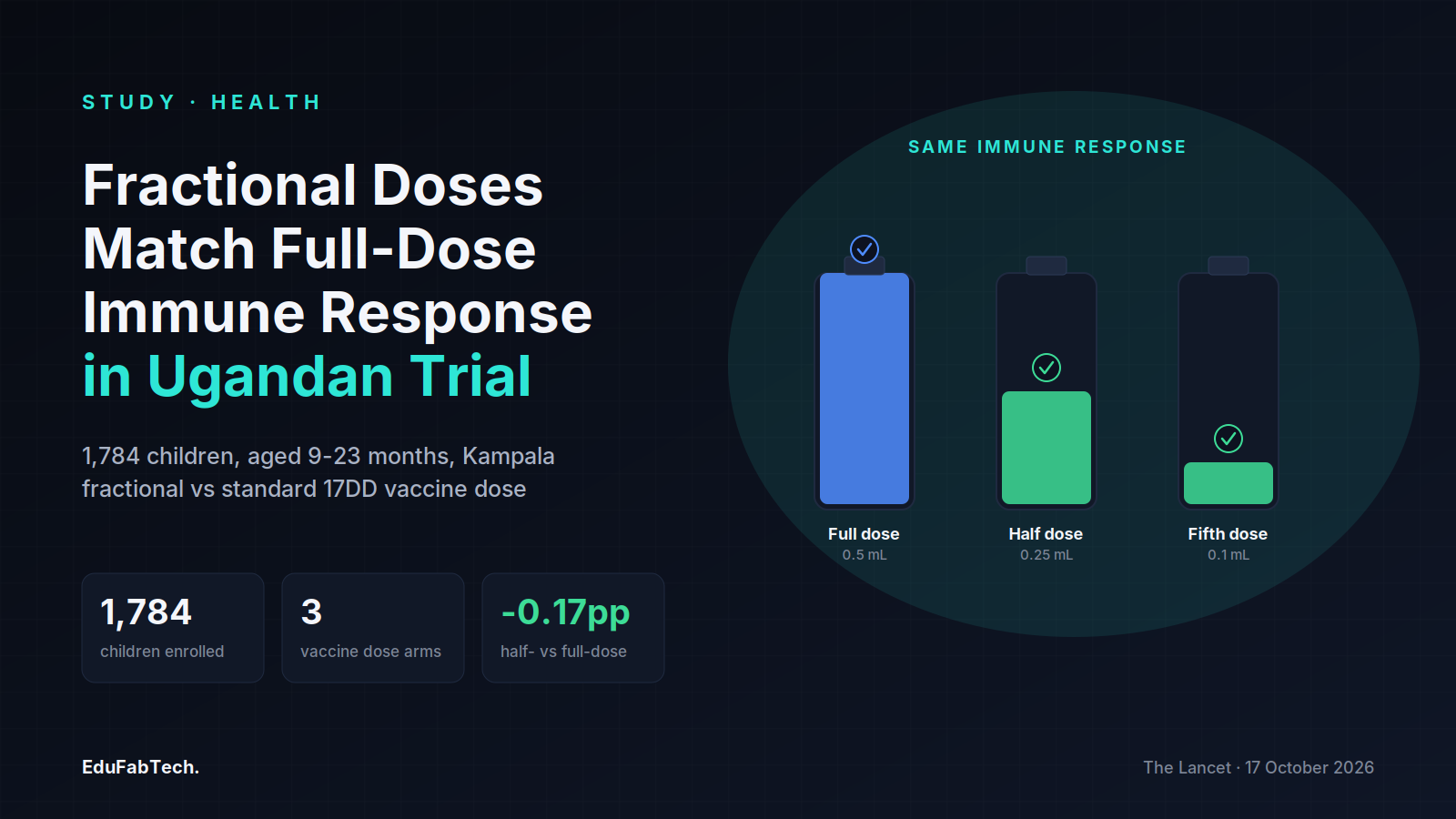
A randomised trial of 1,784 children aged 9-23 months in Kampala, Uganda, has found that one-fifth and one-half doses of the 17DD yellow fever vaccine produced antibody responses as strong as the standard full dose, according to results published in The Lancet on 17 October 2026. The phase 4, single-blind trial ran at three public-sector health facilities in Kampala and is registered as NCT03725618.
Children were randomly assigned to a one-fifth dose (0.1 mL, 600 participants), a one-half dose (0.25 mL, 594 participants) or the standard full dose (0.5 mL, 590 participants). The trial's primary outcome was non-inferiority in seroconversion, measured by the 50% plaque reduction neutralisation test, against a pre-set margin of 5 percentage points. In the per-protocol analysis, the one-half dose differed from the full dose by just -0.17 percentage points (95% CI -0.52 to 0.17), comfortably inside the non-inferiority margin, and the one-fifth dose showed no difference from the full dose at the first follow-up visit, according to the trial report.
What the trial measured
The 17DD substrain used in this trial is one of four yellow fever vaccines prequalified by the World Health Organization and is manufactured in Brazil for use across endemic countries. Investigators drew blood from participants to confirm neutralising antibody levels before concluding that a fifth or a half of the standard antigen dose triggered a comparable immune response in toddlers. The authors describe the result as supporting the use of fractional doses in this age group specifically for outbreak response when full-dose supply is constrained, rather than as a routine replacement for standard immunisation.
Safety data from the same children
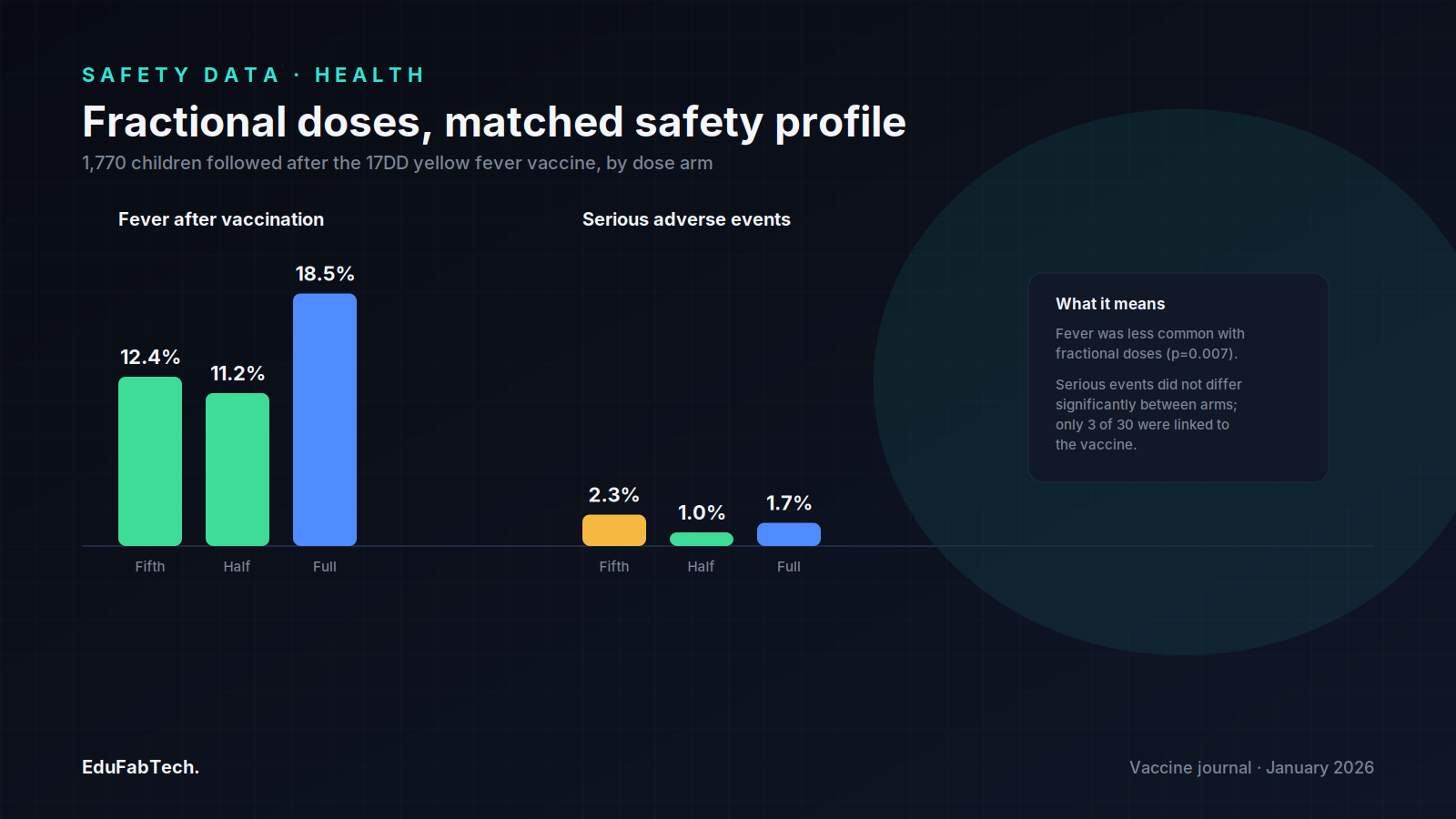
A companion safety analysis of the same trial cohort, led by Scarlett Lee of the US Centers for Disease Control and Prevention with the Infectious Diseases Institute in Kampala, was published in the journal Vaccine in January 2026. Among 1,770 children who completed follow-up, 1,066 (60%) reported at least one non-serious adverse event, most commonly fever (34%) and diarrhoea (34%), both peaking two days after vaccination. Fever occurred in 18.5% of the full-dose group, compared with 12.4% of the one-fifth-dose group and 11.2% of the one-half-dose group (p=0.007), the authors reported.
Serious adverse events, defined as those requiring hospitalisation or resulting in death, occurred in 2.3% of the one-fifth-dose group (14 of 597 children), 1.0% of the one-half-dose group (6 of 588) and 1.7% of the full-dose group (10 of 585) — differences the authors said were not statistically significant between arms. Only three of these serious events across all three arms were judged by investigators to be related to vaccination. Six deaths occurred during the study period, and none were causally linked to the vaccine, according to the Vaccine paper.
Taken together, the two papers describe a dataset collected between 26 March 2019 and 2022, with the immunogenicity findings now appearing in full in The Lancet nearly four years after enrolment closed, a gap that reflects the time needed to complete laboratory confirmation and safety follow-up in a paediatric cohort before publication.
Why dosing flexibility matters beyond the clinic
Yellow fever causes between 67,000 and 173,000 severe cases and 31,000 to 82,000 deaths worldwide each year, according to the World Health Organization's Disease Outbreak News update published on 24 June 2026. Between January and May 2026, three African countries reported 16 confirmed cases with 32 more suspected, while six countries in the Americas reported 79 confirmed cases; the Americas region recorded 241 cases and 100 deaths between late 2024 and early 2025, an eightfold increase on the previous year. The update notes that a global stockpile of yellow fever vaccines, coordinated by the International Coordinating Group on Vaccine Provision, remains available to countries for rapid outbreak response.
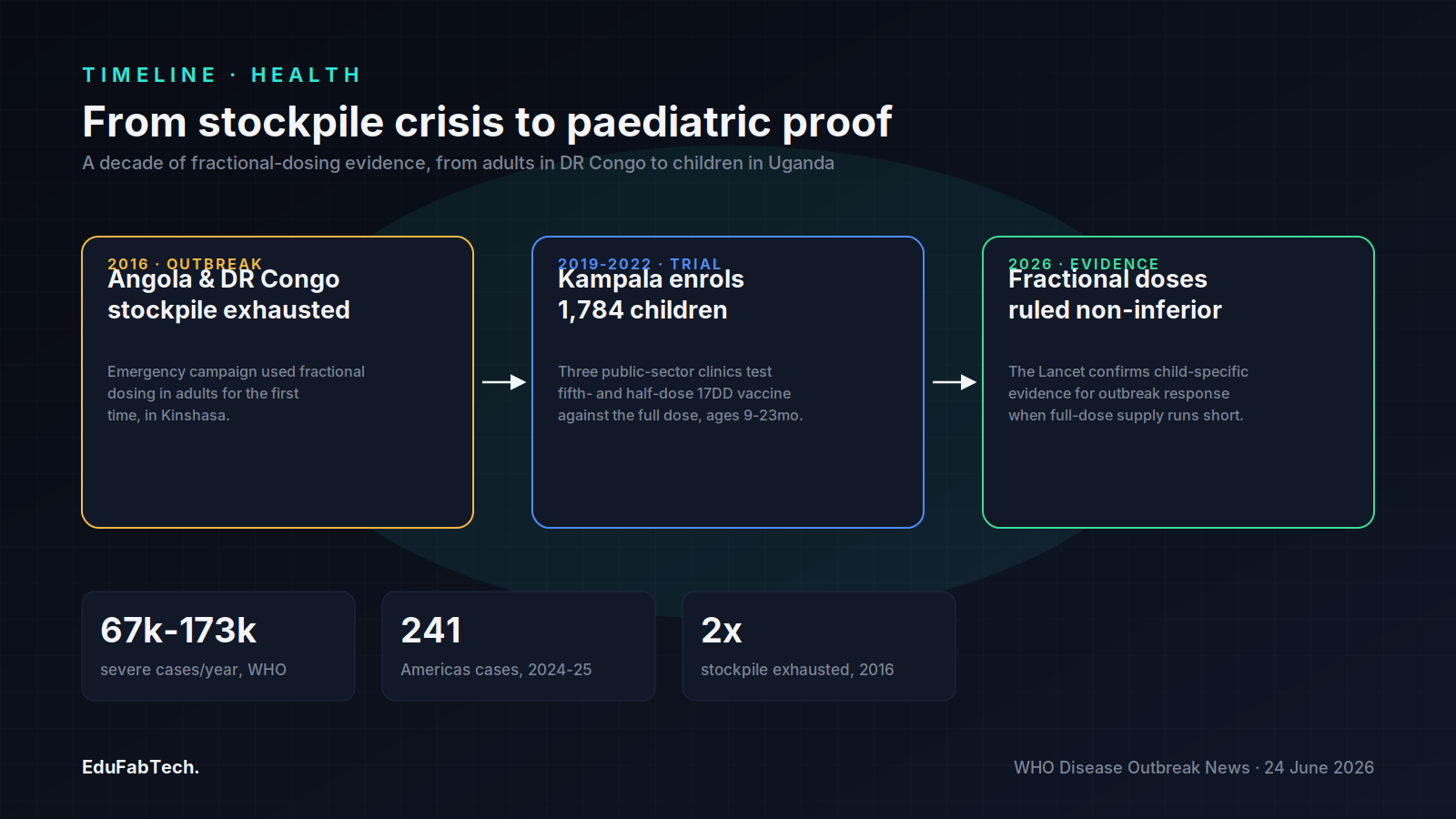
That stockpile has been strained before: the 2016 outbreak in Angola and the Democratic Republic of the Congo exhausted it twice over, prompting the first large-scale use of fractional dosing in adults during a mass vaccination campaign in Kinshasa that year. The Uganda trial adds dedicated evidence for the 17DD substrain in children aged 9-23 months, an age group that fractional-dosing research has covered less consistently than adults.
What it means for researchers and health workers
The trial's authors frame fractional dosing as a contingency tool for outbreak response rather than a settled change to routine schedules, and they note the non-inferiority finding applies to short-term seroconversion rather than confirmed long-term protection, which was not the endpoint of this trial. For researchers studying vaccine supply and dose-sparing strategies, the combination of the Lancet immunogenicity results and the Vaccine safety follow-up gives national programmes and the International Coordinating Group a paediatric evidence base to weigh against the risks of running short on full-dose vaccine during the next large outbreak.
A quick question for readers
How much do you sleep on a typical night during exam weeks?
Sleep is when memory consolidates. How much are students actually getting when it matters most?
Pick an answer, create a free account in a minute, and your vote counts. Already a member? Sign in
Comments 0
CommentNo comments yet. Members start the conversation.
Source: The Lancet
Sources (3)
- Doshi RH, et al.. Immunogenicity of fractional one-fifth and one-half doses of 17DD yellow fever vaccine compared with full dose in children aged 9-23 months in Uganda: a phase 4, single-blind, randomised clinical trial. The Lancet, 2026. thelancet.com ↗ · checked 17 Oct 2026
- Lee SE, et al.. Adverse events following immunization (AEFI) with fractional one-fifth and one-half doses of yellow fever vaccine compared to standard dose in children 9-23 months old in Uganda, 2019-2022 - final report. Vaccine, 2026. pmc.ncbi.nlm.nih.gov ↗ · checked 17 Oct 2026
- World Health Organization. Yellow fever - Global. WHO Disease Outbreak News, 2026. who.int ↗ · checked 17 Oct 2026