Astronomers Confirm the Youngest Known Exoplanet, a Jupiter-Mass World Still Forming at 55 AU
Reanalysis of archival Keck Observatory images has confirmed Elias 2-24 b, a giant planet under one million years old whose existence challenges standard timelines for how gas giants form.
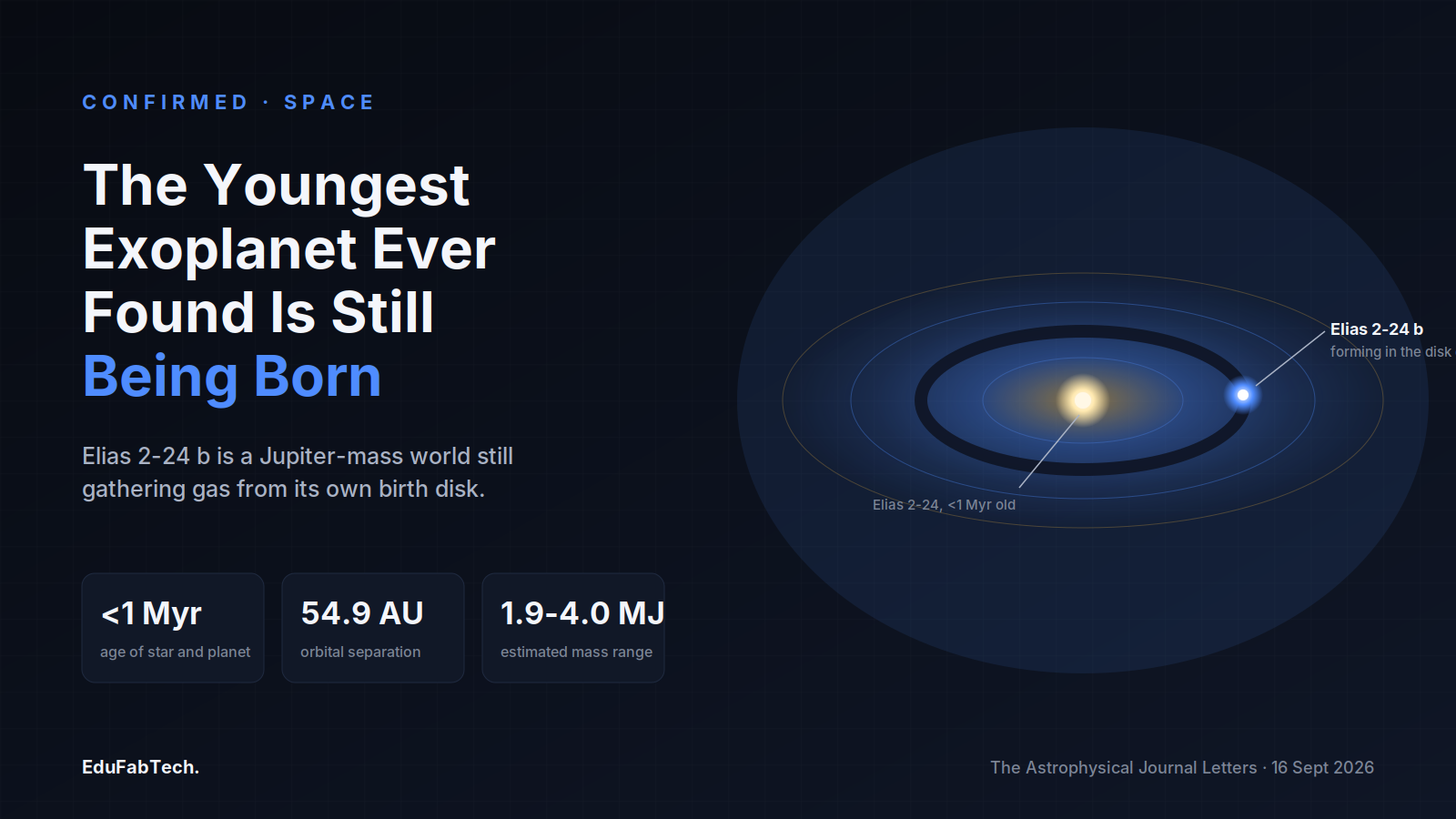
Astronomers have confirmed the youngest planet yet found outside the solar system: a Jupiter-mass world still gathering material from the disk that built it, orbiting a star less than a million years old. The confirmation, led by Andrea Bernardi of Universidad Diego Portales in Chile with co-authors including Alice Zurlo and Lucas Cieza, appeared in The Astrophysical Journal Letters on 16 September 2026.
The planet, Elias 2-24 b, orbits the young star Elias 2-24 in the Ophiuchus star-forming region, roughly 450 light-years from Earth, according to NASA's account of the discovery. Estimates for the age of the Elias 2-24 system range from about 0.2 to 0.4 million years, and the paper places an upper bound of roughly one million years on both star and planet — making it the youngest confirmed exoplanet on record, younger than the previous record holders by a wide margin.
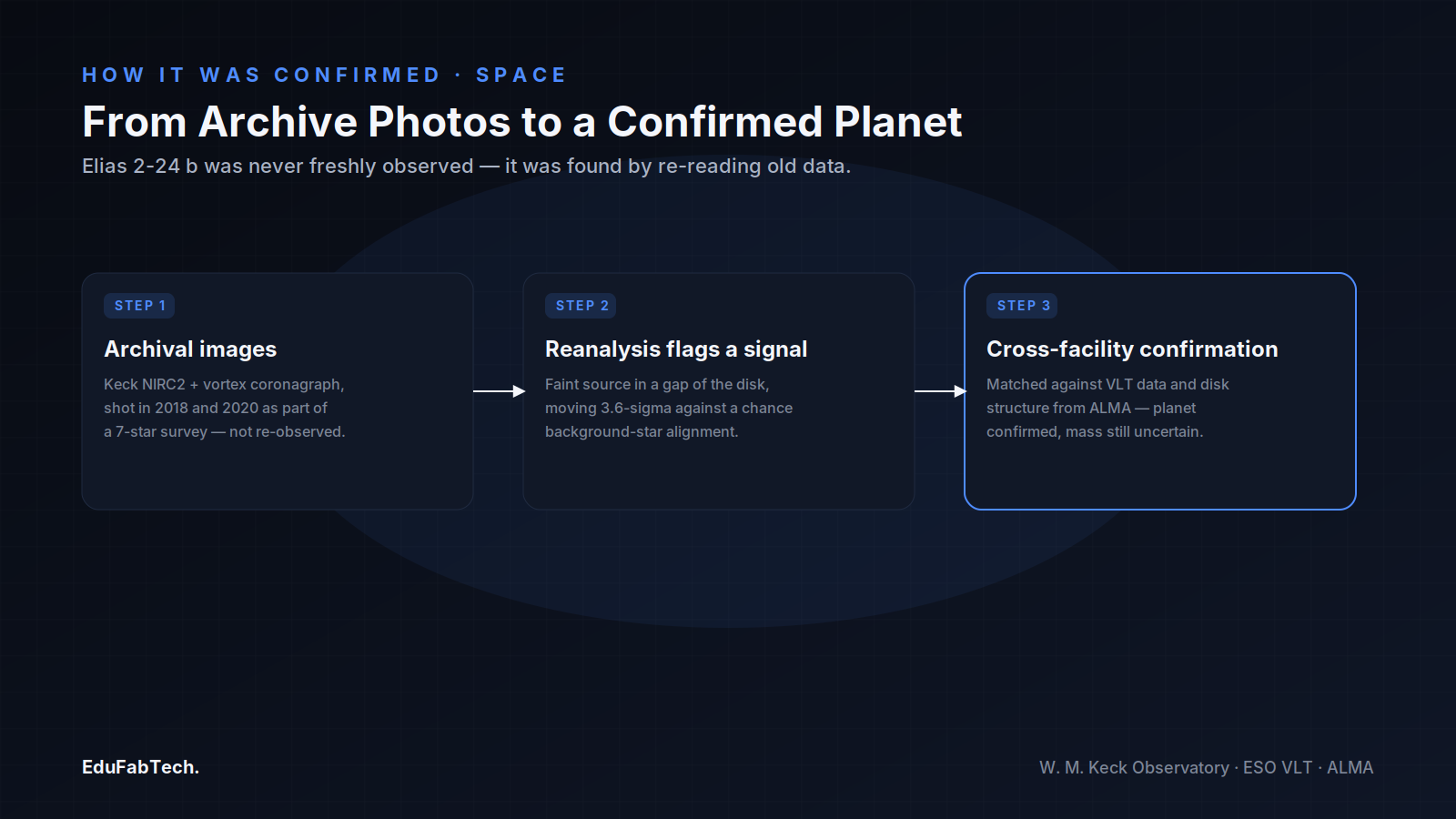
The team did not find the planet in new observations. Bernardi reanalyzed archival images from the W. M. Keck Observatory's NIRC2 instrument, fitted with a vortex coronagraph that blocks starlight to reveal faint objects nearby, taken in 2018 and again in 2020 as part of a survey of seven young stars. The reprocessing turned up a faint signal sitting inside a narrow gap in the star's protoplanetary disk, in a location where a 2023 study had already flagged a candidate protoplanet. Confirming it required combining the two Keck epochs with independent data from the European Southern Observatory's Very Large Telescope and structural evidence from ALMA, according to the W. M. Keck Observatory's own account.
A mass the models can barely pin down
The paper reports Elias 2-24 b's mass at somewhere between 1.9 and 4.0 Jupiter masses under non-equilibrium evolutionary models including ATMO-NEQ-STRONG, derived by comparing the planet's brightness with one-million-year isochrones. The authors are explicit that these figures are best treated as upper limits, since a planet this young is still radiating heat from ongoing accretion, and current models struggle to translate that luminosity into a reliable mass. Zurlo put it directly: the planet "is currently undergoing a stage of its evolution for which theoretical models still struggle to reliably predict its mass, entropy, and, consequently, its expected luminosity," as quoted in the Keck Observatory release.
The detection itself is not open-and-shut. Individual epochs of the signal fall short of the five-sigma threshold usually treated as a firm discovery in imaging surveys. What raised the team's confidence was a proper-motion analysis — tracking how the object moved against background stars between the 2018 and 2020 observations — which reached 3.6-sigma significance against the possibility that the signal was a chance alignment with a background star, combined with consistent detections across the separate Keck, VLT and ALMA datasets. The authors treat this as a confirmation, but one that will benefit from follow-up spectroscopy rather than a fully closed case.
Faster than the standard timeline allows
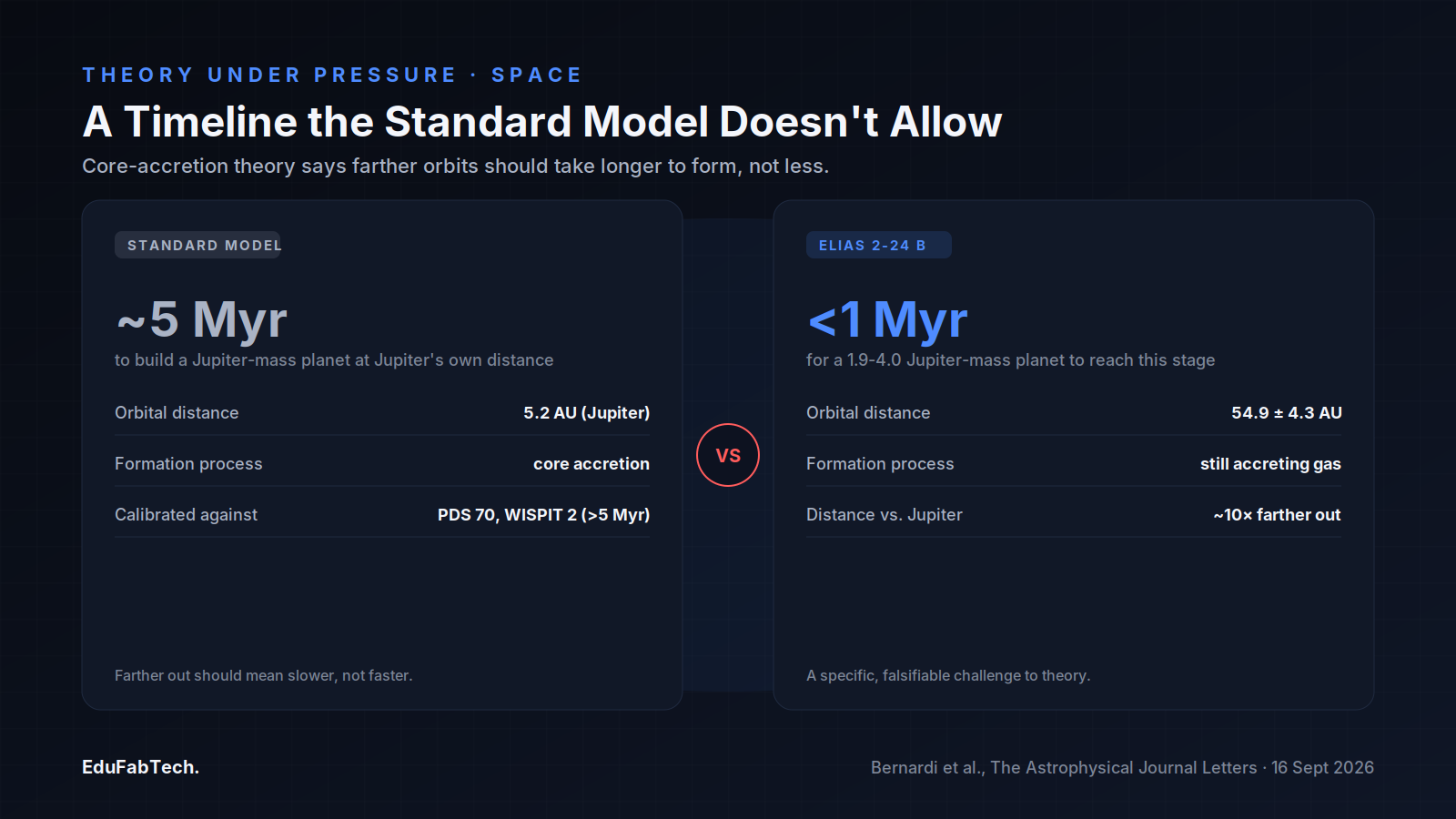
Elias 2-24 b orbits at a separation of 54.9 ± 4.3 astronomical units from its star — roughly ten times farther out than Jupiter sits from the Sun, and beyond Neptune's distance from the Sun for scale. Core-accretion theory, the leading explanation for how gas giants form by first building a solid core and then pulling in gas, has mostly been calibrated against older systems such as PDS 70 and WISPIT 2, whose known planets are all more than five million years old. Existing models hold that a Jupiter-mass planet needs roughly five million years to assemble at Jupiter's own orbital distance — a process that should take longer, not less, ten times farther out. Elias 2-24 b appears to have gotten most of the way there in under a million years.
"In a way, we're observing a much younger version of a planetary system like our own," Cieza said in the Keck Observatory release. "Because our solar system is billions of years old, we can only reconstruct how it formed. Systems like Elias 2-24 b allow us to study that process while it is still underway." In NASA's account of the discovery, he added that the result shows "even our best planet-formation models are still missing some important processes."
What would tighten the case
The authors and outside observers agree the object sits close to the edge of what current instruments can resolve, which is part of why it took two archival datasets, a re-analysis years after they were taken, and cross-checks from three separate facilities to confirm. Sharper mass and temperature constraints will require follow-up spectroscopy, and the researchers note that a new generation of instruments — including space-based observatories designed for higher-contrast direct imaging — should make objects like this easier to catch during formation rather than find by chance in years-old archives.
For now, Elias 2-24 b stands as a rare direct look at a giant planet in the act of forming, and a specific, falsifiable challenge to how quickly theory says that process should take.
- Andrea Bernardi, Alice Zurlo, Lucas A. Cieza, et al.. Searching for Embedded Protoplanets with the Keck/NIRC2 Vortex Coronagraph: Confirmation of a Core-accretion Planet in the Narrow Gap of the Elias 2-24 Disk. The Astrophysical Journal Letters, 2026. doi:10.3847/2041-8213/ae9bb6
- NASA Science. Newfound 'Baby' Planet Smashes Record for Youngest Known World. NASA, 2026. link
- W. M. Keck Observatory. Youngest Exoplanet Yet Discovered Found Hiding in Keck Observatory Data. W. M. Keck Observatory, 2026. link
- ScienceDaily. Astronomers just found the youngest known planet ever. ScienceDaily, 2026. link