ZDI Discloses Eight Unpatched PyTorch Flaws, Each Rated CVSS 7.0 to 7.8
Trend Micro's Zero Day Initiative published eight PyTorch vulnerabilities as zero-days on 24 November 2026, after the project rejected each report between July and September 2026.
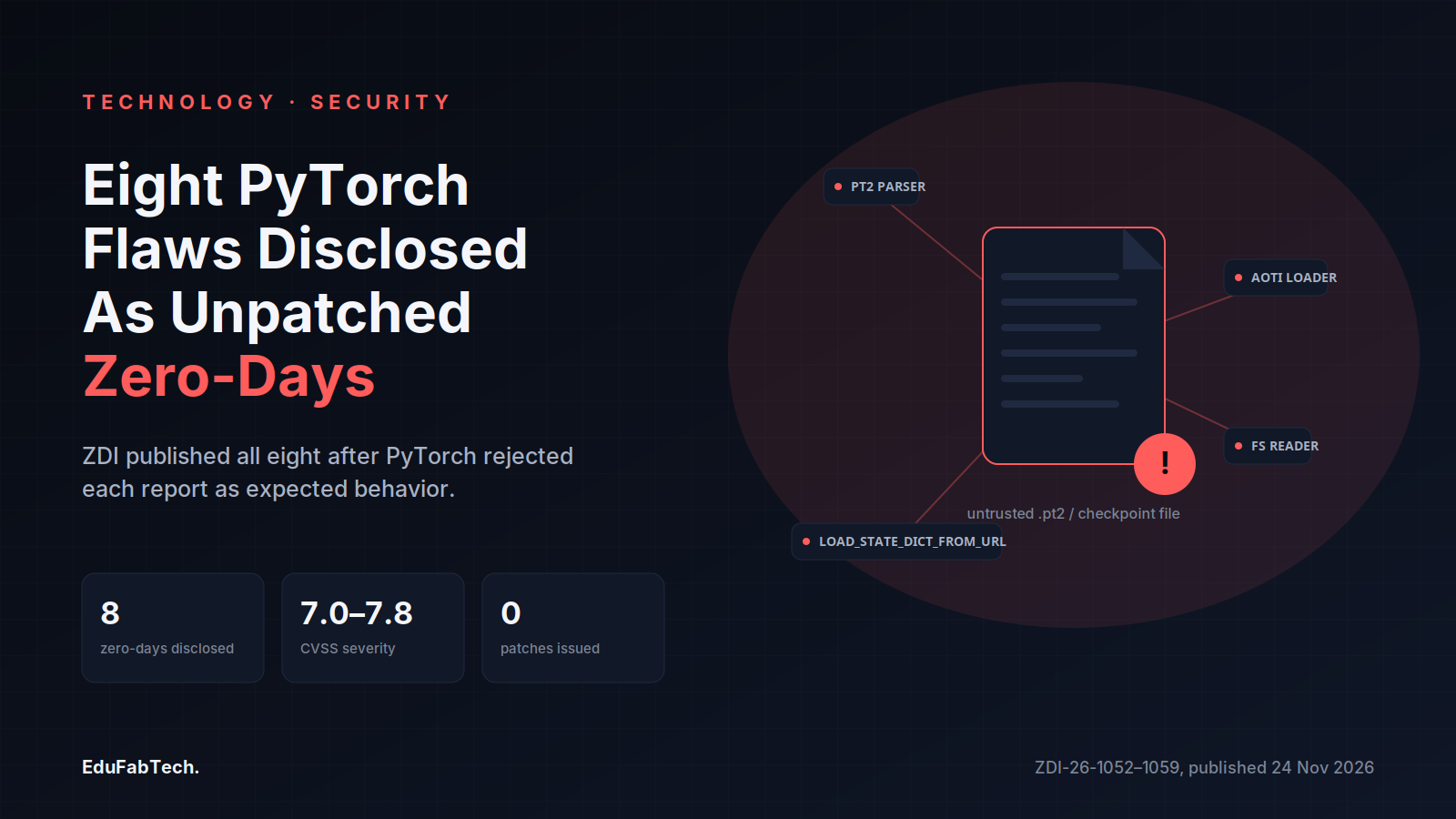
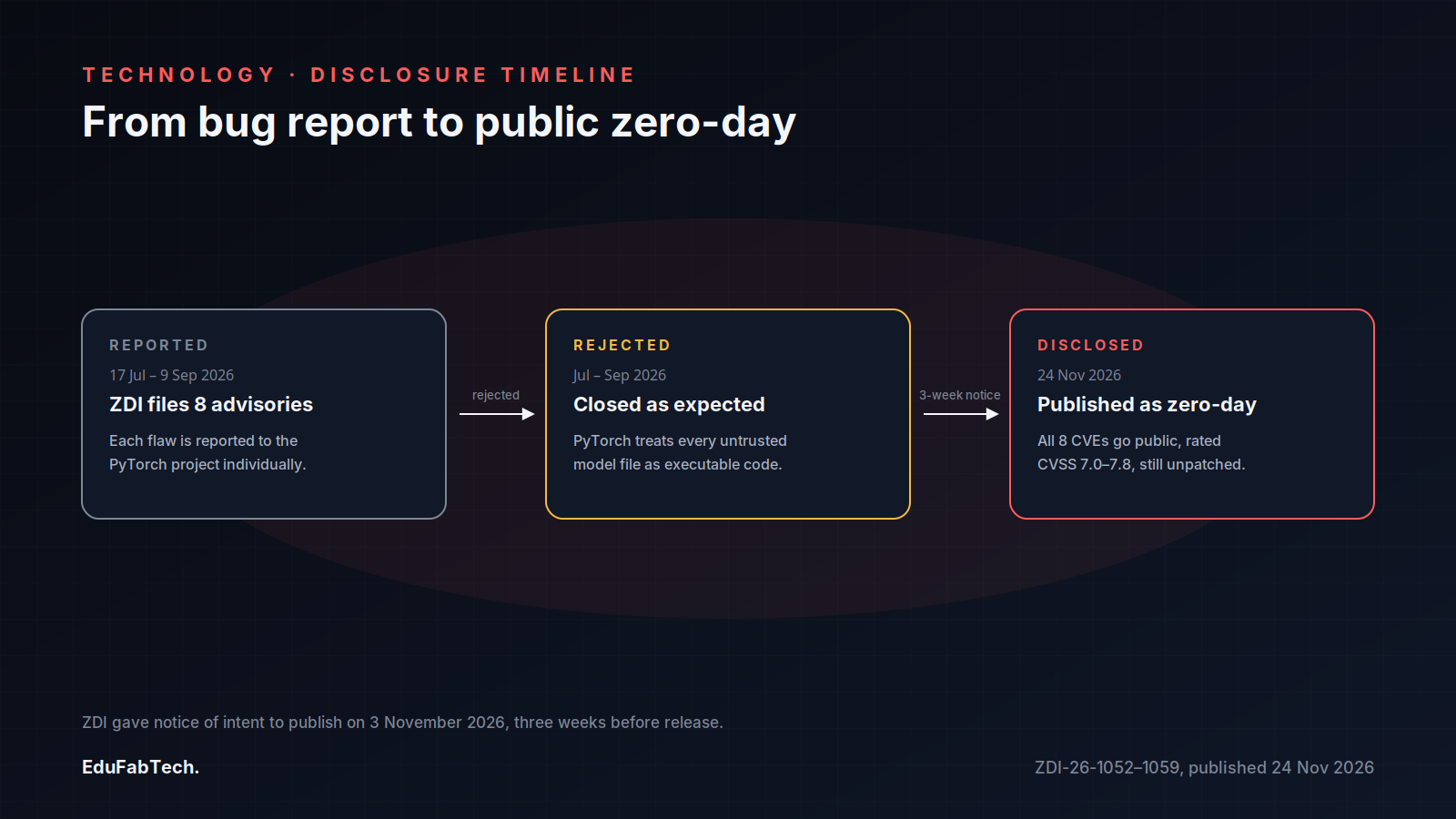
On 24 November 2026, Trend Micro's Zero Day Initiative (ZDI) published eight security advisories covering previously unreported vulnerabilities in PyTorch, the open-source machine learning framework maintained by the PyTorch Foundation. ZDI says it reported all eight issues to the project between 17 July and 9 September 2026, that the project rejected each one as already expected behavior, and that ZDI then gave notice on 3 November 2026 of its intent to publish before releasing the advisories three weeks later as unpatched zero-days.
Each of the eight flaws carries a CVE identifier and a CVSS score of either 7.0 or 7.8, and each sits in a different part of PyTorch's model- and checkpoint-loading code: the parsing of exported PT2 program archives, the AOTIModelPackageLoader used for ahead-of-time compiled model packages, FileSystemReader and torch_save_to_dcp in the distributed checkpoint tooling, and the load_compiled_function and load_state_dict_from_url loading paths. All eight require a victim to open or load an attacker-supplied file, and none needs any prior privileges, according to the advisories' shared CVSS vector.
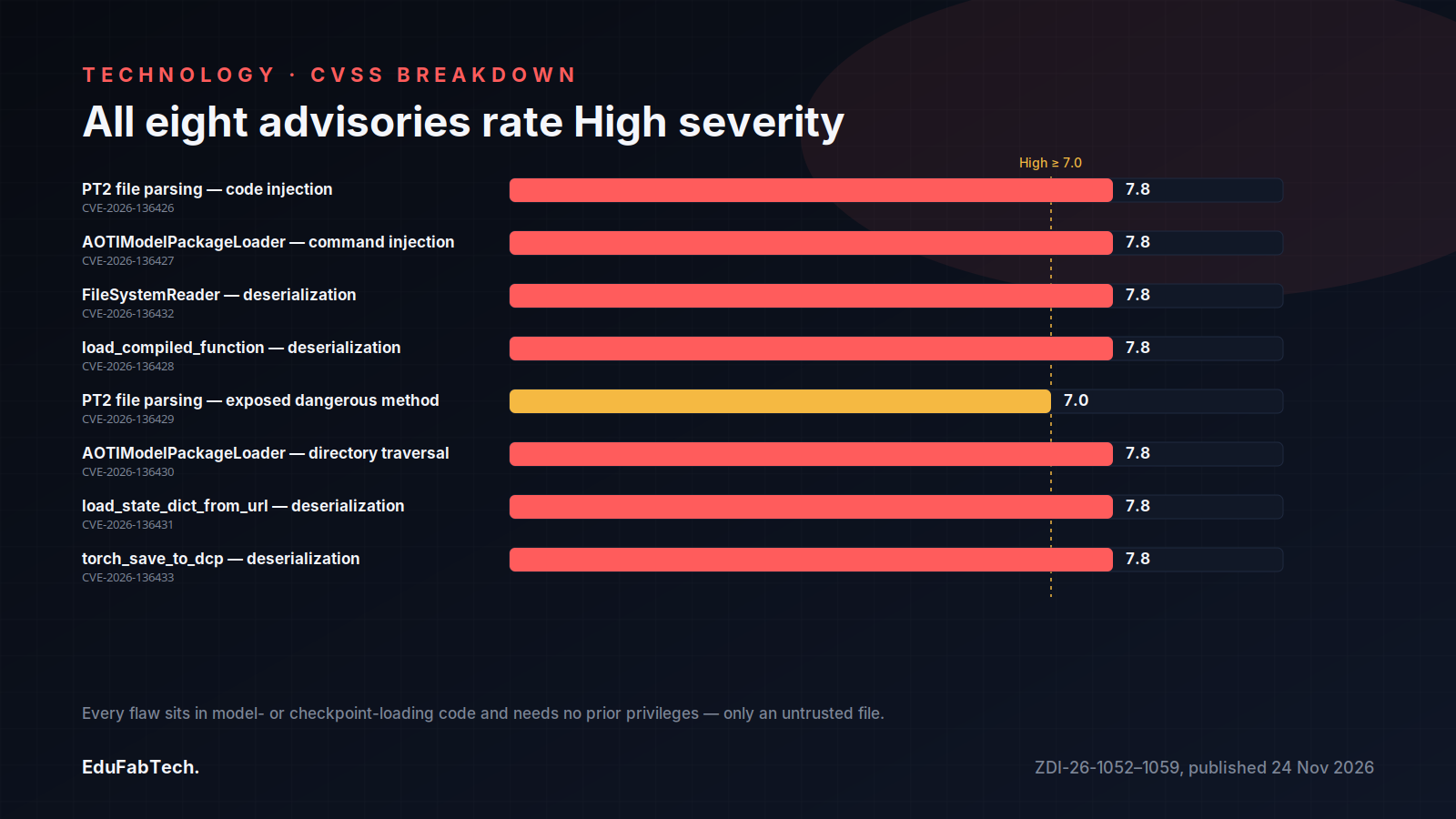
The individual advisories describe code injection, command injection, path traversal and insecure-deserialization bugs. For the PT2 parsing flaw tracked as CVE-2026-136426, ZDI's advisory states that "the issue results from the lack of proper validation of a user-supplied string before using it to execute Python code," which "allows an attacker to execute arbitrary code in the context of the current process." The other seven advisories describe similar gaps: missing validation before a system call, a file path, or a pickled object is trusted, and in one case — the PT2 parsing flaw tracked as CVE-2026-136429 — an exposed dangerous function reachable from the same file-parsing code.
| Advisory | CVE | Component | CVSS |
|---|---|---|---|
| ZDI-26-1052 | CVE-2026-136426 | PT2 file parsing (code injection) | 7.8 |
| ZDI-26-1053 | CVE-2026-136427 | AOTIModelPackageLoader (command injection) | 7.8 |
| ZDI-26-1054 | CVE-2026-136432 | FileSystemReader (deserialization) | 7.8 |
| ZDI-26-1055 | CVE-2026-136428 | load_compiled_function (deserialization) | 7.8 |
| ZDI-26-1056 | CVE-2026-136429 | PT2 file parsing (exposed dangerous method) | 7.0 |
| ZDI-26-1057 | CVE-2026-136430 | AOTIModelPackageLoader (directory traversal) | 7.8 |
| ZDI-26-1058 | CVE-2026-136431 | load_state_dict_from_url (deserialization) | 7.8 |
| ZDI-26-1059 | CVE-2026-136433 | torch_save_to_dcp (deserialization) | 7.8 |
Why PyTorch calls this expected behavior
The pattern of rejections is consistent with PyTorch's own published security policy. In its SECURITY.md, the PyTorch Foundation tells users to "prefer to execute untrusted models within a secure, isolated environment such as a sandbox (e.g., containers, virtual machines)" and warns that "torch.load has a significantly larger surface of attack but is more flexible in what it can serialize" than safer formats such as Safetensors. On distributed checkpoints specifically, the policy states that checkpoints "are produced by your own training job and read back from a trusted store; they are not artifacts you download from the internet or accept from untrusted third parties," adding that "because a checkpoint is always assumed to come from a trusted source, the weights_only protections of torch.load do not apply here."
That framing treats a PyTorch model or checkpoint file as equivalent to a program the loading machine chooses to run, not as inert data. It is why the project's response to each of ZDI's eight reports was to close it rather than issue a patch: under that documented threat model, a user who opens an untrusted PT2 archive or state dictionary has already stepped outside the boundary PyTorch promises to defend.
What it means for students, researchers and developers
PyTorch underpins a large share of published machine learning research and coursework, and pretrained weights, compiled model packages and checkpoints circulate constantly between labs, model hubs and course repositories. The eight advisories are a reminder, backed by the project's own documentation rather than a new design change, that opening a .pt2 archive, calling load_state_dict_from_url against an untrusted address, or restoring a distributed checkpoint from a source outside one's own training pipeline carries the same risk as running unreviewed code. ZDI's own mitigation advice in each advisory is to restrict interaction with the affected functionality to trusted sources, which is the same boundary PyTorch's security policy already draws. No independent exploitation in the wild has been reported for any of the eight CVEs as of this writing, and PyTorch has not issued patches for them, so the practical defense available to users is the one the project already documents: treat any PyTorch model file from outside your own trusted pipeline as executable code, and load it only in an isolated environment.
A quick question for readers
Which skill will matter most for getting a job in 2030?
Everyone has a prediction. Add yours and see what students are betting on.
Pick an answer, create a free account in a minute, and your vote counts. Already a member? Sign in
Comments 3
Comment-
The part I'd push back on is calling this "expected behavior" and leaving it there. Fine, the SECURITY.md says checkpoints are trusted artif…
-
What stands out is that this isn't really eight new bugs, it's one design decision reflected eight times. PyTorch's own SECURITY.md already…
-
The part worth sitting with is that PyTorch isn't wrong by its own rules - the SECURITY.md is explicit that torch.load and checkpoint restor…
Join free to read the full comments and reply Comments are between members; an account takes a minute.
Source: Zero Day Initiative (Trend Micro)
Sources (2)
- Zero Day Initiative. ZDI-26-1052: PyTorch Foundation PyTorch PT2 File Parsing Code Injection Remote Code Execution Vulnerability. Zero Day Initiative (Trend Micro), 2026. zerodayinitiative.com ↗ · checked 25 Nov 2026
- PyTorch Foundation. SECURITY.md. GitHub (pytorch/pytorch), 2026. github.com ↗ · checked 25 Nov 2026