Studying in Chambersburg: universities, housing and student life
A sourced, practical guide to studying in Chambersburg, Pennsylvania — Wilson College in town, Shippensburg up the valley, where students live, what it costs, and how to get around.
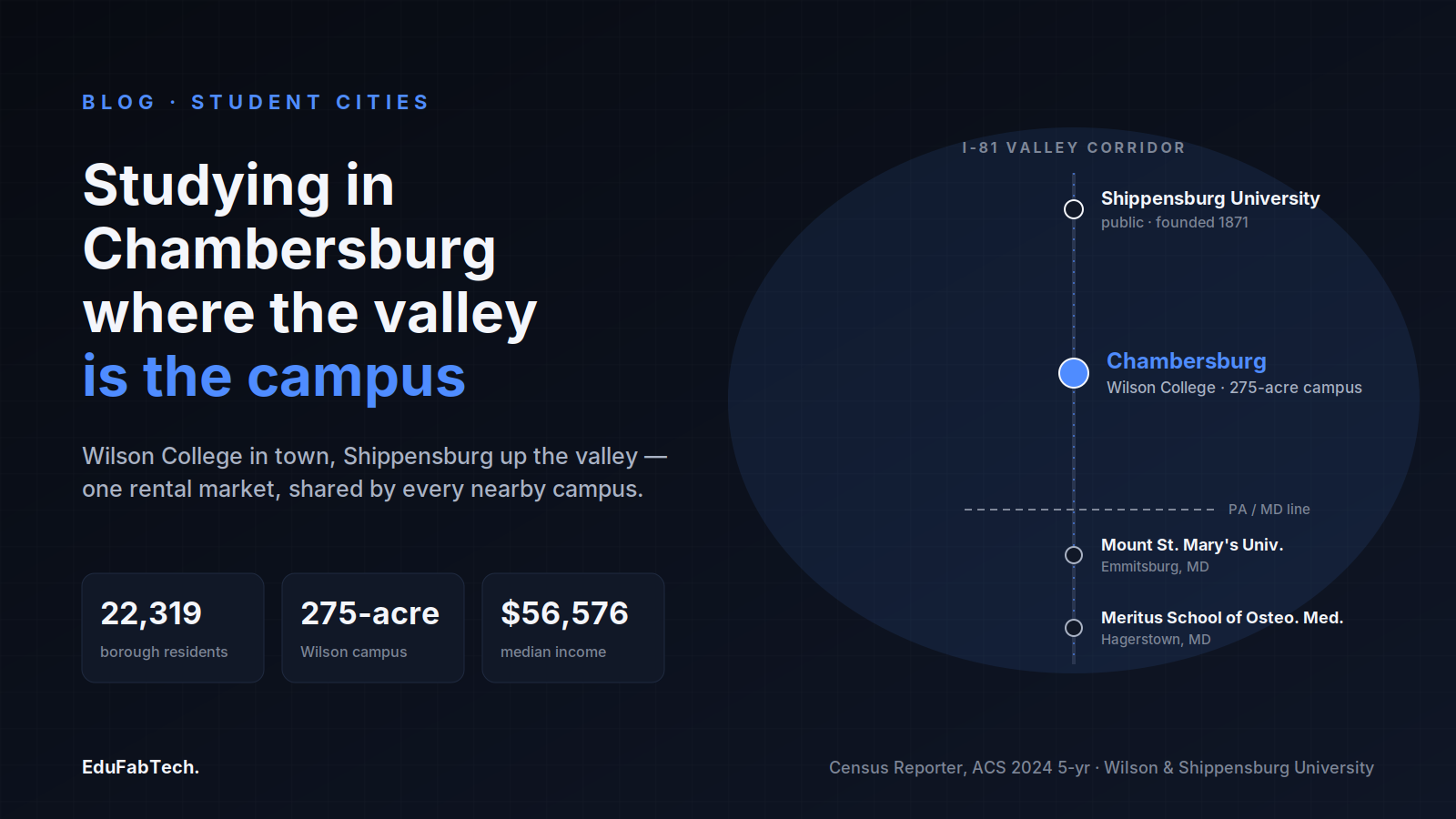
Chambersburg sits in the middle of Pennsylvania's Cumberland Valley, the seat of Franklin County and a stop on the Interstate 81 corridor that runs the length of the valley floor. According to Census Reporter's compilation of the U.S. Census Bureau's 2024 American Community Survey (5-year), the borough has about 22,319 residents and a median household income of $56,576. That makes it a mid-sized valley town rather than a city a university was built around — which shapes almost everything about studying here.
There is one degree-granting campus inside Chambersburg itself, and a cluster of others within a short drive up and down the valley, including two across the state line in Maryland. A student's experience depends heavily on which of them they attend: living on a 275-acre campus in town is a very different thing from commuting to Shippensburg or crossing into Maryland for medical school. This guide treats them together because, in practice, students at all of them end up renting, shopping and getting around in the same valley.
The colleges in and around the valley
The campus that is actually in Chambersburg is Wilson College, a private liberal-arts college on a 275-acre campus at 1015 Philadelphia Avenue, a short walk from downtown, as described on the college's own "About" page. Wilson's academic strengths cluster in education, business, nursing, the arts and the humanities, and it runs an equestrian programme with stabling for college-owned and student horses; the same page lists online doctoral programmes in occupational therapy and physical therapy and a master's in speech-language pathology. For a student who wants a small campus embedded in a real town rather than a self-contained college bubble, Wilson is the obvious local choice.
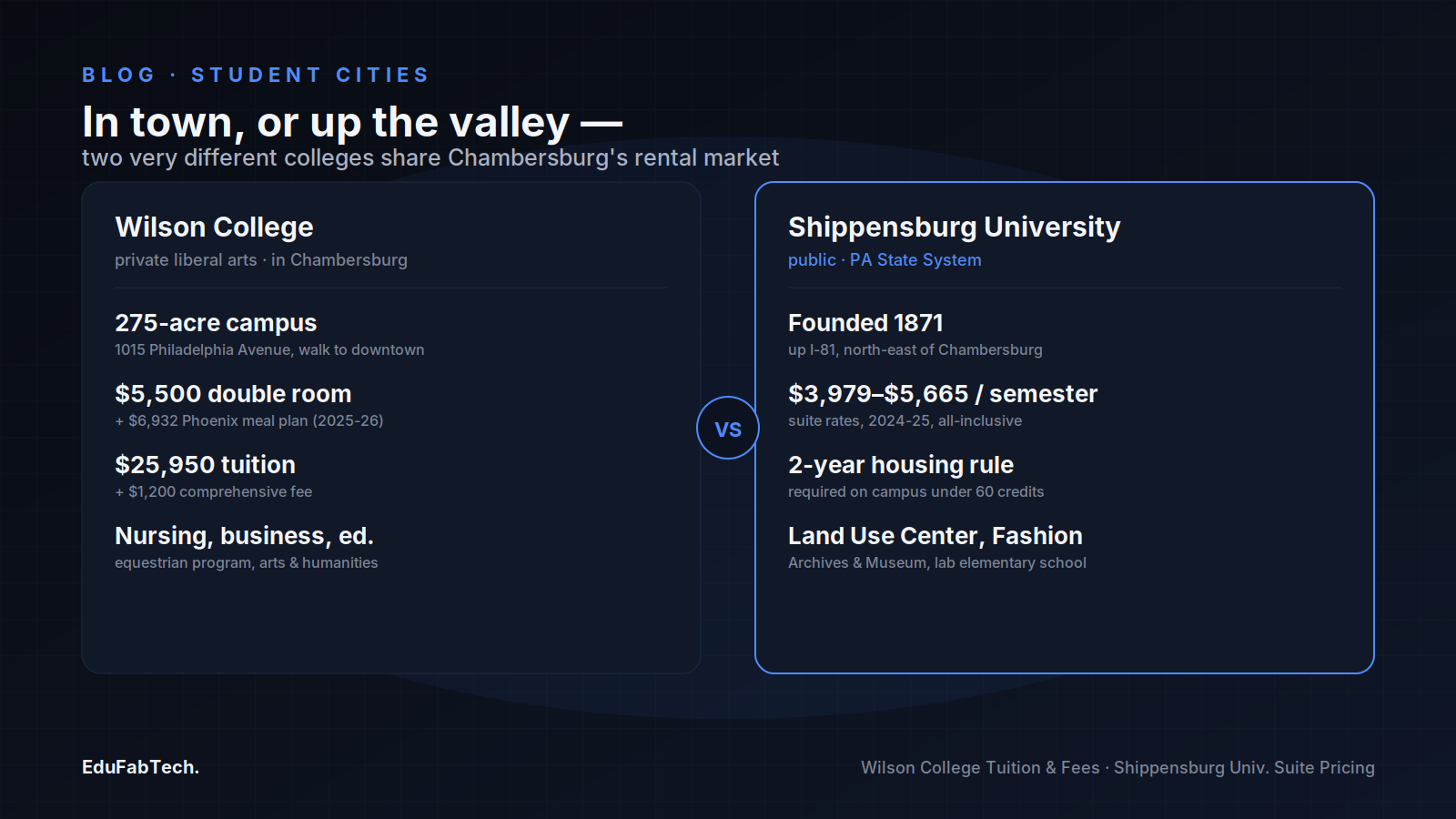
The largest nearby institution is Shippensburg University of Pennsylvania, up the valley to the north-east on Interstate 81. Its "About Shippensburg University" page records that it was founded in 1871 as the Cumberland Valley State Normal School, marked its sesquicentennial in 2021, and is a member of Pennsylvania's State System of Higher Education — the public system that keeps its tuition well below private rates. The same page points to distinctive on-campus resources including the Center for Land Use and Sustainability, the Fashion Archives and Museum, and the Grace B. Luhrs University Elementary School, which it describes as the only public elementary lab school in the state. Many Shippensburg students who want cheaper or quieter housing look south to Chambersburg, so the two towns share a rental market.
Two more campuses sit across the Maryland line to the south. Mount St. Mary's University is a private Catholic university in Emmitsburg, Maryland, near Gettysburg, set in the Catoctin Mountains (msmary.edu). Meritus School of Osteopathic Medicine is in Hagerstown, Maryland, at 11120 Health Drive; its website states it was launched by Meritus Health and grants the Doctor of Osteopathic Medicine degree. Both are a drive rather than a walk from Chambersburg, so students there usually live closer to their own campuses, but Chambersburg's shops and services sit squarely between all of them.
Finding a room when the town came first
Because Chambersburg existed long before any student housing market, most rentals here are ordinary borough apartments, converted houses and duplexes rather than purpose-built student blocks. Wilson College houses students on its own campus; Shippensburg students, by contrast, increasingly spread into Chambersburg and the surrounding townships once they are past the required on-campus years. The practical consequence is that you are mostly renting from the general market, competing with families and long-term residents, not from a landlord who runs a building purely for undergraduates.
Start looking earlier than the town's relaxed pace suggests. Leases in valley towns tend to turn over in the summer, so the best-value rooms near either campus are often gone by July for an autumn start. If you are arriving from abroad and cannot view a place in person, ask the university's housing or international-student office whether they keep a vetted list, and lean on EduFabTech's own Chambersburg rooms listings and the wider Chambersburg student page rather than committing to anything sight-unseen.
The scam pattern to watch for in a town like this is the "listing" for a house or apartment that looks too cheap for a downtown or near-campus address, posted by someone who says they are out of town and wants a deposit to "hold" it. Never send money by bank transfer, gift card or cryptocurrency to reserve a room you have not seen — a genuine local landlord expects to meet you, show the unit and sign a written lease. Before paying anything, confirm the address exists and matches the photos, see the actual room (in person or over a live video call), and keep the deposit and first month's rent to normal amounts documented in the lease. If someone pressures you to pay instantly to beat other applicants, treat that as the warning sign it is.
What a room here actually costs
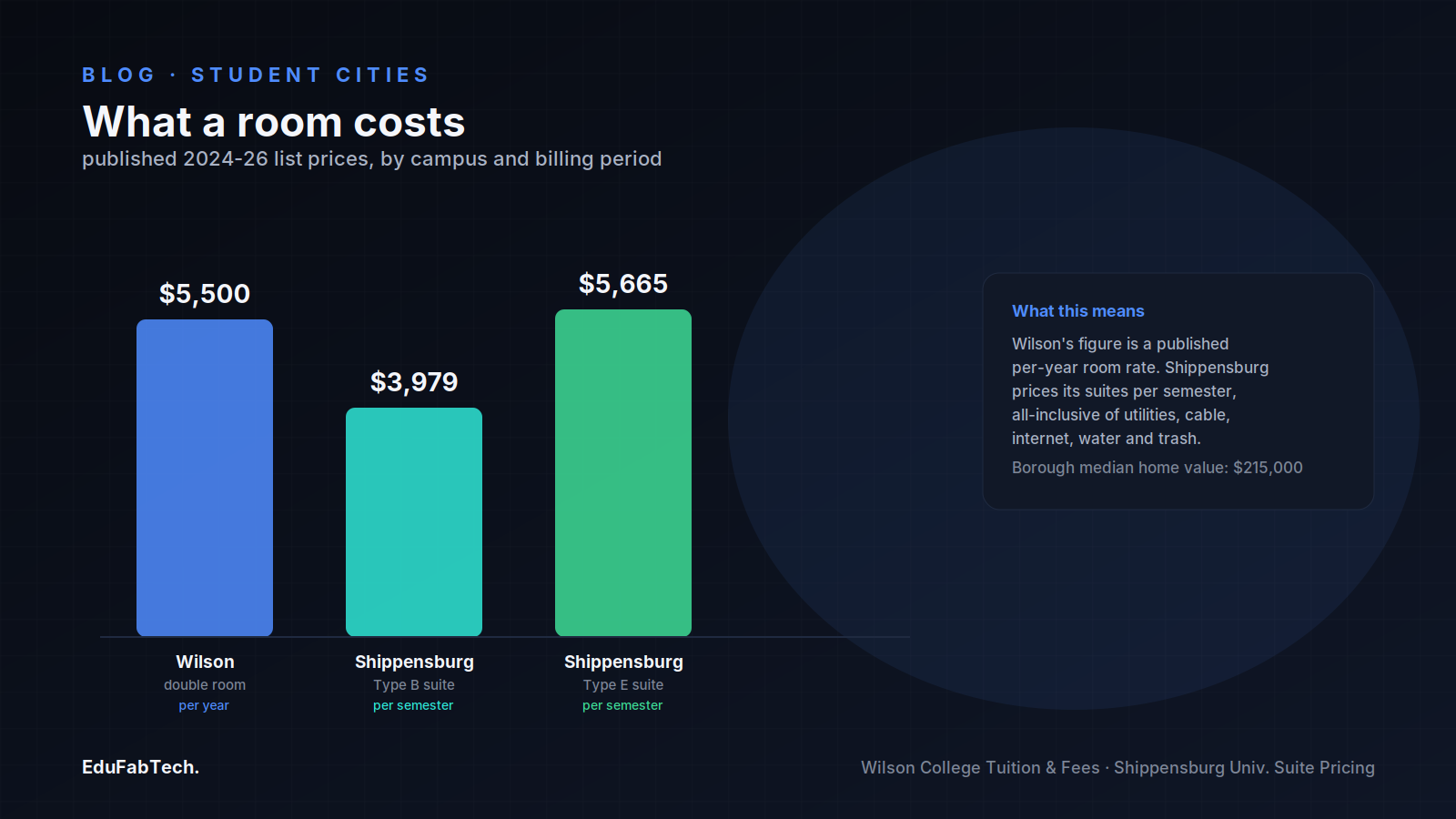
For an on-campus figure you can rely on, Wilson College publishes its rates directly. Its Tuition and Fees page lists, for the 2025-26 academic year, a double room at $5,500, the Phoenix meal plan at $6,932, undergraduate tuition at $25,950 and a comprehensive fee of $1,200. Those are list prices before any aid, but they are the real sticker figures a Wilson student budgets against.
Shippensburg's own numbers give a sense of public-university housing in the same valley. Its suite pricing page quotes 2024-25 costs per student per semester ranging from $3,979 for a Unit Type B space up to $5,665 for a Unit Type E space, and the university's housing page notes that these room charges are "all inclusive," covering electricity, cable, internet, water, trash and building maintenance. Shippensburg also runs a two-year housing requirement for students under 60 credits, so first- and second-year students there generally cannot opt straight into a Chambersburg apartment.
For the private market, there is no single reliable published "student rent" figure for Chambersburg, so treat any number you see on a listing site with caution. What can be sourced is the broader housing context: Census Reporter's reading of the 2024 American Community Survey (5-year) puts the borough's median owner-occupied home value at $215,000, a figure that signals a relatively affordable valley market rather than a high-cost college town. In practice that tends to keep room rents below what students pay in Pennsylvania's bigger university cities, though it also means fewer purpose-built student units to choose from.
Furnishing a room without overspending
A general-market rental usually arrives less furnished than a student block, so plan to kit out a room cheaply. The seasonal North Square Farmers Market is the most reliably documented local market: the Franklin County tourism bureau lists it at Chambers Fort Park on North Main Street in downtown Chambersburg, running from 30 May to 21 November 2026, from 8:00 a.m. to noon, selling local produce, baked goods, cheese and meat. It is the place to sort out groceries and get a feel for the town, though it is a food market rather than a furniture source.
For the room itself, second-hand is the sensible route, and the turnover of students moving in and out of the valley each summer means usable furniture and kitchenware circulate steadily. EduFabTech keeps Chambersburg-specific pages for second-hand things, second-hand furniture and items people are giving away free, which is usually a better first stop than buying new. When you do collect something, remember that Chambersburg is a car-oriented town: arrange a lift or a short rental for anything bigger than you can carry, because the bus network will not help you move a sofa.
Working while you study
Rules for international students are set by the U.S. government, not the university, and they are strict about the difference between on- and off-campus work. The U.S. Citizenship and Immigration Services (USCIS) "Students and Employment" guidance states that an F-1 student with approval from their Designated School Official may work on campus up to 20 hours per week while school is in session, and full-time during breaks, without a separate USCIS work-authorisation application; off-campus employment, by contrast, requires authorisation and an Employment Authorization Document before you start. This is a summary, not legal advice — confirm your own situation with your university's international-student office and the USCIS page itself before accepting any job.
Because Chambersburg is a general-economy town rather than a campus economy, part-time openings sit mostly in retail, hospitality, warehousing and healthcare support across the borough, which can suit students who are allowed to work off campus but are harder to reach without a car. On-campus roles at Wilson or Shippensburg are the simplest fit for F-1 students. EduFabTech's Chambersburg jobs and part-time work page is a place to start a local search.
Libraries and places to study
The town's public anchor is the Coyle Free Library at 102 North Main Street in downtown Chambersburg, part of the Franklin County Library System; the system's catalogue describes Coyle as the resource centre for the public libraries in Franklin and Fulton counties, with longer hours and a larger collection than its branches. It is open to anyone and is the obvious free, neutral study space for students who live off campus or at a college without a large library of its own.
On campus, Shippensburg students have the Ezra Lehman Memorial Library, which lends laptops for use in the building and posts its current term-time hours on its own site — worth checking when you are writing against a deadline. Wilson students have their own campus library, and EduFabTech's Chambersburg study-spaces page collects additional desks and quiet rooms around the town for when the campus and the public library are full.
Getting around without a car
Chambersburg has no conventional fixed-route city bus network; its public transport is an on-demand microtransit service. The operator, rabbittransit, runs the Stop Hopper service, which its Stop Hopper page describes as $2.50 cash per one-way trip, or $2.25 per ride when paid through the Stop Hopper or rabbitPAY app, free for seniors with a registered Free Fare ID card, operating Monday to Friday from 6:30 a.m. to 6:30 p.m.; the same page lists the Franklin County service area as Chambersburg and Fayetteville. Franklin County's announcement of the service adds that it uses nine-passenger ADA-accessible vans and lets riders book either through the app or by calling 1-800-632-9063 (franklincountypa.gov). rabbittransit's materials list a free fare for registered seniors but do not advertise a separate student discount, so budget for the standard fare.
The honest picture is that Stop Hopper works for errands and short hops within town during weekday hours, but it does not run evenings or weekends, it does not reach Shippensburg or the Maryland campuses, and it is not a substitute for the car that most people in the valley rely on. Students without a vehicle should pick housing within walking distance of campus and the shops they use most, and plan around the fact that the valley is built for driving.
The trade-offs, and a first-weeks checklist
What is good about Chambersburg for a student is also what is hard about it. The cost of living is modest for the United States, the town is real and lived-in rather than a seasonal college strip, and downtown, the farmers market and the library give it a centre. But the same qualities mean there is no dense student quarter, limited nightlife aimed at undergraduates, weekday-only on-demand transit, and a strong practical assumption that you will drive. For students who want a quiet, affordable base in a scenic valley, that is a fair bargain; for those who want a campus city, it will feel small.
A short checklist for the first few weeks:
- Register with your university's international-student or housing office and confirm your work rules against the USCIS students-and-employment page before taking any job.
- Never pay a deposit for a room you have not seen in person or on a live video call, and never by bank transfer, gift card or cryptocurrency.
- Get a free Coyle Free Library account for a reliable downtown study space and borrowing.
- Download the rabbitPAY or Stop Hopper app, but check the Monday-to-Friday, daytime-only hours before you rely on it.
- Furnish from EduFabTech's second-hand and free-stuff pages, and arrange transport before buying anything large.
- If you are at Shippensburg, check listings near the campus as well as in Chambersburg itself.
A quick question for readers
Do you work part-time while you study?
Many students work to pay the bills. See how common it is — and how many hours people really do.
Pick an answer, create a free account in a minute, and your vote counts. Already a member? Sign in
Comments 3
Comment-
Nine vans is the number that jumps out at me. That is a thin fleet to run a county's entire on-demand network on - one van down for maintena…
-
The weak spot is the private-rent section admitting there's no sourced student-rent figure, then substituting median owner-occupied home val…
-
The bit worth flagging is buried in the transport section: Stop Hopper only runs weekdays, 6:30 to 6:30, and doesn't reach Shippensburg or e…
Join free to read the full comments and reply Comments are between members; an account takes a minute.
Source: Wilson College
Sources (5)
- Wilson College. Tuition and Fees. Wilson College, 2025. wilson.edu ↗ · checked 1 Nov 2026
- Shippensburg University. Suite Pricing and Renderings. Shippensburg University of Pennsylvania, 2024. ship.edu ↗ · checked 1 Nov 2026
- rabbittransit. Stop Hopper. rabbittransit, 2026. rabbittransit.org ↗ · checked 1 Nov 2026
- Census Reporter. Chambersburg, PA (ACS 2024 5-year). Census Reporter, 2024. censusreporter.org ↗ · checked 1 Nov 2026
- U.S. Citizenship and Immigration Services. Students and Employment. USCIS, 2026. uscis.gov ↗ · checked 1 Nov 2026