Graduates Without Jobs, Part 1: 264 Million Students, Not Enough Graduate Jobs
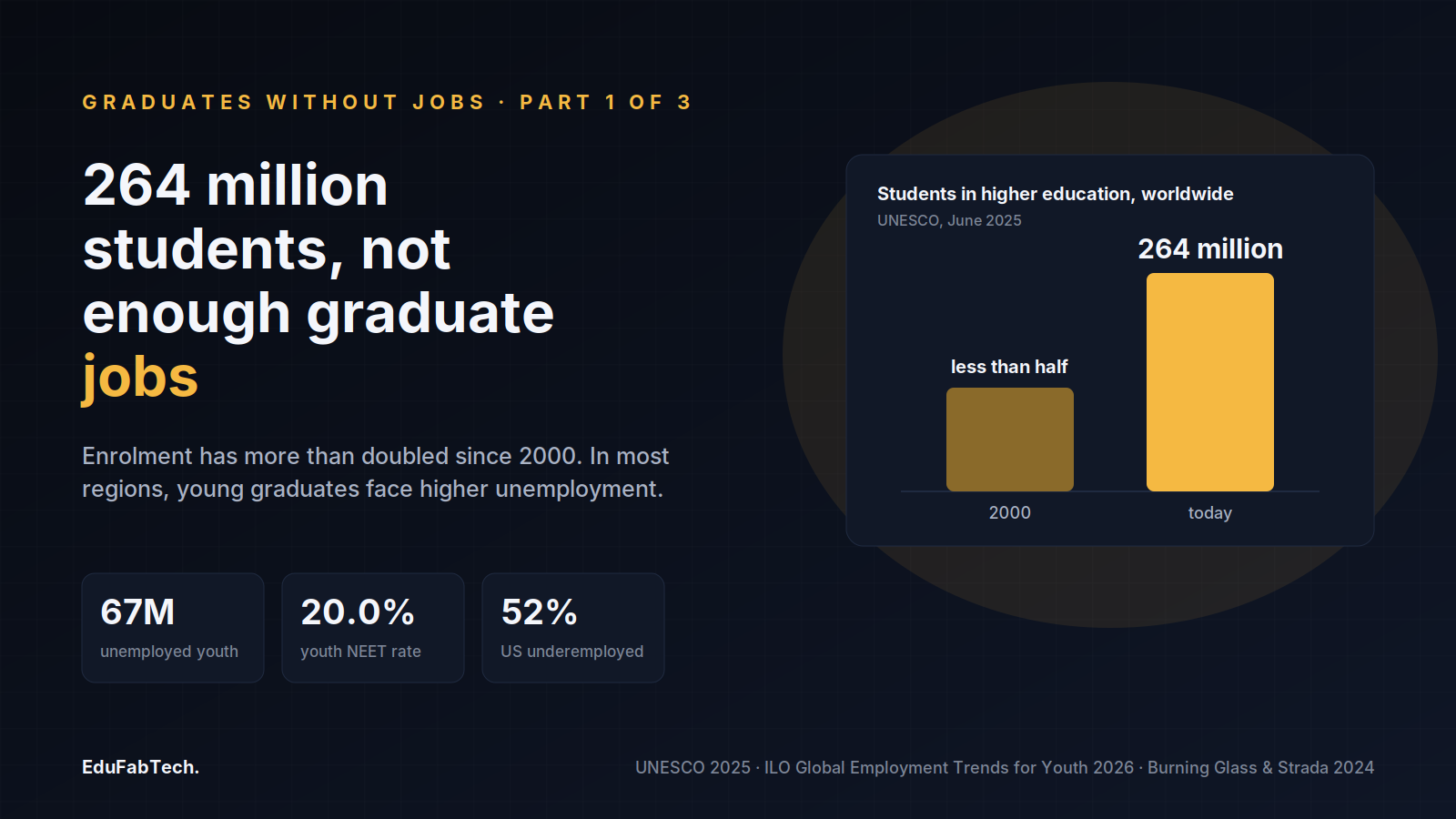
Higher education enrolment has more than doubled since 2000 to 264 million students, but in most regions young graduates are more likely to be unemployed than those with less education. The numbers behind the gap, country by country.
Hannah Radabaugh graduated in sociology in 2025. By the end of September 2026 she had applied for 261 jobs, about 60 per cent of her applications had received no reply at all, and she was still serving at the gelato shop where she has worked since high school, the Daily Bruin reported. "You don't know if you need to keep your hopes up for it," she said. Two of her fellow graduates found work only after about 400 and more than 600 applications.
Her story is American, but the shape of it is global. More young people than ever hold degrees, and in much of the world a degree no longer guarantees a first job, let alone a job that needs a degree. This is the first of three articles on graduates without jobs. Part 1 measures the problem: how many graduates there are, how many find work, and how many end up in work they did not need a degree for. Part 2 looks at the graduates who cross into other fields, and Part 3 sets out a plan.
The world picture: twice as many students, not twice as many graduate jobs
UNESCO reported in June 2025 that a record 264 million students are enrolled in higher education worldwide, more than double the number in 2000 and 25 million more than in 2020. The global gross enrolment ratio is 43 per cent, but in sub-Saharan Africa it is 9 per cent, and women outnumber men, at 113 women for every 100 men in 2023.
The labour market has not doubled with it. The International Labour Organization's Global Employment Trends for Youth 2026, published in August 2026, puts global youth unemployment at 12.4 per cent in 2025, or 67 million people aged 15 to 24, about 2 million more than in 2023. One young person in five, 257 million, is not in employment, education or training (NEET), a rate of 20.0 per cent. Young people are 3.43 times as likely as adults to be unemployed.
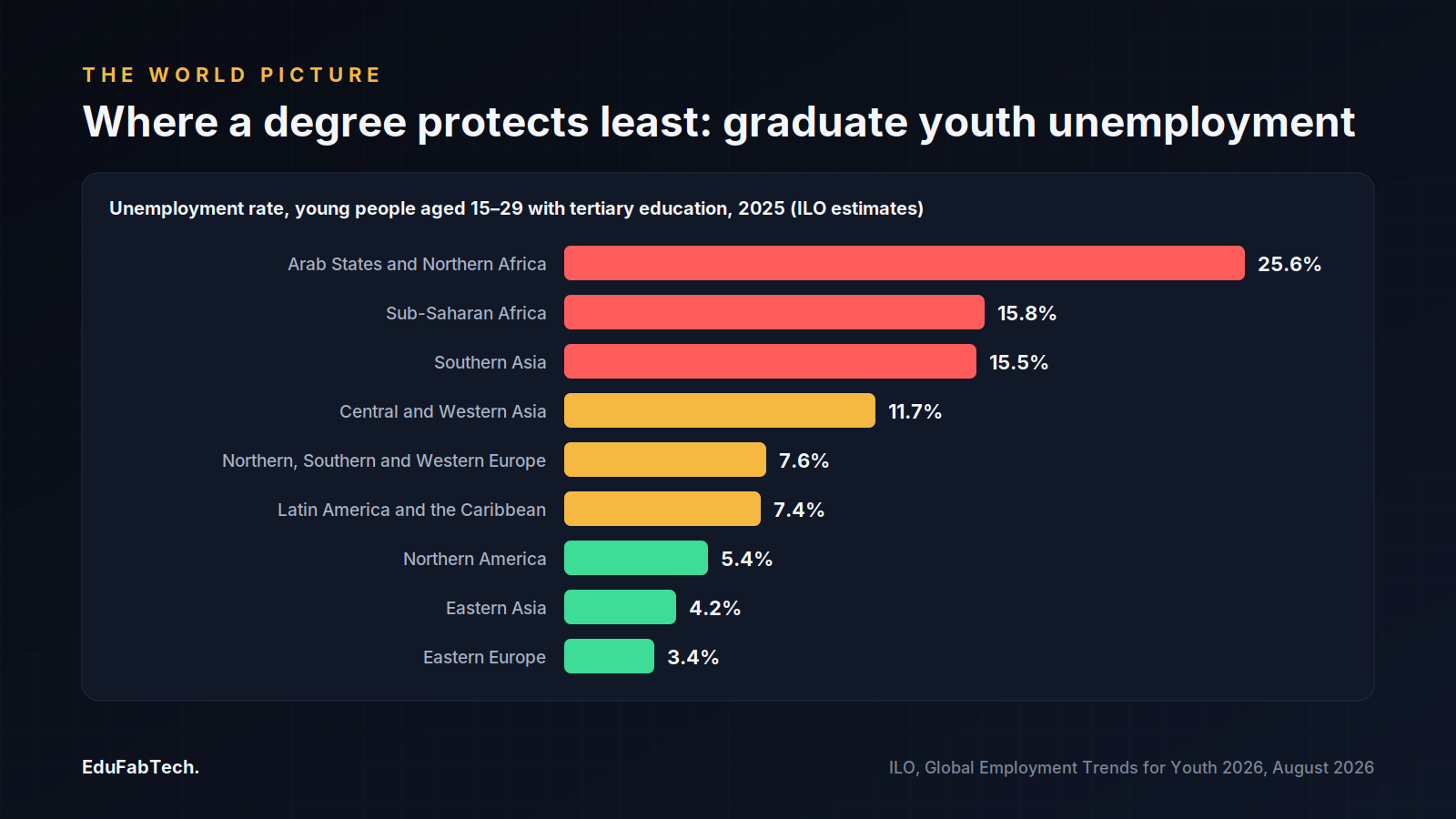
The ILO's most striking finding concerns education. In most regions of the world, unemployment is higher among young university graduates than among young people with less education. The exceptions are Europe and North America. Among young people aged 15 to 29 with tertiary education, the ILO estimates unemployment in 2025 at 25.6 per cent in the Arab States and Northern Africa, 15.8 per cent in sub-Saharan Africa, 15.5 per cent in Southern Asia, 11.7 per cent in Central and Western Asia, 7.6 per cent in Northern, Southern and Western Europe, 7.4 per cent in Latin America and the Caribbean, 5.4 per cent in Northern America, 4.2 per cent in Eastern Asia and 3.4 per cent in Eastern Europe. The ILO adds a caution: unemployment rose for secondary-school leavers too, and it found no definitive evidence that graduates are suffering more than they are.
In rich countries, a degree still pays on average. The OECD's Education at a Glance 2026 shows an employment rate of 87 per cent in 2025 for 25- to 64-year-olds with a tertiary degree, against 78 per cent for those whose highest qualification is upper secondary and 60 per cent for those below it. Among 25- to 34-year-olds, unemployment was 5 per cent for graduates and 14 per cent for those without upper secondary education. The average hides wide differences between countries.
Country by country
Each country measures graduate unemployment differently, so the figures below are not a league table. They show where, and how, the problem appears.
| Country or region | Indicator | Figure | Source and year |
|---|---|---|---|
| India | Unemployment, young graduates vs young people who cannot read or write | 29.1% vs 3.4% | ILO and Institute for Human Development, 2022 data |
| China | Unemployment, ages 16–24 excluding students; graduates in 2026 | 18.0% (Sept 2026); 12.7 million graduates | National Bureau of Statistics via Caixin; Ministry of Education via CGTN |
| South Africa | Unemployment, ages 15–34; all ages | 47.4%; 33.6% | Statistics South Africa, Q2 2026 |
| Arab States and Northern Africa, including Egypt | Unemployment, tertiary-educated youth aged 15–29 | 25.6% | ILO, 2025 estimate |
| Greece | Employment rate of recent tertiary and upper-secondary graduates, 20–34 | 62.4%, lowest in the EU | Eurostat, 2025 |
| Italy | Same indicator | 71.8% | Eurostat, 2025 |
| Spain | Graduates in jobs that do not need a degree | 35.0%, highest in the EU | Eurostat, 2024 |
| Türkiye | Employment rate of graduates aged 25–64 (OECD average 87%); unemployment of graduates aged 25–34 vs those without upper secondary | 75%; 10% vs 11% | OECD Education at a Glance 2026, 2025 data |
| United States | Unemployment, recent graduates aged 22–27 vs all workers; underemployment | 5.7% vs 4.1%; about 42% | New York Fed via Fortune, June 2026 |
Three patterns stand out. In India, the less education a young person has, the more likely they are to be working; the joint ILO and Institute for Human Development report found that the share of educated young people among the unemployed rose substantially between 2000 and 2022. In China, a record 12.7 million graduates entered a market where youth unemployment reached its highest September level since the current series began in January 2024. In Southern Europe and Türkiye, the problem shows up less in unemployment rates than in low employment rates and in graduates working below their level; in Türkiye, a degree barely lowers the risk of unemployment for 25- to 34-year-olds compared with leaving school early.
Why graduates cannot find jobs
Supply grew faster than demand. Enrolment more than doubled in two decades; the number of jobs that need a degree did not grow at that pace everywhere. Where economies are dominated by agriculture, informal work or low-skilled services, a degree can price a young person out of the jobs that exist without opening the ones they trained for. It helps explain why the ILO's graduate unemployment rates are highest in North Africa, the Arab States and South Asia.
The first job asks for experience the graduate does not have. The most detailed evidence on this is American. The Burning Glass Institute and the Strada Institute for the Future of Work tracked the careers of graduates in their February 2024 report Talent Disrupted. Graduates with at least one internship had 48.5 per cent lower odds of being underemployed. Five years after graduation, 41 per cent of those who had done an internship were underemployed, against 54 per cent of those who had not. A degree opens the application; experience decides who gets the job.
Where you live matters as much as what you studied. The same degree carries different odds in different labour markets: tertiary-educated youth unemployment is about six times higher in the Arab States and Northern Africa than in Eastern Asia, on the ILO's 2025 estimates. Within Europe, Eurostat reports that 83.0 per cent of recent graduates aged 20 to 34 were in work in 2025, and 87.0 per cent of those with a tertiary degree, but the share ranged from 62.4 per cent in Greece to 91.0 per cent in Malta. A graduate in Athens and a graduate in Valletta with the same degree face very different first years.
A new pressure: AI and the entry level. The ILO estimates that 6.1 per cent of jobs held by people aged 15 to 29 fall into the categories most exposed to generative AI, and that if just 10 per cent of those jobs disappeared, about 5.6 million young workers, mostly in high-income countries, would have to find other work. The early evidence, examined in our analysis "Is AI Eating First Jobs?", points to fewer beginners being hired into tasks AI can do, rather than mass layoffs.
Employed, but not as graduates
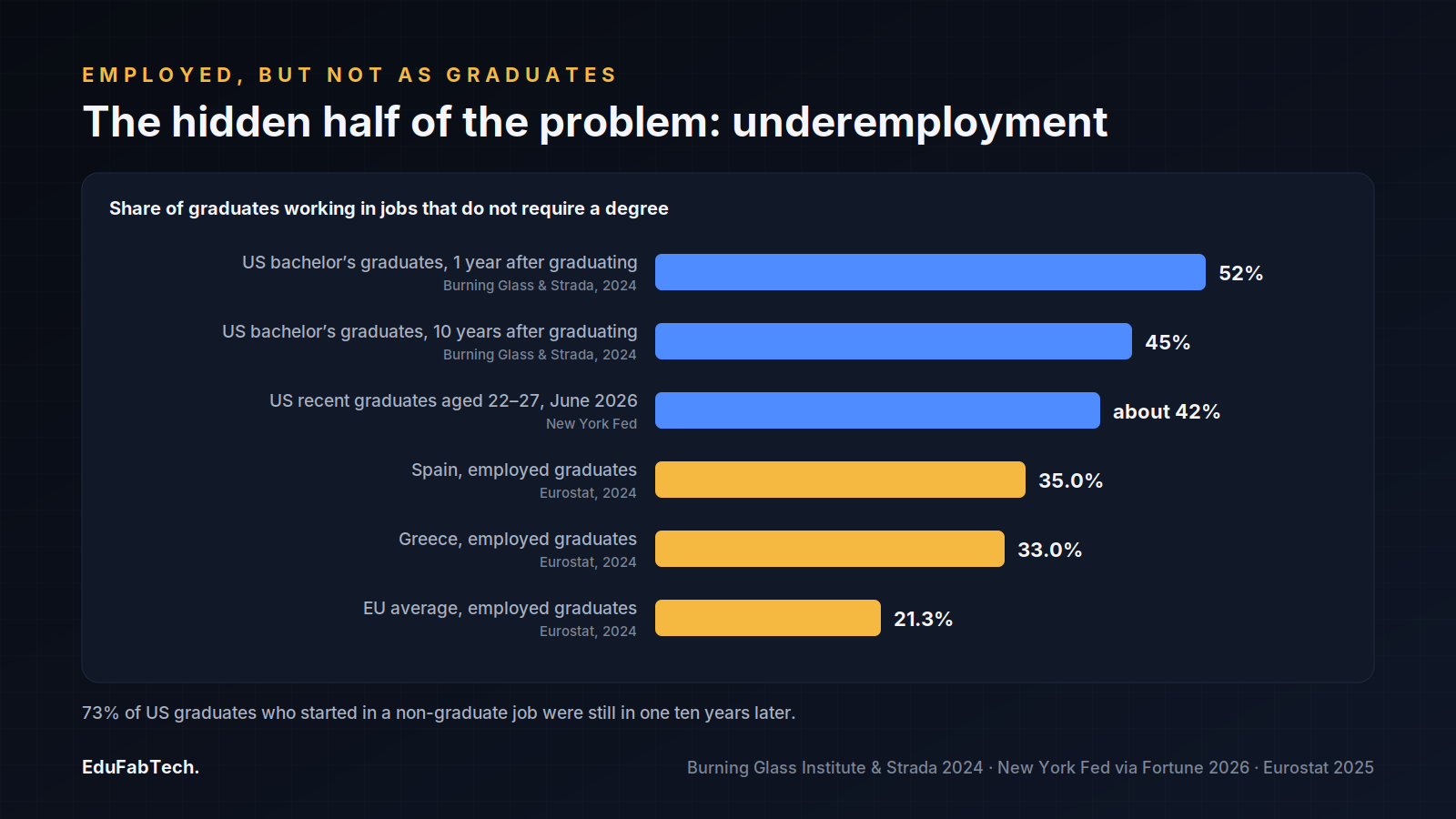
Unemployment counts only those who have no job. A second measure, underemployment, counts graduates working in jobs that do not require a degree, and it is larger. Talent Disrupted found that 52 per cent of US bachelor's graduates were underemployed a year after graduating, and 45 per cent were still underemployed ten years later. Of those who started in a non-graduate job, 73 per cent were still in one a decade on: the first job tends to become the career.
Europe measures the same thing as over-qualification. Eurostat reports that in 2024, 21.3 per cent of employed people with tertiary education in the EU worked in occupations that do not require it, rising to 33.0 per cent in Greece and 35.0 per cent in Spain. In Türkiye, an Education Monitoring Report published by the İLKE Foundation's education policy centre and reported by Indigo on 3 November 2026 puts the figure at about one graduate in five.
Underemployment is not a personal failure. Hannah Radabaugh did not choose the gelato counter over a graduate job; she has not yet found one. But the data shows that the time spent below one's level is not neutral, and that the way out starts early.
What comes next in the series
The figures point to two kinds of answer. The first is individual: graduates who cannot find work in their own field often find it in another, and the studies above already show that experience before graduation changes the odds. Part 2 will map those crossings: which graduates end up in which jobs, which moves work, and how to make one on purpose. The second is collective: countries that plan what they teach around what their economies need, and use common definitions of skills and qualifications, waste less of their young people's education. Part 3 will set out that plan and test it against real-world examples.
Are you a graduate looking for work, or did you find a job outside your field? Tell us in the forum, and answer this week's question in the polls: how long did it take you to find your first job?
A quick question for readers
Which study method makes things stick for you until the exam?
Research says some methods work far better than others. Vote first, then see whether students agree with the evidence.
Pick an answer, create a free account in a minute, and your vote counts. Already a member? Sign in
Comments 0
CommentNo comments yet. Members start the conversation.
Sources (5)
- UNESCO. Record number of higher education students highlights global need for recognition of qualifications. UNESCO, 2025. unesco.org ↗ · checked 9 Nov 2026
- International Labour Organization. Global Employment Trends for Youth 2026. ILO, 2026. ilo.org ↗ · checked 9 Nov 2026
- OECD. Education at a Glance 2026: How does educational attainment affect participation in the labour market?. OECD, 2026. oecd.org ↗ · checked 9 Nov 2026
- Eurostat. Employment of recent graduates reached 83% in 2025. Eurostat, 2026. ec.europa.eu ↗ · checked 9 Nov 2026
- Burning Glass Institute; Strada Institute for the Future of Work. Talent Disrupted: College Graduates, Underemployment, and the Way Forward. Burning Glass Institute, 2024. static1.squarespace.com ↗ · checked 9 Nov 2026