Graduates Without Jobs, Part 2: Crossing Fields, and How to Plan the Crossing
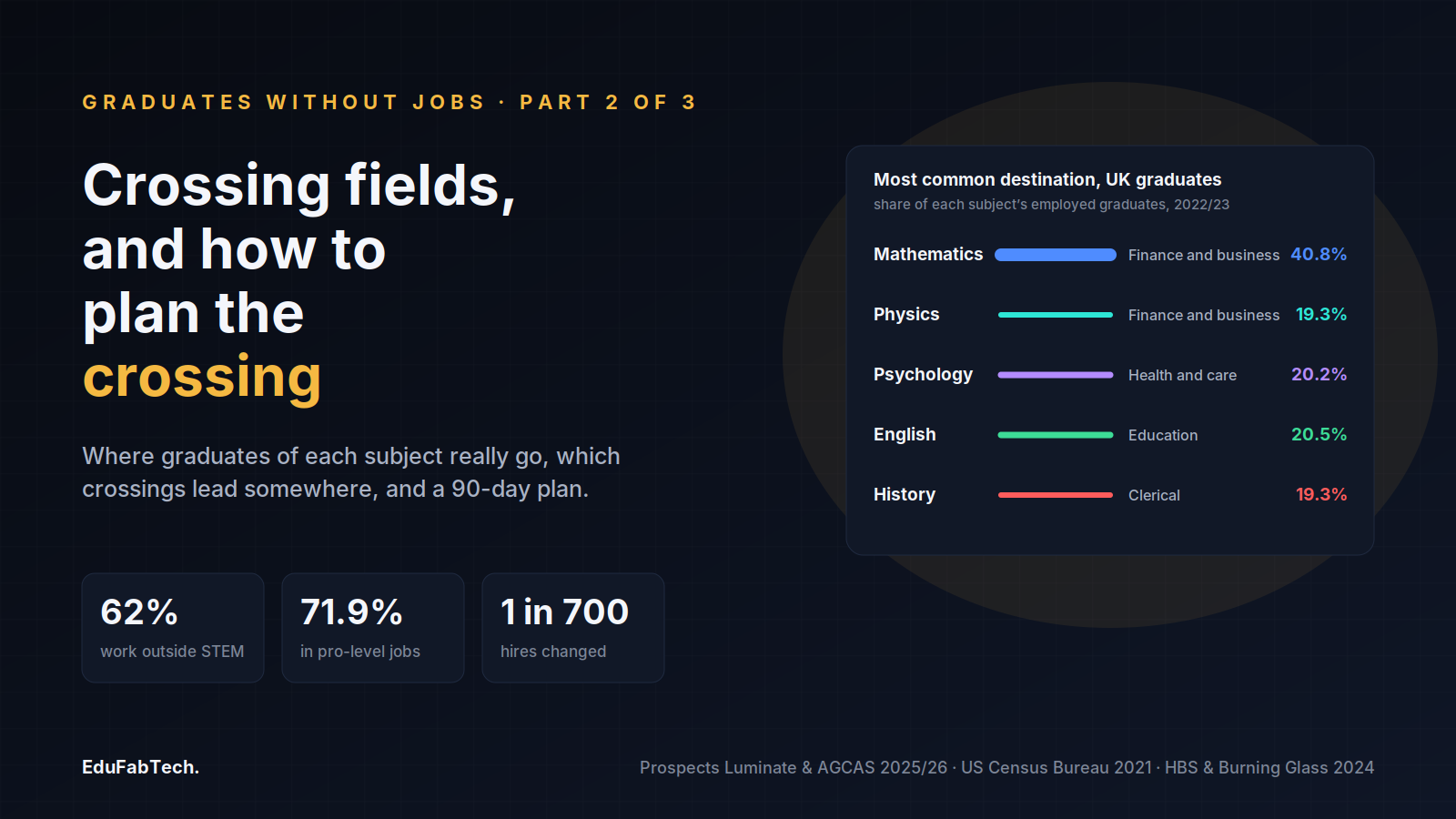
Only about a quarter of graduates work in a job directly tied to their major, and 62% of STEM graduates work outside STEM. Where graduates of each subject really go, which crossings lead somewhere, and a 90-day plan to make one.
Stewart Butterfield studied philosophy at the University of Victoria in Canada, then took a master's in philosophy and the history of science at Cambridge. He went on to co-found Slack and run it as chief executive. "Studying philosophy taught me two things," he told Forbes in 2015: how to write clearly, and how to follow an argument "all the way down", which he called "invaluable in running meetings". The same article found Slack's editorial director, Anna Pickard, working with a theatre degree from Manchester Metropolitan University. Neither had studied for the job they ended up doing.
Part 1 of this series set out the problem: 264 million students worldwide, graduate unemployment above that of less-educated young people in most regions, and about half of new US graduates in jobs that do not need a degree. This part is about the way out that most graduates actually take: working outside the field they studied. It looks at how common that is, where graduates of each subject really go, which crossings lead somewhere, and how to plan one in 90 days.
Working outside your field is the norm, not the exception
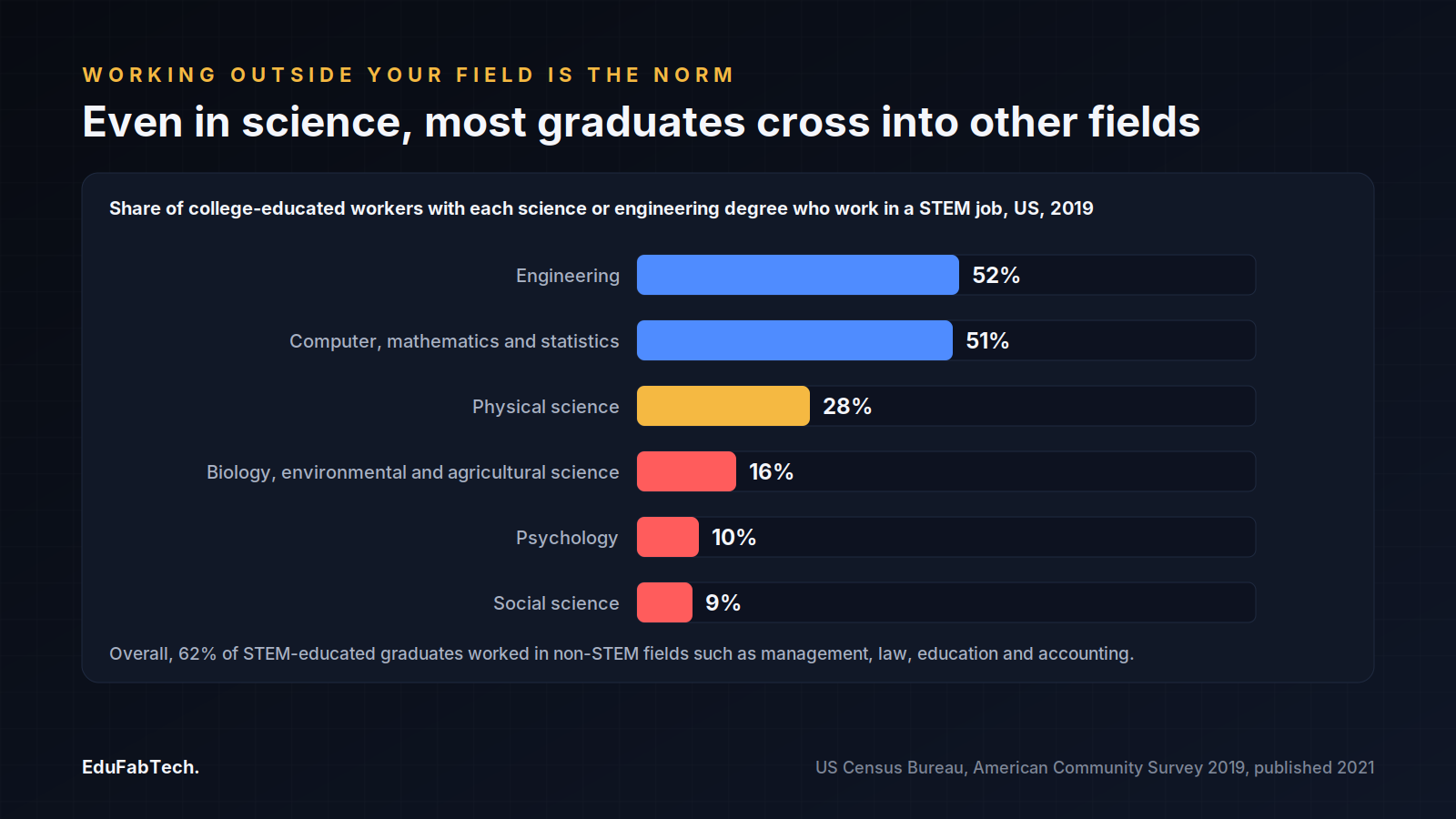
The idea that a degree leads to one matching job does not survive the data. Economists at the Federal Reserve Bank of New York found that close to two-thirds of US college graduates in the labour force work in a job that requires a degree, but only a little more than a quarter work in a job directly related to their major. Even in science and engineering, the subjects most tied to specific jobs, most graduates leave. The US Census Bureau reported that in 2019, 62 per cent of college-educated workers with a STEM degree worked in non-STEM fields such as management, law, education, social work and accounting, and only 28 per cent worked in STEM jobs. The share staying in STEM was 52 per cent for engineering majors, 51 per cent for computing, mathematics and statistics, 28 per cent for physical science, 16 per cent for biology and related fields, 10 per cent for psychology and 9 per cent for social science.
Leaving the field does not mean wasting the degree. In the United Kingdom, 77 per cent of first-degree graduates in work or study 15 months after graduating say they use what they learned in their degree, and 92 per cent say their work or study is meaningful, according to the HESA Graduate Outcomes survey as summarised by Universities UK. The useful question is not "Am I working in my field?" but "Am I working at the level my education allows?"
The crossing map: where graduates of each subject really go
The clearest public map comes from the UK, where graduates are surveyed 15 months after finishing. The 2025/26 edition of What Do Graduates Do?, published by Prospects Luminate and the Association of Graduate Careers Advisory Services and based on 179,675 graduates of 2022/23, lists the three most common occupation groups for each subject. Across all subjects, 71.9 per cent were in professional-level work.
| Subject | 1st | 2nd | 3rd |
|---|---|---|---|
| Mathematics | Business, HR and finance professionals 40.8% | IT professionals 17.0% | Education professionals 12.4% |
| Physics | Business, HR and finance professionals 19.3% | IT professionals 18.3% | Engineering and building professionals 14.5% |
| Computer science | IT professionals 63.4% | Retail, catering, waiting and bar staff 9.2% | Business, HR and finance professionals 4.6% |
| Law | Legal, social and welfare professionals 40.2% | Clerical, secretarial and numerical clerks 13.0% | Retail, catering, waiting and bar staff 11.9% |
| Biology | Science professionals 17.0% | Retail, catering, waiting and bar staff 16.6% | Business, HR and finance professionals 13.3% |
| Psychology | Childcare, health and education occupations 20.2% | Retail, catering, waiting and bar staff 14.0% | Clerical, secretarial and numerical clerks 12.6% |
| History | Clerical, secretarial and numerical clerks 19.3% | Retail, catering, waiting and bar staff 17.8% | Business, HR and finance professionals 15.5% |
| English | Education professionals 20.5% | Retail, catering, waiting and bar staff 16.4% | Clerical, secretarial and numerical clerks 14.7% |
| Sociology | Retail, catering, waiting and bar staff 18.9% | Clerical, secretarial and numerical clerks 15.9% | Legal, social and welfare professionals 14.1% |
The table shows two different kinds of crossing. The first is sideways and up: more mathematics graduates go into business, HR and finance than into any other field, and physics graduates spread across finance, IT and engineering; physics graduates also reported the highest rate of high-skilled employment of any subject, at 84 per cent of those in full-time work. Their degree is valued for what it trains, numbers and modelling, not for its subject matter. The second is sideways and down: for history, English, sociology and psychology, retail, catering and clerical jobs sit in the top three. Psychology is a useful example of a planned crossing; Prospects reports that 27 per cent of UK psychology graduates were working in health or care roles.
The US pattern is similar. The New York Fed's data for 2023, compiled by the St. Louis Fed, shows the highest underemployment among recent graduates in criminal justice (67.2 per cent), performing arts (62.3 per cent) and liberal arts (56.5 per cent), and the lowest in nursing (9.7 per cent), elementary education (16.1 per cent) and computer science (16.5 per cent). The subjects with the lowest underemployment lead to a defined job; the others depend on how well the graduate plans the crossing.
"Skills, not degrees": what employers say and what they do
Many employers now say they hire for skills rather than credentials, which should help anyone crossing fields. LinkedIn's Economic Graph team calculated that a skills-first approach expands employers' talent pools by nearly ten times on average, and by 10.3 times for Gen Z workers.
Practice lags far behind. A February 2024 study by Harvard Business School and the Burning Glass Institute, Skills-Based Hiring: The Long Road from Pronouncements to Practice, found that removing degree requirements had changed the outcome in fewer than 1 in 700 hires the previous year. Only about 37 per cent of the companies studied were real "skills-based hiring leaders"; at those firms, workers hired without degrees stayed longer, with two-year retention of 58 per cent against 48 per cent for graduates. The lesson for a graduate crossing fields: an employer may say skills matter, but the screener will still look for proof. The crossing works when you can show the skill, not just claim it.
Where the demand is growing
The World Economic Forum's Future of Jobs Report 2025 expects about 170 million jobs to be created and 92 million displaced worldwide by 2030, a net gain of 78 million. The largest growth in absolute numbers is in farmworkers, delivery drivers, software developers, building construction workers and shop salespersons, followed by food processing and care roles such as nursing professionals, social workers and counselling professionals. The fastest-growing roles in percentage terms are big data specialists, fintech engineers, and AI and machine learning specialists. Employers expect 39 per cent of workers' key skills to change by 2030; the fastest-rising are AI and big data, networks and cybersecurity, and technological literacy, alongside creative thinking, resilience, curiosity and leadership.
For a graduate, that list points to four realistic crossings: into data and digital roles from any subject with numbers in it; into health and care from psychology, biology and social sciences; into sales, client and business roles from humanities and social sciences; and into teaching and training from almost anything, given a teaching qualification.
Portable skills, and how to prove them
Butterfield's two lessons, clear writing and following an argument, are what careers advisers call transferable skills. So are analysis, research, persuasion, handling data and managing a project. Every degree trains some of them. The problem is that a degree certificate does not show them to an employer. Four kinds of proof do:
- A portfolio: three to five pieces of work in the target field, such as an analysis of a public dataset, a marketing plan for a real business, a policy brief or a piece of code, published where an employer can see it.
- A targeted certificate: one recognised credential that a real job advert in your target field asks for, not a collection.
- An internship or project: as Part 1 showed, US graduates with at least one internship had 48.5 per cent lower odds of being underemployed.
- Volunteering with a result: organising, fundraising or teaching that you can describe with a number.
A 90-day plan for crossing into a new field
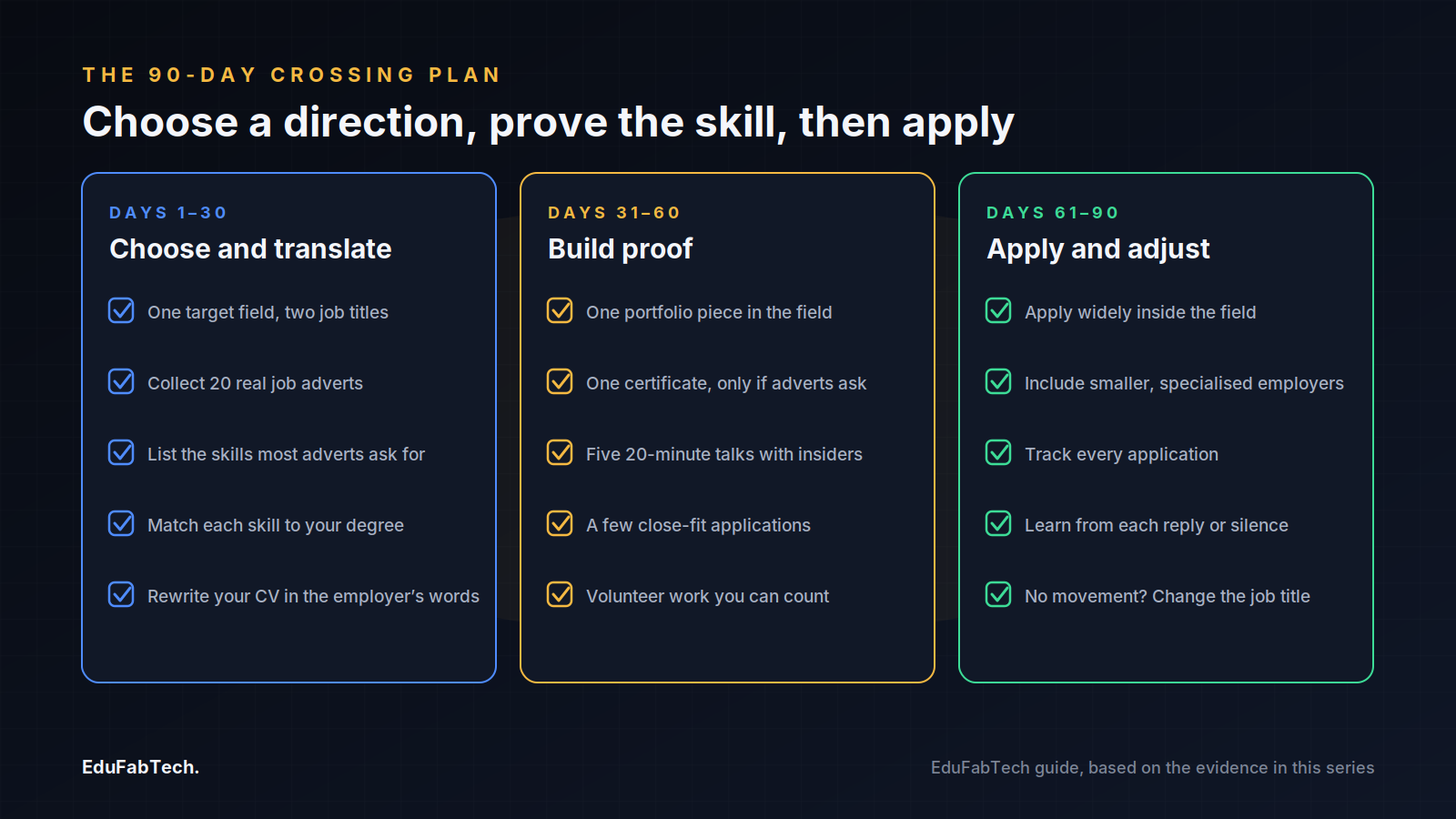
- Days 1–30: choose and translate. Pick one target field and two job titles in it. Collect 20 real job adverts and list the skills that appear in most of them. Rewrite your CV so that each skill is matched by something you did in your degree, with the subject jargon translated into the employer's language.
- Days 31–60: build proof. Complete one portfolio piece and, if the adverts ask for it, start one certificate. Contact five people already working in the field for 20-minute conversations about how they got in. Apply to a small number of roles that fit closely, rather than hundreds that do not.
- Days 61–90: apply and adjust. Apply widely within the chosen field, including smaller and more specialised employers; one UCLA graduate told the Daily Bruin that "the more specialized companies typically will receive fewer applications". Track every application and response. If nothing is moving by day 90, change the job title, not the whole plan.
Traps to avoid
- Collecting random certificates. Ten short online courses in unrelated subjects tell an employer you have not chosen a direction. One that a real advert asks for does more.
- Staying too long in a non-graduate job. A temporary job pays the rent; it should not become the plan. As Part 1 showed, 73 per cent of US graduates whose first job did not need a degree were still in such a job ten years later.
- Hiding the degree instead of translating it. A history graduate applying for an analyst role should not apologise for history; they should explain that it trained them to evaluate sources and write clear conclusions from incomplete evidence.
- Applying everywhere. Hundreds of untargeted applications produce mostly silence. A narrower search with a portfolio behind it produces conversations.
Most graduates will work outside their subject at some point, and the data says that is normal. What separates a crossing that leads somewhere from one that leads to a till is a choice of direction and proof of skill. Part 1 measured the problem; Part 3 will ask what countries, universities and employers should do so that fewer graduates have to find this path alone. Tell us in the forum how you crossed into your current job, and answer this week's question in the polls: do you work in the field you studied?
A quick question for readers
What mattered most when you chose your university?
Pick up to three. Future students will use these results to decide what to weigh.
Pick up to 3 →Comments 3
Comment-
The crossing data is clean but the 'proof' section glosses over something: an internship cuts underemployment odds by 48.5%, which is a real…
-
The line that deserves more weight than it got is the HBS/Burning Glass number: removing degree requirements changed the outcome in fewer th…
-
The occupation breakdown is the part worth sitting with longer than the headline 62% STEM figure. Physics graduates scatter across finance,…
Join free to read the full comments and reply Comments are between members; an account takes a minute.
Sources (4)
- Day, J. C.; Martinez, A.. STEM Majors Earned More Than Other STEM Workers. US Census Bureau, 2021. census.gov ↗ · checked 10 Nov 2026
- Prospects Luminate; AGCAS. What Do Graduates Do? 2025/26. Prospects Luminate, 2025. york.ac.uk ↗ · checked 10 Nov 2026
- Fuller, J.; Sigelman, M.; Martin, A.. Skills-Based Hiring: The Long Road from Pronouncements to Practice. Harvard Business School; Burning Glass Institute, 2024. hbs.edu ↗ · checked 10 Nov 2026
- World Economic Forum. Future of Jobs Report 2025: The jobs of the future and the skills you need to get them. World Economic Forum, 2025. weforum.org ↗ · checked 10 Nov 2026