Jobless to Founder, Part 1: Nine Graduates Who Turned Their Degree Into a Business
An engineer, an architect, a teacher and six others lost their jobs or could not find one. Each of them stopped waiting to be hired and started selling what they knew.
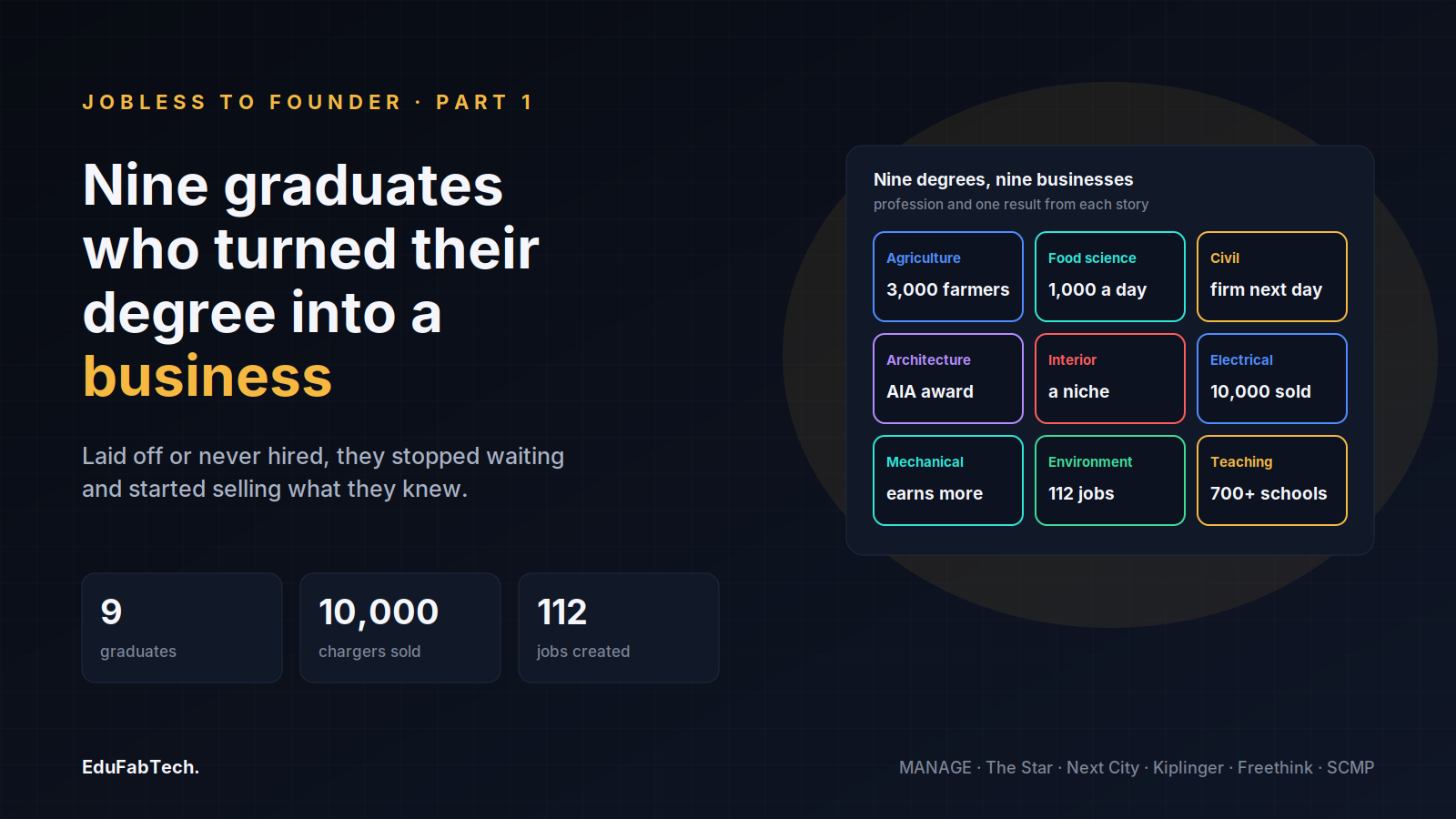
In 2008, Hewlett-Packard closed the division where Dean Sala worked as an electrical engineer. Like millions of people that year, he found himself without a job. Instead of joining the queue for the few engineering vacancies left, he started tinkering with a solar charger for mobile phones. A year later he had a company, Suntactics. By 2013 it had sold about 10,000 chargers and passed half a million dollars in revenue.
Sala did not get lucky in the job market. He left it.
This is the first article in a monthly series about graduates who did the same. In our three-part series Graduates Without Jobs, we measured the problem: millions of young people with degrees and not enough jobs that need them. This series is about the other side of that story. It is about the people who looked at their degree and saw something more than a CV line: a skill that someone, somewhere, would pay for.
Your degree is a golden bracelet
Think of a real skill as a gold bracelet on your wrist. It is wealth you carry with you, and no one can take it away. You can lose your job, your city or your savings, but the skill stays with you, and you can turn it into income again, anywhere in the world.
An engineering, architecture or teaching degree is exactly that kind of bracelet. The problem is that most graduates are taught to wear it in only one way: as an employee, waiting for a company to offer a salary. When those offers don't come, or come at a wage that barely pays the rent, it feels like the bracelet has lost its value.
It hasn't. What changes is who you sell it to. An employee sells their time to one buyer. A service provider sells the result of their skill to many. The nine graduates in this article made that switch, most of them after being laid off or rejected. Their stories have the same shape: a degree, a setback, a small first step, and a climb.
Group 1: from the field to the market
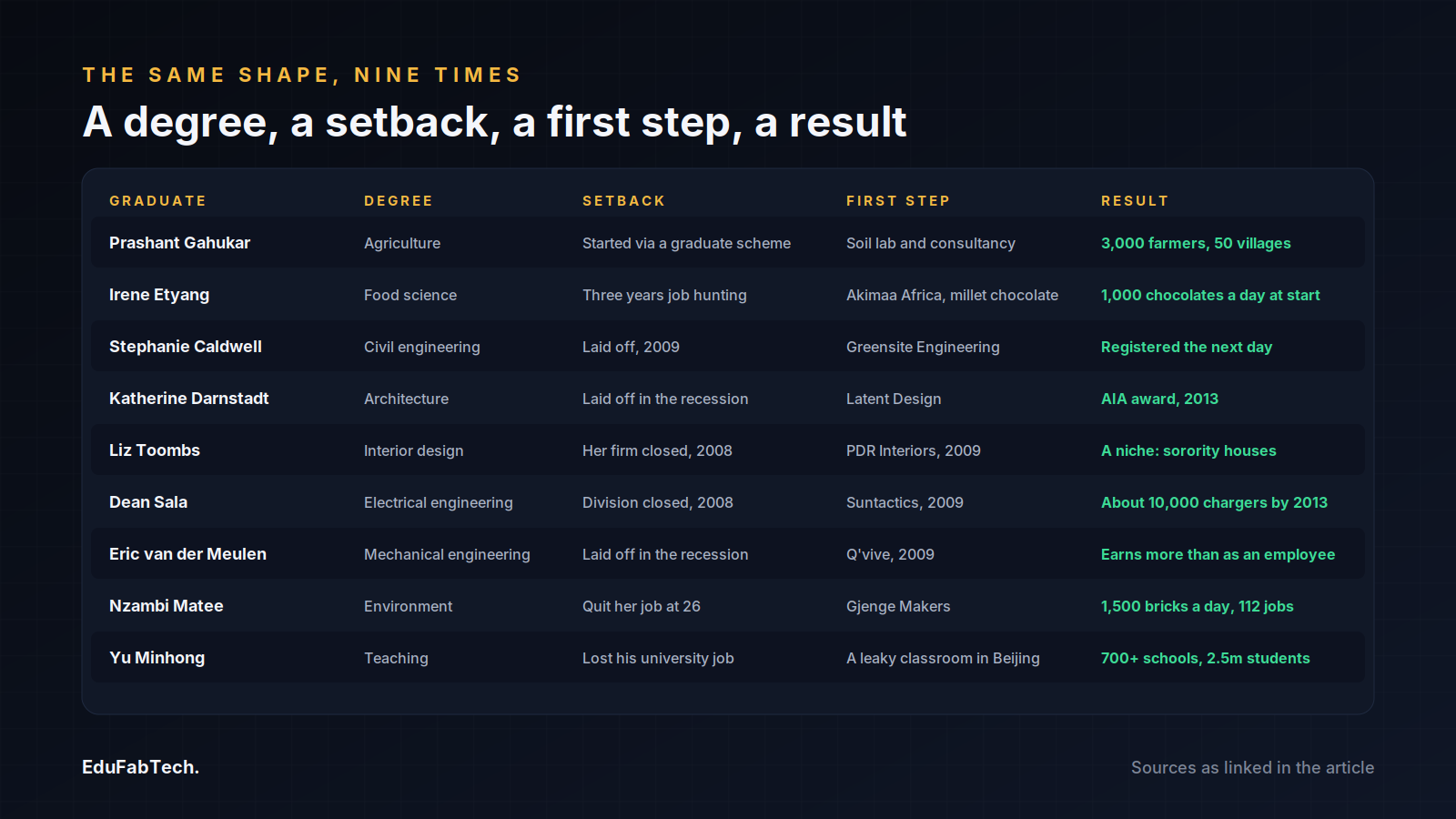
The agricultural graduate who became the village's soil doctor. Prashant Gahukar, an agriculture graduate in Wardha district, Maharashtra, trained under India's Agri-Clinics and Agri-Business Centres scheme, a government programme set up for agriculture graduates. With a bank loan of 20 lakh rupees, he opened a farm-input shop with a mini soil-testing laboratory and a consultancy service, and stocks organic inputs by default. He now works with a network of about 3,000 farmers from 50 villages, and his business turns over more than 3 crore rupees a year, according to the scheme's managing institute, MANAGE. Farmers come for the soil test and stay for the advice. That is the whole model.
The food scientist who made chocolate from millet. Irene Etyang graduated in food science and technology from the University of Nairobi in 2012. Three years later she was still looking for a job. So she used her degree on a crop her home region in western Kenya grows in abundance: millet. Her company, Akimaa Africa, began by making 1,000 millet chocolates a day, and in 2019 she was selected for the Mandela Washington Fellowship, The Star reported. She did not need a food company to hire her. She became one.
The move you can copy: find a local product or a local problem that your degree understands better than anyone nearby.
Group 2: building, design and space
The civil engineer who registered her firm the day after she was laid off. When Stephanie Caldwell lost her job at the engineering firm Kimley-Horn in 2009, she did not take a week off. She incorporated her own company, Greensite Engineering, the next day, and started winning stormwater-design projects and subcontracting work on public projects, Business Observer reported.
The architect who designed her own job. Katherine Darnstadt was a newly licensed architect, and pregnant, when she was laid off during the recession. In Chicago she founded Latent Design and took on the projects bigger firms ignored, from vacant lots to a shop built in a shipping container. In 2013 she received the American Institute of Architects' Young Architects Award, Next City reported.
The interior designer who found a niche nobody else wanted. In 2008, the design firm where Liz Toombs worked closed. In 2009 she started PDR Interiors, specialising in something most designers had never thought about: decorating American university sorority houses. A narrow niche means fewer competitors and clients who recommend you to each other, The Story Exchange reported.
The move you can copy: go where the big firms don't. Small projects, unusual niches and neglected buildings are where a one-person practice can win.
Group 3: energy and machines
The electrical engineer in our opening story, Dean Sala, turned a layoff into a product company, Kiplinger reported.
The mechanical engineer who sold his expertise instead of his time. Eric van der Meulen was laid off at the height of the recession. In 2009 he founded Q'vive, a one-person consulting and training firm in Michigan. It is still a small business, and that is the point: he told Metromode he was earning more than he did as an employee.
The move you can copy: if you know how to fix, design or improve something, small and medium firms will pay for that knowledge by the project, without hiring a full-time engineer.
Group 4: environment
The engineer who quit her job to fight plastic. Nzambi Matee's start was different: she did not lose her job. She left a data analyst role in Kenya's oil industry at 26 and built a small laboratory in her mother's backyard. Her company, Gjenge Makers, turns plastic waste into building bricks. It produces 1,500 bricks a day and has created 112 jobs, and in 2020 the UN Environment Programme named her a Young Champion of the Earth, Freethink reported. Waste was a problem for her city. For her, it became raw material.
Group 5: education
The teacher who was punished for teaching too much. Yu Minhong was a teacher at Peking University when administrators found out he was teaching classes on the side. "I was punished and lost face," he later said, and he lost the job. He started again on his own, in a leaky classroom in Beijing's northern suburbs. That school became New Oriental, which now has more than 700 schools and language centres in 50 cities and teaches more than 2.5 million students, the South China Morning Post reported. The skill the university punished became one of China's best-known education companies.
The move you can copy: teaching does not need a school building. It needs students who want to learn something you know well.
The climb: why being a provider pays more over time
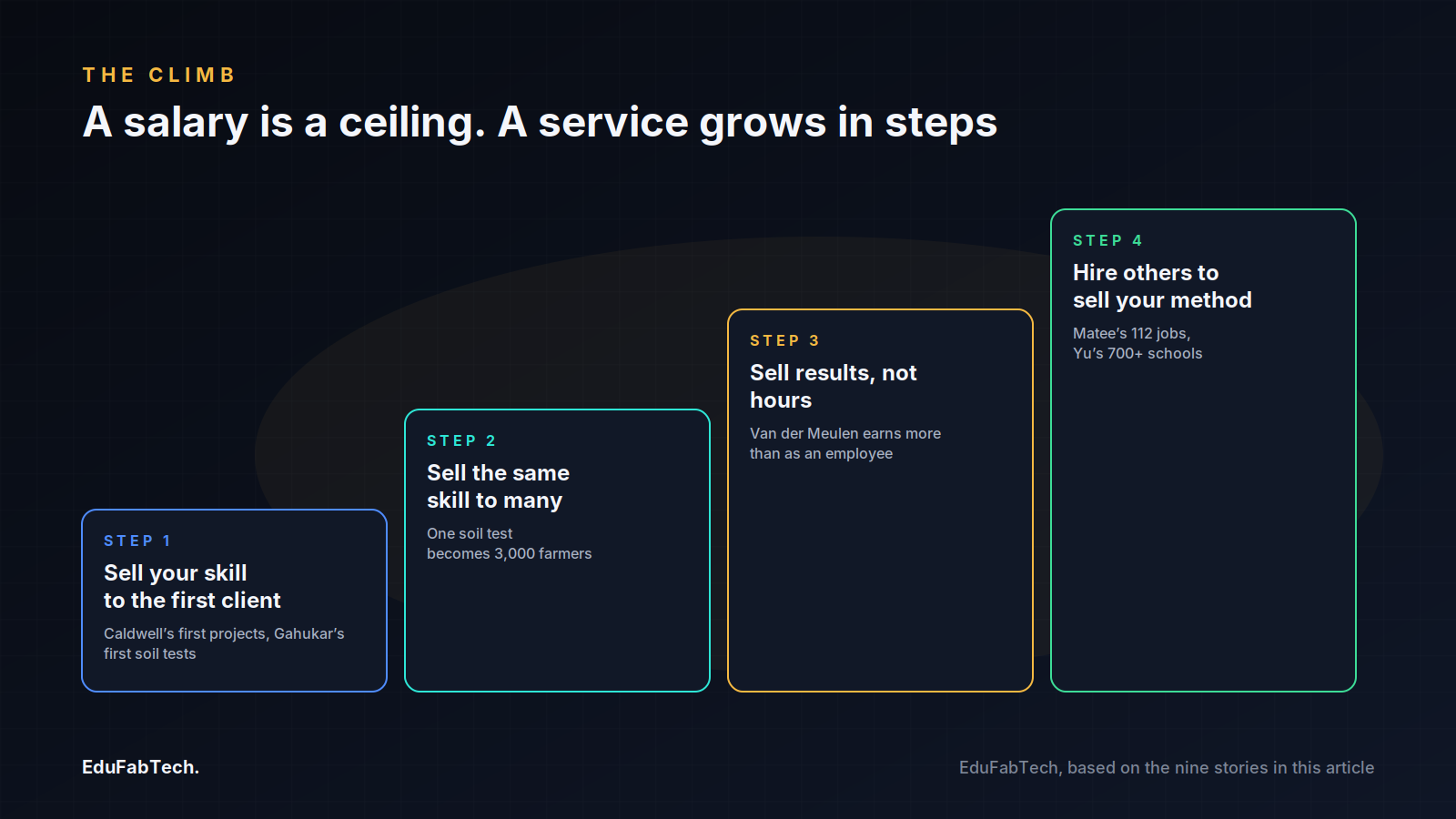
A salary is a ceiling. However hard you work, you are paid for the hours in your contract. A service provider's income works differently, and it grows in steps:
- Step one: sell your skill to the first client. Caldwell's first projects, Gahukar's first soil tests. Income is small, but it is yours.
- Step two: sell the same skill to many clients. One soil test becomes 3,000 farmers. One sorority house becomes a niche.
- Step three: sell results, not hours. Van der Meulen earns more by charging for expertise, not for time at a desk.
- Step four: hire others to sell your method. Matee's 112 jobs and Yu's 700 schools started with one person.
Not every venture climbs all four steps, and not every one survives. The founders in this article have something in common that improves the odds: they started small, kept their costs low, and sold their first service before they spent big.
Start this week: five steps
- Write down what your degree lets you do that most people cannot: test soil, check a building, design a room, teach a subject, cut an energy bill.
- Find the people who need it and can't afford a big firm: farmers, small factories, homeowners, cafés, students.
- Offer one simple service at a clear, fixed price. A soil test, a building check, a room design, a ten-lesson course.
- Ask your first ten clients for referrals. In every story above, word of mouth did more than advertising.
- Look for support programmes. Gahukar used a government scheme for agriculture graduates; many countries run start-up grants, loans and training for young graduates.
You have the bracelet. Wear it.
Being unemployed after graduation feels like failure. The nine people in this article show that it can be a starting point. None of them was waiting for permission. They took what they had learned, found someone who needed it, and started selling it, one client at a time.
Next month we will bring nine more stories, from professions we have not covered yet. Did you start a business with your degree, or are you thinking about it? Tell us in the forum, and answer this week's question in our polls: would you rather earn a fixed salary or build your own client list?
A quick question for readers
Which study habit do you think is most overrated?
Some popular habits have little evidence behind them. Which one do you think gets too much credit?
Pick an answer, create a free account in a minute, and your vote counts. Already a member? Sign in
Comments 0
CommentNo comments yet. Members start the conversation.
Sources (5)
- MANAGE (National Institute of Agricultural Extension Management). Agri-Clinics and Agri-Business Centres e-bulletin no. 151: agripreneur success stories. MANAGE, 2019. agriclinics.net ↗ · checked 15 Nov 2026
- The Star (Kenya). Millet chocolate earns Busia entrepreneur US fellowship. The Star, 2019. the-star.co.ke ↗ · checked 15 Nov 2026
- Next City. Latent Design: Katherine Darnstadt and social impact architecture. Next City, 2017. nextcity.org ↗ · checked 15 Nov 2026
- Kiplinger. Small business success story: a new career in solar. Kiplinger, 2014. kiplinger.com ↗ · checked 15 Nov 2026
- South China Morning Post. Success beyond the classroom for language school founder. South China Morning Post, 2014. scmp.com ↗ · checked 15 Nov 2026