Studying in Sacramento: universities, housing and student life
A grounded guide to studying in California's river capital — its universities, where students live, what a year costs, how the SacRT student pass works, and the honest trade-offs.
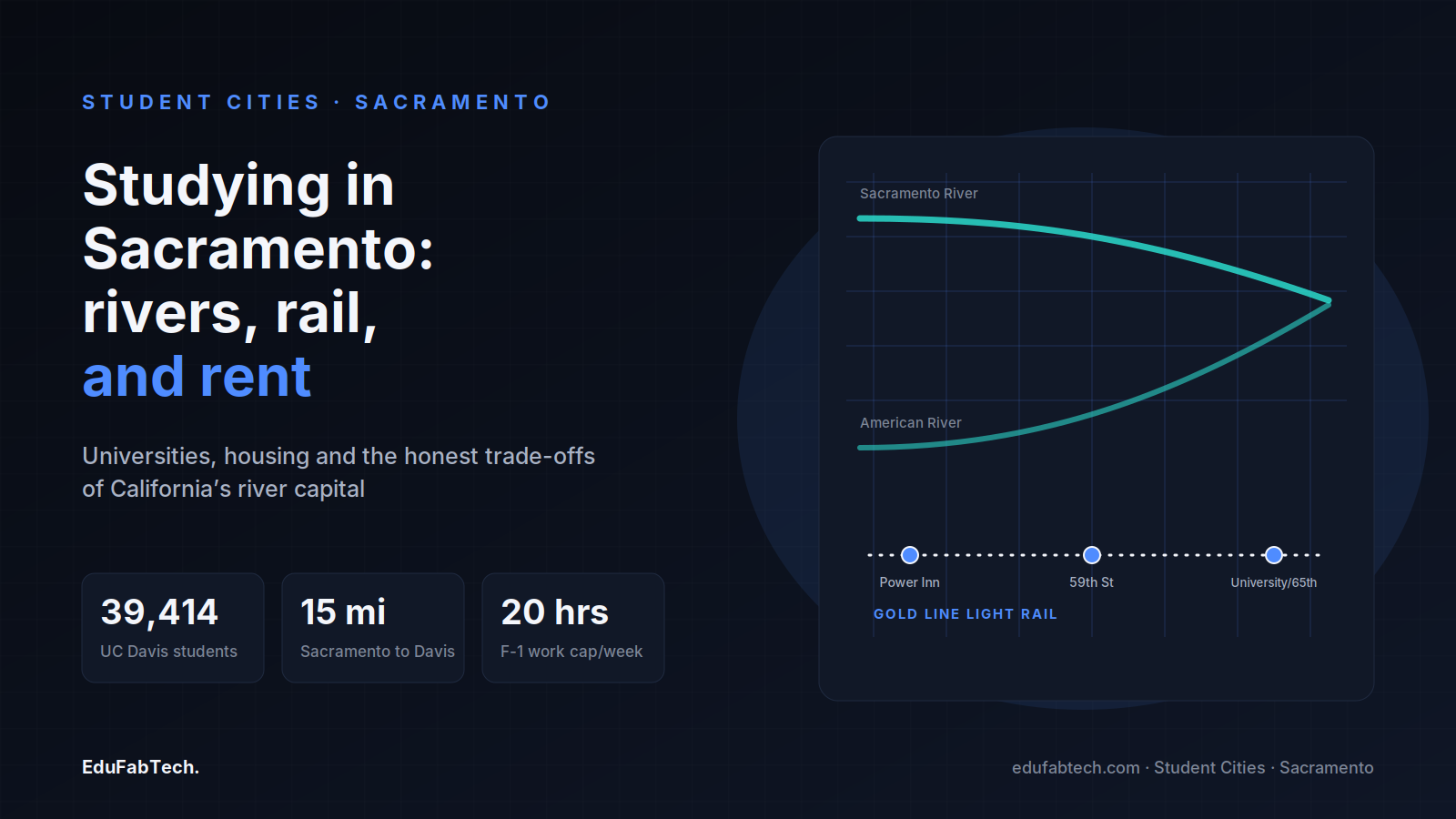
Sacramento is a state capital that wears the role lightly. The legislature meets under the gold dome downtown, but the city most students meet is a flat, tree-shaded grid laid out between two rivers — the Sacramento and the American — where the streets are numbered one way and lettered the other, so an address like "21st and X" is a set of coordinates you can walk to. Summers are long and genuinely hot, with stretches of triple-digit Fahrenheit days, and the tree canopy that gives the city its "City of Trees" nickname is the difference between a bearable walk and a punishing one. For a student, the practical shape of the place is this: a large public university on the American River, a world-class research campus fifteen miles west, several smaller colleges in the suburbs, and a light-rail line that threads them to a downtown grid.
This guide covers who grants degrees here, where students actually find rooms, how to avoid the deposit scams that recur in this market, what the year costs according to the institutions that publish the numbers, and what is genuinely good and genuinely hard about student life in the region.
Because the campuses sit in different towns — Sacramento proper, Davis, Rocklin, Rosemont, Foothill Farms — your choice of university largely decides which neighbourhoods and which commute become yours. It is worth reading the housing and transport sections against the campus you have in mind rather than the city as a whole.
The universities, and what studying here is like
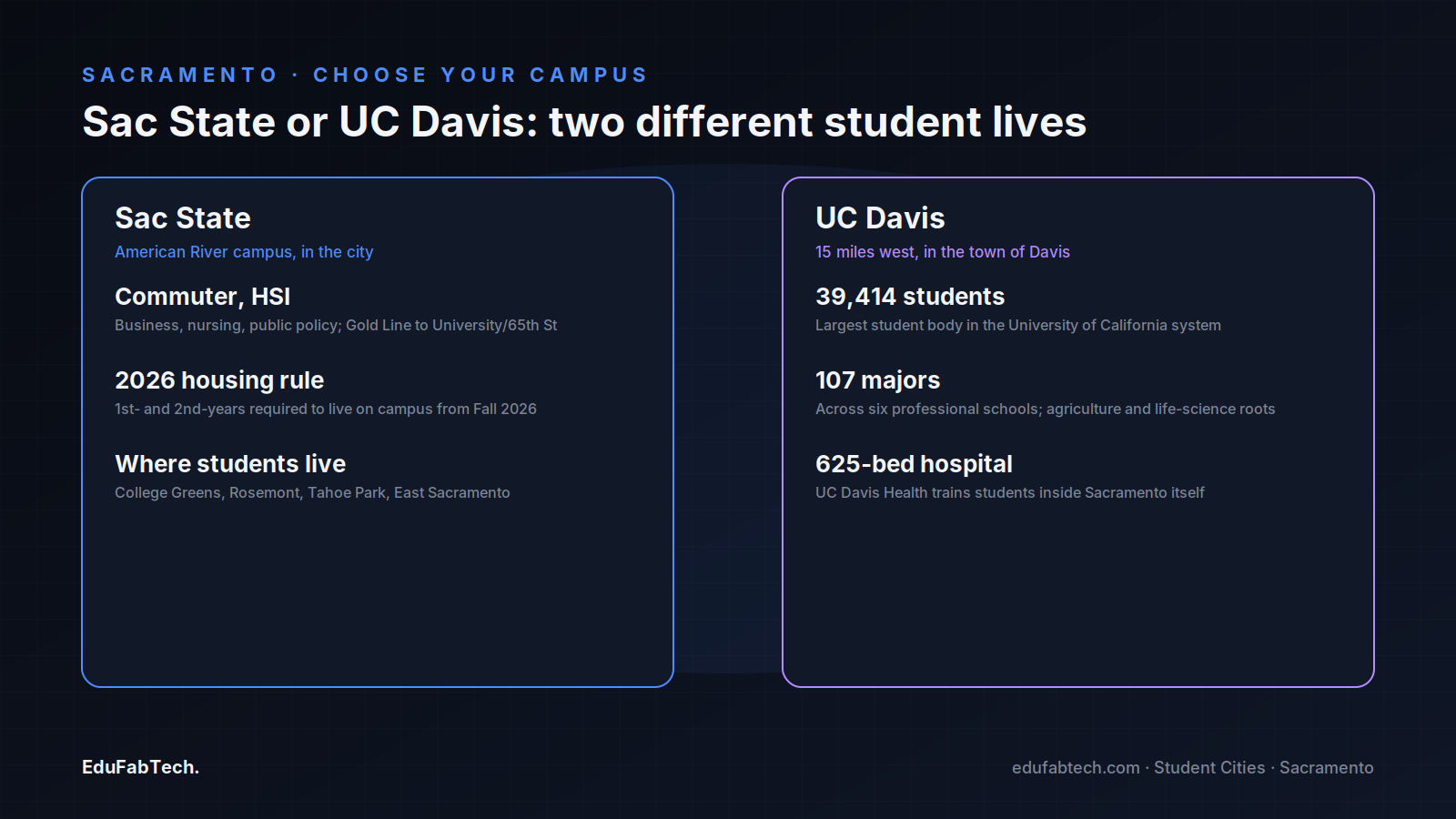
California State University, Sacramento — "Sac State" — is the city's own public university, set on a wooded campus beside the American River in the east of the city, reachable by the light rail's University/65th Street Station. It is a large, commuter-heavy teaching university and a Hispanic-Serving Institution, strong in business, education, nursing, criminal justice and public policy — fitting for a capital whose biggest employer is government. Starting in Fall 2026, according to Sacramento State's housing office, the university will require incoming first-year, non-transfer students to live in university housing for their first two academic years, with exemptions for students whose permanent home is within a set radius of campus, those aged 21 and over by the first day of classes, and cases of verified financial hardship (csus.edu). If you are starting a bachelor's degree there, budget for on-campus housing from the outset.
University of California, Davis is not in Sacramento, but no student guide to the region can leave it out. Its main campus is in Davis, "a lush green college town just 15 miles west of Sacramento," and the university opened in 1908 as the University Farm; it now enrols 39,414 students, the largest student body in the University of California system, and offers 107 majors across six professional schools (ucdavis.edu). UC Davis keeps its agricultural and life-sciences roots — it is a global name in plant science, veterinary medicine, agriculture and food — and it runs UC Davis Health, a 625-bed teaching hospital, inside Sacramento itself, so medical and nursing students do live and train in the city even when the undergraduate campus is in Davis.
William Jessup University is a Christian liberal-arts university whose Northern California campus is in Rocklin, in the suburbs northeast of Sacramento, with a second campus in San Jose (jessup.edu). It is small, with class sizes to match, and offers undergraduate, graduate and online programmes.
Three career-focused colleges round out the picture and are worth knowing if their fields are yours: Carrington College in the Rosemont district (health-care and trades programmes), MTI College in Sacramento (business, legal, IT and cosmetology training), and Epic Bible College in Foothill Farms. These are smaller, vocational or faith-based institutions rather than research universities, but they grant degrees or certificates and have their own campuses in the metro area.
Where students put down roots
Sac State students cluster in the flat, grid-numbered neighbourhoods east and south of campus — College Greens and Rosemont right beside it, Tahoe Park and East Sacramento a little further in, and Midtown if you want bars, cafés and the farmers' market at the cost of a longer commute. The Gold Line light rail matters here: a room near the University/65th Street, 59th Street or Power Inn stations lets you reach campus without a car, which is worth real money in a city built for driving. UC Davis students, by contrast, mostly live in Davis itself — a famously bike-friendly town — or commute in from Sacramento across the Yolo Causeway. William Jessup students look to Rocklin and Roseville in Placer County, which is suburban and car-dependent.
Start looking early. Sac State's own calendar now pushes first- and second-year students into the residence halls, and the newer halls fill on a deadline; the university has been adding beds, including the new Mt. Whitney Hall opening for 2026–2027, precisely because demand outstrips supply. For off-campus rooms, the useful window is late spring to mid-summer for a September start: leases in the student neighbourhoods turn over around the academic year, and the best-value rooms near the light rail go first. EduFabTech's own city listings collect rooms, sublets and shared flats in one place — see rooms in Sacramento and everything in the city at EduFabTech Sacramento, or filter by campus at listings near Sac State and listings near UC Davis.
Renting a room without losing a deposit
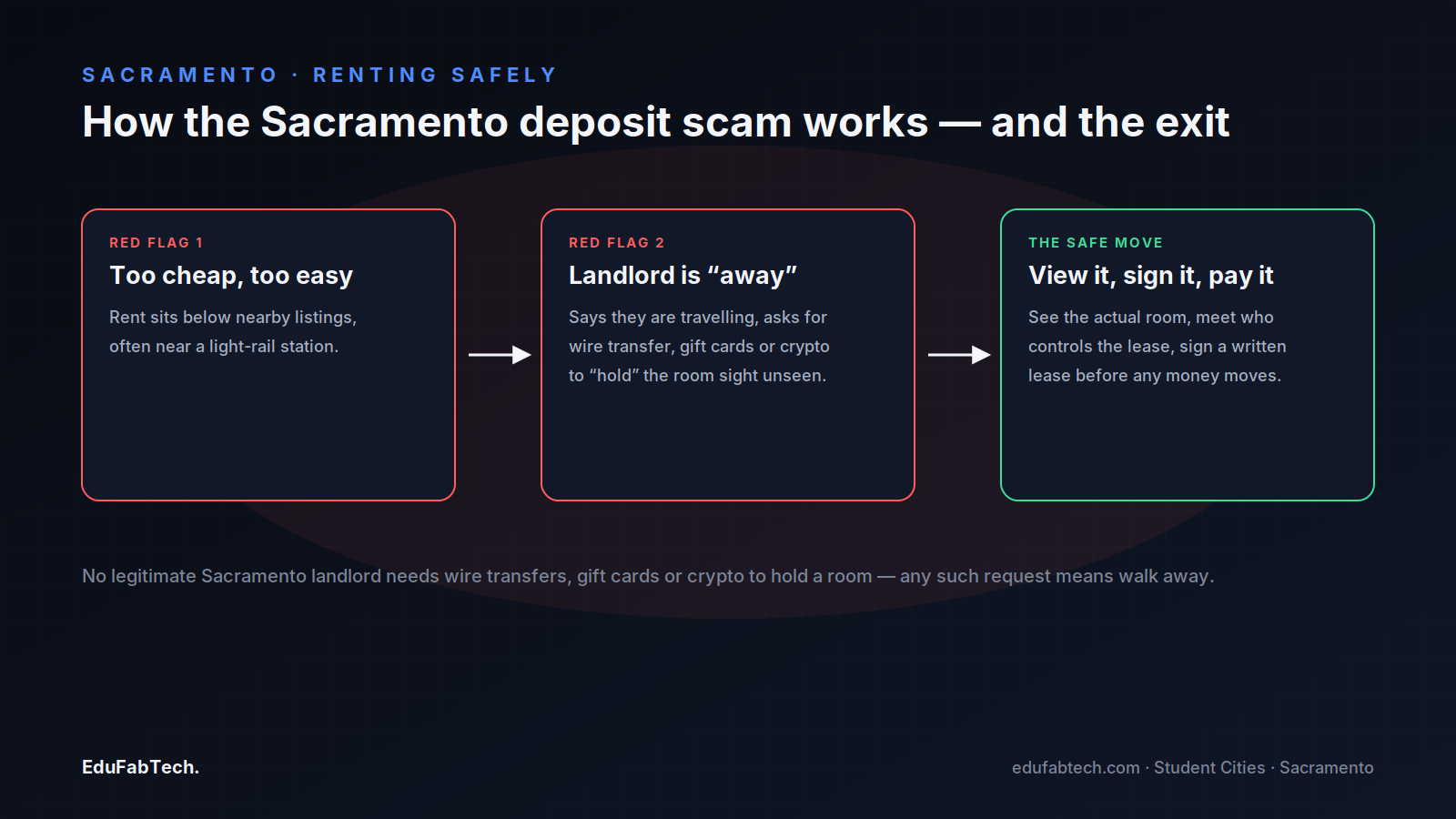
The scams in this market follow a pattern. A listing shows a room in Midtown, East Sac or near the 65th Street station at a rent noticeably below the others; the "landlord" is conveniently out of town — often said to be travelling or relocated — and asks you to secure it with a deposit before you can view it. That is the warning sign. In Sacramento, as across the United States, a normal arrangement is to see the actual room, meet the person who controls the lease, and sign a written California residential lease before any money changes hands; a security deposit is paid on signing, to the landlord, by a traceable method. No legitimate Sacramento landlord needs you to wire money, buy gift cards, or send cryptocurrency to "hold" a room — any of those requests means walk away. If you are arriving from abroad and cannot view in person, ask someone you trust to visit, do a video walk-through of the specific unit, and confirm the address exists and matches public records before you commit. Treat a too-cheap room near a transit station with the same suspicion you would treat a too-cheap anything.
Furnishing a room for very little
Sacramento is a good city for second-hand furnishing because of its markets. The Sacramento Antique Faire runs on the second Sunday of every month from 6:30 a.m. to 3 p.m., spread under the elevated W-X freeway in Midtown near 21st and X Streets — shaded, which matters in summer — with hundreds of vendors selling furniture, kitchenware and oddments (sacantiquefaire.com). North of the city in Roseville, Denio's Farmers Market & Swap Meet has run on Vineyard Road since 1947 and combines a produce pavilion with a large open-air swap meet of new and used goods, open Friday through Sunday (deniosmarket.com). For produce and the city's food culture, the Midtown Farmers Market and the long-running Sunday market under the freeway are part of weekend life. Between markets, EduFabTech lists what other students are selling, giving away or moving on — browse second-hand things, second-hand furniture, and the free-stuff page, which is busiest at the end of each semester when leases end.
Working while you study
If you hold an F-1 student visa, the rules on working come from the U.S. Department of Homeland Security, through its Study in the States / SEVP guidance. That guidance states that an active F-1 student "may not work more than 20 hours per week when school is in session" in on-campus or educationally affiliated employment, that you can begin applying up to 30 days before classes start, and that you need approval from your school's Designated School Official (DSO) and a Social Security Number (studyinthestates.dhs.gov). Off-campus work for F-1 students is tightly limited and generally requires completing a full academic year plus a specific authorisation, and training options such as CPT and OPT run through your DSO as well. None of this is legal advice — your DSO is the person who signs off on what you are actually allowed to do, so talk to them before accepting any job. For campus jobs, tutoring, and the kind of part-time work students in the city take, EduFabTech's Sacramento jobs page is a starting point.
Libraries and places to study
The Sacramento State University Library anchors studying on the Sac State campus; it has 12 group study rooms, bookable by students with a SacLink login for a maximum of two hours per day and one reservation per week, with extended hours during finals (library.csus.edu). At UC Davis, Shields Library offers 24-hour access to study space year-round for currently enrolled undergraduate and graduate students, with silent, quiet-conversation and collaboration zones and reservable group rooms (library.ucdavis.edu). Off campus, the Sacramento Public Library's Central Library at 828 I Street downtown gives you public computers, quiet tables and a makerspace with 3D printers and a recording studio, and it is open to anyone — useful on weekends or when you want to study away from your own campus (saclibrary.org). More desks, cafés and bookable rooms that students share are on EduFabTech's study spaces in Sacramento.
Getting around on light rail and the bus
The Sacramento Regional Transit District (SacRT) runs the region's buses and the Gold, Blue and Green light-rail lines, with the Gold Line serving Sac State at the University/65th Street Station roughly every 15 minutes on weekdays. You pay by the Connect Card or the Transit Connect smartphone app, which replaced the older ZipPass. Standard adult fares are US$2.50 for a single ride, US$7.00 for a daily pass and US$100.00 for a monthly pass (sacrt.com). The best news for students: at Sacramento State, your OneCard with the current semester commuter sticker is "your ticket to unlimited SacRT rides," covered by your registration fees, and students in the Los Rios Community College District get an equivalent Universal Transit Pass through the app (sacrt.com). In other words, a Sac State or Los Rios student rides SacRT free all semester — a genuine reason to live near a line. The region is also flat enough for cycling, and Davis in particular is built around bikes.
What a year costs
Use published budgets rather than guesses. Sacramento State's 2026–2027 cost-of-attendance figures put the living-expense estimate for a student living on campus at US$20,212, and at US$23,504 for a student living off campus, with separate line items for books, transport and personal costs on top (csus.edu). Those are the university's own planning numbers, drawn from the CSU student-expenses survey and adjusted for inflation, not advertised rents, and they are the most reliable single figure to anchor your own budget against. Add tuition and mandatory fees, which differ sharply between a California State University, a University of California campus and a private university like William Jessup, and which differ again for international and out-of-state students — always check the specific bursar or fees page for your own status and year. The free SacRT pass for Sac State and Los Rios students meaningfully lowers the transport line if you choose where you live with the light rail in mind.
The honest trade-offs
What is good: Sacramento is markedly cheaper than coastal California, the grid is walkable and flat, the light rail is free for the largest group of students in the city, and you are close to real escapes — the Bay Area, Lake Tahoe and the Sierra, the wine country — for weekends. The food culture and the farmers' markets are a genuine pleasure, and the two rivers give you a parkway and beaches in summer.
What is hard: the summer heat is relentless, with long runs of triple-digit days that make an un-air-conditioned room miserable and a mid-afternoon walk a chore. The city is built for cars, so living away from a light-rail line can mean long commutes or a vehicle you did not plan to buy. Sac State is a commuter campus, which can make it harder to build a social life if you are not deliberate about it, and the two-year live-on-campus requirement from Fall 2026 removes some first-year flexibility. Housing near campus and transit is competitive and fills early. And the two best-known universities sit in two different towns — a real factor if your friends, or your programme, are split across the Causeway.
A checklist for the first weeks
- Confirm your housing situation against your university's rules — for Sac State starters, assume the two-year on-campus requirement applies and plan accordingly (csus.edu).
- Never pay a deposit before seeing the specific room and the person who controls the lease; never wire money, send gift cards or pay in crypto to "hold" a place.
- Get your student ID and, if you are at Sac State or a Los Rios college, activate your free SacRT transit pass before term starts (sacrt.com).
- International students: meet your DSO about work and any CPT/OPT questions before accepting a job, and get a Social Security Number if you will work on campus (studyinthestates.dhs.gov).
- Furnish from the second-Sunday Antique Faire, Denio's in Roseville, and end-of-semester giveaways rather than buying new — start with second-hand furniture and free stuff.
- Pick your library early — the campus library for term-time, the Central Library downtown for weekends — and learn the group-study-room booking rules before you need a room at finals (library.csus.edu).
A quick question for readers
Do you work part-time while you study?
Many students work to pay the bills. See how common it is — and how many hours people really do.
Pick an answer, create a free account in a minute, and your vote counts. Already a member? Sign in
Source: California State University, Sacramento (Bursar)
Sources (5)
- California State University, Sacramento. Tuition, Fees & Living Costs (2026–2027 Cost of Attendance). California State University, Sacramento, 2026. csus.edu ↗ · checked 5 Oct 2026
- Sacramento Regional Transit District. Student Passes and Fares. SacRT, 2026. sacrt.com ↗ · checked 5 Oct 2026
- University of California, Davis. About UC Davis. University of California, Davis, 2026. ucdavis.edu ↗ · checked 5 Oct 2026
- U.S. Department of Homeland Security. Working in the United States (F-1 students). Study in the States, SEVP/DHS, 2026. studyinthestates.dhs.gov ↗ · checked 5 Oct 2026
- California State University, Sacramento. Live-On Requirement (Two-Year Residential Requirement). California State University, Sacramento, 2026. csus.edu ↗ · checked 5 Oct 2026